
Article II, Section 2, Clause 1 makes the President Commander in Chief of the Army and Navy. That single clause carries the Commander-in-Chief power, the broadest reserved authority the executive holds: the President directs deployment, strategy and tactical operations without waiting for Congress to declare anything. Yet the same Constitution gives Congress the declaration power and the purse, so the clause is only half the story.
Bar examiners almost never ask you to resolve the outer boundary of war powers. They ask a binary question instead: who deploys, and who declares? Get that split right, layer the Youngstown framework on top, and remember that money is the check that actually bites.
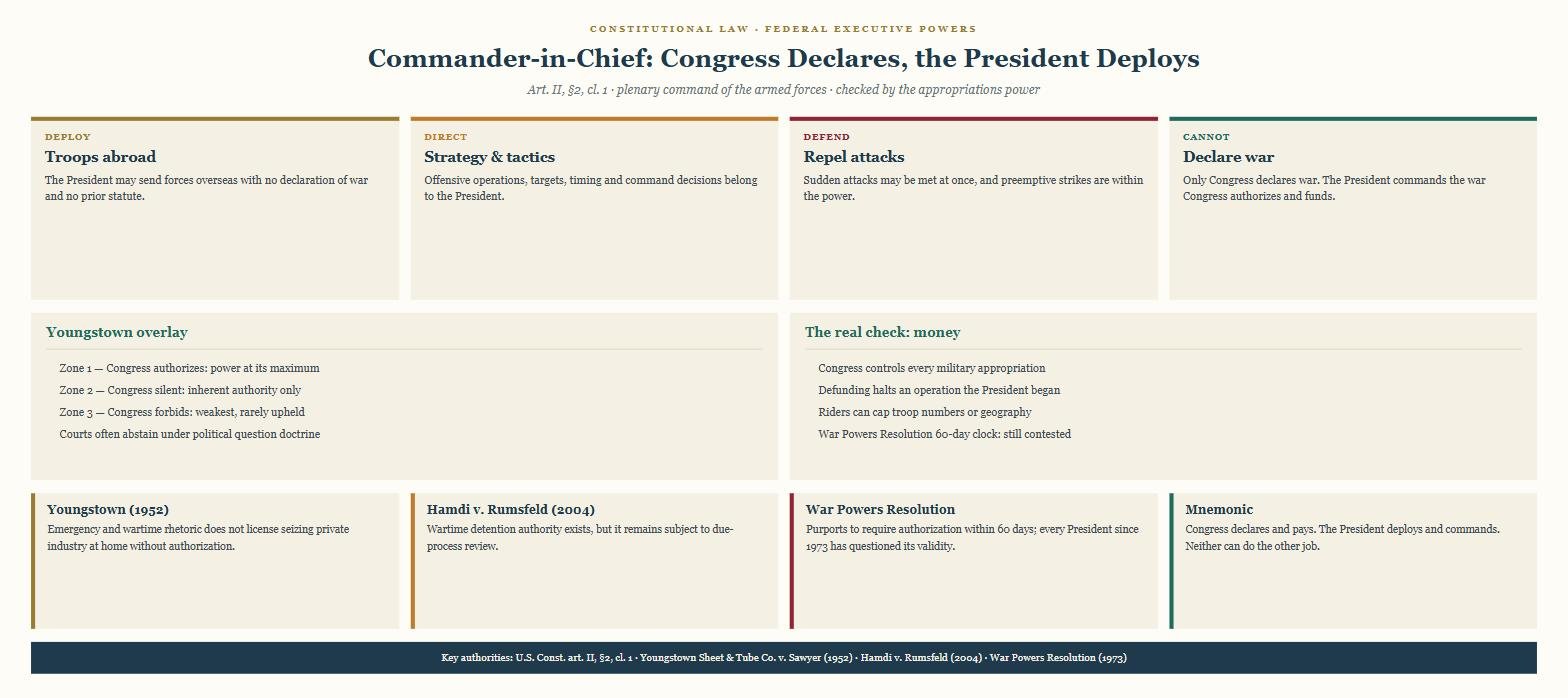
What the Commander-in-Chief power includes
The power is plenary with respect to military operations. The President may send troops abroad without a declaration of war, order offensive operations, repel sudden attacks on the United States, and order preemptive strikes in anticipation of an enemy attack. None of these require a prior vote in Congress.
What the President may not do is declare war. That authority sits with Congress alone under Article I, Section 8. The distinction is between commanding the military, which is executive, and committing the nation to a legal state of war, which is legislative.
- Deploy forces overseas, including into hostilities, on the President’s own authority.
- Choose targets, timing, force levels and rules of engagement.
- Respond immediately to an attack without waiting for legislative approval.
- Not declare war, and not fund the operation without Congress.
The Youngstown overlay
Almost every modern military-power question is really a separation-of-powers question, which means Justice Jackson’s three zones from Youngstown Sheet & Tube Co. v. Sawyer control the analysis. When Congress has authorized the action, presidential power is at its maximum and the challenger must show the action exceeds federal power altogether. When Congress is silent, the President relies on inherent authority alone and the outcome depends on the practice and the subject matter. When Congress has forbidden the action, presidential power is at its lowest ebb and the President must point to an exclusive constitutional grant.
Exam tip: Congress declares and pays; the President deploys and commands. If the facts show Congress affirmatively prohibiting something, you are in Zone 3 and the President almost always loses — even in wartime, as Youngstown itself proved.
Notice what Youngstown did not hold. It did not say the President lacks military authority. It said an emergency abroad does not justify seizing private industry at home when Congress has provided a different mechanism. The Commander-in-Chief power runs to the armed forces, not to the domestic economy.
| Question | Congress | President |
|---|---|---|
| Declare war | Exclusive power (Art. I, §8) | No authority |
| Deploy troops into hostilities | May authorize, may restrict by statute | Primary authority (Art. II, §2) |
| Direct operations and strategy | No operational role | Plenary |
| Fund the operation | Exclusive control of appropriations | Cannot spend unappropriated funds |
| Repel a sudden attack | No prior approval required | Immediate authority |
| Detain enemy combatants | May legislate procedures | Authority exists, subject to due process |
Where the real limits come from
The textual limits are thin, so the practical limits do the work. Congress controls every military appropriation, which means it can cap troop numbers, restrict geography, or simply defund an operation the President has already begun. A President who cannot pay soldiers cannot keep them in the field. That is why the appropriations clause, Article I, Section 9, Clause 7, belongs in your outline next to the Commander-in-Chief clause.
The War Powers Resolution of 1973 attempts to add a procedural limit: report to Congress and withdraw within sixty days absent authorization. Its constitutionality has never been squarely resolved, and Presidents of both parties have disputed it while often complying in form. On an exam, mention the sixty-day clock and flag that its validity remains unsettled — do not treat it as settled law.
Judicial limits are thinner still. Courts frequently abstain from these disputes under the political question doctrine, especially where the claim is that a deployment was insufficiently authorized. Detention and individual-rights claims are different: Hamdi v. Rumsfeld confirms that wartime detention authority exists but must yield to basic due process.
Worked example
The President orders military action against another country without congressional authorization, paying for it out of existing military budgets. Congress then votes to defund the operation. Can Congress stop it?
Begin with the President’s side. Directing operations is squarely within Article II, Section 2, Clause 1, and no declaration of war is needed to deploy. With Congress initially silent, this is Zone 2 and the deployment stands on inherent authority. Then Congress speaks. Once it votes to defund, the appropriations power under Article I, Section 9, Clause 7 forecloses further spending, and the President cannot draw money from the Treasury without a law authorizing it. Conclusion: yes, Congress can halt the operation, not by commanding the military but by refusing to finance it.
Change one fact. Suppose Congress instead passes a statute purporting to name the commanding general and select the bombing targets. Now Congress has crossed into operational command, which is the President’s exclusive province. The statute would be vulnerable precisely because appropriations conditions are legitimate while tactical direction is not.
Common mistakes that cost points
- Treating the Commander-in-Chief power as an unlimited war power. It is command authority, not the power to declare war.
- Assuming a deployment needs a declaration of war to be lawful. It does not; deployment and declaration are different acts.
- Forgetting that operations cannot continue indefinitely without appropriations. Funding is the operative constraint.
- Confusing operational command, which is presidential, with the legal authority to wage war, which is congressional.
- Skipping the Youngstown analysis. Every serious answer maps the facts onto Jackson’s three zones.
- Citing the War Powers Resolution as settled constitutional law rather than a contested statute.
- Reading Youngstown as a case about troops. It is about domestic seizure of private property during a foreign conflict.
- Ignoring the political question doctrine, which frequently keeps courts out of authorization disputes entirely.
Frequently asked questions
Can the President start a war without Congress?
The President can order hostilities and deploy forces, which in practice starts a shooting conflict. What the President cannot do is declare war as a legal matter, and cannot sustain the operation once Congress withholds funds.
Are there exceptions to the Commander-in-Chief power?
Not to the power itself, which is plenary as to military operations. The limits sit outside the clause: Congress’s declaration power, its control of appropriations, and individual constitutional rights such as the due-process protections recognized in Hamdi.
How is this tested on the bar exam?
Intermittently, and usually inside a broader separation-of-powers essay rather than on its own. Expect a fact pattern where the President acts and Congress reacts, which is your cue to run the Youngstown zones.
Commander in chief: the California National Guard and Los Angeles, 2026
The President commands the armed forces, but the Governor of California is commander in chief of the state militia under article V of the California Constitution, and the California National Guard therefore has two possible masters. Which one is in charge determines what the troops may lawfully do, and Los Angeles has furnished the clearest modern illustration.
During the civil unrest of 1992 the Guard was initially deployed by the Governor under state authority and was subsequently federalised, with regular federal forces also committed. That shift mattered legally, because the Posse Comitatus Act restricts the use of federal military personnel for civilian law enforcement, while National Guard troops serving under state control are not subject to it and may perform police functions at the Governor’s direction.
The three duty statuses to keep straight:
- State active duty. Ordered and paid by California, under the Governor’s command, and available for law enforcement support. This is the status used for wildfire and emergency response across the county.
- Title 32 status. Federally funded but remaining under state command, so the Posse Comitatus restriction still does not apply.
- Title 10 status. Federalised under presidential command, at which point the Guard becomes a federal force and law enforcement activity is restricted.
- The Insurrection Act is the exception. It authorises federal military deployment for domestic law enforcement in defined circumstances, and it was invoked in 1992.
- Detention authority is limited. Troops in any status generally support civilian agencies rather than exercising independent arrest powers.
- Federal installations remain federal. Military property in the county operates under federal jurisdiction regardless of Guard status.
For 2026, identify the duty status before analysing what is permitted. Read with congressional war powers, the Youngstown framework and anti-commandeering.
Next steps
Pair this guide with the legislative half of the analysis in congressional war powers, then look at how the President acts abroad without the Senate in executive agreements and with it in the treaty power.
For primary sources, read Youngstown Sheet & Tube Co. v. Sawyer on Justia, review the text of Article II on Cornell Legal Information Institute, and check current subject coverage with the State Bar of California.
Related guides
- Advisory Opinions: Article III and Declaratory Relief
- Access to the Courts: When Filing Fees Are Unconstitutional
- Other Enumerated Powers: Postal, Bankruptcy, Admiralty
- Franchise Amendments: Congress and the Right to Vote
- Property Clause: Congress and Federal Lands Explained
- No Federal Police Power: Enumerated Powers and Enclaves
- Contracts Clause: When States May Impair Agreements
- Takings Clause: Lucas, Penn Central and Just Compensation
- Free Exercise Clause: Smith, Lukumi and Fulton Applied
- Establishment Clause: Church, State and the New Test
- Freedom of Association: Scrutiny, Dale and Disclosure
- Freedom of the Press: Publication Liability and Limits
- Campaign Finance and Anonymous Speech: The Core Rules
- Unconstitutional Conditions: Benefits and Rights Waivers
- Government Speech Doctrine: When the State Can Choose
- Vagueness and Overbreadth: Facial Challenges Explained
- Prior Restraint and Licensing: The Freedman Safeguards
- Symbolic Conduct and the O’Brien Test: The Pivot Question
- Government Employee Speech: Garcetti and Pickering Rules
- Commercial Speech and the Central Hudson Four-Part Test
- Actual Malice and the Three Tracks of Defamation Law
- Public Forum Doctrine and the Time, Place, Manner Test
- First Amendment: The Three-Question Speech Framework
- One Person, One Vote: Voting Rights Under Equal Protection
- Alienage Classifications: Strict Scrutiny and Its Pockets
- Equal Protection: The Three-Step Classification Test
- Second Amendment: The Bruen Text-and-History Standard
- Substantive Due Process After Dobbs: A Two-Step Test
- Procedural Due Process: Notice, Hearing and Mathews
- Incorporation Doctrine: Which Rights Bind the States
- Full Faith and Credit: Recognising Sister-State Judgments
- The Complete Auto Test: Taxing Interstate Commerce
- The Right to Travel: Durational Residency Explained
- Article IV Privileges and Immunities: The Comity Rule
- Federal Preemption: The Three-Step Ladder Explained
- The Supremacy Clause: Floors, Ceilings and Preemption
- Intergovernmental Immunity: The Shield Runs One Way
- The Presidential Pardon Power: Four Limits That Matter
- Executive Privilege: A Qualified Right That Must Yield
- Presidential Immunity: Criminal, Civil and Private Acts
- The Removal Power: At-Will Firing and Its Exceptions
- The Appointment Power: Principal and Inferior Officers
- Take Care Clause: Enforcement Discretion and Its Limits
- Executive Agreements: The President’s Sole Foreign Power
- The Treaty Power: Senate Advice and Consent Explained
- The Presidential Veto Power, Override and Pocket Veto
- Bicameralism and Presentment: Two Vetoes Struck Down
- The Nondelegation Doctrine and the Intelligible Principle
- Speech or Debate Clause: Absolute but Narrow Immunity
- The Impeachment Power: House Majority, Senate Two-Thirds
- Congress’s Naturalization Power and Citizenship Limits
- Congressional War Powers: Declare, Fund and Command
- Anti-Commandeering Doctrine and the Tenth Amendment
- Section 5 Enforcement Power: Remedy, Do Not Redefine
- The Spending Power and the Five Dole Test Conditions
- Congress’s Taxing Power: When a Penalty Is Really a Tax
- The Necessary and Proper Clause: Congress’s Multiplier
- Ex Post Facto Clause: Retroactive Criminal Laws Barred
- Bills of Attainder: Legislative Punishment Explained
- The Writ of Habeas Corpus: Testing Unlawful Detention
- Supreme Court Jurisdiction: Original vs Appellate Power
- Abstention Doctrine: 4 Ways Federal Courts Step Aside
- Dormant Commerce Clause: Discrimination vs Pike Balancing
- The Commerce Clause: 3 Categories and 2 Hard Limits
- State Action Doctrine: The Government Conduct Threshold
- The Eleventh Amendment and State Sovereign Immunity
- Political Question Doctrine: What Courts Will Not Decide
- Ripeness and Mootness: Timing Rules in Federal Court
- Standing in Federal Court: The 3-Part Article III Test
- Marbury v. Madison and the Power of Judicial Review
- The Youngstown Framework: Presidential Power in 3 Zones
- The IRAC Method: How to Structure a Bar Exam Answer
- Piercing the Corporate Veil: A Two-Prong Alter Ego Test
- Defamation Elements, Fault Standards and Privileges
- The Parol Evidence Rule: Integration and Exceptions
- Recording Acts: Race, Notice and Race-Notice Explained
- Partner Liability and Authority Under RUPA Explained
- Trustee Duties: Care, Loyalty, Impartiality, Accounts
- Specific Performance: A Six-Element Bar Exam Framework
- Will Execution Requirements: Formalities and Rescue
- Community Property Presumptions in California Explained
- Easements Explained: Creation, Scope and Termination
- Products Liability: The Three Defect Theories Explained
- Miranda Rights: Custody, Interrogation and Invocation
- The Character Evidence Rules: Propensity Bar and Doorways
- Adverse Possession Elements: OCEAN and the Tax Rule
- Business Judgment Rule and Directors’ Fiduciary Duties
- The Statute of Frauds: MYLEGS and How to Satisfy It
- Res Judicata vs Collateral Estoppel: Bar Exam Guide
- The Erie Doctrine Explained: A 4-Step Bar Exam Guide
- Conflicts of Interest: A 6-Step Decision Tree for the Bar
- The Rule Against Perpetuities Explained Step by Step
- Murder and Manslaughter: The Homicide Ladder Explained
- Consideration in Contract Law: Rules and Exceptions
- The Four Elements of Negligence: Bar Exam Breakdown
- The Hearsay Rule Explained: Exceptions and Exemptions
- Personal Jurisdiction: The 3-Step Bar Exam Framework
- 3 Levels of Scrutiny in Constitutional Law Explained
- The Citizenship Clause After Trump v. Barbara