
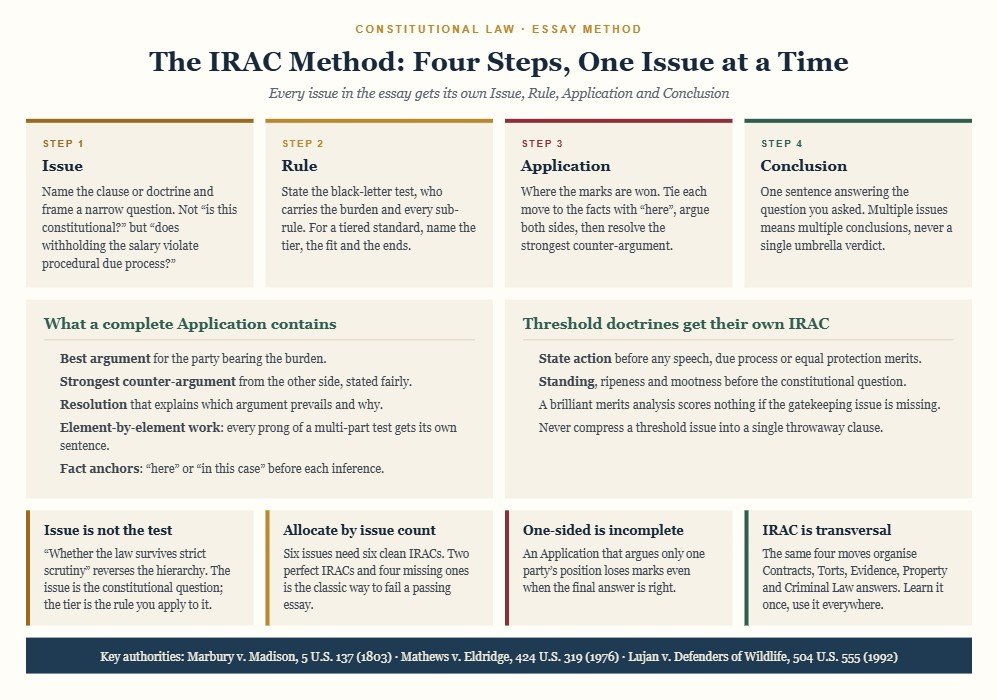
The IRAC method is the four-step skeleton that turns an open-ended legal question into a disciplined sequence of moves: Issue, Rule, Application, Conclusion. Examiners do not award marks for a correct hunch. They award marks for reasoning they can see, and IRAC is the format that makes reasoning visible.
This guide explains what each step has to contain, why threshold doctrines need their own IRAC before the merits, how to divide time across a multi-issue essay, and the organisational errors that cost points even when the final answer is right.
Why structure earns marks on its own
Two candidates can reach the same conclusion and receive very different scores. The reason is that essay grading is done against a checklist of analytical moves rather than against the outcome. A rambling answer that happens to land on “the ordinance is unconstitutional” buries the moves the grader is looking for; an IRAC answer puts each one in a predictable place.
IRAC also protects you from yourself under time pressure. Compartmentalising the question means you cannot accidentally skip the rule, argue only one side, or forget to answer the question you asked. The framework is not a stylistic preference: it is a checklist disguised as a paragraph structure.
The four steps, one issue at a time
Issue: a narrow question, not a topic
Name the specific clause or doctrine at stake and phrase it as a question a court could answer. “Does the school district’s withholding of Bob’s salary violate his Fourteenth Amendment procedural due process rights?” orients the reader immediately. “Is this constitutional?” tells the grader nothing and often signals that the candidate has not yet identified the doctrine.
A common inversion is to write “the issue is whether the law survives strict scrutiny”. That reverses the hierarchy. Strict scrutiny is the rule you will apply; the issue is the constitutional question the rule resolves.
Rule: the test, the sub-rules and the burden
State the black-letter standard with enough specificity that the application has something to bite on. For a tiered standard, that means naming the tier, the required fit between means and ends, and the party who carries the burden. For a multi-element doctrine such as standing, it means reciting every element rather than gesturing at the general concept. The three tiers themselves are set out in 3 Levels of Scrutiny in Constitutional Law Explained.
Application: the section that is actually graded
This is where the marks are won and lost. Anchor every inference to the facts with “here” or “in this case”, work through each element of the rule separately, and argue both sides. A complete application has a recognisable shape: the best argument for one party, the strongest reply from the other, then a resolution explaining why one prevails.
Element-by-element visibility matters even when the outcome is obvious. A candidate who writes “Bob has standing” without separately discussing redressability loses credit, because the grader cannot verify that the candidate knows redressability is a requirement at all.
Conclusion: one sentence per issue
Answer the question you asked, in a single sentence, and then move on. Two or three conclusion sentences for one issue signal that you are still weighing alternatives. Ten issues need ten conclusions, not one umbrella verdict at the end of the essay.
Exam tip: write the conclusion as a direct answer to your own issue statement. If the two sentences do not mirror each other grammatically, you have drifted onto a different question somewhere in the application.
Threshold doctrines get their own IRAC
State action, standing, ripeness and mootness feel like preliminaries, which is exactly why candidates compress them into a throwaway clause. They are separate issues with their own rules and their own conclusions, and they come before the merits. A flawless free speech analysis earns nothing if the defendant was a private party and state action was never established.
| Threshold issue | Question it answers | What happens if you skip it |
|---|---|---|
| State action | Is the challenged conduct attributable to government? | The entire merits analysis rests on an unproven premise |
| Standing | Is this the proper party to bring the claim? | The court never reaches the constitutional question |
| Ripeness and mootness | Has the dispute matured, and is it still live? | The answer discusses a controversy no court could decide |
| Political question | Is the issue committed to the political branches? | A non-justiciable claim is analysed as though it were justiciable |
One label, two doctrines
Some labels cover more than one body of law, and the issue step is where you disambiguate. “Due process” is the classic trap: procedural due process asks what notice and hearing were owed before a deprivation, while substantive due process asks whether the government may interfere with the liberty at all. An answer that jumps straight to a rule without isolating which branch is at stake will blend two doctrines and lose marks on both.
The habit generalises. Before writing the rule, ask yourself whether the phrase you have just used has a second meaning elsewhere in the subject. If it does, say which one you mean in the issue sentence.
Allocate time by issue count, not by ambition
The most expensive mistake in essay writing is not a doctrinal error. It is spending twenty minutes perfecting the first issue and leaving four minutes for the remaining five. A six-issue essay needs six complete IRACs; an abbreviated but complete IRAC scores, while a missing one cannot. Before writing, count the issues, divide the clock, and accept that some IRACs will be three sentences long.
A worked example
A city ordinance bans “aggressive panhandling” within fifty feet of retail businesses. A careless answer treats this as one amorphous free speech question. Proper IRAC splits it in two.
- Issue one: is the ordinance content-based or content-neutral? Rule: a regulation is content-based when liability turns on the message or viewpoint expressed, and content-neutral when it targets conduct. Application: the ordinance restricts aggressive behaviour rather than any ideology. Conclusion: content-neutral review applies.
- Issue two: does the ordinance survive the intermediate standard for content-neutral regulation? Rule: a significant governmental interest, a substantial relation to that interest, no greater burden on expression than necessary, and adequate alternative channels. Application: pedestrian safety is significant, but fifty feet from every retail business may sweep in most of the downtown pavement. Conclusion follows from that tailoring analysis.
Two issues, two rules, two conclusions. Together they answer the question the examiner actually asked.
Common mistakes that cost points
- Framing the issue as the test (“whether strict scrutiny is satisfied”) rather than as the constitutional question.
- Stating the rule in a single vague sentence with no sub-rules and no burden of proof.
- Writing a one-sided application that never states the opponent’s best argument.
- Concluding on a multi-element test without analysing each element separately.
- Giving one issue several conclusions, or the whole essay a single conclusion.
- Treating state action, standing or ripeness as a preliminary sentence instead of a full IRAC.
- Failing to specify which of two same-named doctrines, such as procedural or substantive due process, is in play.
- Over-investing in the first issue and running out of time for the rest.
Frequently asked questions
Does IRAC apply to multiple-choice questions too?
Not as a writing format, but the same sequence explains why an answer choice is right. Identifying the issue and the governing test before reading the options is the fastest way to avoid distractors that state a real rule from the wrong doctrine.
Is CRAC or IRAAC better than IRAC?
They are the same discipline with different signposting. Leading with the conclusion can help when the answer is genuinely clear, and splitting the application in two can help when the counter-argument is substantial. Whichever label you use, the graded content is the same: rule, both sides, resolution.
How long should each IRAC be?
Long enough to make every element visible and no longer. Examiners score the presence of analytical moves, not word count, so proportion the length to the number of issues you still have to reach.
Using IRAC on the California Bar Exam in 2026
IRAC is a general analytical habit, but the way it is rewarded depends on the examination you are sitting, and the California Bar Exam has distinctive features. It tests California-specific subjects that many jurisdictions do not, most notably community property and professional responsibility assessed against the California Rules of Professional Conduct rather than the ABA model rules alone. Where California law diverges from the majority position, graders expect the California rule and often credit an explicit comparison.
The examination’s structure and administration have been in flux, and the State Bar has made significant changes to format, question sourcing and delivery in recent cycles. Before building a study plan for 2026, confirm the current structure, subject list and scoring directly with the State Bar of California, because relying on an older description of the exam is the single most avoidable mistake a candidate can make. Test centres serving Los Angeles County candidates are administered through the State Bar, which maintains an office in downtown Los Angeles.
How to apply the method to California questions:
- State the California rule first. Where a divergence exists, lead with California and note the majority rule only if it earns credit.
- Flag community property early. Characterisation of each asset is the organising step, and the presumption analysis carries most of the marks.
- Use the California conduct rules for ethics. Numbering and substance differ from the model rules in several respects.
- Apply, do not restate. The application sentence should name the fact and the legal consequence together.
- Separate issues with headings. Graders read quickly, and a visible structure protects marks.
- Practise the performance test separately. It rewards instruction-following and document design rather than memorised law.
In 2026, verify the exam format before anything else, then drill California divergences. Read with community property presumptions, conflicts of interest and the elements of negligence.
Next steps
Practise by writing rule statements alone, without applications, until each one names the test, the sub-rules and the burden without prompting. Then apply the framework to a doctrine with clean elements, such as the three-part inquiry in Personal Jurisdiction: The 3-Step Bar Exam Framework, the four-element structure in The Four Elements of Negligence: Bar Exam Breakdown, and the definition-plus-exceptions pattern in The Hearsay Rule Explained: Exceptions and Exemptions.
For primary sources, the opinion that models the structure most famously is Marbury v. Madison, the leading example of a worked multi-factor rule is Mathews v. Eldridge, and Cornell’s note on IRAC gives a compact definition. Format and timing rules for the examination itself are published by the State Bar of California.
Related guides
- Advisory Opinions: Article III and Declaratory Relief
- Access to the Courts: When Filing Fees Are Unconstitutional
- Other Enumerated Powers: Postal, Bankruptcy, Admiralty
- Franchise Amendments: Congress and the Right to Vote
- Property Clause: Congress and Federal Lands Explained
- No Federal Police Power: Enumerated Powers and Enclaves
- Contracts Clause: When States May Impair Agreements
- Takings Clause: Lucas, Penn Central and Just Compensation
- Free Exercise Clause: Smith, Lukumi and Fulton Applied
- Establishment Clause: Church, State and the New Test
- Freedom of Association: Scrutiny, Dale and Disclosure
- Freedom of the Press: Publication Liability and Limits
- Campaign Finance and Anonymous Speech: The Core Rules
- Unconstitutional Conditions: Benefits and Rights Waivers
- Government Speech Doctrine: When the State Can Choose
- Vagueness and Overbreadth: Facial Challenges Explained
- Prior Restraint and Licensing: The Freedman Safeguards
- Symbolic Conduct and the O’Brien Test: The Pivot Question
- Government Employee Speech: Garcetti and Pickering Rules
- Commercial Speech and the Central Hudson Four-Part Test
- Actual Malice and the Three Tracks of Defamation Law
- Public Forum Doctrine and the Time, Place, Manner Test
- First Amendment: The Three-Question Speech Framework
- One Person, One Vote: Voting Rights Under Equal Protection
- Alienage Classifications: Strict Scrutiny and Its Pockets
- Equal Protection: The Three-Step Classification Test
- Second Amendment: The Bruen Text-and-History Standard
- Substantive Due Process After Dobbs: A Two-Step Test
- Procedural Due Process: Notice, Hearing and Mathews
- Incorporation Doctrine: Which Rights Bind the States
- Full Faith and Credit: Recognising Sister-State Judgments
- The Complete Auto Test: Taxing Interstate Commerce
- The Right to Travel: Durational Residency Explained
- Article IV Privileges and Immunities: The Comity Rule
- Federal Preemption: The Three-Step Ladder Explained
- The Supremacy Clause: Floors, Ceilings and Preemption
- Intergovernmental Immunity: The Shield Runs One Way
- The Presidential Pardon Power: Four Limits That Matter
- Executive Privilege: A Qualified Right That Must Yield
- Presidential Immunity: Criminal, Civil and Private Acts
- The Removal Power: At-Will Firing and Its Exceptions
- The Appointment Power: Principal and Inferior Officers
- Take Care Clause: Enforcement Discretion and Its Limits
- Commander-in-Chief Power: Deploy Without Declaring War
- Executive Agreements: The President’s Sole Foreign Power
- The Treaty Power: Senate Advice and Consent Explained
- The Presidential Veto Power, Override and Pocket Veto
- Bicameralism and Presentment: Two Vetoes Struck Down
- The Nondelegation Doctrine and the Intelligible Principle
- Speech or Debate Clause: Absolute but Narrow Immunity
- The Impeachment Power: House Majority, Senate Two-Thirds
- Congress’s Naturalization Power and Citizenship Limits
- Congressional War Powers: Declare, Fund and Command
- Anti-Commandeering Doctrine and the Tenth Amendment
- Section 5 Enforcement Power: Remedy, Do Not Redefine
- The Spending Power and the Five Dole Test Conditions
- Congress’s Taxing Power: When a Penalty Is Really a Tax
- The Necessary and Proper Clause: Congress’s Multiplier
- Ex Post Facto Clause: Retroactive Criminal Laws Barred
- Bills of Attainder: Legislative Punishment Explained
- The Writ of Habeas Corpus: Testing Unlawful Detention
- Supreme Court Jurisdiction: Original vs Appellate Power
- Abstention Doctrine: 4 Ways Federal Courts Step Aside
- Dormant Commerce Clause: Discrimination vs Pike Balancing
- The Commerce Clause: 3 Categories and 2 Hard Limits
- State Action Doctrine: The Government Conduct Threshold
- The Eleventh Amendment and State Sovereign Immunity
- Political Question Doctrine: What Courts Will Not Decide
- Ripeness and Mootness: Timing Rules in Federal Court
- Standing in Federal Court: The 3-Part Article III Test
- Marbury v. Madison and the Power of Judicial Review
- The Youngstown Framework: Presidential Power in 3 Zones
- Piercing the Corporate Veil: A Two-Prong Alter Ego Test
- Defamation Elements, Fault Standards and Privileges
- The Parol Evidence Rule: Integration and Exceptions
- Recording Acts: Race, Notice and Race-Notice Explained
- Partner Liability and Authority Under RUPA Explained
- Trustee Duties: Care, Loyalty, Impartiality, Accounts
- Specific Performance: A Six-Element Bar Exam Framework
- Will Execution Requirements: Formalities and Rescue
- Community Property Presumptions in California Explained
- Easements Explained: Creation, Scope and Termination
- Products Liability: The Three Defect Theories Explained
- Miranda Rights: Custody, Interrogation and Invocation
- The Character Evidence Rules: Propensity Bar and Doorways
- Adverse Possession Elements: OCEAN and the Tax Rule
- Business Judgment Rule and Directors’ Fiduciary Duties
- The Statute of Frauds: MYLEGS and How to Satisfy It
- Res Judicata vs Collateral Estoppel: Bar Exam Guide
- The Erie Doctrine Explained: A 4-Step Bar Exam Guide
- Conflicts of Interest: A 6-Step Decision Tree for the Bar
- The Rule Against Perpetuities Explained Step by Step
- Murder and Manslaughter: The Homicide Ladder Explained
- Consideration in Contract Law: Rules and Exceptions
- The Four Elements of Negligence: Bar Exam Breakdown
- The Hearsay Rule Explained: Exceptions and Exemptions
- Personal Jurisdiction: The 3-Step Bar Exam Framework
- 3 Levels of Scrutiny in Constitutional Law Explained
- The Citizenship Clause After Trump v. Barbara