
The First Amendment covers speech, press, religion, assembly and petition, but on any examination the speech clause does most of the work. What makes it tractable is that every speech problem answers to the same routine, asked in the same order, and the marks are awarded for running that routine visibly rather than for arriving at a conclusion.
Three questions, in sequence. Is the expression protected at all? If it is, does the restriction turn on content? If it does not, where is the speech taking place? Skipping a step is how candidates end up applying strict scrutiny to a noise ordinance, or deferential review to a viewpoint ban.
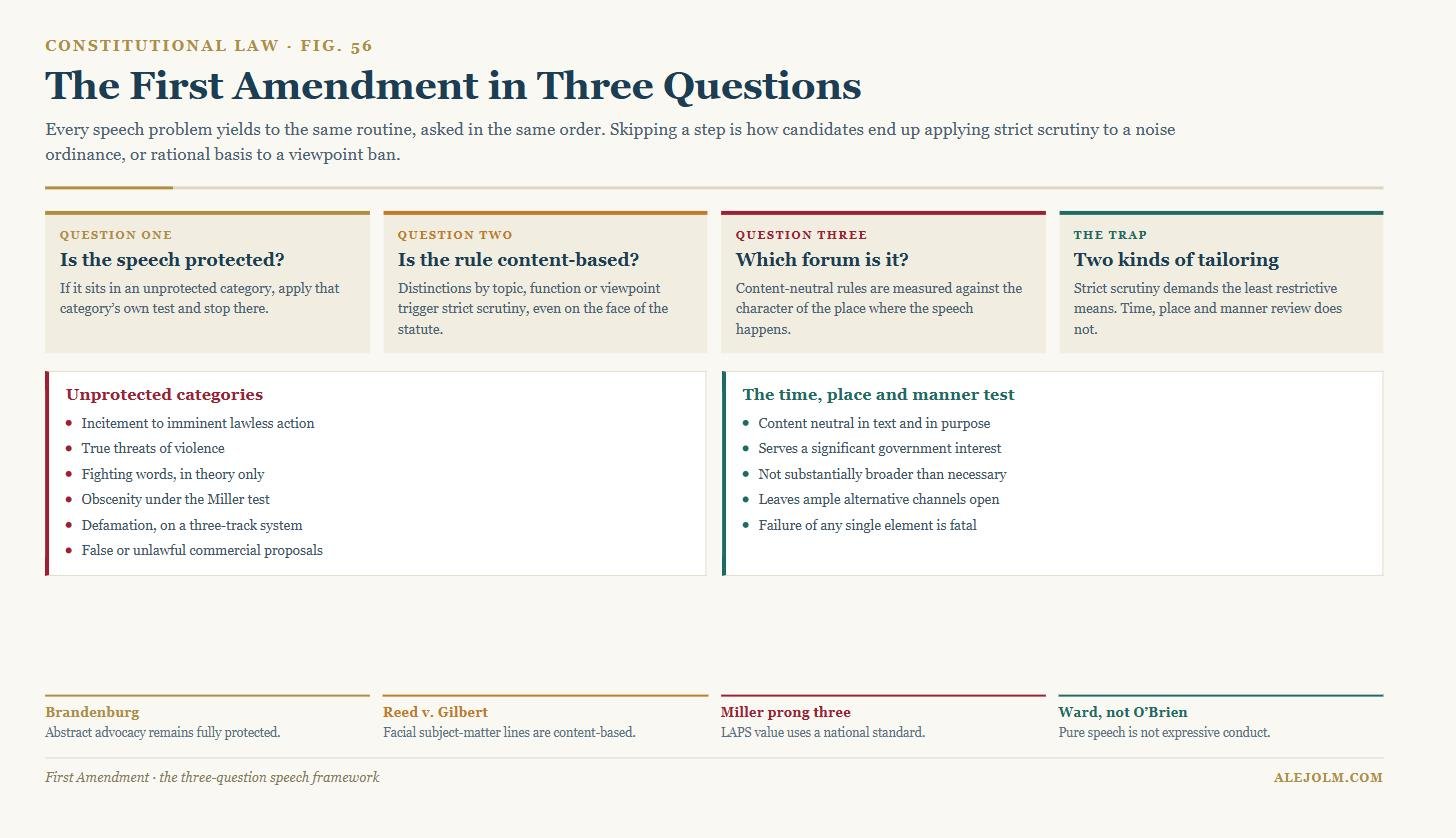
Question one: is the expression protected?
Protection is the rule and the exceptions are narrow and closed. Political argument, artistic work, symbolic conduct and commercial advertising all fall inside. Crucially, speech does not lose protection because it is offensive, insulting, upsetting or contemptible. That is the most common overgeneralisation in the subject.
The unprotected categories are specific. Incitement is punishable only where the speech is directed to producing imminent lawless action and is likely to produce it, which means abstract advocacy of illegality — however inflammatory — stays protected. True threats require a serious, credible expression of intent to commit violence against identified persons. Fighting words remain a category in name, but modern statutes drafted to capture them are struck down as vague or overbroad with such regularity that you should expect the challenge to succeed. Obscenity is measured by a three-part test, defamation runs on a three-track fault system, and commercial speech loses protection where it is false, misleading or proposes something unlawful.
One detail in the obscenity test is worth isolating because it is so frequently reversed. Prurient appeal and patent offensiveness are judged by contemporary community standards, but the third element — whether the work lacks serious literary, artistic, political or scientific value — is assessed against a national standard. A local jury does not get to decide that question by local taste.
Question two: content-based or content-neutral?
A restriction is content-based if it draws its distinctions from the message: the subject matter, the topic, the function or purpose of the speech, or the viewpoint expressed. Such restrictions receive strict scrutiny, and the government must show the rule is necessary to a compelling interest and is the least restrictive means available. In practice this is close to fatal.
Two refinements matter. First, a statute is content-based if it makes topic-based distinctions on its face, and no showing of improper legislative motive is required; the text alone decides it. Second, viewpoint discrimination — permitting one side of a debate while suppressing the other — is the gravest form and is essentially never sustained.
Content-neutral regulations govern when, where and how speech occurs without reference to what is said. They receive intermediate scrutiny through a four-element test: the rule must be content neutral in text and purpose, serve a significant government interest, be narrowly tailored in the sense of not being substantially broader than necessary, and leave open ample alternative channels of communication. Failure of any single element is fatal.
Exam tip: the phrase “narrowly tailored” means different things in the two tracks. Under strict scrutiny it requires the least restrictive means. Under time, place and manner review it requires only that the rule not be substantially broader than necessary. Conflating them is a reliable way to reach the wrong answer.
| Type of restriction | Standard |
|---|---|
| Content-based, including subject matter | Strict scrutiny |
| Viewpoint-based | Strict scrutiny |
| Content-neutral time, place, manner | Intermediate scrutiny |
| Expressive conduct regulation | Intermediate scrutiny |
| Speech in a non-public forum | Reasonableness |
Question three: forum analysis
Where content-neutral rules are concerned, the character of the place fixes the standard. Traditional public forums — streets, pavements, parks — have been open to expression by long usage, and speech there receives the fullest protection, with time, place and manner review applying to neutral rules.
Designated public forums are government properties deliberately opened to expressive activity. While they remain open they are treated like traditional forums, and selective closure aimed at particular speakers or views raises a viewpoint problem. Limited public forums are opened for particular subjects or particular classes of speaker, and restrictions there need only be reasonable and viewpoint neutral. Non-public forums — military installations, prisons, government workplaces, airport terminals — require only that restrictions be reasonable and viewpoint neutral, which is a low bar. Purely private property is outside the Amendment altogether unless state action can be established.
The Ward and O’Brien distinction
Two intermediate-scrutiny tests with similar four-part structures govern different things, and citing the wrong one is a visible error. Restrictions on the time, place or manner of pure speech — loudspeaker hours, parade permits, sign ordinances, camping bans applied to a demonstration — are governed by the time, place and manner test. Regulation of expressive conduct, where the government restricts the non-speech element of an act, is governed by a separate symbolic-conduct test.
There is a further wrinkle. Where the government’s interest lies in suppressing the message the conduct conveys, the deferential conduct test drops away and strict scrutiny returns. That is why flag burning is protected: the asserted interest was preserving the flag’s symbolic value, which is an interest in the message itself.
Worked example
A city bans all outdoor loudspeaker use in its parks between six in the evening and eight in the morning, and requires a permit for daytime amplification. The stated purpose is noise control. An activist is refused a permit for a seven o’clock evening rally protesting government policy and sues.
Run the routine. The expression is political advocacy, the core of the protected category, so question one is satisfied. The ordinance regulates amplification hours without reference to any message, and noise control is unrelated to suppression, so it is content neutral; question two sends us to intermediate scrutiny rather than strict. A municipal park is a traditional public forum, so the time, place and manner test governs. Content neutrality is met. Noise control is a significant interest. Tailoring is where it fails: a blanket prohibition on all evening amplification is substantially broader than necessary when decibel limits, directional equipment or duration caps would address the same harm. The alternative-channels element is also strained, because daytime permits are a poor substitute for evening assembly, which is when demonstrations realistically occur. The ordinance falls.
Change one fact. Suppose the ordinance banned evening amplification only for rallies criticising municipal government, leaving other subjects untouched. The restriction is now content-based on its face, the forum analysis becomes irrelevant, strict scrutiny applies, and the ordinance is unsustainable regardless of how genuine the noise concern might be.
Common mistakes that cost points
- Jumping to forum analysis before deciding whether the speech is protected and whether the rule is content-based.
- Requiring the least restrictive means under time, place and manner review, where the standard is only that the rule not be substantially broader than necessary.
- Treating offensive, insulting or disturbing speech as unprotected; only the closed categories are.
- Citing the symbolic-conduct test for a pure-speech restriction such as a loudspeaker or permit ordinance.
- Applying community standards to the third element of the obscenity test, which uses a national standard.
- Accepting facial neutrality without asking whether the statute in fact draws lines by topic or function.
- Treating incitement as covering abstract advocacy, when imminence and likelihood are both required.
- Forgetting that a non-public forum still cannot be administered in a viewpoint-discriminatory way.
Frequently asked questions
Is offensive or hateful speech protected?
Generally yes. Offensiveness is not a category of unprotected expression, and a restriction aimed at speech because it gives offence is content-based and receives strict scrutiny. Liability attaches only where the speech independently satisfies a recognised category such as incitement, true threats or defamation.
What is the difference between content-based and viewpoint-based?
Content-based restrictions turn on subject matter, so banning all discussion of a topic qualifies. Viewpoint-based restrictions permit one position on a topic while suppressing the other. Both receive strict scrutiny, but viewpoint discrimination is treated as the more serious and is almost never sustained, even in forums where the government otherwise has wide latitude.
Does the First Amendment apply to state and local government?
Yes, through incorporation via the Fourteenth Amendment. It restrains federal, state and local authorities alike. It does not restrain private parties, so a claim against a private entity requires state action to be established first.
First Amendment protection in California: broader rights in 2026
California grants more speech protection than the federal Constitution requires, and a practitioner who stops at federal doctrine will miss the stronger argument. Article I, section 2 of the California Constitution is affirmatively worded rather than framed as a restriction on government, and the California Supreme Court has read it independently.
Two consequences are distinctive. First, under the Pruneyard line, speech and petitioning are protected in privately owned shopping centres designed as public gathering places, without any federal state action. Second, California’s anti-SLAPP statute, section 425.16 of the California Code of Civil Procedure, gives defendants an early special motion to strike claims arising from protected speech or petitioning, with fee shifting and immediate appeal. In the Los Angeles Superior Court this motion is a central feature of defamation and business tort litigation rather than an exotic remedy.
Other California-specific features:
- Private universities are bound by speech standards. The Education Code prohibits private postsecondary institutions from disciplining students for speech that would be protected off campus, an obligation with no federal analogue.
- High school journalism is protected by statute. California limits prior restraint of student publications more strictly than Hazelwood permits.
- Employee political activity is protected. The California Labor Code restricts employers from controlling employees’ political activity, reaching private employers.
- Anti-SLAPP has a commercial speech exemption. Not every business dispute qualifies, and the two-step analysis of arising from protected activity is where most motions are won or lost.
- Recording public officials is protected. California law expressly confirms the right to record police in public, subject to non-interference.
- Time, place and manner rules still govern. County park and street permit schemes must be content neutral, narrowly tailored and leave open alternatives.
In 2026, plead the state constitutional claim alongside the federal one and consider anti-SLAPP at the outset. Read with public forum doctrine, the state action doctrine and prior restraint.
Next steps
The mechanics of each standard are set out in the levels of scrutiny, and the incorporation doctrine explains how the Amendment reaches state and local government at all. Because private conduct falls outside entirely, the state action doctrine is the necessary threshold companion, while defamation covers the fault standards that the speech clause imposes on reputational claims.
The leading opinions are collected at Justia, the amendment is annotated by the Cornell Legal Information Institute, and current examination scope is published by the State Bar of California.
Related guides
- Advisory Opinions: Article III and Declaratory Relief
- Access to the Courts: When Filing Fees Are Unconstitutional
- Other Enumerated Powers: Postal, Bankruptcy, Admiralty
- Franchise Amendments: Congress and the Right to Vote
- Property Clause: Congress and Federal Lands Explained
- No Federal Police Power: Enumerated Powers and Enclaves
- Contracts Clause: When States May Impair Agreements
- Takings Clause: Lucas, Penn Central and Just Compensation
- Free Exercise Clause: Smith, Lukumi and Fulton Applied
- Establishment Clause: Church, State and the New Test
- Freedom of Association: Scrutiny, Dale and Disclosure
- Freedom of the Press: Publication Liability and Limits
- Campaign Finance and Anonymous Speech: The Core Rules
- Unconstitutional Conditions: Benefits and Rights Waivers
- Government Speech Doctrine: When the State Can Choose
- Vagueness and Overbreadth: Facial Challenges Explained
- Prior Restraint and Licensing: The Freedman Safeguards
- Symbolic Conduct and the O’Brien Test: The Pivot Question
- Government Employee Speech: Garcetti and Pickering Rules
- Commercial Speech and the Central Hudson Four-Part Test
- Actual Malice and the Three Tracks of Defamation Law
- Public Forum Doctrine and the Time, Place, Manner Test
- One Person, One Vote: Voting Rights Under Equal Protection
- Alienage Classifications: Strict Scrutiny and Its Pockets
- Equal Protection: The Three-Step Classification Test
- Second Amendment: The Bruen Text-and-History Standard
- Substantive Due Process After Dobbs: A Two-Step Test
- Procedural Due Process: Notice, Hearing and Mathews
- Incorporation Doctrine: Which Rights Bind the States
- Full Faith and Credit: Recognising Sister-State Judgments
- The Complete Auto Test: Taxing Interstate Commerce
- The Right to Travel: Durational Residency Explained
- Article IV Privileges and Immunities: The Comity Rule
- Federal Preemption: The Three-Step Ladder Explained
- The Supremacy Clause: Floors, Ceilings and Preemption
- Intergovernmental Immunity: The Shield Runs One Way
- The Presidential Pardon Power: Four Limits That Matter
- Executive Privilege: A Qualified Right That Must Yield
- Presidential Immunity: Criminal, Civil and Private Acts
- The Removal Power: At-Will Firing and Its Exceptions
- The Appointment Power: Principal and Inferior Officers
- Take Care Clause: Enforcement Discretion and Its Limits
- Commander-in-Chief Power: Deploy Without Declaring War
- Executive Agreements: The President’s Sole Foreign Power
- The Treaty Power: Senate Advice and Consent Explained
- The Presidential Veto Power, Override and Pocket Veto
- Bicameralism and Presentment: Two Vetoes Struck Down
- The Nondelegation Doctrine and the Intelligible Principle
- Speech or Debate Clause: Absolute but Narrow Immunity
- The Impeachment Power: House Majority, Senate Two-Thirds
- Congress’s Naturalization Power and Citizenship Limits
- Congressional War Powers: Declare, Fund and Command
- Anti-Commandeering Doctrine and the Tenth Amendment
- Section 5 Enforcement Power: Remedy, Do Not Redefine
- The Spending Power and the Five Dole Test Conditions
- Congress’s Taxing Power: When a Penalty Is Really a Tax
- The Necessary and Proper Clause: Congress’s Multiplier
- Ex Post Facto Clause: Retroactive Criminal Laws Barred
- Bills of Attainder: Legislative Punishment Explained
- The Writ of Habeas Corpus: Testing Unlawful Detention
- Supreme Court Jurisdiction: Original vs Appellate Power
- Abstention Doctrine: 4 Ways Federal Courts Step Aside
- Dormant Commerce Clause: Discrimination vs Pike Balancing
- The Commerce Clause: 3 Categories and 2 Hard Limits
- State Action Doctrine: The Government Conduct Threshold
- The Eleventh Amendment and State Sovereign Immunity
- Political Question Doctrine: What Courts Will Not Decide
- Ripeness and Mootness: Timing Rules in Federal Court
- Standing in Federal Court: The 3-Part Article III Test
- Marbury v. Madison and the Power of Judicial Review
- The Youngstown Framework: Presidential Power in 3 Zones
- The IRAC Method: How to Structure a Bar Exam Answer
- Piercing the Corporate Veil: A Two-Prong Alter Ego Test
- Defamation Elements, Fault Standards and Privileges
- The Parol Evidence Rule: Integration and Exceptions
- Recording Acts: Race, Notice and Race-Notice Explained
- Partner Liability and Authority Under RUPA Explained
- Trustee Duties: Care, Loyalty, Impartiality, Accounts
- Specific Performance: A Six-Element Bar Exam Framework
- Will Execution Requirements: Formalities and Rescue
- Community Property Presumptions in California Explained
- Easements Explained: Creation, Scope and Termination
- Products Liability: The Three Defect Theories Explained
- Miranda Rights: Custody, Interrogation and Invocation
- The Character Evidence Rules: Propensity Bar and Doorways
- Adverse Possession Elements: OCEAN and the Tax Rule
- Business Judgment Rule and Directors’ Fiduciary Duties
- The Statute of Frauds: MYLEGS and How to Satisfy It
- Res Judicata vs Collateral Estoppel: Bar Exam Guide
- The Erie Doctrine Explained: A 4-Step Bar Exam Guide
- Conflicts of Interest: A 6-Step Decision Tree for the Bar
- The Rule Against Perpetuities Explained Step by Step
- Murder and Manslaughter: The Homicide Ladder Explained
- Consideration in Contract Law: Rules and Exceptions
- The Four Elements of Negligence: Bar Exam Breakdown
- The Hearsay Rule Explained: Exceptions and Exemptions
- Personal Jurisdiction: The 3-Step Bar Exam Framework
- 3 Levels of Scrutiny in Constitutional Law Explained
- The Citizenship Clause After Trump v. Barbara