
The hearsay rule is the most heavily tested single doctrine in Evidence, and it is also where careless answers leak the most marks. FRE 801 defines hearsay as an out-of-court statement offered to prove the truth of the matter asserted, and FRE 802 makes it inadmissible unless an exemption or exception applies.
The rule looks simple in that one sentence. The difficulty is that examiners rarely test the definition head-on; they test whether you can run a disciplined three-step analysis under time pressure. This guide sets out that sequence, the exemptions and exceptions that matter, and the traps that decide close calls.
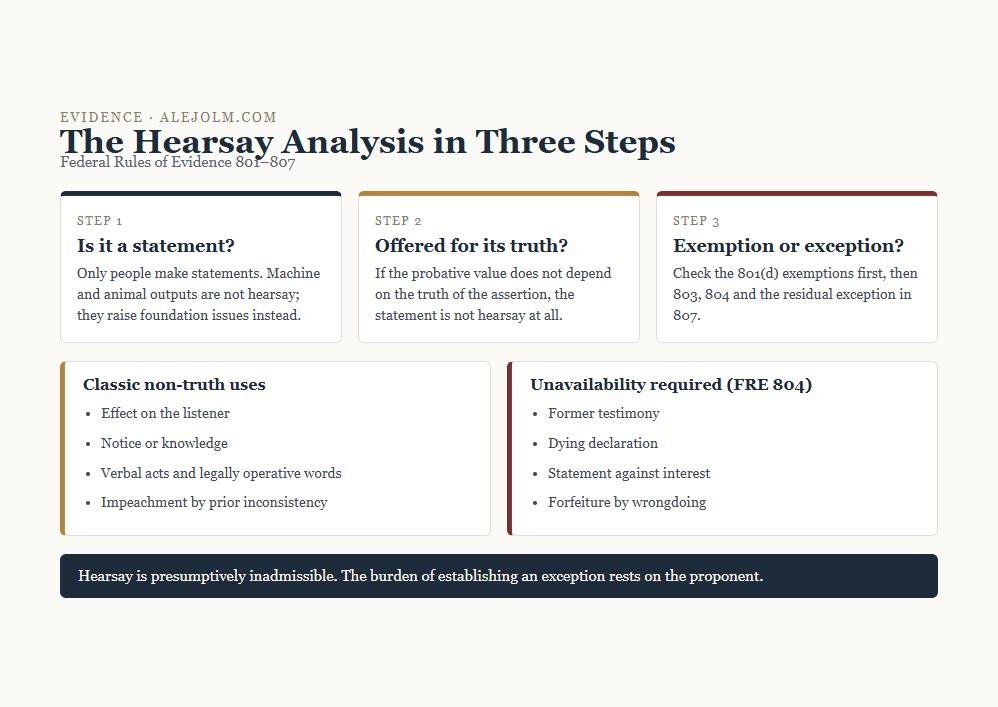
What counts as hearsay under FRE 801
Two elements must both be present. There must be a statement, and it must be offered for its truth. Miss either and the rule simply does not apply.
Note what “out of court” really means: outside this proceeding. Prior trial testimony, and even a deposition taken in the same case, are still out-of-court statements. That surprises candidates every year.
Note also that only people make statements. The output of a radar gun, a clock or a thermometer is not hearsay, because there is no human declarant. Machine output raises foundation, calibration and authentication problems instead.
Step 1: is there a statement?
A statement is an oral or written assertion, or non-verbal conduct intended as an assertion. Pointing at a suspect in a line-up is a statement. Wincing in pain generally is not, because it is not intended to communicate an assertion.
Implied assertions sit at the hard end of this step and examiners know it. When a declarant says something that only indirectly conveys the fact you care about, ask whether the speaker intended to assert that fact.
Step 2: is it offered for its truth?
This is where most fact patterns are won or lost. Apply one question: does the probative value of the statement depend on the statement being true? If yes, it is hearsay. If the statement is probative simply because it was said, it is not.
The classic non-truth uses
- Effect on the listener — offered to show why the listener acted, as with a warning that establishes notice of a danger.
- Notice or knowledge — offered to show the party knew of a condition, regardless of whether the condition existed.
- Verbal acts and legally operative words — the words of offer, acceptance, defamation or a threat are the legal event itself.
- State of mind — offered to show the declarant’s own belief or emotion rather than the external fact.
- Impeachment — a prior inconsistent statement offered only to show the witness has told two different stories.
If the answer to “does this only matter if it is true?” is no, stop. You never reach the exceptions, and writing about them signals that you missed the point of the question.
Step 3: exemptions and exceptions
If both prongs are satisfied, the statement is hearsay and the proponent must find a route to admission. Work in a fixed order so nothing is missed.
FRE 801(d): exemptions that are not hearsay at all
- Prior statements of a testifying witness — inconsistent statements made under oath, certain consistent statements, and prior statements of identification.
- Statements of a party-opponent — a party’s own statement, an adoptive admission, an authorised statement, a statement by an agent or employee within the scope of the relationship, and a co-conspirator statement.
The party-opponent route deserves special attention because it generates a recurring trap. A party’s own statement is admissible under 801(d)(2) whether or not the declarant is available, whether or not it was against interest when made, and with no corroboration requirement. Analysing it under the statement-against-interest exception instead is a classic error.
FRE 803: availability is irrelevant
These exceptions apply whether or not the declarant testifies. The pair examiners love most is the first two, because they are distinguished by their rationale rather than by their wording.
| Present sense impression 803(1) | Excited utterance 803(2) | |
|---|---|---|
| Rationale | Contemporaneity | Stress suppresses fabrication |
| Timing | While perceiving the event or immediately afterwards | While still under the stress of the startling event |
| Time window | Very narrow | Potentially much longer, as long as stress persists |
| Content | Describes or explains the event | Relates to the startling event |
- Then-existing state of mind 803(3) — covers present intent, plan, motive, emotion or physical condition, but not a statement of memory or belief offered to prove the fact remembered, subject to the will exception.
- Statements for medical diagnosis or treatment 803(4) — need not be made to a physician, but statements attributing fault are generally excluded unless pertinent to treatment.
- Recorded recollection 803(5) — applies only where memory cannot be revived; the record is read into evidence and the exhibit itself is received only if offered by an adverse party.
- Business records 803(6) — kept in the course of a regularly conducted activity; records prepared in anticipation of litigation are excluded as untrustworthy.
- Public records 803(8) — but matters observed by law-enforcement personnel are not admissible against a criminal defendant.
FRE 804: the declarant must be unavailable
Unavailability under 804(a) covers a privilege claim, a refusal to testify, testimony of lack of memory, death, illness or infirmity, and absence the proponent cannot cure.
- Former testimony 804(b)(1) — prior testimony where there was an opportunity to cross-examine, by the party or, in civil cases, a predecessor with the same interest.
- Dying declaration 804(b)(2) — made believing death imminent and concerning its cause or circumstances.
- Statement against interest 804(b)(3) — so contrary to the declarant’s pecuniary, proprietary or penal interest that a reasonable person would not have said it unless true; corroboration is required where it is offered to exculpate an accused.
- Forfeiture by wrongdoing 804(b)(6) — the party procured the declarant’s unavailability with the intent of preventing testimony.
FRE 807: the residual exception
A narrow safety valve for trustworthy statements that fit no enumerated exception. Treat it as a last resort in an answer, never a first move.
Two rules that ride alongside the analysis
FRE 806 allows the credibility of a hearsay declarant to be attacked, and once attacked supported, as if the declarant had testified. Separately, in criminal cases the Confrontation Clause imposes a constitutional limit on testimonial statements that exists independently of the hearsay rules, so an exception is necessary but not always sufficient.
California adds a further layer. The hearsay rules live in Evidence Code section 1200 and following, the enumeration does not track the Federal Rules exactly, and Proposition 8 does not abrogate them.
Common mistakes that cost points
- Reaching for exceptions before deciding whether the statement is offered for its truth.
- Treating prior testimony or a deposition in the same case as an in-court statement.
- Analysing a party’s own statement under 804(b)(3) instead of 801(d)(2).
- Using an excited utterance analysis for a statement whose only claim is contemporaneity.
- Admitting a police report against a criminal defendant under the public records exception.
- Stopping at the hearsay exception in a criminal case and ignoring confrontation.
Frequently asked questions
Is a question ever hearsay?
Usually not, because a question rarely asserts anything. But a question can carry an implied assertion, and if it is offered for the truth of that implied assertion the rule can apply.
What is the difference between an exemption and an exception?
An exemption under 801(d) means the statement is defined as not hearsay in the first place. An exception under 803, 804 or 807 concedes the statement is hearsay but permits it anyway.
Does silence count as a statement?
It can, as an adoptive admission, where a reasonable person would have denied the assertion and the party did not. The context has to make the silence meaningful.
Hearsay under the California Evidence Code: key divergences, 2026
California drafted its own evidence code in 1965 and did not follow the structure the Federal Rules adopted a decade later, so the differences are structural rather than merely numerical. Section 1200 of the California Evidence Code defines hearsay and states the rule, and everything else in this area is an exception. That single point explains the most common error made by lawyers trained on the federal rules.
Federally, a statement of an opposing party and certain prior statements of testifying witnesses are excluded from the definition of hearsay altogether. California instead admits them as exceptions: section 1220 covers a party’s own statement, and sections 1235 and 1236 cover prior inconsistent and consistent statements. The practical consequence is that California requires the foundational requirements of an exception to be satisfied, but it is also broader in places, because section 1235 admits a prior inconsistent statement for its truth without any requirement that it was made under oath.
The divergences that matter in the Los Angeles Superior Court:
- There is no residual exception. California has no catch-all provision, so a statement that fits no enumerated exception is inadmissible however reliable.
- Spontaneous statements are the excited utterance analogue. Section 1240 requires a statement made while under the stress of the event it describes.
- Business and official records are separate. Sections 1271 and 1280 have distinct foundations, and official records do not require a custodian witness.
- Special exceptions cover violence cases. Provisions admit statements describing infliction of physical injury and statements by child abuse victims, subject to reliability findings.
- Forfeiture by wrongdoing is narrowly drawn. California’s provision applies to serious felonies with procedural preconditions.
- Confrontation is a separate hurdle. Crawford v. Washington (2004) bars testimonial hearsay against a criminal defendant regardless of any state exception.
For 2026, name the California exception by number and address confrontation separately. Read with character evidence, Miranda rights and homicide.
Next steps
Hearsay interlocks with impeachment, privilege and the Confrontation Clause, and the underlying constitutional analysis is worth reviewing alongside it. Our guides to the three levels of scrutiny and to the personal jurisdiction framework use the same step-by-step method applied to different subjects.
For rule text, the Federal Rules of Evidence at Cornell are the fastest reference, and the California Evidence Code is published by the state legislature.
The most efficient drill is narrow: take fifty short fact patterns and write only steps one and two. Deciding truth versus non-truth quickly is what separates a competent answer from a strong one.
Related guides
- Advisory Opinions: Article III and Declaratory Relief
- Access to the Courts: When Filing Fees Are Unconstitutional
- Other Enumerated Powers: Postal, Bankruptcy, Admiralty
- Franchise Amendments: Congress and the Right to Vote
- Property Clause: Congress and Federal Lands Explained
- No Federal Police Power: Enumerated Powers and Enclaves
- Contracts Clause: When States May Impair Agreements
- Takings Clause: Lucas, Penn Central and Just Compensation
- Free Exercise Clause: Smith, Lukumi and Fulton Applied
- Establishment Clause: Church, State and the New Test
- Freedom of Association: Scrutiny, Dale and Disclosure
- Freedom of the Press: Publication Liability and Limits
- Campaign Finance and Anonymous Speech: The Core Rules
- Unconstitutional Conditions: Benefits and Rights Waivers
- Government Speech Doctrine: When the State Can Choose
- Vagueness and Overbreadth: Facial Challenges Explained
- Prior Restraint and Licensing: The Freedman Safeguards
- Symbolic Conduct and the O’Brien Test: The Pivot Question
- Government Employee Speech: Garcetti and Pickering Rules
- Commercial Speech and the Central Hudson Four-Part Test
- Actual Malice and the Three Tracks of Defamation Law
- Public Forum Doctrine and the Time, Place, Manner Test
- First Amendment: The Three-Question Speech Framework
- One Person, One Vote: Voting Rights Under Equal Protection
- Alienage Classifications: Strict Scrutiny and Its Pockets
- Equal Protection: The Three-Step Classification Test
- Second Amendment: The Bruen Text-and-History Standard
- Substantive Due Process After Dobbs: A Two-Step Test
- Procedural Due Process: Notice, Hearing and Mathews
- Incorporation Doctrine: Which Rights Bind the States
- Full Faith and Credit: Recognising Sister-State Judgments
- The Complete Auto Test: Taxing Interstate Commerce
- The Right to Travel: Durational Residency Explained
- Article IV Privileges and Immunities: The Comity Rule
- Federal Preemption: The Three-Step Ladder Explained
- The Supremacy Clause: Floors, Ceilings and Preemption
- Intergovernmental Immunity: The Shield Runs One Way
- The Presidential Pardon Power: Four Limits That Matter
- Executive Privilege: A Qualified Right That Must Yield
- Presidential Immunity: Criminal, Civil and Private Acts
- The Removal Power: At-Will Firing and Its Exceptions
- The Appointment Power: Principal and Inferior Officers
- Take Care Clause: Enforcement Discretion and Its Limits
- Commander-in-Chief Power: Deploy Without Declaring War
- Executive Agreements: The President’s Sole Foreign Power
- The Treaty Power: Senate Advice and Consent Explained
- The Presidential Veto Power, Override and Pocket Veto
- Bicameralism and Presentment: Two Vetoes Struck Down
- The Nondelegation Doctrine and the Intelligible Principle
- Speech or Debate Clause: Absolute but Narrow Immunity
- The Impeachment Power: House Majority, Senate Two-Thirds
- Congress’s Naturalization Power and Citizenship Limits
- Congressional War Powers: Declare, Fund and Command
- Anti-Commandeering Doctrine and the Tenth Amendment
- Section 5 Enforcement Power: Remedy, Do Not Redefine
- The Spending Power and the Five Dole Test Conditions
- Congress’s Taxing Power: When a Penalty Is Really a Tax
- The Necessary and Proper Clause: Congress’s Multiplier
- Ex Post Facto Clause: Retroactive Criminal Laws Barred
- Bills of Attainder: Legislative Punishment Explained
- The Writ of Habeas Corpus: Testing Unlawful Detention
- Supreme Court Jurisdiction: Original vs Appellate Power
- Abstention Doctrine: 4 Ways Federal Courts Step Aside
- Dormant Commerce Clause: Discrimination vs Pike Balancing
- The Commerce Clause: 3 Categories and 2 Hard Limits
- State Action Doctrine: The Government Conduct Threshold
- The Eleventh Amendment and State Sovereign Immunity
- Political Question Doctrine: What Courts Will Not Decide
- Ripeness and Mootness: Timing Rules in Federal Court
- Standing in Federal Court: The 3-Part Article III Test
- Marbury v. Madison and the Power of Judicial Review
- The Youngstown Framework: Presidential Power in 3 Zones
- The IRAC Method: How to Structure a Bar Exam Answer
- Piercing the Corporate Veil: A Two-Prong Alter Ego Test
- Defamation Elements, Fault Standards and Privileges
- The Parol Evidence Rule: Integration and Exceptions
- Recording Acts: Race, Notice and Race-Notice Explained
- Partner Liability and Authority Under RUPA Explained
- Trustee Duties: Care, Loyalty, Impartiality, Accounts
- Specific Performance: A Six-Element Bar Exam Framework
- Will Execution Requirements: Formalities and Rescue
- Community Property Presumptions in California Explained
- Easements Explained: Creation, Scope and Termination
- Products Liability: The Three Defect Theories Explained
- Miranda Rights: Custody, Interrogation and Invocation
- The Character Evidence Rules: Propensity Bar and Doorways
- Adverse Possession Elements: OCEAN and the Tax Rule
- Business Judgment Rule and Directors’ Fiduciary Duties
- The Statute of Frauds: MYLEGS and How to Satisfy It
- Res Judicata vs Collateral Estoppel: Bar Exam Guide
- The Erie Doctrine Explained: A 4-Step Bar Exam Guide
- Conflicts of Interest: A 6-Step Decision Tree for the Bar
- The Rule Against Perpetuities Explained Step by Step
- Murder and Manslaughter: The Homicide Ladder Explained
- Consideration in Contract Law: Rules and Exceptions
- The Four Elements of Negligence: Bar Exam Breakdown
- Personal Jurisdiction: The 3-Step Bar Exam Framework
- 3 Levels of Scrutiny in Constitutional Law Explained
- The Citizenship Clause After Trump v. Barbara