
Governments hand out things they were never obliged to hand out: grants, licences, jobs, contracts, tax exemptions, planning permission. Because the benefit is discretionary, officials often assume they can attach whatever strings they like — after all, the applicant could simply have been refused. The unconstitutional conditions doctrine says otherwise. A benefit may not be conditioned on the recipient surrendering a constitutional right that has nothing to do with the purpose of the benefit.
The doctrine exists because the alternative would be a comprehensive workaround. If the state cannot forbid criticism of the Governor directly, it should not be able to achieve the same silence by making every grant, permit and public contract contingent on staying quiet. The whole doctrine reduces to one question about relatedness, and this guide shows how to answer it — through AOSI, Rust, Rutan, and the property-exaction line running from Nollan to Koontz.
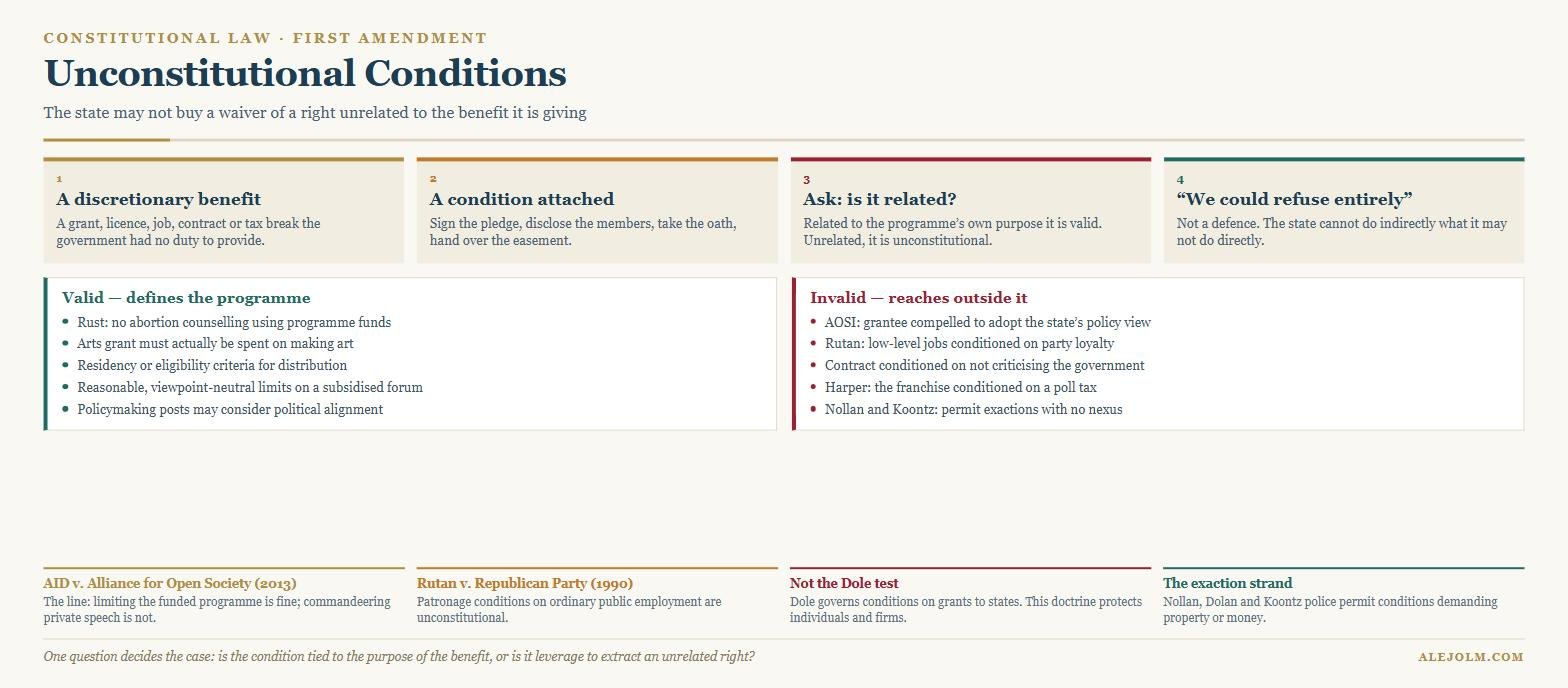
The core rule and why “we could refuse entirely” fails
The rule has two halves. First, the government may not leverage a discretionary benefit to extract a waiver of an unrelated constitutional right. Second — and this is the half that surprises people — the fact that the government could lawfully have withheld the benefit altogether is no defence. There is no obligation to fund the arts, employ anyone, or issue contracts. But once the state decides to do so, the terms it sets are subject to constitutional review.
The reasoning is the standard prohibition on indirect achievement of forbidden ends. A statute criminalising criticism of the government would be struck down instantly. A grant programme that pays people on condition they refrain from criticising the government produces the same suppression through a different mechanism, and with rather more efficiency, since nobody has to be prosecuted. Constitutional rights that could be bought out one applicant at a time would not be rights in any meaningful sense.
Two familiar cases show the pattern. In Pickering v. Board of Education the state could in principle decline to employ anybody, yet it could not make employment contingent on giving up the right to speak on matters of public concern. In Harper v. Virginia Board of Elections the poll tax fell because the franchise could not be conditioned on payment, whatever the state’s general authority over election machinery. The benefit’s discretionary character never insulates the condition.
Relatedness: the escape valve that decides every case
Not every string is a constitutional problem. Conditions that genuinely serve the purpose of the benefit are ordinary programme design and raise no issue at all. An arts grant may require that the money be spent on making art. A research grant may require the research be conducted. A residency requirement for a state scheme is a rule about distribution, not a rights waiver. The label “condition” does not by itself signal anything wrong.
The defect appears when the condition operates as leverage rather than definition — when it demands something the programme has no need of, in exchange for money or permission the applicant does need. A loyalty oath is not necessary to compose music. Disclosure of unrelated political memberships is not necessary to obtain a licence. Silence about environmental policy is not necessary to run a healthcare charity. In each case the state is not shaping its programme; it is buying a right.
So the analytical sequence is short. Identify the benefit and articulate its purpose narrowly and honestly. Identify precisely what the condition requires the recipient to give up. Then ask whether the second is instrumentally necessary to the first. If the answer is yes, the condition is almost certainly valid. If the purpose could be fully achieved without the condition, the condition is leverage and it falls.
AOSI and Rust: inside the programme or outside it?
The sharpest modern statement of the line comes from Agency for International Development v. Alliance for Open Society International (2013). Congress conditioned federal HIV and AIDS funding on recipient organisations affirmatively adopting a policy explicitly opposing prostitution. That was struck down. The condition did not merely restrict what the grantees did with federal money; it required them to adopt and voice the government’s position as their own institutional policy, binding their privately funded speech as well.
Compare Rust v. Sullivan, which the Court took care to distinguish. There, family-planning funds could not be used to counsel in favour of abortion. That condition defined the boundaries of the federally funded programme: the recipient remained free to counsel differently using other money, through separate operations. Congress was declining to subsidise a particular activity, which it may do, rather than commandeering the grantee’s voice, which it may not.
The distinction is therefore about reach rather than subject matter. Ask whether the condition governs the funded activity or the recipient as an entity. A condition saying “do not do X with this money” is a permissible definition of scope. A condition saying “be an organisation that believes X” reaches outside the programme and is unconstitutional. That single reformulation resolves the great majority of funding-condition problems.
Exam tip: never accept “the government could have refused the benefit entirely” as an answer. It is the argument the doctrine exists to defeat. Go straight to relatedness, and then ask whether the condition governs the funded activity or the recipient as a whole.
Employment, patronage and the Rutan line
Public employment is the most litigated benefit, because the leverage is continuous rather than one-off. Rutan v. Republican Party of Illinois (1990) held that conditioning hiring, promotion and transfer of ordinary public employees on party affiliation violates the First Amendment. Political loyalty has no bearing on whether someone can maintain a road or process a licence application, so the condition is unrelated and therefore invalid.
The exception is instructive precisely because it is an application of relatedness rather than a departure from it. For genuine policymaking and confidential posts, political alignment is related to the job, because the role involves advancing the elected administration’s programme. The exception is narrow and turns on actual function rather than job title, but it confirms that the doctrine is not hostile to conditions as such — only to conditions that do no work for the benefit they are attached to.
Exactions: the property strand from Nollan to Koontz
The same principle polices land-use permits, where the currency is property rather than speech. Nollan v. California Coastal Commission required an essential nexus between the permit condition and the harm the permit requirement addresses; Dolan v. City of Tigard added rough proportionality between the exaction and the projected impact. Koontz v. St. Johns River Water Management District closed two escape routes, holding that the analysis applies where the permit is denied for refusal to accept a condition, and where the demand is for money rather than land.
Practically this means a council may require drainage works proportionate to the run-off a development will create, but it may not use the permit as an occasion to obtain a public easement or a cash payment unconnected to the project’s effects. It is worth keeping this strand distinct from the conditional-spending analysis under South Dakota v. Dole, which governs conditions Congress attaches to grants to states and protects federalism. The unconstitutional conditions doctrine protects individuals and private entities, and conflating the two is a reliable way to answer the wrong question.
| Condition | Related to the benefit? |
|---|---|
| Arts grant funds must be spent on art | Yes — defines the programme |
| Arts grant conditioned on not criticising the Governor | No — pure leverage |
| No abortion counselling with programme funds (Rust) | Yes — scope of the subsidy |
| Grantee must adopt an anti-prostitution policy (AOSI) | No — binds private speech |
| Party loyalty for an ordinary public job (Rutan) | No — irrelevant to the work |
| Political alignment for a policymaking post | Yes — the role is political |
| Drainage works proportionate to run-off (Dolan) | Yes — nexus and proportionality |
| Public easement or cash demanded for a permit (Nollan, Koontz) | No — no essential nexus |
Worked example
State P operates an arts-funding programme open to qualified applicants. The application form requires each applicant to sign a pledge: “I will not engage in any speech that criticises State P’s government or elected officials during the grant period”, with forfeiture of the grant and a $10,000 penalty for breach. A musician signs, receives the grant, and then publicly attacks the Governor’s environmental record. The state demands repayment and the penalty. She sues.
The benefit is a discretionary arts subsidy, and its purpose is to support artistic creation and performance. The condition requires the recipient to abandon political criticism of the state. Ask whether political silence is instrumentally necessary to composing or performing music, and the answer is plainly no — the programme’s objectives are fully achievable without it. The condition therefore extracts a First Amendment right unrelated to the benefit and is unconstitutional. The state’s obvious rejoinder, that it could have declined to fund the arts at all, is exactly the argument the doctrine rejects. Note too that the condition reaches the musician’s speech generally, not merely her use of the money, which puts it on the AOSI side of the line rather than the Rust side. She keeps the grant, and neither forfeiture nor the penalty may be enforced.
Change one fact. Suppose the condition instead provided that grant funds may not be spent producing works that advocate for or against any candidate for office. Now the state is defining what its own subsidy pays for, and the musician remains free to produce political work with other money. That is scope, not leverage, and it would very likely survive. The shift from “what you may do with our money” to “what you may say at all” is the entire difference between a valid programme and an unconstitutional condition.
Common mistakes that cost points
- Accepting “the government could withhold the benefit entirely” as a defence. It never is; the doctrine exists to answer it.
- Confusing this doctrine with the Dole conditional-spending test. Dole concerns conditions on grants to states and protects federalism, not individual rights.
- Skipping the relatedness analysis and assuming any condition on a discretionary benefit is valid.
- Reading Rust too broadly. It permits defining the funded programme, not controlling the recipient’s speech outside it.
- Treating an onerous or expensive condition as unconstitutional. Burden is not the test; extraction of an unrelated right is.
- Forgetting the exaction strand. Nollan, Dolan and Koontz apply the same principle to permit conditions demanding land or money.
- Assuming Koontz does not apply because the permit was refused rather than granted with conditions. It applies either way.
- Applying the doctrine where the government is funding its own message. That is government speech, and the state may control content.
Frequently asked questions
If the government need not provide the benefit, why can it not set any condition?
Because a condition is itself government action subject to the Constitution. Allowing the state to purchase waivers one applicant at a time would let it accomplish indirectly what it is forbidden to do directly, and rights that can be bought out are not rights. The power to refuse a benefit is simply not the power to attach any term to it.
What is the difference between Rust and AOSI?
Reach. Rust upheld a condition limiting what recipients could do with the funded programme, leaving them free to act differently with other resources. AOSI struck down a condition requiring grantees to adopt the government’s policy position as their own, which bound their privately funded speech. Defining a subsidy is permissible; commandeering a voice is not.
Does this doctrine apply outside free speech?
Yes. It has been applied to voting, in the poll-tax cases; to religious exercise, where a benefit is denied because of a religious practice; and extensively to property, through the Nollan, Dolan and Koontz line on permit exactions. Speech simply supplies the largest share of the case law.
Unconstitutional conditions: California origins and 2026 practice
Two of the defining cases in this area are Californian. Speiser v. Randall (1958) struck down California’s requirement that veterans claiming a property tax exemption swear a loyalty oath, holding that the state could not use a tax benefit to suppress speech it had no power to prohibit directly. Three decades later Nollan v. California Coastal Commission (1987) held that a permit condition requiring a public easement across beachfront property had to bear an essential nexus to the harm the permit requirement addressed.
The line has moved recently. In Sheetz v. County of El Dorado (2024) the Supreme Court held that permit conditions imposed by legislation are not exempt from the nexus and rough proportionality requirements, rejecting the distinction California courts had drawn between adjudicative and legislative exactions. That decision reopened a substantial body of development fee practice across California, including in Los Angeles County.
Where conditions are attached locally:
- Development entitlements carry the most exposure. Dedications, setbacks and impact fees imposed through Los Angeles County Regional Planning or city processes must satisfy Nollan and Dolan.
- Coastal permits are a separate regulator. The Coastal Commission still imposes access and mitigation conditions along the county shoreline.
- Contracting conditions raise different questions. Living wage, local hire and labour peace requirements are analysed as government-as-purchaser terms, and Article IV privileges and immunities can apply.
- Benefit conditions cannot buy away rights. A county programme may not require recipients to surrender speech or religious exercise as the price of participation.
- Fee protest deadlines are short. Statutory procedures in the California Government Code impose limitation periods that will bar an otherwise strong claim.
- Germaneness saves many conditions. A requirement that defines the scope of the subsidised programme itself is generally permissible.
In 2026, ask whether the condition regulates the funded activity or leverages control beyond it. Read with the Takings Clause, the spending power and government employee speech.
Next steps
This doctrine sits at the junction of several frameworks, so read it alongside them. Start with the First Amendment analysis, since speech is the right most often leveraged, and then contrast the spending power, which governs conditions Congress places on grants to states under an entirely different test. Because funding conditions frequently blur into the state’s own message, pair this with the government speech doctrine, and note that the employment strand running from Pickering to Rutan is developed further in government employee speech.
The opinions in AOSI and Koontz are the two most useful to read in full and are freely available through Justia’s First Amendment collection. Cornell’s Legal Information Institute keeps a concise entry with current citations, and candidates should check the tested scope against the outlines published by the State Bar of California.
Related guides
- Advisory Opinions: Article III and Declaratory Relief
- Access to the Courts: When Filing Fees Are Unconstitutional
- Other Enumerated Powers: Postal, Bankruptcy, Admiralty
- Franchise Amendments: Congress and the Right to Vote
- Property Clause: Congress and Federal Lands Explained
- No Federal Police Power: Enumerated Powers and Enclaves
- Contracts Clause: When States May Impair Agreements
- Takings Clause: Lucas, Penn Central and Just Compensation
- Free Exercise Clause: Smith, Lukumi and Fulton Applied
- Establishment Clause: Church, State and the New Test
- Freedom of Association: Scrutiny, Dale and Disclosure
- Freedom of the Press: Publication Liability and Limits
- Campaign Finance and Anonymous Speech: The Core Rules
- Government Speech Doctrine: When the State Can Choose
- Vagueness and Overbreadth: Facial Challenges Explained
- Prior Restraint and Licensing: The Freedman Safeguards
- Symbolic Conduct and the O’Brien Test: The Pivot Question
- Government Employee Speech: Garcetti and Pickering Rules
- Commercial Speech and the Central Hudson Four-Part Test
- Actual Malice and the Three Tracks of Defamation Law
- Public Forum Doctrine and the Time, Place, Manner Test
- First Amendment: The Three-Question Speech Framework
- One Person, One Vote: Voting Rights Under Equal Protection
- Alienage Classifications: Strict Scrutiny and Its Pockets
- Equal Protection: The Three-Step Classification Test
- Second Amendment: The Bruen Text-and-History Standard
- Substantive Due Process After Dobbs: A Two-Step Test
- Procedural Due Process: Notice, Hearing and Mathews
- Incorporation Doctrine: Which Rights Bind the States
- Full Faith and Credit: Recognising Sister-State Judgments
- The Complete Auto Test: Taxing Interstate Commerce
- The Right to Travel: Durational Residency Explained
- Article IV Privileges and Immunities: The Comity Rule
- Federal Preemption: The Three-Step Ladder Explained
- The Supremacy Clause: Floors, Ceilings and Preemption
- Intergovernmental Immunity: The Shield Runs One Way
- The Presidential Pardon Power: Four Limits That Matter
- Executive Privilege: A Qualified Right That Must Yield
- Presidential Immunity: Criminal, Civil and Private Acts
- The Removal Power: At-Will Firing and Its Exceptions
- The Appointment Power: Principal and Inferior Officers
- Take Care Clause: Enforcement Discretion and Its Limits
- Commander-in-Chief Power: Deploy Without Declaring War
- Executive Agreements: The President’s Sole Foreign Power
- The Treaty Power: Senate Advice and Consent Explained
- The Presidential Veto Power, Override and Pocket Veto
- Bicameralism and Presentment: Two Vetoes Struck Down
- The Nondelegation Doctrine and the Intelligible Principle
- Speech or Debate Clause: Absolute but Narrow Immunity
- The Impeachment Power: House Majority, Senate Two-Thirds
- Congress’s Naturalization Power and Citizenship Limits
- Congressional War Powers: Declare, Fund and Command
- Anti-Commandeering Doctrine and the Tenth Amendment
- Section 5 Enforcement Power: Remedy, Do Not Redefine
- The Spending Power and the Five Dole Test Conditions
- Congress’s Taxing Power: When a Penalty Is Really a Tax
- The Necessary and Proper Clause: Congress’s Multiplier
- Ex Post Facto Clause: Retroactive Criminal Laws Barred
- Bills of Attainder: Legislative Punishment Explained
- The Writ of Habeas Corpus: Testing Unlawful Detention
- Supreme Court Jurisdiction: Original vs Appellate Power
- Abstention Doctrine: 4 Ways Federal Courts Step Aside
- Dormant Commerce Clause: Discrimination vs Pike Balancing
- The Commerce Clause: 3 Categories and 2 Hard Limits
- State Action Doctrine: The Government Conduct Threshold
- The Eleventh Amendment and State Sovereign Immunity
- Political Question Doctrine: What Courts Will Not Decide
- Ripeness and Mootness: Timing Rules in Federal Court
- Standing in Federal Court: The 3-Part Article III Test
- Marbury v. Madison and the Power of Judicial Review
- The Youngstown Framework: Presidential Power in 3 Zones
- The IRAC Method: How to Structure a Bar Exam Answer
- Piercing the Corporate Veil: A Two-Prong Alter Ego Test
- Defamation Elements, Fault Standards and Privileges
- The Parol Evidence Rule: Integration and Exceptions
- Recording Acts: Race, Notice and Race-Notice Explained
- Partner Liability and Authority Under RUPA Explained
- Trustee Duties: Care, Loyalty, Impartiality, Accounts
- Specific Performance: A Six-Element Bar Exam Framework
- Will Execution Requirements: Formalities and Rescue
- Community Property Presumptions in California Explained
- Easements Explained: Creation, Scope and Termination
- Products Liability: The Three Defect Theories Explained
- Miranda Rights: Custody, Interrogation and Invocation
- The Character Evidence Rules: Propensity Bar and Doorways
- Adverse Possession Elements: OCEAN and the Tax Rule
- Business Judgment Rule and Directors’ Fiduciary Duties
- The Statute of Frauds: MYLEGS and How to Satisfy It
- Res Judicata vs Collateral Estoppel: Bar Exam Guide
- The Erie Doctrine Explained: A 4-Step Bar Exam Guide
- Conflicts of Interest: A 6-Step Decision Tree for the Bar
- The Rule Against Perpetuities Explained Step by Step
- Murder and Manslaughter: The Homicide Ladder Explained
- Consideration in Contract Law: Rules and Exceptions
- The Four Elements of Negligence: Bar Exam Breakdown
- The Hearsay Rule Explained: Exceptions and Exemptions
- Personal Jurisdiction: The 3-Step Bar Exam Framework
- 3 Levels of Scrutiny in Constitutional Law Explained
- The Citizenship Clause After Trump v. Barbara