
The ex post facto clause appears twice in Article I: section 9 forbids Congress to pass such laws and section 10 forbids the states. It bars a legislature from criminalising conduct after the fact and from increasing the punishment for conduct already completed. Its purpose is fair warning: people must be able to rely on the law as it stood when they acted.
This guide explains the four categories identified in Calder v. Bull and reaffirmed in Collins v. Youngblood, the three limits that keep the clause narrow, why retroactive civil liability is treated quite differently, and how to tell a genuinely civil penalty from a criminal one wearing a civil label.
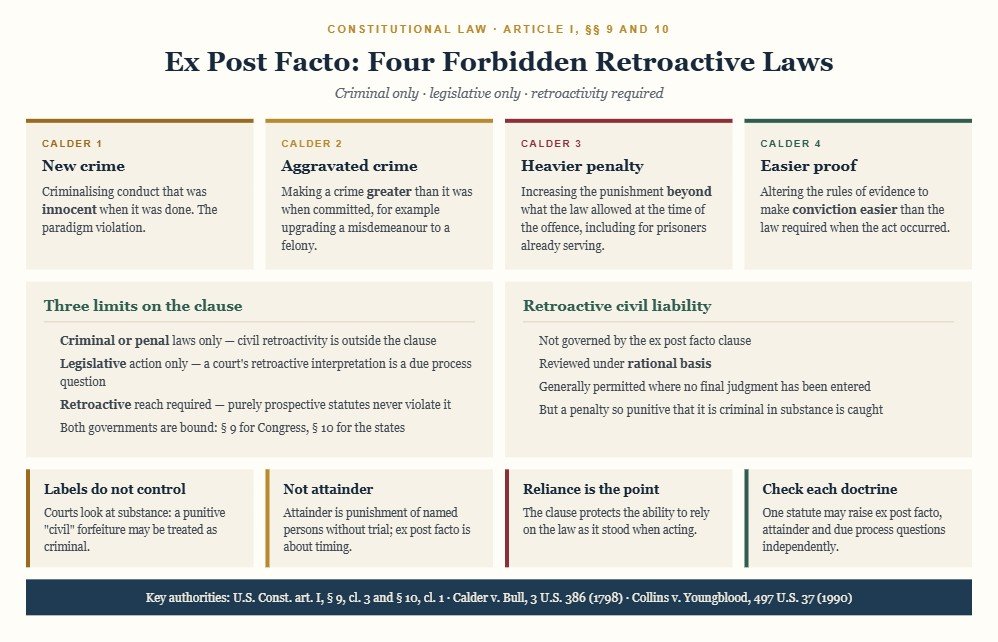
The four Calder v. Bull categories
Justice Chase’s opinion in Calder v. Bull remains the controlling framework, and Collins v. Youngblood confirmed it as the test. A retroactive criminal law is unconstitutional if it does any of four things.
- Criminalises an act that was innocent when it was done.
- Aggravates a crime, making it greater than it was when committed.
- Increases the punishment for a crime beyond what the law provided at the time of the offence.
- Alters the rules of evidence so as to make conviction easier than the law required when the act occurred.
The fourth category is the one candidates forget. A statute that lowers the standard of proof, removes a corroboration requirement or shifts a burden, and then applies to past conduct, offends the clause just as surely as one that lengthens a sentence.
Exam tip: name the Calder category you are using. Saying which of the four applies is worth more than a general statement that the statute is retroactive.
Three limits that keep the clause narrow
Criminal or penal laws only
The clause reaches criminal and penal legislation. Retroactive taxes, regulatory charges and civil remedies fall outside it, however burdensome. Those measures are reviewed under rational basis and are generally sustained where no final judgment has already fixed the parties’ rights.
Legislative action only
The clause constrains legislatures. If a court announces a new interpretation and applies it to conduct that preceded the decision, that is not an ex post facto violation, although it may raise a due process question about fair warning. Keep the two arguments separate.
Retroactivity required
A statute that governs only conduct occurring after enactment is never ex post facto, no matter how severe it is. The clause is about reach backwards in time, not about severity.
Criminal or civil in substance
Because the clause is confined to criminal laws, everything can turn on characterisation, and the legislature’s label does not control. Courts examine the substance of the measure: its purpose, whether it has historically been regarded as punishment, whether it turns on a finding of scienter, and whether it is excessive in relation to any remedial aim. A forfeiture so punitive that it functions as criminal punishment can be caught even though the statute calls it civil.
| Retroactive measure | Ex post facto violation? | Why |
|---|---|---|
| Criminalises conduct lawful when done | Yes | Calder category one |
| Adds three years to sentences already being served | Yes | Calder category three |
| Removes a corroboration requirement for past offences | Yes | Calder category four, easier conviction |
| Imposes a modest civil forfeiture on past offenders | No | Civil penalty, reviewed under rational basis |
| Applies a new sentencing rule only to future conduct | No | No retroactive reach |
| A court applies a new reading of an old statute | No | Judicial action, analysed under due process |
Worked example: the longer sentence
A legislature raises the penalty for a possession offence from two years to five and provides expressly that the increase applies to all past violations, including people currently serving sentences. The statute is legislative, criminal and retroactive, and it increases punishment beyond what the law allowed at the time of the offence. That is Calder category three, and the increase cannot be applied to those offenders.
Change the penalty. The legislature instead imposes a five hundred dollar civil forfeiture on past offenders. The clause is not engaged because the penalty is civil, so the measure is reviewed under rational basis and will usually survive. It may still be attacked on due process or excessive fines grounds, but those are separate arguments.
Change the timing. The five-year term applies only to offences committed after enactment. There is no retroactivity and therefore no violation, even though the sentence more than doubled.
Ex post facto compared with bills of attainder
The two clauses sit side by side and guard against different evils. A bill of attainder is legislative punishment of specific, identified persons without any trial: the objection is that the legislature adjudicated guilt. An ex post facto law may apply to an open class and may be enforced through an ordinary trial: the objection is that the law changed after the conduct. A single statute can violate both, and each should be analysed on its own terms.
Common mistakes that cost points
- Applying the clause to retroactive civil liability. Taxes, fees and civil remedies are outside it.
- Applying the clause to courts. Judicial retroactivity is a due process problem, not an ex post facto one.
- Confusing severity with retroactivity. A harsh but purely prospective statute is untouched.
- Forgetting the fourth Calder category about evidentiary rules that ease conviction.
- Accepting the statute’s own label. Substance controls, so a punitive civil measure can be criminal in effect.
- Merging the analysis with bills of attainder instead of running both tests separately.
- Overlooking that section 10 imposes the same ban on the states as section 9 does on Congress.
- Failing to identify the date of the conduct, which is the fact that decides the whole question.
Frequently asked questions
Can a legislature lower a penalty retroactively?
Yes. The clause bars retroactive disadvantage, not retroactive leniency, so a reduction may be applied to past conduct.
Do sex-offender registration schemes violate the clause?
Courts have generally held that such schemes are civil and regulatory rather than punitive, and so are outside the clause, though the answer depends on how burdensome the particular scheme is in substance.
Does the clause protect against changes in procedure?
Only where the change makes conviction easier than the law required at the time of the offence. Neutral procedural adjustments are permitted.
Ex post facto problems in California sentencing, 2026
Both the federal Constitution and article I, section 9 of the California Constitution prohibit retroactive criminal legislation, and the categories from Calder v. Bull as restated in Collins v. Youngblood (1990) remain the test: criminalising past conduct, aggravating a crime, increasing punishment, or altering the rules of evidence to make conviction easier.
California’s frequent use of ballot initiatives makes retroactivity a live question rather than a historical one. Measures reducing penalties have generally been applied to people already sentenced, because reducing punishment raises no ex post facto concern and California has its own rule favouring retroactive application of ameliorative changes. Measures increasing penalties operate prospectively only, which is why the effective date of an initiative such as the 2024 measure raising penalties for certain theft and drug offences matters so much in Los Angeles County District Attorney charging decisions.
Recurring issues in Los Angeles County practice:
- Ameliorative changes apply retroactively. Under the California rule associated with In re Estrada, a reduction in punishment reaches cases not yet final unless the enactment says otherwise.
- Registration schemes are usually regulatory. Smith v. Doe (2003) treated sex offender registration as non-punitive, so retroactive application is generally permitted.
- Residency restrictions can still fail. The California Supreme Court invalidated blanket residency restrictions as applied in a densely populated county, though on due process rather than ex post facto grounds.
- Parole and credit rules are analysed for effect. A change that lengthens actual confinement can violate the clause even if framed as procedural.
- Limitation periods cannot be revived. Reopening an expired criminal limitations period is unconstitutional under Stogner v. California (2003), itself a California case.
- Civil commitment is outside the clause. Sexually violent predator proceedings are treated as civil, so retroactivity arguments generally fail.
In 2026, ask whether the change increases punishment and whether the case was final when it took effect. Read with bills of attainder, habeas corpus and murder and manslaughter.
Next steps
Study this clause with its Article I neighbours and with the wider retroactivity rules. Read Bills of Attainder: Legislative Punishment Explained and The Writ of Habeas Corpus: Testing Unlawful Detention, then compare the tiers of review in Levels of Scrutiny in Constitutional Law.
For primary sources, read Calder v. Bull and Collins v. Youngblood at Justia, the entry on ex post facto laws at Cornell LII, and the examination scope published by the State Bar of California.
Related guides
- Advisory Opinions: Article III and Declaratory Relief
- Access to the Courts: When Filing Fees Are Unconstitutional
- Other Enumerated Powers: Postal, Bankruptcy, Admiralty
- Franchise Amendments: Congress and the Right to Vote
- Property Clause: Congress and Federal Lands Explained
- No Federal Police Power: Enumerated Powers and Enclaves
- Contracts Clause: When States May Impair Agreements
- Takings Clause: Lucas, Penn Central and Just Compensation
- Free Exercise Clause: Smith, Lukumi and Fulton Applied
- Establishment Clause: Church, State and the New Test
- Freedom of Association: Scrutiny, Dale and Disclosure
- Freedom of the Press: Publication Liability and Limits
- Campaign Finance and Anonymous Speech: The Core Rules
- Unconstitutional Conditions: Benefits and Rights Waivers
- Government Speech Doctrine: When the State Can Choose
- Vagueness and Overbreadth: Facial Challenges Explained
- Prior Restraint and Licensing: The Freedman Safeguards
- Symbolic Conduct and the O’Brien Test: The Pivot Question
- Government Employee Speech: Garcetti and Pickering Rules
- Commercial Speech and the Central Hudson Four-Part Test
- Actual Malice and the Three Tracks of Defamation Law
- Public Forum Doctrine and the Time, Place, Manner Test
- First Amendment: The Three-Question Speech Framework
- One Person, One Vote: Voting Rights Under Equal Protection
- Alienage Classifications: Strict Scrutiny and Its Pockets
- Equal Protection: The Three-Step Classification Test
- Second Amendment: The Bruen Text-and-History Standard
- Substantive Due Process After Dobbs: A Two-Step Test
- Procedural Due Process: Notice, Hearing and Mathews
- Incorporation Doctrine: Which Rights Bind the States
- Full Faith and Credit: Recognising Sister-State Judgments
- The Complete Auto Test: Taxing Interstate Commerce
- The Right to Travel: Durational Residency Explained
- Article IV Privileges and Immunities: The Comity Rule
- Federal Preemption: The Three-Step Ladder Explained
- The Supremacy Clause: Floors, Ceilings and Preemption
- Intergovernmental Immunity: The Shield Runs One Way
- The Presidential Pardon Power: Four Limits That Matter
- Executive Privilege: A Qualified Right That Must Yield
- Presidential Immunity: Criminal, Civil and Private Acts
- The Removal Power: At-Will Firing and Its Exceptions
- The Appointment Power: Principal and Inferior Officers
- Take Care Clause: Enforcement Discretion and Its Limits
- Commander-in-Chief Power: Deploy Without Declaring War
- Executive Agreements: The President’s Sole Foreign Power
- The Treaty Power: Senate Advice and Consent Explained
- The Presidential Veto Power, Override and Pocket Veto
- Bicameralism and Presentment: Two Vetoes Struck Down
- The Nondelegation Doctrine and the Intelligible Principle
- Speech or Debate Clause: Absolute but Narrow Immunity
- The Impeachment Power: House Majority, Senate Two-Thirds
- Congress’s Naturalization Power and Citizenship Limits
- Congressional War Powers: Declare, Fund and Command
- Anti-Commandeering Doctrine and the Tenth Amendment
- Section 5 Enforcement Power: Remedy, Do Not Redefine
- The Spending Power and the Five Dole Test Conditions
- Congress’s Taxing Power: When a Penalty Is Really a Tax
- The Necessary and Proper Clause: Congress’s Multiplier
- Bills of Attainder: Legislative Punishment Explained
- The Writ of Habeas Corpus: Testing Unlawful Detention
- Supreme Court Jurisdiction: Original vs Appellate Power
- Abstention Doctrine: 4 Ways Federal Courts Step Aside
- Dormant Commerce Clause: Discrimination vs Pike Balancing
- The Commerce Clause: 3 Categories and 2 Hard Limits
- State Action Doctrine: The Government Conduct Threshold
- The Eleventh Amendment and State Sovereign Immunity
- Political Question Doctrine: What Courts Will Not Decide
- Ripeness and Mootness: Timing Rules in Federal Court
- Standing in Federal Court: The 3-Part Article III Test
- Marbury v. Madison and the Power of Judicial Review
- The Youngstown Framework: Presidential Power in 3 Zones
- The IRAC Method: How to Structure a Bar Exam Answer
- Piercing the Corporate Veil: A Two-Prong Alter Ego Test
- Defamation Elements, Fault Standards and Privileges
- The Parol Evidence Rule: Integration and Exceptions
- Recording Acts: Race, Notice and Race-Notice Explained
- Partner Liability and Authority Under RUPA Explained
- Trustee Duties: Care, Loyalty, Impartiality, Accounts
- Specific Performance: A Six-Element Bar Exam Framework
- Will Execution Requirements: Formalities and Rescue
- Community Property Presumptions in California Explained
- Easements Explained: Creation, Scope and Termination
- Products Liability: The Three Defect Theories Explained
- Miranda Rights: Custody, Interrogation and Invocation
- The Character Evidence Rules: Propensity Bar and Doorways
- Adverse Possession Elements: OCEAN and the Tax Rule
- Business Judgment Rule and Directors’ Fiduciary Duties
- The Statute of Frauds: MYLEGS and How to Satisfy It
- Res Judicata vs Collateral Estoppel: Bar Exam Guide
- The Erie Doctrine Explained: A 4-Step Bar Exam Guide
- Conflicts of Interest: A 6-Step Decision Tree for the Bar
- The Rule Against Perpetuities Explained Step by Step
- Murder and Manslaughter: The Homicide Ladder Explained
- Consideration in Contract Law: Rules and Exceptions
- The Four Elements of Negligence: Bar Exam Breakdown
- The Hearsay Rule Explained: Exceptions and Exemptions
- Personal Jurisdiction: The 3-Step Bar Exam Framework
- 3 Levels of Scrutiny in Constitutional Law Explained
- The Citizenship Clause After Trump v. Barbara