
A woman moves from one state to another and applies for benefits she would receive as a long-settled resident. The state pays her less, or makes her wait a year, on the ground that she has only just arrived. That single fact pattern is the whole of the modern Fourteenth Amendment Privileges or Immunities Clause.
The clause forbids any state to abridge the privileges or immunities of citizens of the United States. Read broadly, it might have been the engine of federal rights against the states. The Slaughterhouse Cases (1873) read it narrowly instead, and incorporation had to run through the Due Process Clause. What survived, and what Saenz v. Roe (1999) revived, is the right to travel.
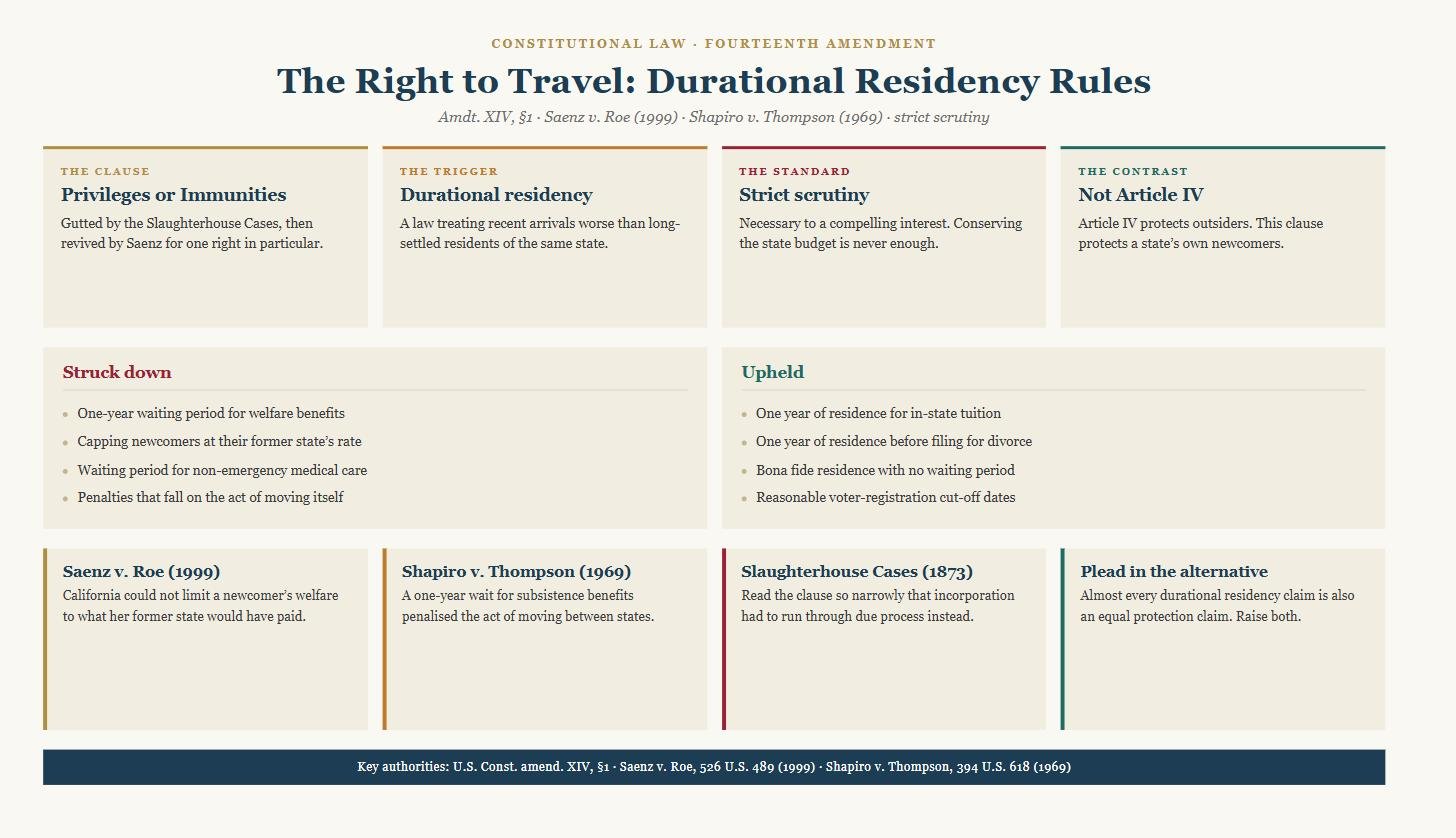
Three components, three different homes
Saenz is worth reading closely because it separates the right to travel into three parts, each protected by a different provision. The first is the right to enter and leave a state, which is structural and needs no textual hook. The second is the right to be treated as a welcome visitor rather than an unfriendly alien while temporarily present, which is Article IV’s job. The third is the right of a newly arrived citizen to be treated on equal terms with other citizens of the state she has chosen, and that is the Fourteenth Amendment component.
Keeping the three apart solves most of the confusion in this area. If the plaintiff is a visitor from another state complaining about discrimination, the claim is Article IV comity. If the plaintiff has moved in and is being treated as a second-class member of her new state, the claim is Fourteenth Amendment privileges or immunities.
The trigger: durational residency
The clause is engaged by durational residency classifications — rules that divide the state’s own residents by how long they have lived there. Bona fide residence requirements are not the problem. A state may insist that you genuinely live within its borders before it treats you as a resident, and it may verify the fact. What it may not casually do is make you wait, once you genuinely live there, before you are treated like everyone else.
Where the trigger is satisfied, the standard is strict scrutiny: the classification must be necessary to a compelling state interest. Because durational requirements are almost always defended on budgetary grounds, and cost saving is not a compelling interest, most of them fail. Shapiro v. Thompson (1969) struck down a one-year wait for welfare, reasoning that withholding subsistence penalises the act of moving. Saenz struck down a subtler version: California paid newcomers only what their previous state would have paid, which the Court treated as the same penalty in different clothing.
Exam tip: distinguish a bona fide residence requirement from a durational one. The first asks whether you live here. The second asks how long you have lived here, and only the second triggers strict scrutiny.
Which requirements survive
The pattern in the decided cases turns on how severely the waiting period punishes migration and how closely the benefit is tied to something the state genuinely needs time to establish.
| Durational requirement | Outcome |
|---|---|
| One-year wait for welfare benefits | Struck down — Shapiro v. Thompson |
| Newcomers capped at their former state’s benefit level | Struck down — Saenz v. Roe |
| One-year wait for non-emergency state medical care | Struck down — subsistence-level need |
| One-year residence for reduced in-state university tuition | Upheld — a subsidy, not a necessity |
| One-year residence before filing for divorce | Upheld — Sosna v. Iowa, a genuine forum interest |
| Bona fide residence with no waiting period | Valid — no durational classification at all |
The unifying idea is not the length of the wait but what is being withheld. Where the benefit is necessary for survival, the waiting period operates as a penalty on the decision to move and cannot be justified. Where the benefit is a subsidy that the state funds for its established community, or where the state has an independent reason to require settled residence before acting — as a divorce court does before dissolving a marriage — the requirement survives.
Why equal protection usually rides along
Modern courts often resolve durational residency cases under the Equal Protection Clause rather than privileges or immunities, because equal protection has the more developed apparatus: a fundamental right triggers strict scrutiny, and the right to travel is fundamental. The two routes reach the same destination in nearly every case, and the safe practice is to plead both.
There is also a doctrinal frontier worth knowing about. Justice Thomas has argued that the Privileges or Immunities Clause, not the Due Process Clause, should be the vehicle for applying the Bill of Rights to the states, a position he set out in McDonald v. City of Chicago (2010). It is not the law. Incorporation still runs through due process, and the clause remains narrow. But a question that asks which clause “should” do the work of incorporation is asking about that debate.
Worked example
State P funds a treatment programme for rare diseases and limits access to residents who have lived in the state for at least two years. A citizen who moved there one year ago is refused, and sues.
She wins. The rule classifies the state’s own residents by duration of residence, so the trigger is satisfied and strict scrutiny applies. State P will defend on cost and on the idea that resources should go to those who have contributed longest, but neither is a compelling interest; the Court rejected precisely that reasoning in Shapiro. Nor is a two-year wait necessary to any legitimate end the state can identify, since verifying genuine residence takes weeks rather than years. Because the benefit withheld is medical treatment rather than a discretionary subsidy, the case sits on the Shapiro side of the line.
Change one fact. Suppose the programme is a scholarship rather than a treatment, and the wait is one year. Now the state is much better placed. A tuition-style subsidy is not necessary for survival, the one-year period tracks the recognised in-state tuition cases, and the classification is likely to be upheld.
Common mistakes that cost points
- Confusing the two privileges clauses. Article IV protects visitors from other states; the Fourteenth Amendment protects a state’s own newcomers.
- Treating every residence requirement as unconstitutional. Bona fide residence rules are perfectly valid.
- Assuming a one-year wait is always fatal. The tuition and divorce cases went the other way.
- Accepting fiscal savings as a compelling interest. It never is.
- Forgetting the equal protection alternative, which most courts actually rely on.
- Stating that the clause is the vehicle for incorporation. That is a concurring view, not current doctrine.
Frequently asked questions
Is the right to travel in the constitutional text?
Not by name. It is assembled from several sources: the structure of the union for the right of movement itself, Article IV for the treatment of visitors, and the Fourteenth Amendment Privileges or Immunities Clause for the equal treatment of new residents.
Does the right to travel cover international travel?
Only weakly. Movement abroad is treated as a liberty interest subject to reasonable regulation rather than as a fundamental right attracting strict scrutiny, which is why passport and visa restrictions are analysed very differently from interstate residency penalties.
May a state require residence before allowing someone to vote?
It may require bona fide residence and a reasonable registration cut-off for administrative reasons, but long waiting periods aimed at newcomers do not survive. The permissible period is measured by what election administration actually needs.
The right to travel: California’s landmark cases and 2026 practice
California has produced the two decisions that define this right, which makes it an unusually rewarding topic to localise. In Edwards v. California (1941) the Court struck down a state statute making it a crime to bring an indigent person into California, a Depression-era measure aimed at migrants from the Dust Bowl states. Nearly six decades later, Saenz v. Roe (1999) invalidated a California statute that limited welfare benefits for new residents to the amount payable in their former state during their first year.
Saenz is the case worth knowing cold, because it identified three components of the right and located the third in the Privileges or Immunities Clause of the Fourteenth Amendment, one of the very few modern decisions to give that clause real work. The components are the right to enter and leave a state, the right to be treated as a welcome visitor, and the right of a new resident to be treated the same as long-standing residents.
Where durational residency issues arise in Los Angeles County:
- Benefit programmes cannot discount new arrivals. County general assistance and state aid must be calculated on the same terms for recent and established residents.
- Tuition residency rules survive. A one-year requirement for reduced tuition has been upheld as a bona fide residence test rather than a penalty on migration.
- Voting residency requirements must be short. Brief periods tied to administrative necessity are permissible; long ones are not.
- Divorce and licensing residency rules differ. Section 2320 of the California Family Code requires a period of residence before a California dissolution, and such rules have generally been sustained.
- Bona fide residence is not the same as duration. Requiring that someone actually live in the county is lawful; requiring that they have lived there for a year to receive equal treatment usually is not.
- Homelessness policy sits in this shadow. Measures that effectively penalise arrival, rather than regulate conduct, invite Edwards arguments.
In 2026, distinguish a genuine residence requirement from a durational penalty, because that single distinction resolves most problems. Read with Article IV privileges and immunities, equal protection and the incorporation doctrine.
Next steps
Read this next to the Article IV Privileges and Immunities Clause, its constant companion in exam questions, then the three levels of scrutiny for the standard the trigger unlocks, and the state action doctrine for the threshold every Fourteenth Amendment claim must cross.
For primary sources, read Saenz v. Roe on Justia and Shapiro v. Thompson also on Justia, review the Fourteenth Amendment on Cornell Legal Information Institute, and confirm current subject coverage with the State Bar of California.
Related guides
- Advisory Opinions: Article III and Declaratory Relief
- Access to the Courts: When Filing Fees Are Unconstitutional
- Other Enumerated Powers: Postal, Bankruptcy, Admiralty
- Franchise Amendments: Congress and the Right to Vote
- Property Clause: Congress and Federal Lands Explained
- No Federal Police Power: Enumerated Powers and Enclaves
- Contracts Clause: When States May Impair Agreements
- Takings Clause: Lucas, Penn Central and Just Compensation
- Free Exercise Clause: Smith, Lukumi and Fulton Applied
- Establishment Clause: Church, State and the New Test
- Freedom of Association: Scrutiny, Dale and Disclosure
- Freedom of the Press: Publication Liability and Limits
- Campaign Finance and Anonymous Speech: The Core Rules
- Unconstitutional Conditions: Benefits and Rights Waivers
- Government Speech Doctrine: When the State Can Choose
- Vagueness and Overbreadth: Facial Challenges Explained
- Prior Restraint and Licensing: The Freedman Safeguards
- Symbolic Conduct and the O’Brien Test: The Pivot Question
- Government Employee Speech: Garcetti and Pickering Rules
- Commercial Speech and the Central Hudson Four-Part Test
- Actual Malice and the Three Tracks of Defamation Law
- Public Forum Doctrine and the Time, Place, Manner Test
- First Amendment: The Three-Question Speech Framework
- One Person, One Vote: Voting Rights Under Equal Protection
- Alienage Classifications: Strict Scrutiny and Its Pockets
- Equal Protection: The Three-Step Classification Test
- Second Amendment: The Bruen Text-and-History Standard
- Substantive Due Process After Dobbs: A Two-Step Test
- Procedural Due Process: Notice, Hearing and Mathews
- Incorporation Doctrine: Which Rights Bind the States
- Full Faith and Credit: Recognising Sister-State Judgments
- The Complete Auto Test: Taxing Interstate Commerce
- Article IV Privileges and Immunities: The Comity Rule
- Federal Preemption: The Three-Step Ladder Explained
- The Supremacy Clause: Floors, Ceilings and Preemption
- Intergovernmental Immunity: The Shield Runs One Way
- The Presidential Pardon Power: Four Limits That Matter
- Executive Privilege: A Qualified Right That Must Yield
- Presidential Immunity: Criminal, Civil and Private Acts
- The Removal Power: At-Will Firing and Its Exceptions
- The Appointment Power: Principal and Inferior Officers
- Take Care Clause: Enforcement Discretion and Its Limits
- Commander-in-Chief Power: Deploy Without Declaring War
- Executive Agreements: The President’s Sole Foreign Power
- The Treaty Power: Senate Advice and Consent Explained
- The Presidential Veto Power, Override and Pocket Veto
- Bicameralism and Presentment: Two Vetoes Struck Down
- The Nondelegation Doctrine and the Intelligible Principle
- Speech or Debate Clause: Absolute but Narrow Immunity
- The Impeachment Power: House Majority, Senate Two-Thirds
- Congress’s Naturalization Power and Citizenship Limits
- Congressional War Powers: Declare, Fund and Command
- Anti-Commandeering Doctrine and the Tenth Amendment
- Section 5 Enforcement Power: Remedy, Do Not Redefine
- The Spending Power and the Five Dole Test Conditions
- Congress’s Taxing Power: When a Penalty Is Really a Tax
- The Necessary and Proper Clause: Congress’s Multiplier
- Ex Post Facto Clause: Retroactive Criminal Laws Barred
- Bills of Attainder: Legislative Punishment Explained
- The Writ of Habeas Corpus: Testing Unlawful Detention
- Supreme Court Jurisdiction: Original vs Appellate Power
- Abstention Doctrine: 4 Ways Federal Courts Step Aside
- Dormant Commerce Clause: Discrimination vs Pike Balancing
- The Commerce Clause: 3 Categories and 2 Hard Limits
- State Action Doctrine: The Government Conduct Threshold
- The Eleventh Amendment and State Sovereign Immunity
- Political Question Doctrine: What Courts Will Not Decide
- Ripeness and Mootness: Timing Rules in Federal Court
- Standing in Federal Court: The 3-Part Article III Test
- Marbury v. Madison and the Power of Judicial Review
- The Youngstown Framework: Presidential Power in 3 Zones
- The IRAC Method: How to Structure a Bar Exam Answer
- Piercing the Corporate Veil: A Two-Prong Alter Ego Test
- Defamation Elements, Fault Standards and Privileges
- The Parol Evidence Rule: Integration and Exceptions
- Recording Acts: Race, Notice and Race-Notice Explained
- Partner Liability and Authority Under RUPA Explained
- Trustee Duties: Care, Loyalty, Impartiality, Accounts
- Specific Performance: A Six-Element Bar Exam Framework
- Will Execution Requirements: Formalities and Rescue
- Community Property Presumptions in California Explained
- Easements Explained: Creation, Scope and Termination
- Products Liability: The Three Defect Theories Explained
- Miranda Rights: Custody, Interrogation and Invocation
- The Character Evidence Rules: Propensity Bar and Doorways
- Adverse Possession Elements: OCEAN and the Tax Rule
- Business Judgment Rule and Directors’ Fiduciary Duties
- The Statute of Frauds: MYLEGS and How to Satisfy It
- Res Judicata vs Collateral Estoppel: Bar Exam Guide
- The Erie Doctrine Explained: A 4-Step Bar Exam Guide
- Conflicts of Interest: A 6-Step Decision Tree for the Bar
- The Rule Against Perpetuities Explained Step by Step
- Murder and Manslaughter: The Homicide Ladder Explained
- Consideration in Contract Law: Rules and Exceptions
- The Four Elements of Negligence: Bar Exam Breakdown
- The Hearsay Rule Explained: Exceptions and Exemptions
- Personal Jurisdiction: The 3-Step Bar Exam Framework
- 3 Levels of Scrutiny in Constitutional Law Explained
- The Citizenship Clause After Trump v. Barbara