
The veto power is the President’s share in the legislative process. Article I, section 7 requires that every bill passed by Congress be presented to the President, who may sign it into law or return it with objections, and a returned bill becomes law only if two-thirds of both chambers vote to override.
This guide sets out the four things that can happen to a presented bill, how the ten-day clock and the pocket veto work, how override votes are counted, and why the veto must always be exercised on the bill as a whole.
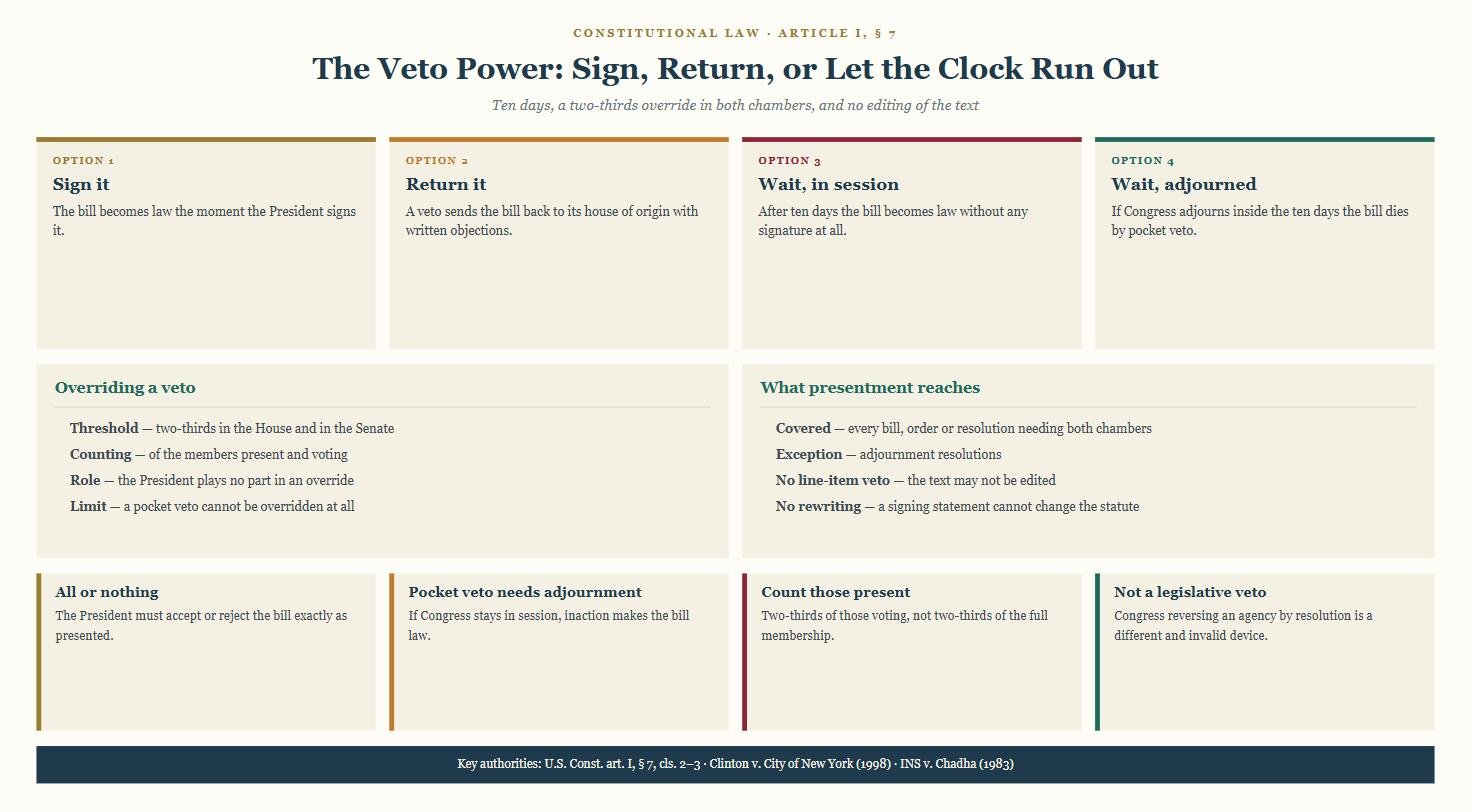
What presentment requires
Every bill, order or resolution that requires the concurrence of both the House and the Senate must be presented to the President. The standard exception is a resolution to adjourn, which concerns the internal operation of Congress rather than the law. Each chamber’s own rules are likewise not presented.
Presentment matters because it gives the executive a voice in legislation without giving it the power to legislate. The President cannot write a statute, and cannot amend one, but can force Congress either to accommodate his objections or to assemble a supermajority.
Exam tip: count the days and ask whether Congress was in session. Those two facts decide most veto questions.
The four outcomes
- Signature. The bill becomes law when the President signs it.
- Return veto. The President sends the bill back to the chamber where it originated, together with written objections. Congress may then attempt an override.
- Inaction while Congress sits. If ten days pass, excluding Sundays, and Congress remains in session, the bill becomes law without a signature.
- Inaction where Congress adjourns. If Congress adjourns within the ten days and the President has not signed, the bill dies. This is the pocket veto, and because there is no return there is nothing for Congress to override.
The pocket veto is therefore the most powerful of the four, and it depends entirely on the calendar. Where Congress arranges to remain technically in session and to receive messages, the conditions for a pocket veto are not met and inaction produces a statute instead of a corpse.
How an override is counted
An override requires two-thirds of each chamber. The fraction is taken from the members present and voting, not from the full membership, so absences change the arithmetic. Sixty-seven is the familiar figure for the Senate only because it assumes that all one hundred senators vote.
The President has no role in an override. If both chambers reach the threshold, the bill becomes law over his objection, which is the only route by which legislation is enacted without executive assent.
| Facts | Outcome | Reason |
|---|---|---|
| President signs on day three | Law | Signature completes enactment |
| Twelve days pass, Congress in session, no signature | Law | Ten-day rule operates in favour of the bill |
| Presented 26 December, Congress adjourns 3 January, no signature | Dies | Pocket veto, adjournment inside ten days |
| Veto returned, House musters 60 per cent | Dies | Two-thirds not reached in one chamber |
| Veto returned, both chambers reach two-thirds of those voting | Law | Valid override |
| President signs and then cancels two spending items | Cancellation void | No line-item veto exists |
Worked example: the December bill
Congress presents a bill to the President on 26 December and adjourns on 3 January, nine days later. The President neither signs nor formally returns it. The issue is whether the bill becomes law. The rule is that a bill unsigned for ten days becomes law if Congress remains in session, but dies if Congress adjourns within that period. Applying it, adjournment came on the ninth day, so the return route was unavailable and the bill dies by pocket veto. The conclusion is that no statute was enacted, and Congress has no override to attempt.
Change one fact. Congress does not adjourn but stays in session and appoints agents to receive messages. Now the ten days expire with Congress sitting, and the bill becomes law without a signature. Presidential inaction has produced the opposite result on almost identical facts.
The limits of the power
The veto is absolute in the sense that no reason need be given and no court will review the choice, but it is narrow in form. It must be exercised on the bill exactly as presented. Clinton v. City of New York struck down the Line Item Veto Act precisely because cancelling individual provisions after signature amounts to amending a statute unilaterally, which only bicameralism and presentment can accomplish.
Keep the presidential veto separate from the legislative veto invalidated in INS v. Chadha. The first is the constitutional mechanism; the second was an attempt by Congress to reverse executive action by resolution and is unconstitutional. Confusing the two is the single most common error in this area.
Common mistakes that cost points
- Treating the presidential veto and the legislative veto as related devices. Only one of them is lawful.
- Allowing a line-item veto. The choice is the whole bill or nothing.
- Calculating two-thirds from the full membership rather than from those present and voting.
- Assuming a pocket veto can be overridden. There is no return to act on.
- Forgetting that Sundays are excluded from the ten-day count.
- Applying the pocket veto where Congress has stayed in session.
- Thinking a signing statement can change what the statute means.
- Presenting an adjournment resolution to the President, which is the recognised exception.
Frequently asked questions
Can a President veto part of a treaty or an appropriation?
No. Any veto operates on the instrument as presented. Selective cancellation of appropriations was the exact mechanism invalidated in Clinton.
Is a veto reviewable?
The decision to veto is committed to the President and generates no justiciable claim. Disputes in this area concern whether the process was followed, not whether the objection was sound.
What happens if a bill is returned while Congress is in recess?
This is the contested ground around the pocket veto. Modern practice is for Congress to keep receiving messages so that a genuine return remains possible, which preserves the override.
The veto in California and Los Angeles County lawmaking, 2026
The federal veto is all or nothing. The President must approve or reject a bill in its entirety, which is why the statutory line-item veto failed in Clinton v. City of New York (1998). California’s Governor has the tool the President lacks, because article IV of the California Constitution expressly permits reducing or eliminating individual items of appropriation while approving the rest of a budget bill.
The override arithmetic is the same in both systems, two-thirds of each chamber, but the practical reality is not. California overrides are extraordinarily rare, and the state has gone decades without one, so a veto in Sacramento is effectively final. Federal pocket veto rules also have a California counterpart: bills left unsigned become law after a set period during session, while bills presented near the end of session follow a different timetable.
Los Angeles County works on an entirely different model, and the contrast is instructive:
- There is no county veto. The Los Angeles County Board of Supervisors adopts ordinances by majority vote, and no executive officer can reject them.
- Administration is separate from lawmaking. The county chief executive implements Board policy, and charter reform approved by Los Angeles County voters contemplates an elected county executive on a phased timetable.
- Referendum is the check on the Board. County voters may petition to suspend and reverse an ordinance, which functions as a popular veto.
- Budget line items still get scrutiny. The Board itself amends departmental allocations during county budget hearings.
- Pocket approval exists in California. Inaction by the Governor within the constitutional period enacts the bill rather than killing it.
- Signing statements carry little weight. California courts rely on legislative history and the Legislative Counsel’s digest rather than executive commentary.
For 2026, remember that the constitutional source of a veto power determines its scope. Read with bicameralism and presentment, the Take Care Clause and the nondelegation doctrine.
Next steps
Read this with the doctrine that polices the process. Start with Bicameralism and Presentment: Two Vetoes Struck Down, then The Nondelegation Doctrine and the Intelligible Principle and The Youngstown Framework: Presidential Power in 3 Zones.
For primary sources, read Clinton v. City of New York at Justia, the annotation to the Presentment Clause at Cornell LII, and the examination scope published by the State Bar of California.
Related guides
- Advisory Opinions: Article III and Declaratory Relief
- Access to the Courts: When Filing Fees Are Unconstitutional
- Other Enumerated Powers: Postal, Bankruptcy, Admiralty
- Franchise Amendments: Congress and the Right to Vote
- Property Clause: Congress and Federal Lands Explained
- No Federal Police Power: Enumerated Powers and Enclaves
- Contracts Clause: When States May Impair Agreements
- Takings Clause: Lucas, Penn Central and Just Compensation
- Free Exercise Clause: Smith, Lukumi and Fulton Applied
- Establishment Clause: Church, State and the New Test
- Freedom of Association: Scrutiny, Dale and Disclosure
- Freedom of the Press: Publication Liability and Limits
- Campaign Finance and Anonymous Speech: The Core Rules
- Unconstitutional Conditions: Benefits and Rights Waivers
- Government Speech Doctrine: When the State Can Choose
- Vagueness and Overbreadth: Facial Challenges Explained
- Prior Restraint and Licensing: The Freedman Safeguards
- Symbolic Conduct and the O’Brien Test: The Pivot Question
- Government Employee Speech: Garcetti and Pickering Rules
- Commercial Speech and the Central Hudson Four-Part Test
- Actual Malice and the Three Tracks of Defamation Law
- Public Forum Doctrine and the Time, Place, Manner Test
- First Amendment: The Three-Question Speech Framework
- One Person, One Vote: Voting Rights Under Equal Protection
- Alienage Classifications: Strict Scrutiny and Its Pockets
- Equal Protection: The Three-Step Classification Test
- Second Amendment: The Bruen Text-and-History Standard
- Substantive Due Process After Dobbs: A Two-Step Test
- Procedural Due Process: Notice, Hearing and Mathews
- Incorporation Doctrine: Which Rights Bind the States
- Full Faith and Credit: Recognising Sister-State Judgments
- The Complete Auto Test: Taxing Interstate Commerce
- The Right to Travel: Durational Residency Explained
- Article IV Privileges and Immunities: The Comity Rule
- Federal Preemption: The Three-Step Ladder Explained
- The Supremacy Clause: Floors, Ceilings and Preemption
- Intergovernmental Immunity: The Shield Runs One Way
- The Presidential Pardon Power: Four Limits That Matter
- Executive Privilege: A Qualified Right That Must Yield
- Presidential Immunity: Criminal, Civil and Private Acts
- The Removal Power: At-Will Firing and Its Exceptions
- The Appointment Power: Principal and Inferior Officers
- Take Care Clause: Enforcement Discretion and Its Limits
- Commander-in-Chief Power: Deploy Without Declaring War
- Executive Agreements: The President’s Sole Foreign Power
- The Treaty Power: Senate Advice and Consent Explained
- Bicameralism and Presentment: Two Vetoes Struck Down
- The Nondelegation Doctrine and the Intelligible Principle
- Speech or Debate Clause: Absolute but Narrow Immunity
- The Impeachment Power: House Majority, Senate Two-Thirds
- Congress’s Naturalization Power and Citizenship Limits
- Congressional War Powers: Declare, Fund and Command
- Anti-Commandeering Doctrine and the Tenth Amendment
- Section 5 Enforcement Power: Remedy, Do Not Redefine
- The Spending Power and the Five Dole Test Conditions
- Congress’s Taxing Power: When a Penalty Is Really a Tax
- The Necessary and Proper Clause: Congress’s Multiplier
- Ex Post Facto Clause: Retroactive Criminal Laws Barred
- Bills of Attainder: Legislative Punishment Explained
- The Writ of Habeas Corpus: Testing Unlawful Detention
- Supreme Court Jurisdiction: Original vs Appellate Power
- Abstention Doctrine: 4 Ways Federal Courts Step Aside
- Dormant Commerce Clause: Discrimination vs Pike Balancing
- The Commerce Clause: 3 Categories and 2 Hard Limits
- State Action Doctrine: The Government Conduct Threshold
- The Eleventh Amendment and State Sovereign Immunity
- Political Question Doctrine: What Courts Will Not Decide
- Ripeness and Mootness: Timing Rules in Federal Court
- Standing in Federal Court: The 3-Part Article III Test
- Marbury v. Madison and the Power of Judicial Review
- The Youngstown Framework: Presidential Power in 3 Zones
- The IRAC Method: How to Structure a Bar Exam Answer
- Piercing the Corporate Veil: A Two-Prong Alter Ego Test
- Defamation Elements, Fault Standards and Privileges
- The Parol Evidence Rule: Integration and Exceptions
- Recording Acts: Race, Notice and Race-Notice Explained
- Partner Liability and Authority Under RUPA Explained
- Trustee Duties: Care, Loyalty, Impartiality, Accounts
- Specific Performance: A Six-Element Bar Exam Framework
- Will Execution Requirements: Formalities and Rescue
- Community Property Presumptions in California Explained
- Easements Explained: Creation, Scope and Termination
- Products Liability: The Three Defect Theories Explained
- Miranda Rights: Custody, Interrogation and Invocation
- The Character Evidence Rules: Propensity Bar and Doorways
- Adverse Possession Elements: OCEAN and the Tax Rule
- Business Judgment Rule and Directors’ Fiduciary Duties
- The Statute of Frauds: MYLEGS and How to Satisfy It
- Res Judicata vs Collateral Estoppel: Bar Exam Guide
- The Erie Doctrine Explained: A 4-Step Bar Exam Guide
- Conflicts of Interest: A 6-Step Decision Tree for the Bar
- The Rule Against Perpetuities Explained Step by Step
- Murder and Manslaughter: The Homicide Ladder Explained
- Consideration in Contract Law: Rules and Exceptions
- The Four Elements of Negligence: Bar Exam Breakdown
- The Hearsay Rule Explained: Exceptions and Exemptions
- Personal Jurisdiction: The 3-Step Bar Exam Framework
- 3 Levels of Scrutiny in Constitutional Law Explained
- The Citizenship Clause After Trump v. Barbara