
The nondelegation doctrine asks whether Congress may hand legislative authority to an agency. In principle the answer is constrained; in practice it is almost unlimited. A delegation is valid so long as Congress supplies an intelligible principle to guide the exercise of the delegated power, and no delegation has been held unconstitutional since 1936.
This guide explains the conditions for a valid delegation, the standards the Court has accepted, the two powers Congress may never delegate at all, and why the end of Chevron deference did not change any of this.
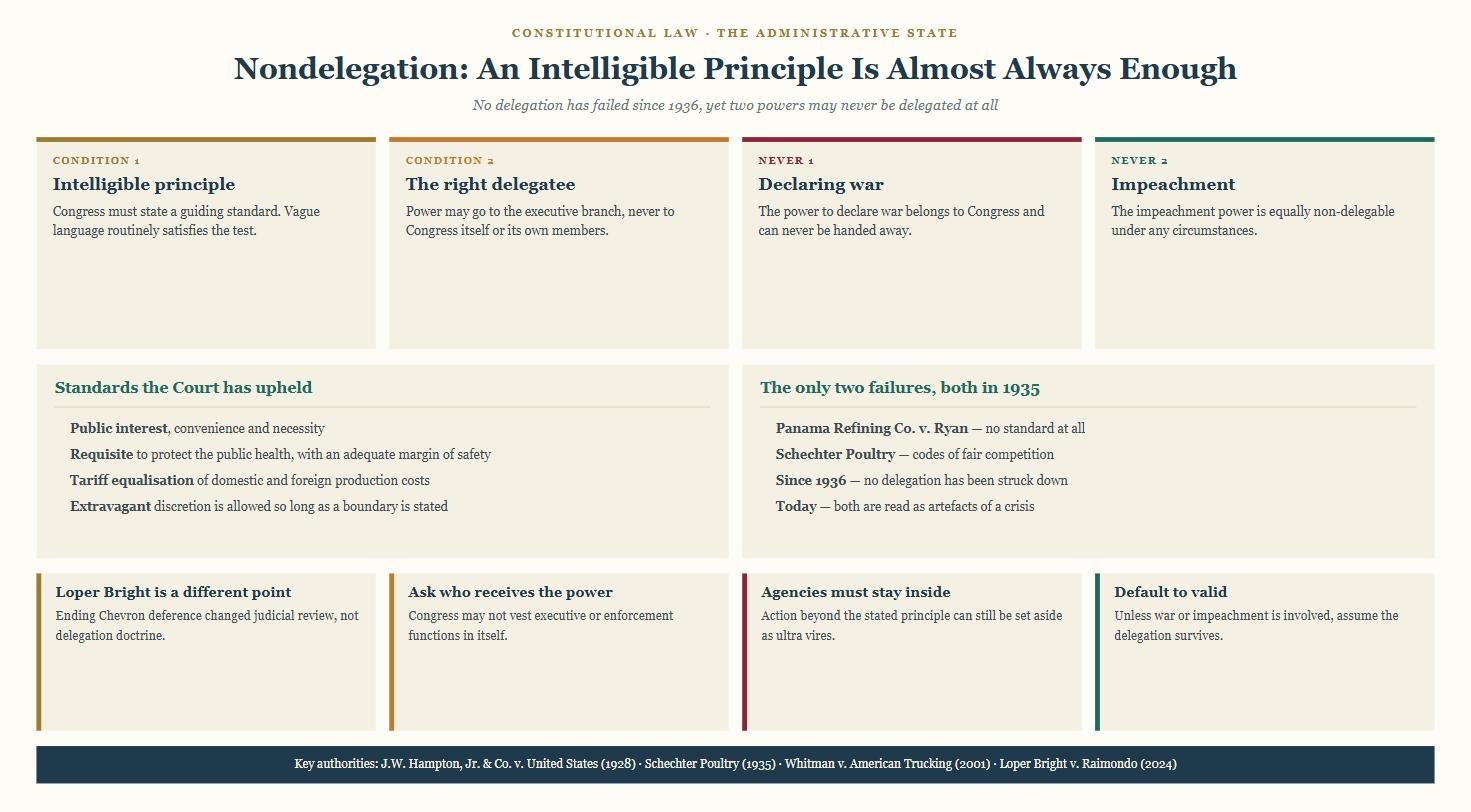
The three conditions for a valid delegation
- An intelligible principle. Congress must state a guiding standard that cabins the delegatee’s discretion. The phrase comes from J.W. Hampton, Jr. & Co. v. United States, which upheld a delegation to the President to adjust tariff rates so as to equalise domestic and foreign production costs.
- A power that is not uniquely legislative. Two authorities are categorically off limits: the power to declare war and the power to impeach.
- The right recipient. Congress may assign executive functions only to actors in the executive branch. It may not vest them in itself, in its own officers, or in private hands.
The first condition does almost no filtering. The Court has accepted standards as loose as the public interest, convenience and necessity, and in Whitman v. American Trucking Associations it unanimously sustained a direction to set air quality standards requisite to protect the public health with an adequate margin of safety, rejecting an attempt to require something more determinate.
Exam tip: if the statute contains any stated purpose at all, the delegation is almost certainly valid. Spend your words on the delegatee question instead.
The only two failures
Panama Refining Co. v. Ryan and A.L.A. Schechter Poultry Corp. v. United States, both decided in 1935, remain the only delegations the Supreme Court has ever invalidated. Both involved New Deal statutes that conferred sweeping authority with essentially no stated standard. Nothing has failed the test since, and the modern administrative state, from the Environmental Protection Agency to the Food and Drug Administration, rests on that record.
Treat the two cases as the outer boundary rather than as a live threat. Their function on an examination is to show that the doctrine exists, not to suggest that a modern statute is likely to fall.
Loper Bright changed review, not delegation
Loper Bright Enterprises v. Raimondo overruled Chevron U.S.A. v. Natural Resources Defense Council and ended the practice of deferring to a reasonable agency reading of an ambiguous statute. Courts now exercise independent judgment on questions of statutory interpretation, while still giving an agency’s expertise ordinary respect as a persuasive factor.
That is a change to how courts review what an agency has decided. It says nothing about whether Congress was permitted to give the agency the power in the first place. Keeping the two questions apart is one of the easiest ways to show control of this material.
| Statutory delegation | Valid? | Reason |
|---|---|---|
| Agency may set standards requisite to protect public health | Yes | Upheld in Whitman as an intelligible principle |
| President may adjust tariffs to equalise production costs | Yes | The original intelligible-principle case |
| Agency may issue any regulation it deems necessary for the environment | Likely yes | A stated purpose is enough, however general |
| President may declare war whenever he judges it necessary | No | The declaration power is non-delegable |
| Congressional committee given power to veto agency rules | No | Congress may not retain executive functions for itself |
| Private trade association empowered to write binding codes | No | Delegation to private hands, as in Schechter |
Worked example: the tariff statute
Congress authorises the President to negotiate and set tariff rates as he considers appropriate to maximise United States economic interests, and gives no further guidance. The President imposes a fifty per cent tariff on goods from a single country. The issue is whether the delegation is valid. The rule is that Congress may delegate legislative power if it supplies an intelligible principle. Applying it, the phrase about maximising economic interests is vague but it states a purpose, and it is no less determinate than the tariff-equalisation standard sustained in J.W. Hampton itself. The delegation stands.
Change the statute so that it authorises the President to declare war on any country he considers hostile. Now the delegation fails, and the intelligible-principle analysis never begins, because the power at issue is one Congress cannot transfer on any terms. That is the shift the examiners are testing for.
Where this doctrine sits in the syllabus
Nondelegation belongs with the structural material rather than with individual rights. It pairs naturally with congressional war powers, because the non-delegable powers are defined there, and with the Necessary and Proper Clause, which supplies the authority for most of the statutes that do the delegating. When a question involves a clash between a statute and executive action, run it through the Youngstown framework as well.
Common mistakes that cost points
- Predicting that a modern delegation will be struck down. Nothing has failed since 1936.
- Demanding a precise standard. Vague purposes routinely suffice.
- Treating Loper Bright as a nondelegation case. It concerns judicial review of interpretation.
- Forgetting the two non-delegable powers, which are the whole point of many questions.
- Missing a delegation to Congress itself or to private parties, which is the real vulnerability.
- Confusing an invalid delegation with valid delegation exceeded by the agency.
- Citing Schechter as though it stated current doctrine.
- Ignoring that agencies remain bound by the principle Congress actually stated.
Frequently asked questions
Is the doctrine being revived?
Several Justices have expressed interest in a stricter approach, and related tools such as the major questions doctrine have done comparable work. As matters stand, however, the intelligible-principle test remains the governing standard.
Can Congress delegate to a state or a private body?
Delegation to private parties is the most vulnerable form, since it removes both political accountability and executive supervision. That was part of what doomed the codes in Schechter.
What happens if an agency exceeds the principle?
The delegation remains valid and the agency action is set aside. That is an ultra vires question, not a constitutional one.
Delegation and agency deference in California, 2026
Federal nondelegation doctrine asks whether Congress supplied an intelligible principle, and it has almost never invalidated a statute. California asks a related but differently framed question: the Legislature may delegate, but it must provide adequate standards and procedural safeguards to guide and check the exercise of the delegated power. The formulation associated with Kugler v. Yocum (1968) means safeguards can substitute for detailed substantive standards.
The deference picture is where California diverges most usefully. Loper Bright Enterprises v. Raimondo (2024) overruled Chevron and directed federal courts to exercise independent judgment on questions of statutory meaning. California never adopted Chevron in the first place. Under Yamaha Corp. v. State Board of Equalization (1998), California courts decide the meaning of a statute independently while giving an agency’s interpretation whatever weight its expertise and consistency deserve. For state and county administrative litigation, therefore, the federal upheaval changed very little.
How this plays out locally:
- Quasi-legislative rules get deferential review. A regulation is tested for consistency with the enabling statute and for reasonableness, not for whether the court would have chosen it.
- Interpretations get independent review. The court decides what the statute means, with the agency’s view as persuasive material.
- County delegation must be structured. Authority conferred on the county health officer or on Los Angeles County Regional Planning needs standards and a review mechanism to survive challenge.
- Subdelegation to private parties is suspect. California is notably hostile to delegating public regulatory power to private bodies.
- Initiative-created bodies are different. Agencies established by voter initiative may have authority the Legislature cannot readily alter.
- Major questions reasoning is federal. Arguments that an agency has claimed unusually broad power are federal in origin and travel poorly into California doctrine.
For 2026, identify whether the dispute is about a rule or about a statute’s meaning, since the standards differ sharply. Read with the Youngstown framework, bicameralism and presentment and procedural due process.
Next steps
Read this with the powers that generate the statutes. Start with The Necessary and Proper Clause: Congress’s Multiplier, then Congressional War Powers: Declare, Fund and Command and The Impeachment Power: House Majority, Senate Two-Thirds.
For primary sources, read Whitman v. American Trucking Associations and A.L.A. Schechter Poultry Corp. v. United States at Justia, the annotation on delegation of legislative power at Cornell LII, and the examination scope published by the State Bar of California.
Related guides
- Advisory Opinions: Article III and Declaratory Relief
- Access to the Courts: When Filing Fees Are Unconstitutional
- Other Enumerated Powers: Postal, Bankruptcy, Admiralty
- Franchise Amendments: Congress and the Right to Vote
- Property Clause: Congress and Federal Lands Explained
- No Federal Police Power: Enumerated Powers and Enclaves
- Contracts Clause: When States May Impair Agreements
- Takings Clause: Lucas, Penn Central and Just Compensation
- Free Exercise Clause: Smith, Lukumi and Fulton Applied
- Establishment Clause: Church, State and the New Test
- Freedom of Association: Scrutiny, Dale and Disclosure
- Freedom of the Press: Publication Liability and Limits
- Campaign Finance and Anonymous Speech: The Core Rules
- Unconstitutional Conditions: Benefits and Rights Waivers
- Government Speech Doctrine: When the State Can Choose
- Vagueness and Overbreadth: Facial Challenges Explained
- Prior Restraint and Licensing: The Freedman Safeguards
- Symbolic Conduct and the O’Brien Test: The Pivot Question
- Government Employee Speech: Garcetti and Pickering Rules
- Commercial Speech and the Central Hudson Four-Part Test
- Actual Malice and the Three Tracks of Defamation Law
- Public Forum Doctrine and the Time, Place, Manner Test
- First Amendment: The Three-Question Speech Framework
- One Person, One Vote: Voting Rights Under Equal Protection
- Alienage Classifications: Strict Scrutiny and Its Pockets
- Equal Protection: The Three-Step Classification Test
- Second Amendment: The Bruen Text-and-History Standard
- Substantive Due Process After Dobbs: A Two-Step Test
- Procedural Due Process: Notice, Hearing and Mathews
- Incorporation Doctrine: Which Rights Bind the States
- Full Faith and Credit: Recognising Sister-State Judgments
- The Complete Auto Test: Taxing Interstate Commerce
- The Right to Travel: Durational Residency Explained
- Article IV Privileges and Immunities: The Comity Rule
- Federal Preemption: The Three-Step Ladder Explained
- The Supremacy Clause: Floors, Ceilings and Preemption
- Intergovernmental Immunity: The Shield Runs One Way
- The Presidential Pardon Power: Four Limits That Matter
- Executive Privilege: A Qualified Right That Must Yield
- Presidential Immunity: Criminal, Civil and Private Acts
- The Removal Power: At-Will Firing and Its Exceptions
- The Appointment Power: Principal and Inferior Officers
- Take Care Clause: Enforcement Discretion and Its Limits
- Commander-in-Chief Power: Deploy Without Declaring War
- Executive Agreements: The President’s Sole Foreign Power
- The Treaty Power: Senate Advice and Consent Explained
- The Presidential Veto Power, Override and Pocket Veto
- Bicameralism and Presentment: Two Vetoes Struck Down
- Speech or Debate Clause: Absolute but Narrow Immunity
- The Impeachment Power: House Majority, Senate Two-Thirds
- Congress’s Naturalization Power and Citizenship Limits
- Congressional War Powers: Declare, Fund and Command
- Anti-Commandeering Doctrine and the Tenth Amendment
- Section 5 Enforcement Power: Remedy, Do Not Redefine
- The Spending Power and the Five Dole Test Conditions
- Congress’s Taxing Power: When a Penalty Is Really a Tax
- The Necessary and Proper Clause: Congress’s Multiplier
- Ex Post Facto Clause: Retroactive Criminal Laws Barred
- Bills of Attainder: Legislative Punishment Explained
- The Writ of Habeas Corpus: Testing Unlawful Detention
- Supreme Court Jurisdiction: Original vs Appellate Power
- Abstention Doctrine: 4 Ways Federal Courts Step Aside
- Dormant Commerce Clause: Discrimination vs Pike Balancing
- The Commerce Clause: 3 Categories and 2 Hard Limits
- State Action Doctrine: The Government Conduct Threshold
- The Eleventh Amendment and State Sovereign Immunity
- Political Question Doctrine: What Courts Will Not Decide
- Ripeness and Mootness: Timing Rules in Federal Court
- Standing in Federal Court: The 3-Part Article III Test
- Marbury v. Madison and the Power of Judicial Review
- The Youngstown Framework: Presidential Power in 3 Zones
- The IRAC Method: How to Structure a Bar Exam Answer
- Piercing the Corporate Veil: A Two-Prong Alter Ego Test
- Defamation Elements, Fault Standards and Privileges
- The Parol Evidence Rule: Integration and Exceptions
- Recording Acts: Race, Notice and Race-Notice Explained
- Partner Liability and Authority Under RUPA Explained
- Trustee Duties: Care, Loyalty, Impartiality, Accounts
- Specific Performance: A Six-Element Bar Exam Framework
- Will Execution Requirements: Formalities and Rescue
- Community Property Presumptions in California Explained
- Easements Explained: Creation, Scope and Termination
- Products Liability: The Three Defect Theories Explained
- Miranda Rights: Custody, Interrogation and Invocation
- The Character Evidence Rules: Propensity Bar and Doorways
- Adverse Possession Elements: OCEAN and the Tax Rule
- Business Judgment Rule and Directors’ Fiduciary Duties
- The Statute of Frauds: MYLEGS and How to Satisfy It
- Res Judicata vs Collateral Estoppel: Bar Exam Guide
- The Erie Doctrine Explained: A 4-Step Bar Exam Guide
- Conflicts of Interest: A 6-Step Decision Tree for the Bar
- The Rule Against Perpetuities Explained Step by Step
- Murder and Manslaughter: The Homicide Ladder Explained
- Consideration in Contract Law: Rules and Exceptions
- The Four Elements of Negligence: Bar Exam Breakdown
- The Hearsay Rule Explained: Exceptions and Exemptions
- Personal Jurisdiction: The 3-Step Bar Exam Framework
- 3 Levels of Scrutiny in Constitutional Law Explained
- The Citizenship Clause After Trump v. Barbara