
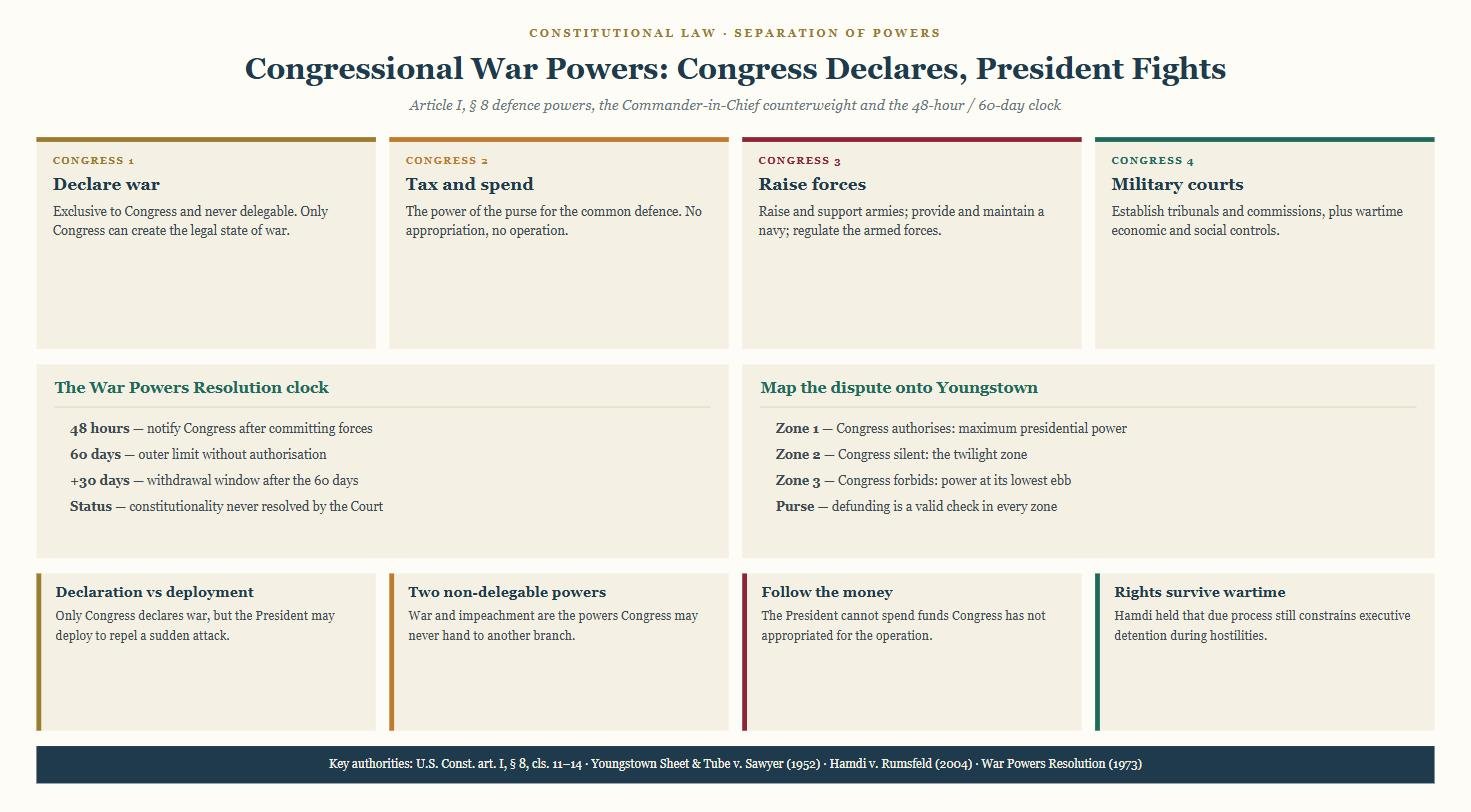
The congressional war powers are the Article I, section 8 authorities that let Congress decide whether the United States enters a war and on what terms. Congress alone may declare war, and it also holds the powers to tax and spend for the common defence, to raise and support armies, to provide and maintain a navy, and to establish military tribunals.
This guide explains what each of those powers covers, why the declaration of war is one of only two authorities Congress can never delegate, how the War Powers Resolution notice and withdrawal clocks work, and how to run a clash between Congress and the President through the Youngstown framework.
Why the Framers split the war power
A monarch could take a country to war on his own judgment. The Framers deliberately refused to reproduce that arrangement. Committing the nation to war was treated as the gravest decision a republic can make, so it was assigned to the branch that deliberates in public and answers to the electorate at fixed intervals.
The result is a divided power rather than a shared one. Congress decides whether there is a war and pays for it. The President decides how the fighting is conducted. Most bar questions in this area are really questions about which side of that line a particular act falls on.
Exam tip: the sentence that unlocks almost every war powers question is that Congress authorises and funds, while the President commands.
The five powers Congress actually holds
- Declare war. Exclusive to Congress. Only a congressional declaration creates the legal state of war, with the domestic consequences that follow from it.
- Tax and spend for the national defence. The appropriations power, and in practice the most effective lever Congress has over an operation already under way.
- Raise and support armies. Including the power to set the size, structure and terms of service of the land forces.
- Provide and maintain a navy. Drafted separately from the army power, and traditionally read as contemplating a standing force.
- Establish military courts and tribunals. The constitutional source of military commissions, including the Guantanamo Bay commissions.
Congress may also impose economic and social controls during wartime and in the period that follows it, from rationing and price controls to broader emergency regulation of the domestic economy.
The declaration of war cannot be delegated
The nondelegation doctrine is famously toothless, and a delegation of legislative power survives whenever Congress supplies an intelligible principle. Two powers are nevertheless outside that permissive regime altogether: the power to declare war and the power to impeach. Neither may be handed to the executive or the judiciary on any terms.
Watch for a fact pattern in which Congress purports to authorise the President to declare war whenever he considers it necessary. However generous the modern delegation case law is, that statute is invalid, because the decision itself is committed to Congress.
Deployment without a declaration
The practical difficulty is that the United States has fought many conflicts without a declaration of war. The President may deploy forces to repel a sudden attack, and in practice has deployed them a great deal more widely than that. The War Powers Resolution of 1973 was Congress attempting to close the gap by statute rather than by amendment.
The Resolution requires the President to notify Congress within 48 hours of committing forces to hostilities, limits an unauthorised deployment to 60 days, and allows a further 30 days for withdrawal. Its constitutionality has never been squarely resolved by the Supreme Court. Treat it as a bar-testable statute of contested validity, not as settled doctrine.
The power of the purse is the real check
Whatever the fate of the War Powers Resolution, Congress retains a check that raises no doctrinal difficulty at all. The President cannot spend money that Congress has not appropriated. Refusing to fund an operation is not an intrusion on the Commander-in-Chief power; it is the exercise of a power that belongs to Congress in its own right.
| Congressional action | Valid? | Reason |
|---|---|---|
| Refusing to appropriate funds for an ongoing operation | Yes | Exercise of the spending power, not interference with command |
| Declaring war over a presidential veto | Yes | Declaration is exclusively legislative |
| Authorising the President to declare war at his discretion | No | The declaration power may never be delegated |
| Statute directing which targets the military may strike | Doubtful | Tactical command is a core Commander-in-Chief function |
| Creating a military commission to try enemy combatants | Yes | Express power to constitute tribunals |
| Imposing wartime price controls on domestic industry | Yes | War-related economic regulation |
Worked example: the undeclared operation
The President commits 50,000 troops to an operation abroad without any congressional authorisation or declaration, describing the deployment as a defensive measure taken under the Commander-in-Chief clause. Congress learns of the operation weeks later and votes to withdraw its funding.
The issue is whether Congress may defund. The rule is that Congress holds the exclusive power to declare war together with the enumerated powers to raise armies, appropriate for defence and constitute tribunals, and that the President may not spend money Congress has not appropriated. Applying it, defunding does not displace the President from operational command; it withdraws a resource that was never his to create. The conclusion is that Congress may defund and thereby end the operation.
Now change one fact. Congress instead passes a statute directing the President to route all air operations through a named allied command. That is no longer a funding decision but an instruction about how the fighting is conducted, and it runs into the Commander-in-Chief power. The analysis has moved from a comfortable congressional power to a genuine separation-of-powers clash.
Mapping the clash onto Youngstown
Every dispute of that second kind should be routed through Justice Jackson three zones. Where Congress has authorised the action, presidential authority is at its maximum and the challenger must argue that the two branches together lack the power. Where Congress is silent, the case falls into the twilight zone and history and practice do much of the work. Where Congress has forbidden the action, presidential power is at its lowest ebb and only a conclusive and exclusive Article II power will save it.
War powers questions are also a reminder that constitutional rights do not switch off during hostilities. In Hamdi v. Rumsfeld the Court held that a citizen detained as an enemy combatant was entitled to notice and a meaningful opportunity to contest the factual basis of the detention.
Common mistakes that cost points
- Treating the Commander-in-Chief power as unlimited. It is a power to command, not a power to fund, to declare or to legislate.
- Presenting the War Powers Resolution as settled constitutional law. Describe it as a statute of contested validity.
- Overlooking the appropriations check, which is usually the cleanest answer available on the facts.
- Conflating declaration with deployment. The President may deploy in some circumstances without a declaration; he may never declare.
- Forgetting that war and impeachment are the two non-delegable powers.
- Skipping Youngstown. A war powers question about a clash between the branches is a Youngstown question.
- Assuming wartime suspends individual rights. Hamdi says otherwise for detained citizens.
- Ignoring the tribunal power, which is the enumerated hook for military commissions.
Frequently asked questions
Has Congress declared war recently?
Formal declarations are rare in modern practice; authorisations for the use of military force have largely taken their place, which is precisely why the constitutional questions in this area remain live.
Can the President ignore the War Powers Resolution?
Presidents have generally reported to Congress while denying that the Resolution binds them. The Supreme Court has never resolved the question, so both positions are defensible in an answer.
Does the tribunal power let Congress bypass Article III courts?
It permits military courts for military justice and for the trial of enemy combatants, but it does not create a general power to move ordinary criminal cases out of the Article III system.
War powers and the California internment cases, 2026
Congress holds the power to declare war, raise armies and make rules for the government of the forces, and the most sobering illustration of how far those powers were once thought to reach came out of California. Following an executive order and supporting legislation in 1942, people of Japanese ancestry were excluded from West Coast areas and confined in camps. Los Angeles County, home to the largest Japanese American community in the mainland United States, was profoundly affected, and Little Tokyo was emptied.
The Supreme Court sustained the curfew in Hirabayashi and the exclusion in Korematsu v. United States (1944), while ordering release in Ex parte Endo on statutory grounds. Those decisions were later shown to have rested on withheld evidence, the convictions were vacated in coram nobis proceedings in the 1980s, Congress apologised and provided redress in 1988, and in Trump v. Hawaii (2018) the Court stated that Korematsu was gravely wrong the day it was decided and has no place in constitutional law.
The doctrinal points that survive:
- Declared war is not required. Congress authorises force through statutes and appropriations, and the war powers do not depend on the formal label.
- The War Powers Resolution imposes reporting and time limits. Its constitutionality has never been definitively settled, and Presidents have treated it as advisory.
- Racial classifications get strict scrutiny. National security does not lower the standard, which is the corrected lesson of the internment cases.
- Military necessity claims require evidence. The coram nobis proceedings turned on the government’s suppression of contrary intelligence assessments.
- Habeas remains available. Detention without charge is testable in court, as Endo and later detention cases confirm.
- California has acknowledged its role. The Legislature formally apologised for the state’s support of the exclusion, and county sites are preserved as memorials.
In 2026, treat the war powers as broad in scope but fully subject to individual rights review. Read with the commander in chief power, habeas corpus and equal protection.
Next steps
Read this alongside the executive-power side of the same dispute. Start with The Youngstown Framework: Presidential Power in 3 Zones, then The Spending Power and the Five Dole Test Conditions and The Necessary and Proper Clause.
For primary sources, read Youngstown Sheet & Tube Co. v. Sawyer and Hamdi v. Rumsfeld at Justia, the annotations to Article I, section 8, clause 11 at Cornell LII, and the examination scope published by the State Bar of California.
Related guides
- Advisory Opinions: Article III and Declaratory Relief
- Access to the Courts: When Filing Fees Are Unconstitutional
- Other Enumerated Powers: Postal, Bankruptcy, Admiralty
- Franchise Amendments: Congress and the Right to Vote
- Property Clause: Congress and Federal Lands Explained
- No Federal Police Power: Enumerated Powers and Enclaves
- Contracts Clause: When States May Impair Agreements
- Takings Clause: Lucas, Penn Central and Just Compensation
- Free Exercise Clause: Smith, Lukumi and Fulton Applied
- Establishment Clause: Church, State and the New Test
- Freedom of Association: Scrutiny, Dale and Disclosure
- Freedom of the Press: Publication Liability and Limits
- Campaign Finance and Anonymous Speech: The Core Rules
- Unconstitutional Conditions: Benefits and Rights Waivers
- Government Speech Doctrine: When the State Can Choose
- Vagueness and Overbreadth: Facial Challenges Explained
- Prior Restraint and Licensing: The Freedman Safeguards
- Symbolic Conduct and the O’Brien Test: The Pivot Question
- Government Employee Speech: Garcetti and Pickering Rules
- Commercial Speech and the Central Hudson Four-Part Test
- Actual Malice and the Three Tracks of Defamation Law
- Public Forum Doctrine and the Time, Place, Manner Test
- First Amendment: The Three-Question Speech Framework
- One Person, One Vote: Voting Rights Under Equal Protection
- Alienage Classifications: Strict Scrutiny and Its Pockets
- Equal Protection: The Three-Step Classification Test
- Second Amendment: The Bruen Text-and-History Standard
- Substantive Due Process After Dobbs: A Two-Step Test
- Procedural Due Process: Notice, Hearing and Mathews
- Incorporation Doctrine: Which Rights Bind the States
- Full Faith and Credit: Recognising Sister-State Judgments
- The Complete Auto Test: Taxing Interstate Commerce
- The Right to Travel: Durational Residency Explained
- Article IV Privileges and Immunities: The Comity Rule
- Federal Preemption: The Three-Step Ladder Explained
- The Supremacy Clause: Floors, Ceilings and Preemption
- Intergovernmental Immunity: The Shield Runs One Way
- The Presidential Pardon Power: Four Limits That Matter
- Executive Privilege: A Qualified Right That Must Yield
- Presidential Immunity: Criminal, Civil and Private Acts
- The Removal Power: At-Will Firing and Its Exceptions
- The Appointment Power: Principal and Inferior Officers
- Take Care Clause: Enforcement Discretion and Its Limits
- Commander-in-Chief Power: Deploy Without Declaring War
- Executive Agreements: The President’s Sole Foreign Power
- The Treaty Power: Senate Advice and Consent Explained
- The Presidential Veto Power, Override and Pocket Veto
- Bicameralism and Presentment: Two Vetoes Struck Down
- The Nondelegation Doctrine and the Intelligible Principle
- Speech or Debate Clause: Absolute but Narrow Immunity
- The Impeachment Power: House Majority, Senate Two-Thirds
- Congress’s Naturalization Power and Citizenship Limits
- Anti-Commandeering Doctrine and the Tenth Amendment
- Section 5 Enforcement Power: Remedy, Do Not Redefine
- The Spending Power and the Five Dole Test Conditions
- Congress’s Taxing Power: When a Penalty Is Really a Tax
- The Necessary and Proper Clause: Congress’s Multiplier
- Ex Post Facto Clause: Retroactive Criminal Laws Barred
- Bills of Attainder: Legislative Punishment Explained
- The Writ of Habeas Corpus: Testing Unlawful Detention
- Supreme Court Jurisdiction: Original vs Appellate Power
- Abstention Doctrine: 4 Ways Federal Courts Step Aside
- Dormant Commerce Clause: Discrimination vs Pike Balancing
- The Commerce Clause: 3 Categories and 2 Hard Limits
- State Action Doctrine: The Government Conduct Threshold
- The Eleventh Amendment and State Sovereign Immunity
- Political Question Doctrine: What Courts Will Not Decide
- Ripeness and Mootness: Timing Rules in Federal Court
- Standing in Federal Court: The 3-Part Article III Test
- Marbury v. Madison and the Power of Judicial Review
- The Youngstown Framework: Presidential Power in 3 Zones
- The IRAC Method: How to Structure a Bar Exam Answer
- Piercing the Corporate Veil: A Two-Prong Alter Ego Test
- Defamation Elements, Fault Standards and Privileges
- The Parol Evidence Rule: Integration and Exceptions
- Recording Acts: Race, Notice and Race-Notice Explained
- Partner Liability and Authority Under RUPA Explained
- Trustee Duties: Care, Loyalty, Impartiality, Accounts
- Specific Performance: A Six-Element Bar Exam Framework
- Will Execution Requirements: Formalities and Rescue
- Community Property Presumptions in California Explained
- Easements Explained: Creation, Scope and Termination
- Products Liability: The Three Defect Theories Explained
- Miranda Rights: Custody, Interrogation and Invocation
- The Character Evidence Rules: Propensity Bar and Doorways
- Adverse Possession Elements: OCEAN and the Tax Rule
- Business Judgment Rule and Directors’ Fiduciary Duties
- The Statute of Frauds: MYLEGS and How to Satisfy It
- Res Judicata vs Collateral Estoppel: Bar Exam Guide
- The Erie Doctrine Explained: A 4-Step Bar Exam Guide
- Conflicts of Interest: A 6-Step Decision Tree for the Bar
- The Rule Against Perpetuities Explained Step by Step
- Murder and Manslaughter: The Homicide Ladder Explained
- Consideration in Contract Law: Rules and Exceptions
- The Four Elements of Negligence: Bar Exam Breakdown
- The Hearsay Rule Explained: Exceptions and Exemptions
- Personal Jurisdiction: The 3-Step Bar Exam Framework
- 3 Levels of Scrutiny in Constitutional Law Explained
- The Citizenship Clause After Trump v. Barbara