
Defamation is the tort that protects reputation, and it is the one tort where the First Amendment has rewritten the common law from the ground up. Whether a plaintiff recovers depends less on how badly the statement hurt and more on who the plaintiff is, what the statement was about, and whether it was written or spoken.
This guide sets out the five elements, explains the three-track fault system created by New York Times Co. v. Sullivan and Gertz v. Robert Welch, distinguishes libel from slander for damages purposes, and works through the defences and privileges that decide most real cases.
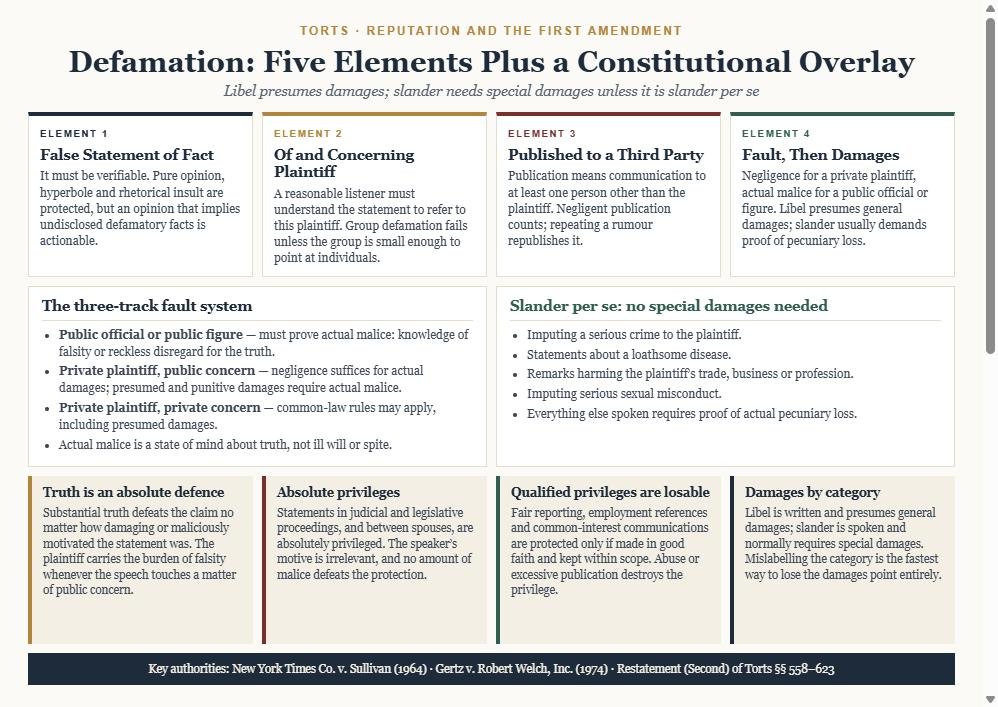
The five common-law elements
Start with the common-law skeleton, then layer the constitutional requirements on top. A plaintiff must establish each of the following:
- A false statement of fact about the plaintiff.
- That the statement was of and concerning the plaintiff.
- Publication to at least one third party.
- Fault on the defendant’s part, at a level the Constitution dictates.
- Damages, which are presumed for libel and usually must be proved for slander.
Fact, not opinion
Only verifiable assertions can be false. Calling a restaurant “the worst in town” is protected evaluative opinion; saying its kitchen failed a health inspection is a checkable fact. The dangerous middle ground is the opinion that implies undisclosed facts, as in “in my view he is not fit to handle client money.” Courts treat that as actionable because it suggests the speaker knows something specific.
Of and concerning the plaintiff
A reasonable recipient must understand the statement to refer to this plaintiff. The plaintiff need not be named if extrinsic facts identify her, a doctrine called colloquium. Group defamation generally fails: a claim that “most politicians take bribes” points at nobody, while the same claim about a three-member city council may point at each member.
Publication
Publication simply means communication to someone other than the plaintiff. It can be intentional or negligent, and it need not be widespread. Each repetition is a fresh publication, which is why repeating a defamatory rumour exposes the repeater to liability even if she attributes it to someone else.
The constitutional overlay: three tracks
Before 1964 defamation was close to a strict liability tort. Sullivan changed that by holding that a public official suing over official conduct must prove actual malice. Gertz extended constitutional protection to speech about private plaintiffs on matters of public concern. The result is a three-track system.
| Plaintiff and subject | Fault the plaintiff must prove | Damages available |
|---|---|---|
| Public official or public figure | Actual malice: knowledge of falsity or reckless disregard for truth | Full damages, including punitive |
| Private plaintiff, matter of public concern | Negligence as to truth | Actual damages only; presumed and punitive require actual malice |
| Private plaintiff, purely private matter | Common-law rules; states may impose liability without a showing of fault | Presumed damages permitted |
Actual malice is a term of art and a persistent source of confusion. It has nothing to do with hostility, spite or bad motive. It asks whether the speaker knew the statement was false or subjectively entertained serious doubts about its truth and published anyway. A reckless failure to investigate can supply the inference, but mere carelessness cannot.
Exam tip: write the words “actual malice means knowledge of falsity or reckless disregard for the truth, not ill will” before you apply it. Graders look for that definition because so many answers substitute spite.
Libel and slander: the damages divide
Libel is defamation in a permanent form, classically writing but also broadcast and online publication. Because the harm is durable and the audience wide, general damages are presumed and the plaintiff need not prove any specific financial loss.
Slander is spoken defamation. The plaintiff must ordinarily plead and prove special damages, meaning concrete pecuniary loss such as a lost job or cancelled contract. Hurt feelings are not enough. Four categories escape that requirement as slander per se:
- Imputing a serious crime, particularly one involving moral turpitude.
- Stating that the plaintiff has a loathsome disease.
- Attacking the plaintiff’s competence or integrity in her trade, business or profession.
- Imputing serious sexual misconduct.
Defences and privileges
Truth
Substantial truth is a complete defence. Minor inaccuracies do not matter if the gist of the statement is accurate. Where the speech concerns a matter of public concern, falsity is part of the plaintiff’s own burden rather than something the defendant must disprove.
Absolute privileges
Some settings receive protection that no amount of malice can defeat: statements by participants in judicial proceedings, legislative debate, certain executive communications, and communications between spouses. The rationale is that candour in these forums is worth more than the occasional reputational injury.
Qualified privileges
Others are conditional. Fair and accurate reports of official proceedings, employment references, credit reports and communications among people with a shared legitimate interest are privileged only while the speaker acts in good faith and stays within the scope of the interest. Publishing to a wider audience than the privilege justifies, or knowing the statement is false, forfeits the protection.
Common mistakes that cost points
- Defining actual malice as spite or ill will instead of knowledge of falsity or reckless disregard.
- Applying the Sullivan standard to a private plaintiff who happens to be suing a newspaper.
- Forgetting to classify the statement as libel or slander before discussing damages.
- Treating any unflattering remark as opinion without asking whether it is verifiable.
- Missing that each republication is a separate act of publication.
- Skipping the qualified privilege analysis, or treating a qualified privilege as though it were absolute.
- Ignoring the requirement that the statement be of and concerning the plaintiff in group cases.
- Confusing defamation with the separate privacy torts of false light, intrusion and appropriation.
Frequently asked questions
Can a true statement ever be defamatory?
No. Falsity is an element, so substantial truth defeats the claim entirely. A true but embarrassing disclosure may support a different theory, such as public disclosure of private facts, but it is not defamation.
Who counts as a public figure?
Public officials hold government positions with substantial responsibility. All-purpose public figures have pervasive fame. Limited-purpose public figures have voluntarily entered a particular public controversy and are treated as public figures only as to that controversy.
Are online reviews and social media posts libel or slander?
Because they are recorded and durable, courts almost always treat them as libel, which means general damages can be presumed. The permanence of the medium, not the informality of the language, drives the classification.
Defamation under California law in Los Angeles County, 2026
California codifies what many states leave to the common law, so a Los Angeles County claim is built from statutory text. Section 45 of the California Civil Code defines libel and section 46 defines slander, listing the categories actionable without proof of special damage. Section 47 supplies the privileges, and it is unusually powerful here.
The litigation privilege in section 47(b) is absolute and broadly construed: statements made in or in connection with a judicial proceeding, including pre-litigation communications reasonably related to contemplated litigation, cannot support a defamation claim regardless of malice. Practitioners in the Los Angeles Superior Court encounter this defence more often than any other, and it defeats claims that would survive in states with narrower privileges.
The mechanics that decide California cases:
- One year to sue. Section 340 of the California Code of Civil Procedure sets a one-year limitations period, and the single publication rule starts it at first general distribution rather than each download.
- Anti-SLAPP comes first. Where the statement concerns a public issue, expect a special motion to strike with fee shifting before any meaningful discovery.
- Retraction demands affect damages. Failing to demand a correction from a newspaper or broadcaster within the statutory window limits recovery to special damages.
- Online platforms are immune. Federal law shields interactive services from liability for third-party content, and California courts have read that immunity broadly.
- Private plaintiffs need only negligence. Actual malice applies to public officials and public figures; a private plaintiff on a private matter faces a lower fault standard.
- Employment references have qualified protection. Section 47(c) privileges communications made without malice by an interested party, which covers many workplace statements.
In 2026, work through publication, falsity, fault and privilege in that order, and screen every claim against the litigation privilege before filing. Read with the actual malice standard and the First Amendment framework.
Next steps
Practise by labelling the plaintiff and the subject matter first, because those two facts select the fault standard and the damages rules simultaneously. Then connect the analysis to the broader tort framework in The Four Elements of Negligence: Bar Exam Breakdown and to the causation and defect analysis in Products Liability: The Three Defect Theories Explained. For the free-speech side of the doctrine, review the tiers of review in 3 Levels of Scrutiny in Constitutional Law Explained.
The two governing cases are short enough to read in full: New York Times Co. v. Sullivan, 376 U.S. 254 (1964) and Gertz v. Robert Welch, Inc., 418 U.S. 323 (1974). Cornell’s overview of defamation collects the common-law elements, and its note on actual malice is a useful corrective to the spite misconception.
Related guides
- Advisory Opinions: Article III and Declaratory Relief
- Access to the Courts: When Filing Fees Are Unconstitutional
- Other Enumerated Powers: Postal, Bankruptcy, Admiralty
- Franchise Amendments: Congress and the Right to Vote
- Property Clause: Congress and Federal Lands Explained
- No Federal Police Power: Enumerated Powers and Enclaves
- Contracts Clause: When States May Impair Agreements
- Takings Clause: Lucas, Penn Central and Just Compensation
- Free Exercise Clause: Smith, Lukumi and Fulton Applied
- Establishment Clause: Church, State and the New Test
- Freedom of Association: Scrutiny, Dale and Disclosure
- Freedom of the Press: Publication Liability and Limits
- Campaign Finance and Anonymous Speech: The Core Rules
- Unconstitutional Conditions: Benefits and Rights Waivers
- Government Speech Doctrine: When the State Can Choose
- Vagueness and Overbreadth: Facial Challenges Explained
- Prior Restraint and Licensing: The Freedman Safeguards
- Symbolic Conduct and the O’Brien Test: The Pivot Question
- Government Employee Speech: Garcetti and Pickering Rules
- Commercial Speech and the Central Hudson Four-Part Test
- Actual Malice and the Three Tracks of Defamation Law
- Public Forum Doctrine and the Time, Place, Manner Test
- First Amendment: The Three-Question Speech Framework
- One Person, One Vote: Voting Rights Under Equal Protection
- Alienage Classifications: Strict Scrutiny and Its Pockets
- Equal Protection: The Three-Step Classification Test
- Second Amendment: The Bruen Text-and-History Standard
- Substantive Due Process After Dobbs: A Two-Step Test
- Procedural Due Process: Notice, Hearing and Mathews
- Incorporation Doctrine: Which Rights Bind the States
- Full Faith and Credit: Recognising Sister-State Judgments
- The Complete Auto Test: Taxing Interstate Commerce
- The Right to Travel: Durational Residency Explained
- Article IV Privileges and Immunities: The Comity Rule
- Federal Preemption: The Three-Step Ladder Explained
- The Supremacy Clause: Floors, Ceilings and Preemption
- Intergovernmental Immunity: The Shield Runs One Way
- The Presidential Pardon Power: Four Limits That Matter
- Executive Privilege: A Qualified Right That Must Yield
- Presidential Immunity: Criminal, Civil and Private Acts
- The Removal Power: At-Will Firing and Its Exceptions
- The Appointment Power: Principal and Inferior Officers
- Take Care Clause: Enforcement Discretion and Its Limits
- Commander-in-Chief Power: Deploy Without Declaring War
- Executive Agreements: The President’s Sole Foreign Power
- The Treaty Power: Senate Advice and Consent Explained
- The Presidential Veto Power, Override and Pocket Veto
- Bicameralism and Presentment: Two Vetoes Struck Down
- The Nondelegation Doctrine and the Intelligible Principle
- Speech or Debate Clause: Absolute but Narrow Immunity
- The Impeachment Power: House Majority, Senate Two-Thirds
- Congress’s Naturalization Power and Citizenship Limits
- Congressional War Powers: Declare, Fund and Command
- Anti-Commandeering Doctrine and the Tenth Amendment
- Section 5 Enforcement Power: Remedy, Do Not Redefine
- The Spending Power and the Five Dole Test Conditions
- Congress’s Taxing Power: When a Penalty Is Really a Tax
- The Necessary and Proper Clause: Congress’s Multiplier
- Ex Post Facto Clause: Retroactive Criminal Laws Barred
- Bills of Attainder: Legislative Punishment Explained
- The Writ of Habeas Corpus: Testing Unlawful Detention
- Supreme Court Jurisdiction: Original vs Appellate Power
- Abstention Doctrine: 4 Ways Federal Courts Step Aside
- Dormant Commerce Clause: Discrimination vs Pike Balancing
- The Commerce Clause: 3 Categories and 2 Hard Limits
- State Action Doctrine: The Government Conduct Threshold
- The Eleventh Amendment and State Sovereign Immunity
- Political Question Doctrine: What Courts Will Not Decide
- Ripeness and Mootness: Timing Rules in Federal Court
- Standing in Federal Court: The 3-Part Article III Test
- Marbury v. Madison and the Power of Judicial Review
- The Youngstown Framework: Presidential Power in 3 Zones
- The IRAC Method: How to Structure a Bar Exam Answer
- Piercing the Corporate Veil: A Two-Prong Alter Ego Test
- The Parol Evidence Rule: Integration and Exceptions
- Recording Acts: Race, Notice and Race-Notice Explained
- Partner Liability and Authority Under RUPA Explained
- Trustee Duties: Care, Loyalty, Impartiality, Accounts
- Specific Performance: A Six-Element Bar Exam Framework
- Will Execution Requirements: Formalities and Rescue
- Community Property Presumptions in California Explained
- Easements Explained: Creation, Scope and Termination
- Products Liability: The Three Defect Theories Explained
- Miranda Rights: Custody, Interrogation and Invocation
- The Character Evidence Rules: Propensity Bar and Doorways
- Adverse Possession Elements: OCEAN and the Tax Rule
- Business Judgment Rule and Directors’ Fiduciary Duties
- The Statute of Frauds: MYLEGS and How to Satisfy It
- Res Judicata vs Collateral Estoppel: Bar Exam Guide
- The Erie Doctrine Explained: A 4-Step Bar Exam Guide
- Conflicts of Interest: A 6-Step Decision Tree for the Bar
- The Rule Against Perpetuities Explained Step by Step
- Murder and Manslaughter: The Homicide Ladder Explained
- Consideration in Contract Law: Rules and Exceptions
- The Four Elements of Negligence: Bar Exam Breakdown
- The Hearsay Rule Explained: Exceptions and Exemptions
- Personal Jurisdiction: The 3-Step Bar Exam Framework
- 3 Levels of Scrutiny in Constitutional Law Explained
- The Citizenship Clause After Trump v. Barbara