
Characterisation is the whole of community property, and the community property presumptions are how characterisation actually gets decided. Two facts do most of the work: when the asset was acquired and where the money came from. Everything else, including how the deed reads, is evidence that may or may not overcome a presumption.
This guide sets out the general presumption, the much stronger joint-title presumption that applies at divorce, the earnings rule, the writing required for a transmutation, and how each presumption is rebutted. The framework is California’s, and it is the model most community property jurisdictions follow.
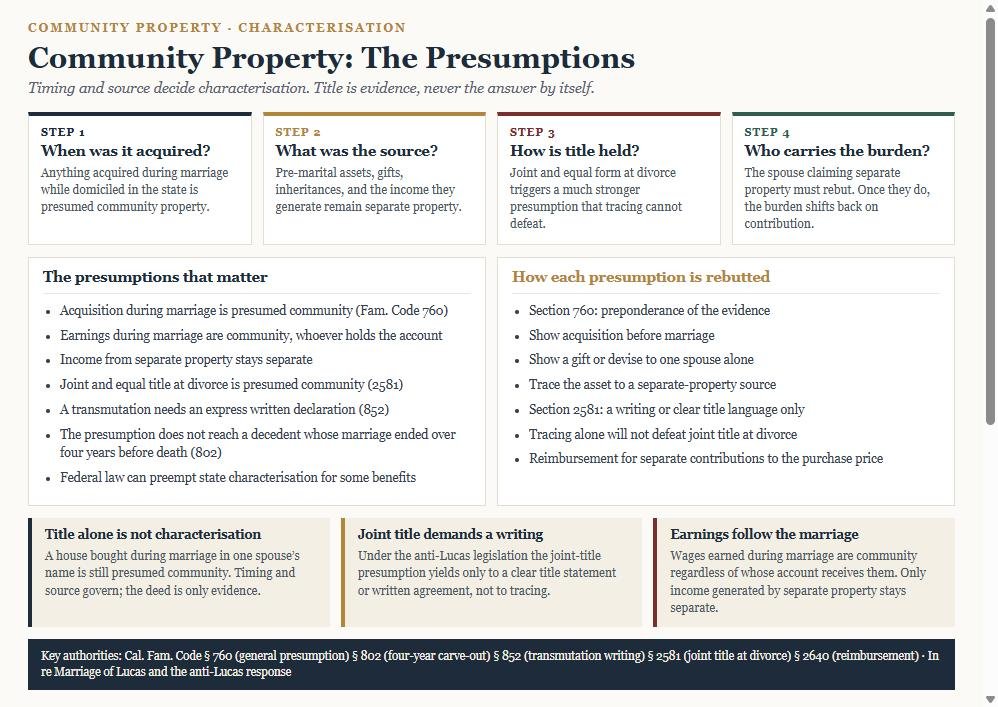
Timing and source: the two questions that decide everything
Start with timing. Property acquired during marriage, while the spouses are domiciled in the state, is community property. Property acquired before marriage, or after permanent separation, is separate. Then ask about source, because an asset bought during marriage with separate funds keeps its separate character through tracing.
Those two questions dispose of most fact patterns. The presumptions exist to tell you who loses when the facts are unclear, and that allocation of risk is what examiners actually test.
The general presumption
Under Family Code section 760, all property acquired by a married person during marriage is presumed community property. The spouse who says otherwise carries the burden, and may discharge it by a preponderance of the evidence in one of four ways.
- Acquisition before marriage, or after the date of separation.
- Receipt by inheritance or devise.
- Receipt as a gift to that spouse alone.
- Designation as separate by a valid agreement between the spouses.
A statutory carve-out in section 802 limits the presumption’s reach: it does not apply to property held by a decedent whose marriage ended more than four years before death. That provision rarely decides an essay but it is a clean point when the timeline invites it.
Title is evidence, not characterisation
A house purchased during marriage and titled in one spouse’s name alone is still presumed community property. The other spouse may claim a half interest, and the titled spouse bears the burden of showing a separate source, such as a pre-marital account or an inheritance.
Candidates lose points here more often than anywhere else in the subject, because the deed is the most conspicuous fact in the problem and it feels dispositive. It is not. Say expressly that title does not determine character under the general presumption, then go to timing and source.
The joint-title presumption at divorce
Section 2581 works differently. Property acquired by the spouses in joint and equal form during marriage is presumed community property at divorce, and this presumption is far stronger than the general one. It yields only to a clear statement in the title itself or to a written agreement. Tracing separate funds into the purchase, which would suffice under section 760, does not rebut it.
The history explains the rule. In re Marriage of Lucas allowed a separate interest to be established in jointly titled property, and the legislature responded with what practitioners call the anti-Lucas provisions. The compromise is that the asset is community, but a spouse who contributed separate funds to the down payment or to improvements has a right of reimbursement without interest or appreciation under section 2640.
| Presumption | What triggers it | How it is rebutted | Strength |
|---|---|---|---|
| Section 760 general | Acquisition during marriage | Preponderance: timing, gift, devise or tracing | Ordinary |
| Joint and equal title | Title in joint form at divorce | Clear title language or a written agreement only | Very strong |
| Earnings | Wages during marriage | Show the income came from separate property | Ordinary |
| Transmutation | A claimed change of character | An express written declaration is required | Formal, not evidentiary |
| Section 802 carve-out | Marriage ended over four years before death | Presumption simply does not apply | N/A |
Exam tip: name the presumption before you argue about the facts. “This asset was acquired during marriage, so section 760 presumes it community, and the burden falls on the spouse asserting a separate interest” gives the grader the framework in one sentence.
Earnings and the income they generate
Income earned by either spouse through labour during marriage is community property, regardless of whose name appears on the pay cheque or the account. The only significant exception is income produced by separate property: rent from a building owned before marriage, dividends on separate shares, interest on a separate account.
That exception has a limit worth remembering. Where a spouse’s own effort during marriage substantially increases the value of a separate-property business, the community acquires an interest in that increase, and the courts use recognised apportionment formulas to divide it. The question is whether the growth came from the asset itself or from community labour.
Transmutation requires a writing
Spouses may change the character of property between themselves, but since 1985 a transmutation is only effective if it is made by an express declaration in writing, joined in or consented to by the spouse whose interest is adversely affected. Oral agreements, however sincere and however well corroborated, do not work.
This is why an essay fact such as “he told her the account was hers now” leads nowhere on its own. The interest may still be community, and the conversation is relevant only to a different argument such as reimbursement or breach of fiduciary duty between spouses.
Commingling, tracing and reimbursement
When separate and community funds mix in one account, the community presumption applies to the whole balance until the separate claimant traces. Two accepted methods do that work. Exhaustion shows that community funds in the account had already been spent on family expenses when the asset was bought, so only separate funds remained available. Direct tracing shows that specific separate funds were available and that the spouse intended to use them for that purchase.
Where tracing fails but a separate contribution can be proved, reimbursement is often the fallback. Keep the two ideas distinct in an answer: tracing changes the character of the asset, while reimbursement leaves it community and returns the contribution.
Common mistakes that cost points
- Treating the deed as decisive under the general presumption.
- Applying the ordinary rebuttal standard to jointly titled property at divorce, where a writing is required.
- Recognising an oral transmutation.
- Assuming a presumption is conclusive. Almost all of them are rebuttable.
- Characterising a spouse’s wages as separate because they were paid into an account in one name.
- Forgetting that community effort can create a community interest in a separate business.
- Confusing tracing with reimbursement, or claiming interest and appreciation on a reimbursement.
- Ignoring the date of separation, which closes the community window.
Frequently asked questions
Does moving to a community property state change the character of earlier assets?
Not retroactively, but the concept of quasi-community property lets a court treat property acquired elsewhere as though it were community for the purposes of divorce or death, where it would have been community had the couple been domiciled in the state at the time.
What happens to a gift from one spouse to the other?
A genuine interspousal gift changes character, but it faces the transmutation writing requirement. A narrow exception exists for relatively modest personal gifts such as clothing or jewellery used principally by the recipient, which do not require the formal declaration.
Can federal law override the characterisation?
Yes. Certain federally regulated benefits are governed by federal statutes that preempt state community property law, so a benefit that looks like community earnings may be allocated differently. Flag preemption whenever a question introduces a federal pension or benefit scheme.
Community property in Los Angeles County family courts, 2026
This is one of the few subjects where California law is the whole subject rather than a variation on a majority rule, so the useful localisation is procedural and practical. Section 760 of the California Family Code creates the general presumption that property acquired during marriage while domiciled in California is community property, and sections 770 and 771 define separate property, including earnings after the date of separation as defined by section 70.
In the Los Angeles Superior Court these disputes are heard in the family law divisions, and the presumptions do most of the work. Section 2581 provides that property acquired during marriage in joint form is presumed community for purposes of division, rebuttable only by a written statement in the deed or a separate written agreement. Section 852 requires an express written declaration for a valid transmutation, and In re Marriage of Valli (2014) confirmed that this requirement applies even between spouses dealing with each other.
The presumptions and tracing rules that decide cases:
- Community property presumption. Acquisition during marriage triggers it; the party claiming separate character bears the burden of tracing.
- Joint title presumption on division. Section 2581 overrides an oral understanding, however sincere.
- Reimbursement under section 2640. A spouse who contributed separate funds to community property recovers the contribution without interest or appreciation.
- Apportionment for a separate residence. Where community funds reduce principal on a separately owned home, the community acquires a proportionate interest in the appreciation.
- Quasi-community property. Property acquired elsewhere that would have been community if acquired in California is treated as community on divorce here.
- Fiduciary duties between spouses. Sections 721 and 1100 impose disclosure obligations, and breach can result in an unequal award.
For 2026, characterise every asset before valuing anything, and confirm current filing procedures with the court. Read with will execution requirements, the statute of frauds and the IRAC method.
Next steps
Characterisation questions frequently arrive attached to a property or estate problem, so it pays to read across. The easements: creation and termination shows how a jointly held parcel can carry servitudes that survive a division, and the statute of frauds and MYLEGS explains why the writing requirements that govern transmutations run through the whole of the law of land and marriage alike.
For practice, take one house purchased during marriage and vary a single fact each time: change the title, change the funding source, add an oral promise, then add a signed declaration. Then read section 760 alongside the community property overview at Cornell’s Legal Information Institute so the statutory language and the doctrine sit together in your memory.
Related guides
- Advisory Opinions: Article III and Declaratory Relief
- Access to the Courts: When Filing Fees Are Unconstitutional
- Other Enumerated Powers: Postal, Bankruptcy, Admiralty
- Franchise Amendments: Congress and the Right to Vote
- Property Clause: Congress and Federal Lands Explained
- No Federal Police Power: Enumerated Powers and Enclaves
- Contracts Clause: When States May Impair Agreements
- Takings Clause: Lucas, Penn Central and Just Compensation
- Free Exercise Clause: Smith, Lukumi and Fulton Applied
- Establishment Clause: Church, State and the New Test
- Freedom of Association: Scrutiny, Dale and Disclosure
- Freedom of the Press: Publication Liability and Limits
- Campaign Finance and Anonymous Speech: The Core Rules
- Unconstitutional Conditions: Benefits and Rights Waivers
- Government Speech Doctrine: When the State Can Choose
- Vagueness and Overbreadth: Facial Challenges Explained
- Prior Restraint and Licensing: The Freedman Safeguards
- Symbolic Conduct and the O’Brien Test: The Pivot Question
- Government Employee Speech: Garcetti and Pickering Rules
- Commercial Speech and the Central Hudson Four-Part Test
- Actual Malice and the Three Tracks of Defamation Law
- Public Forum Doctrine and the Time, Place, Manner Test
- First Amendment: The Three-Question Speech Framework
- One Person, One Vote: Voting Rights Under Equal Protection
- Alienage Classifications: Strict Scrutiny and Its Pockets
- Equal Protection: The Three-Step Classification Test
- Second Amendment: The Bruen Text-and-History Standard
- Substantive Due Process After Dobbs: A Two-Step Test
- Procedural Due Process: Notice, Hearing and Mathews
- Incorporation Doctrine: Which Rights Bind the States
- Full Faith and Credit: Recognising Sister-State Judgments
- The Complete Auto Test: Taxing Interstate Commerce
- The Right to Travel: Durational Residency Explained
- Article IV Privileges and Immunities: The Comity Rule
- Federal Preemption: The Three-Step Ladder Explained
- The Supremacy Clause: Floors, Ceilings and Preemption
- Intergovernmental Immunity: The Shield Runs One Way
- The Presidential Pardon Power: Four Limits That Matter
- Executive Privilege: A Qualified Right That Must Yield
- Presidential Immunity: Criminal, Civil and Private Acts
- The Removal Power: At-Will Firing and Its Exceptions
- The Appointment Power: Principal and Inferior Officers
- Take Care Clause: Enforcement Discretion and Its Limits
- Commander-in-Chief Power: Deploy Without Declaring War
- Executive Agreements: The President’s Sole Foreign Power
- The Treaty Power: Senate Advice and Consent Explained
- The Presidential Veto Power, Override and Pocket Veto
- Bicameralism and Presentment: Two Vetoes Struck Down
- The Nondelegation Doctrine and the Intelligible Principle
- Speech or Debate Clause: Absolute but Narrow Immunity
- The Impeachment Power: House Majority, Senate Two-Thirds
- Congress’s Naturalization Power and Citizenship Limits
- Congressional War Powers: Declare, Fund and Command
- Anti-Commandeering Doctrine and the Tenth Amendment
- Section 5 Enforcement Power: Remedy, Do Not Redefine
- The Spending Power and the Five Dole Test Conditions
- Congress’s Taxing Power: When a Penalty Is Really a Tax
- The Necessary and Proper Clause: Congress’s Multiplier
- Ex Post Facto Clause: Retroactive Criminal Laws Barred
- Bills of Attainder: Legislative Punishment Explained
- The Writ of Habeas Corpus: Testing Unlawful Detention
- Supreme Court Jurisdiction: Original vs Appellate Power
- Abstention Doctrine: 4 Ways Federal Courts Step Aside
- Dormant Commerce Clause: Discrimination vs Pike Balancing
- The Commerce Clause: 3 Categories and 2 Hard Limits
- State Action Doctrine: The Government Conduct Threshold
- The Eleventh Amendment and State Sovereign Immunity
- Political Question Doctrine: What Courts Will Not Decide
- Ripeness and Mootness: Timing Rules in Federal Court
- Standing in Federal Court: The 3-Part Article III Test
- Marbury v. Madison and the Power of Judicial Review
- The Youngstown Framework: Presidential Power in 3 Zones
- The IRAC Method: How to Structure a Bar Exam Answer
- Piercing the Corporate Veil: A Two-Prong Alter Ego Test
- Defamation Elements, Fault Standards and Privileges
- The Parol Evidence Rule: Integration and Exceptions
- Recording Acts: Race, Notice and Race-Notice Explained
- Partner Liability and Authority Under RUPA Explained
- Trustee Duties: Care, Loyalty, Impartiality, Accounts
- Specific Performance: A Six-Element Bar Exam Framework
- Will Execution Requirements: Formalities and Rescue
- Easements Explained: Creation, Scope and Termination
- Products Liability: The Three Defect Theories Explained
- Miranda Rights: Custody, Interrogation and Invocation
- The Character Evidence Rules: Propensity Bar and Doorways
- Adverse Possession Elements: OCEAN and the Tax Rule
- Business Judgment Rule and Directors’ Fiduciary Duties
- The Statute of Frauds: MYLEGS and How to Satisfy It
- Res Judicata vs Collateral Estoppel: Bar Exam Guide
- The Erie Doctrine Explained: A 4-Step Bar Exam Guide
- Conflicts of Interest: A 6-Step Decision Tree for the Bar
- The Rule Against Perpetuities Explained Step by Step
- Murder and Manslaughter: The Homicide Ladder Explained
- Consideration in Contract Law: Rules and Exceptions
- The Four Elements of Negligence: Bar Exam Breakdown
- The Hearsay Rule Explained: Exceptions and Exemptions
- Personal Jurisdiction: The 3-Step Bar Exam Framework
- 3 Levels of Scrutiny in Constitutional Law Explained
- The Citizenship Clause After Trump v. Barbara