
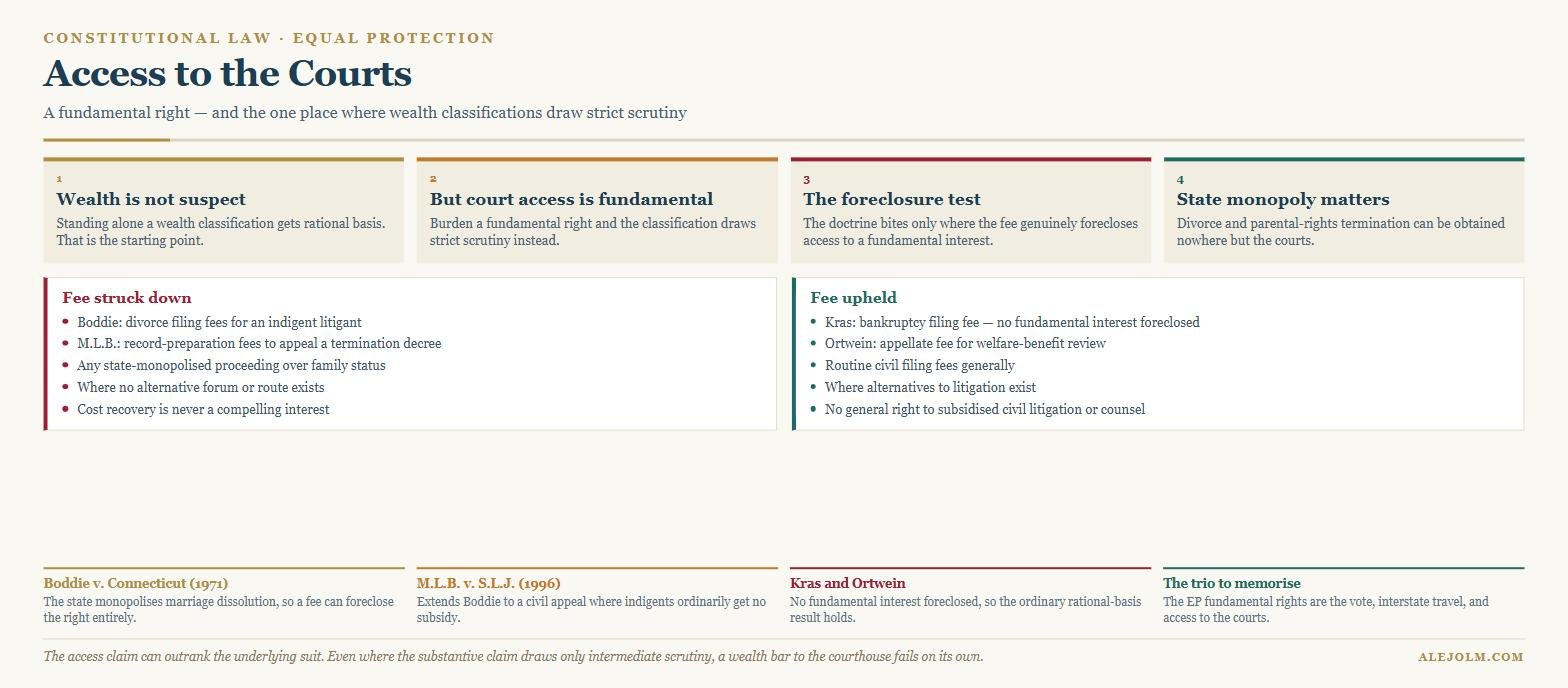
Wealth is not a suspect classification. A statute that distinguishes between rich and poor ordinarily receives rational-basis review and almost always survives it. Yet a small group of cases holds that a filing fee an indigent litigant cannot pay is unconstitutional, and reconciling those two propositions is the whole of this topic.
The reconciliation lies in the fundamental-rights branch of equal protection. Access to the courts is a fundamental right, and where a wealth-based barrier forecloses access to a fundamental interest, the classification attracts strict scrutiny even though wealth by itself would not. The difficulty is that most filing fees are perfectly valid, so the working task is learning exactly when foreclosure occurs. This guide sets out Boddie, Kras, Ortwein and M.L.B., and the test that separates them.
Why wealth is not enough on its own
Start with the baseline, because answers that skip it go wrong in both directions. Wealth has never been recognised as a suspect or quasi-suspect classification. Governments distinguish by ability to pay constantly — in taxation, in benefits eligibility, in fee schedules — and treating every such distinction as constitutionally suspect would be unworkable. So a wealth classification standing alone gets rational basis.
The fundamental-rights branch of equal protection changes the analysis not because of who is being classified but because of what is being burdened. Where a classification of any kind burdens a fundamental right, strict scrutiny follows from the right rather than from the class. That is why the doctrine here is often described as sitting at an intersection: the plaintiff’s poverty supplies the classification, and the fundamental character of court access supplies the tier.
It is worth memorising the trio of equal protection fundamental rights, because the list is short and closed: the right to vote, the right to interstate travel, and access to the courts. Other important interests — bodily autonomy, family decisions, contraception — belong to the substantive due process privacy catalogue, not here. If a right is neither in the privacy group nor one of these three, the presumption is that it is not fundamental and rational basis applies.
Boddie and the foreclosure test
Boddie v. Connecticut (1971) is the anchor. An indigent woman could not pay the fees required to file for divorce, and the Court held that the fee requirement could not be applied to her. The reasoning turned on a specific structural feature: the state monopolises the dissolution of marriage. There is no private route, no arbitration, no self-help. If the courthouse is closed, the interest is unobtainable, full stop.
That gives the doctrine its operative test. The question is not whether a fee is burdensome, nor whether the litigant is poor, but whether the fee genuinely forecloses access to a fundamental interest that only the courts can provide. Foreclosure plus fundamental interest plus state monopoly — those three features together are what produce invalidity.
It is also worth noting that Boddie is often analysed under procedural due process alongside equal protection, since denying any hearing at all to someone seeking to alter a legal status raises both. On an essay it is perfectly appropriate to run both theories, and the fact patterns tend to reward doing so.
Kras and Ortwein: why most fees survive
The limits arrived quickly, and they explain why Boddie did not open the courthouse doors generally. In United States v. Kras the Court upheld a bankruptcy filing fee against an indigent debtor, and in Ortwein v. Schwab it upheld an appellate fee for review of a welfare-benefit determination.
Both rest on the absence of foreclosure. Discharge in bankruptcy, however valuable, is not a fundamental interest in the constitutional sense, and a debtor retains alternatives — negotiating with creditors, arranging payment, simply not paying. Review of a benefits decision is likewise not a fundamental interest, and administrative avenues remained. Because no fundamental interest was foreclosed, the ordinary rational-basis analysis of a wealth classification applied, and cost recovery is a perfectly rational reason for a fee.
The broader principle worth stating is that this doctrine confers no general entitlement to subsidised litigation. There is no constitutional right to appointed counsel in ordinary civil cases, no right to have expenses met, and no right to free process merely because a claim is important to the claimant. The right is specifically against being shut out of a state-monopolised fundamental interest.
Exam tip: ask three questions in sequence. Is the interest fundamental? Does the state monopolise the only route to it? Does the fee genuinely foreclose this litigant? Only if all three are yes does the fee fall.
M.L.B.: extending the principle beyond divorce
M.L.B. v. S.L.J. (1996) shows the doctrine is not confined to divorce. A state conditioned an indigent parent’s appeal from a decree terminating her parental rights on prepayment of record-preparation fees. The Court held that it could not.
The case is significant because it overcomes an ordinarily fatal obstacle. There is generally no constitutional right to a subsidised appeal in civil litigation — the state need not provide appellate review at all, let alone pay for it. What distinguished this appeal was the interest at stake and the forum. Termination of parental rights is a uniquely governmental act affecting a fundamental family relationship, and like divorce it can be accomplished and reviewed nowhere but in the courts. That combination brought it within Boddie despite its civil and appellate posture.
The generalisation to take away is that the doctrine tracks state-monopolised adjudication of fundamental family status. Divorce and termination of parental rights are the established instances. A fee blocking either is unconstitutional as applied to someone who cannot pay it, whether at first instance or on appeal.
A quirk worth knowing: the access claim can outrank the suit
One consequence of treating court access as an independent fundamental right is that it can succeed even where the underlying claim would attract only modest scrutiny. Suppose a litigant is refused a fee waiver on the ground that his lawsuit concerns something the court regards as trivial, and the substantive claim itself — say a sex-discrimination complaint — would draw only intermediate scrutiny.
The access question is analysed on its own footing. Denying a waiver because of an official’s view of the merit or seriousness of the claim is a wealth-based barrier to the courthouse, and it does not become acceptable because the substantive claim is a modest one. The constitutional defect lies in sorting litigants by ability to pay combined with a discretionary judgement about which disputes deserve a forum — not in the strength of the underlying case.
| Fee or barrier | Interest at stake |
|---|---|
| Divorce filing fee, indigent litigant | Marriage dissolution; state monopoly |
| Record fees to appeal a termination decree | Parental rights; state monopoly |
| Bankruptcy filing fee | Discharge; alternatives exist |
| Appellate fee for welfare review | Benefits; not fundamental |
| Ordinary civil filing fee | No fundamental interest foreclosed |
| Waiver refused because the claim seems trivial | Court access itself |
| Request for appointed counsel in a civil case | No general entitlement |
| Fee an indigent litigant can in fact pay | No foreclosure |
Worked example
State Q imposes a $1,000 filing fee for divorce proceedings, waivable only for applicants who can document that their income in the previous calendar year fell below the federal poverty line. A woman who lost her employment three months ago, and who has no current income but whose prior-year earnings were above the threshold, cannot pay the fee and cannot obtain a waiver. She challenges the scheme.
Work the three questions. Is the interest fundamental? Yes — dissolution of marriage, and the state monopolises it, so there is no private route by which she could achieve the same result. Does the fee foreclose her access? On these facts, yes: she has no current income, the sum is substantial, and the waiver is unavailable to her because it is calibrated to the wrong period. That is the analytical heart of the problem — the existence of a waiver provision does not save the scheme if the waiver is drawn so that people genuinely unable to pay fall outside it. Strict scrutiny therefore applies, and the state’s interest in recovering administrative cost, while legitimate, is not compelling, and could in any event be served by a waiver keyed to present means. The fee is unconstitutional as applied to her.
Change one fact. Suppose the identical $1,000 fee and identical waiver applied instead to filing a civil claim for breach of a commercial contract. Now the first question fails: recovering on a contract is not a fundamental interest, and the courts do not monopolise the outcome — she may negotiate, mediate or settle. Without foreclosure of a fundamental interest, the wealth classification receives rational basis, cost recovery supplies a rational justification, and the fee stands. Kras and Ortwein are the authority, and the contrast shows that the doctrine is about the interest, not the amount.
Common mistakes that cost points
- Treating wealth as a suspect classification. It is not; the tier comes from the fundamental right that is burdened.
- Reading Boddie as invalidating filing fees generally. Most fees are valid, as Kras and Ortwein confirm.
- Skipping the foreclosure requirement. A burdensome fee is not enough; access to a fundamental interest must actually be shut off.
- Overlooking the state-monopoly feature. It is what makes divorce and parental-rights termination different from ordinary civil claims.
- Forgetting M.L.B. and confining the doctrine to divorce filings. It reaches appeals from termination decrees too.
- Claiming a general right to appointed counsel or subsidised litigation in civil cases. There is none.
- Assuming a waiver provision cures the defect. A waiver drawn so that genuinely indigent litigants fall outside it does not.
- Misstating the trio of equal protection fundamental rights, which is the vote, interstate travel, and access to the courts.
Frequently asked questions
Why are divorce fees unconstitutional but bankruptcy fees valid?
Because of foreclosure. The state monopolises the dissolution of marriage, so a fee an indigent litigant cannot pay removes the interest entirely. Discharge in bankruptcy is not a fundamental interest and alternatives to litigation remain, so no fundamental interest is foreclosed and the ordinary rational-basis analysis applies.
Is there a right to a free lawyer in civil cases?
No. This doctrine protects against being shut out of a state-monopolised fundamental interest; it does not create a general entitlement to subsidised litigation. Appointed counsel in civil matters is a question of statute and local practice, not of equal protection.
What are the equal protection fundamental rights?
Three: the right to vote, the right to interstate travel, and access to the courts. Interests such as bodily autonomy and family decision-making are protected through substantive due process instead. If a right appears in neither group, presume it is not fundamental and apply rational basis.
Access to the courts in Los Angeles County, 2026
The federal principle is that the state may not price out access to proceedings that determine fundamental interests, as Boddie v. Connecticut held for divorce and M.L.B. v. S.L.J. held for termination of parental rights. California implements this through a statutory fee waiver system rather than case-by-case constitutional adjudication, and the Los Angeles Superior Court, as the largest trial court in the country, processes an enormous volume of waiver applications.
California went further in Jameson v. Desta (2018), where the California Supreme Court held that a court policy denying indigent litigants access to an official court reporter was invalid, because without a verbatim record a fee waiver recipient effectively lost the ability to appeal. The decision reframed access as extending beyond filing fees to the tools needed to make a right of appeal real.
What access actually requires here:
- Fee waivers are governed by statute. Provisions in the California Government Code and the California Rules of Court set eligibility by public benefit receipt, income thresholds or hardship.
- Waivers extend beyond filing. Sheriff service, jury fees, reporter fees and transcript costs can be covered, and the application should request them expressly.
- Interpreters are provided in civil cases. California expanded interpreter availability beyond criminal proceedings, which matters greatly in a county where many residents speak languages other than English at home.
- Electronic filing is mandatory in many divisions. Digital access requirements themselves raise access questions, and exemptions exist for self-represented litigants.
- Self-help centres are part of the system. Court-run assistance and county law libraries substitute for counsel in most civil matters, since there is no general civil right to counsel.
- Prisoner access is protected. Meaningful access to legal materials and to the courts is constitutionally required in county custody as well as state prison.
In 2026, confirm current fee schedules and waiver thresholds with the court directly, since they are revised periodically. Read with procedural due process, equal protection and the right to travel.
Next steps
This doctrine only makes sense inside its parent framework, so read equal protection first and then the levels of scrutiny to see why a non-suspect classification can still attract strict review. Its two siblings in the fundamental-rights branch are the right to vote and one person, one vote and the right to travel. Because Boddie is commonly argued on two theories at once, pair this with procedural due process.
The opinions in Boddie and M.L.B. are the two most useful to read in full and are freely available through Justia’s Fourteenth Amendment collection. Cornell’s Legal Information Institute keeps a concise entry with current citations, and candidates should confirm the tested scope against the outlines published by the State Bar of California.
Related guides
- Advisory Opinions: Article III and Declaratory Relief
- Other Enumerated Powers: Postal, Bankruptcy, Admiralty
- Franchise Amendments: Congress and the Right to Vote
- Property Clause: Congress and Federal Lands Explained
- No Federal Police Power: Enumerated Powers and Enclaves
- Contracts Clause: When States May Impair Agreements
- Takings Clause: Lucas, Penn Central and Just Compensation
- Free Exercise Clause: Smith, Lukumi and Fulton Applied
- Establishment Clause: Church, State and the New Test
- Freedom of Association: Scrutiny, Dale and Disclosure
- Freedom of the Press: Publication Liability and Limits
- Campaign Finance and Anonymous Speech: The Core Rules
- Unconstitutional Conditions: Benefits and Rights Waivers
- Government Speech Doctrine: When the State Can Choose
- Vagueness and Overbreadth: Facial Challenges Explained
- Prior Restraint and Licensing: The Freedman Safeguards
- Symbolic Conduct and the O’Brien Test: The Pivot Question
- Government Employee Speech: Garcetti and Pickering Rules
- Commercial Speech and the Central Hudson Four-Part Test
- Actual Malice and the Three Tracks of Defamation Law
- Public Forum Doctrine and the Time, Place, Manner Test
- First Amendment: The Three-Question Speech Framework
- One Person, One Vote: Voting Rights Under Equal Protection
- Alienage Classifications: Strict Scrutiny and Its Pockets
- Equal Protection: The Three-Step Classification Test
- Second Amendment: The Bruen Text-and-History Standard
- Substantive Due Process After Dobbs: A Two-Step Test
- Procedural Due Process: Notice, Hearing and Mathews
- Incorporation Doctrine: Which Rights Bind the States
- Full Faith and Credit: Recognising Sister-State Judgments
- The Complete Auto Test: Taxing Interstate Commerce
- The Right to Travel: Durational Residency Explained
- Article IV Privileges and Immunities: The Comity Rule
- Federal Preemption: The Three-Step Ladder Explained
- The Supremacy Clause: Floors, Ceilings and Preemption
- Intergovernmental Immunity: The Shield Runs One Way
- The Presidential Pardon Power: Four Limits That Matter
- Executive Privilege: A Qualified Right That Must Yield
- Presidential Immunity: Criminal, Civil and Private Acts
- The Removal Power: At-Will Firing and Its Exceptions
- The Appointment Power: Principal and Inferior Officers
- Take Care Clause: Enforcement Discretion and Its Limits
- Commander-in-Chief Power: Deploy Without Declaring War
- Executive Agreements: The President’s Sole Foreign Power
- The Treaty Power: Senate Advice and Consent Explained
- The Presidential Veto Power, Override and Pocket Veto
- Bicameralism and Presentment: Two Vetoes Struck Down
- The Nondelegation Doctrine and the Intelligible Principle
- Speech or Debate Clause: Absolute but Narrow Immunity
- The Impeachment Power: House Majority, Senate Two-Thirds
- Congress’s Naturalization Power and Citizenship Limits
- Congressional War Powers: Declare, Fund and Command
- Anti-Commandeering Doctrine and the Tenth Amendment
- Section 5 Enforcement Power: Remedy, Do Not Redefine
- The Spending Power and the Five Dole Test Conditions
- Congress’s Taxing Power: When a Penalty Is Really a Tax
- The Necessary and Proper Clause: Congress’s Multiplier
- Ex Post Facto Clause: Retroactive Criminal Laws Barred
- Bills of Attainder: Legislative Punishment Explained
- The Writ of Habeas Corpus: Testing Unlawful Detention
- Supreme Court Jurisdiction: Original vs Appellate Power
- Abstention Doctrine: 4 Ways Federal Courts Step Aside
- Dormant Commerce Clause: Discrimination vs Pike Balancing
- The Commerce Clause: 3 Categories and 2 Hard Limits
- State Action Doctrine: The Government Conduct Threshold
- The Eleventh Amendment and State Sovereign Immunity
- Political Question Doctrine: What Courts Will Not Decide
- Ripeness and Mootness: Timing Rules in Federal Court
- Standing in Federal Court: The 3-Part Article III Test
- Marbury v. Madison and the Power of Judicial Review
- The Youngstown Framework: Presidential Power in 3 Zones
- The IRAC Method: How to Structure a Bar Exam Answer
- Piercing the Corporate Veil: A Two-Prong Alter Ego Test
- Defamation Elements, Fault Standards and Privileges
- The Parol Evidence Rule: Integration and Exceptions
- Recording Acts: Race, Notice and Race-Notice Explained
- Partner Liability and Authority Under RUPA Explained
- Trustee Duties: Care, Loyalty, Impartiality, Accounts
- Specific Performance: A Six-Element Bar Exam Framework
- Will Execution Requirements: Formalities and Rescue
- Community Property Presumptions in California Explained
- Easements Explained: Creation, Scope and Termination
- Products Liability: The Three Defect Theories Explained
- Miranda Rights: Custody, Interrogation and Invocation
- The Character Evidence Rules: Propensity Bar and Doorways
- Adverse Possession Elements: OCEAN and the Tax Rule
- Business Judgment Rule and Directors’ Fiduciary Duties
- The Statute of Frauds: MYLEGS and How to Satisfy It
- Res Judicata vs Collateral Estoppel: Bar Exam Guide
- The Erie Doctrine Explained: A 4-Step Bar Exam Guide
- Conflicts of Interest: A 6-Step Decision Tree for the Bar
- The Rule Against Perpetuities Explained Step by Step
- Murder and Manslaughter: The Homicide Ladder Explained
- Consideration in Contract Law: Rules and Exceptions
- The Four Elements of Negligence: Bar Exam Breakdown
- The Hearsay Rule Explained: Exceptions and Exemptions
- Personal Jurisdiction: The 3-Step Bar Exam Framework
- 3 Levels of Scrutiny in Constitutional Law Explained
- The Citizenship Clause After Trump v. Barbara