
The Establishment Clause forbids laws respecting an establishment of religion, and it also forbids the government preferring religion over irreligion. Stating the prohibition is easy; applying it has proved unusually unstable, because the Supreme Court has produced four overlapping frameworks over sixty years and has recently reordered which one leads.
For anyone learning or examining the area, that instability is itself the practical difficulty. Kennedy v. Bremerton School District (2022) expressly set aside Lemon and the endorsement test as the controlling shorthand and directed courts to historical practices and understandings. But Lemon has not been erased from the syllabus, and a complete answer still walks through all four. This guide sets out each framework, the threshold question that precedes them, and the settled rules on school prayer, displays and school funding.
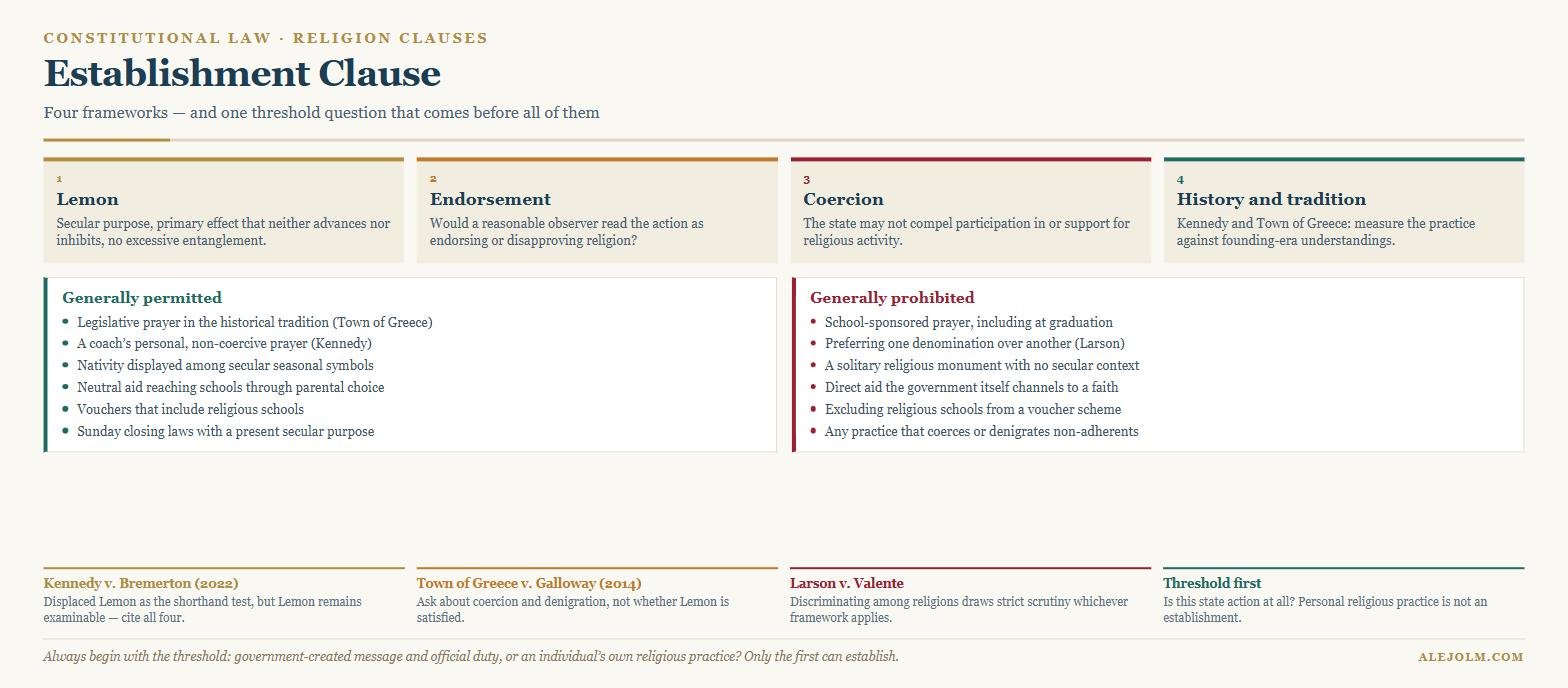
The threshold question: is this government action at all?
Before any framework is applied, establish that the state is actually the actor. The clause reaches government-created messages, actions taken pursuant to official policy, and conduct by public employees within the scope of their duties. It does not reach the private religious practice of individuals who happen to be employed by the state.
This threshold does a great deal of work, and Kennedy turned on it. A high-school coach prayed at midfield after games. The school treated the prayer as its own speech and suppressed it in order to avoid an establishment problem. The Court held the prayer was the coach’s personal religious exercise — he was acting for himself, not conveying a message the school had created — so there was no establishment to avoid, and suppressing it burdened his own rights.
The practical instruction is to identify the speaker precisely before reaching for any test. Officially organised prayer, a school-scheduled invocation, a monument the state selected — all are government action. An employee’s own devotion, even in a public place and even while visibly identifiable as staff, generally is not.
The four frameworks, and how they now fit together
The Lemon test asks three questions, all of which must be satisfied: does the action have a secular purpose; is its primary effect one that neither advances nor inhibits religion; and does it avoid excessive entanglement between government and religion? Entanglement is the prong most often overlooked, and it targets ongoing administrative enmeshment — monitoring, auditing, supervising religious activity — rather than one-off decisions.
The endorsement test, associated with Justice O’Connor, asks whether a reasonable observer would perceive the action as endorsing or disapproving religion. It is heavily contextual, which is why it has generated the most fact-specific case law, particularly on displays.
The coercion test asks whether the government compels anyone to participate in or support religious activity. Coercion may be direct, or indirect through social pressure in a setting people cannot readily leave — which is why school settings, where attendance is required and peer pressure is acute, receive closer attention than adult civic settings.
History and tradition is now the leading approach. Town of Greece v. Galloway (2014) upheld sectarian prayer opening town board meetings because legislative prayer traces directly to the First Congress, and it reframed the inquiry as whether the practice coerces participation or denigrates non-adherents rather than whether it satisfies Lemon. Kennedy generalised that method. The sensible approach for a full answer is to lead with history and tradition, then run the other three, noting that Lemon has been displaced as the primary framework without being formally abolished.
Exam tip: lead with history and tradition after Kennedy, but still walk through Lemon, endorsement and coercion. Marks are awarded for the complete map, and coercion in particular often supplies the cleanest route to the answer.
Religion in public schools
The school cases are the most settled part of the doctrine, and they turn on the coercion concern. Officially sponsored prayer in a public school violates the clause — school-led morning prayers, prayers at school-sponsored events, invocations built into a graduation programme. Attendance is compulsory or socially unavoidable, the audience is young, and the school’s authority makes participation feel obligatory even where nobody is formally required to join.
Two important qualifications follow. First, equal access is not establishment: where a school opens facilities to student groups, religious groups must be admitted on the same terms as everyone else, and excluding them would be viewpoint discrimination rather than neutrality. Second, after Kennedy, an individual employee’s own non-coercive religious practice is not attributable to the school. The distinction to hold onto is between the institution organising worship and an individual worshipping while employed by the institution.
Displays, monuments and the plastic-reindeer rule
Religious displays are resolved by context, which produces the doctrine’s least dignified but most memorable label. A nativity scene standing alone in a courthouse is vulnerable, because in isolation the state appears to adopt the religious message. The same nativity placed among reindeer, candy canes and a Santa in a public square is far more defensible, because the ensemble reads as a seasonal display rather than a theological statement — hence the plastic-reindeer rule.
The principle underneath is not really about ornaments. It is that a display’s meaning depends on what surrounds it, how long it has been there, who placed it and what the setting is for. Longstanding monuments with genuine historical grounding fare better under the current approach than newly erected solitary religious symbols, and a monument accompanied by other documents and traditions is easier to defend than one presented on its own. Where the state discriminates among religions — favouring one denomination over another — strict scrutiny applies under Larson v. Valente whichever framework is otherwise in play.
Aid to religious schools, vouchers and Sunday closing
Funding cases turn on two requirements working together. Aid is permissible where it is neutral on its face, applying to religious and secular beneficiaries alike, and where it reaches religious institutions indirectly through genuine private choice — that is, because parents select the school, not because the government selects which schools receive money. Direct government channelling of funds to a religious institution remains problematic; a voucher redeemable at any qualifying school does not.
The modern position goes further, and it catches people out. A voucher or scholarship programme may not exclude religious schools. Excluding them is not neutrality but discrimination against religion, and it fails. So the error runs in both directions: the state may not fund a faith directly, and it may not shut religious options out of an otherwise open programme.
Sunday closing laws illustrate a final point about purpose. Their origins are unmistakably religious, yet they survive where the present justification is secular — providing a uniform day of rest for workers. The purpose inquiry looks to the law’s current operation and rationale rather than its historical genesis, which means an old religious motive does not permanently taint a statute that now serves ordinary ends.
| Practice | Analysis |
|---|---|
| School-led prayer at graduation | Coercion in a compulsory setting |
| Coach’s personal postgame prayer | Private religious exercise (Kennedy) |
| Sectarian prayer opening a town board | History and tradition (Town of Greece) |
| Solitary nativity in a courthouse | Endorsement in context |
| Nativity among secular seasonal symbols | Endorsement in context |
| Preferring one denomination | Larson v. Valente |
| Vouchers redeemable at any school | Neutral, private choice |
| Voucher scheme excluding religious schools | Discrimination against religion |
| Sunday closing law with secular purpose | Present purpose is secular |
Worked example
State Z installs a Ten Commandments monument at the centre of the capitol rotunda. It stands alone, with no other monument or document nearby. The state’s stated purpose is to display “foundational documents of Western law”. A taxpayer challenges the display.
The threshold is satisfied without difficulty: the state selected, funded and installed the monument, so this is government action conveying a government message. Now run the frameworks. On history and tradition, displays of the Commandments in courthouse and civic settings do have a real pedigree, which is the state’s strongest argument — but the pedigree attaches to displays presented among other legal and historical materials, not to a solitary religious text occupying the ceremonial centre of a capitol. On endorsement, the isolation is decisive: with nothing to contextualise it, a reasonable observer reads the state as adopting the text’s religious content, and the asserted secular purpose is undercut by the choice to display no other foundational document. Lemon points the same way, since the primary effect advances religion. Only coercion is absent, since nobody is required to participate. The display is very likely unconstitutional.
Change one fact. Suppose the monument sat in a landscaped grounds area alongside monuments to the state constitution, the Magna Carta and the Bill of Rights, and had stood there for decades without objection. Now the secular purpose is corroborated by the surroundings, the endorsement reading weakens considerably, and the longevity engages precisely the historical-practice reasoning that Kennedy and Town of Greece endorse. The same object, on the same public land, very likely survives — which is the whole lesson of contextual analysis.
Common mistakes that cost points
- Applying Lemon as though it were still the controlling test, or dropping it entirely. Lead with history and tradition, then run all four.
- Skipping the threshold question. If the actor is an individual pursuing personal religious practice, there is no establishment issue to analyse.
- Forgetting the entanglement prong, which targets ongoing administrative enmeshment rather than a single decision.
- Treating equal access for religious student groups as establishment. Excluding them would be viewpoint discrimination.
- Assuming any religious display is unconstitutional. Context, surroundings and longevity are what decide these cases.
- Missing that excluding religious schools from a voucher programme is itself unconstitutional discrimination.
- Confusing neutral aid reaching schools through parental choice with direct government funding of a faith.
- Assuming a religious historical origin condemns a statute. Sunday closing laws survive where the present purpose is secular.
Frequently asked questions
Is the Lemon test still good law?
Its status is awkward. Kennedy v. Bremerton discarded Lemon and endorsement as the controlling shorthand in favour of historical practices and understandings, so it no longer leads. It has not been formally abolished, however, and it remains examinable — the safe course is to apply the historical approach first and then work through Lemon, endorsement and coercion.
Why was the coach’s prayer in Kennedy permitted when school prayer is not?
Because the speaker was different. School-sponsored prayer is the institution organising worship for a captive and impressionable audience. The coach was engaged in his own religious practice; the school had not created the message and no student was compelled to join. The threshold question, not a change in the school-prayer rule, decided the case.
Can public money reach religious schools?
Yes, on two conditions. The programme must be neutral, available to religious and secular institutions on the same terms, and the money must arrive through genuine private choice — because parents selected the school. What is prohibited is the state channelling funds directly to a faith, and, separately, excluding religious schools from an otherwise open scheme.
The Establishment Clause and the Los Angeles County seal, 2026
Los Angeles County has litigated this clause over its own emblem. A small cross was removed from the county seal in 2004 after legal objection, and when the Board of Supervisors voted a decade later to restore it, a federal court held the restoration unconstitutional, finding that the decision conveyed endorsement of religion in a way the original historical design did not. The case is a useful illustration that the same image can carry different meaning depending on the deliberate act that put it there.
The governing test has since shifted. Kennedy v. Bremerton School District (2022) displaced the endorsement and Lemon frameworks in favour of an enquiry into historical practices and understandings, which changes how county practices such as invocations at Board meetings and holiday displays in public buildings are analysed.
California adds a further layer that pulls in the opposite direction:
- The state constitution bars aid to sectarian schools. No-aid provisions in the California Constitution are stricter than the federal clause and have long prevented voucher programmes in California.
- Federal free exercise doctrine now limits those provisions. Decisions holding that states may not exclude religious schools from generally available benefits have narrowed how far no-aid clauses can be applied.
- Legislative prayer is generally permissible. Invocations before county board meetings follow a long historical practice, provided they are not exploited to proselytise or disparage.
- Ministerial exception is broad. Employment claims by those performing religious functions are barred, which matters given the county’s many faith-based service partners.
- Contracting with religious providers is allowed. Neutral programmes may fund secular services delivered by religious organisations, subject to non-discrimination terms.
- Public school curriculum rules are unchanged. Devotional exercises remain impermissible; teaching about religion does not.
In 2026, apply the history and tradition enquiry federally, then ask whether the California Constitution independently restricts the county. Read with the Free Exercise Clause, government speech and unconstitutional conditions.
Next steps
The two religion clauses are best studied together, since they pull in opposite directions and the same facts often engage both. Read this beside the Free Exercise Clause, which governs burdens on religious practice, and place both inside the First Amendment analysis. Because the threshold question here is the same classification problem that runs through the government speech doctrine, that guide is worth reading in parallel, and funding conditions attached to religious institutions engage the unconstitutional conditions doctrine.
The opinions in Kennedy and Town of Greece are the two most useful to read in full and are freely available through Justia’s First Amendment collection. Cornell’s Legal Information Institute keeps a concise entry with current citations, and candidates should confirm the tested scope against the outlines published by the State Bar of California.
Related guides
- Advisory Opinions: Article III and Declaratory Relief
- Access to the Courts: When Filing Fees Are Unconstitutional
- Other Enumerated Powers: Postal, Bankruptcy, Admiralty
- Franchise Amendments: Congress and the Right to Vote
- Property Clause: Congress and Federal Lands Explained
- No Federal Police Power: Enumerated Powers and Enclaves
- Contracts Clause: When States May Impair Agreements
- Takings Clause: Lucas, Penn Central and Just Compensation
- Free Exercise Clause: Smith, Lukumi and Fulton Applied
- Freedom of Association: Scrutiny, Dale and Disclosure
- Freedom of the Press: Publication Liability and Limits
- Campaign Finance and Anonymous Speech: The Core Rules
- Unconstitutional Conditions: Benefits and Rights Waivers
- Government Speech Doctrine: When the State Can Choose
- Vagueness and Overbreadth: Facial Challenges Explained
- Prior Restraint and Licensing: The Freedman Safeguards
- Symbolic Conduct and the O’Brien Test: The Pivot Question
- Government Employee Speech: Garcetti and Pickering Rules
- Commercial Speech and the Central Hudson Four-Part Test
- Actual Malice and the Three Tracks of Defamation Law
- Public Forum Doctrine and the Time, Place, Manner Test
- First Amendment: The Three-Question Speech Framework
- One Person, One Vote: Voting Rights Under Equal Protection
- Alienage Classifications: Strict Scrutiny and Its Pockets
- Equal Protection: The Three-Step Classification Test
- Second Amendment: The Bruen Text-and-History Standard
- Substantive Due Process After Dobbs: A Two-Step Test
- Procedural Due Process: Notice, Hearing and Mathews
- Incorporation Doctrine: Which Rights Bind the States
- Full Faith and Credit: Recognising Sister-State Judgments
- The Complete Auto Test: Taxing Interstate Commerce
- The Right to Travel: Durational Residency Explained
- Article IV Privileges and Immunities: The Comity Rule
- Federal Preemption: The Three-Step Ladder Explained
- The Supremacy Clause: Floors, Ceilings and Preemption
- Intergovernmental Immunity: The Shield Runs One Way
- The Presidential Pardon Power: Four Limits That Matter
- Executive Privilege: A Qualified Right That Must Yield
- Presidential Immunity: Criminal, Civil and Private Acts
- The Removal Power: At-Will Firing and Its Exceptions
- The Appointment Power: Principal and Inferior Officers
- Take Care Clause: Enforcement Discretion and Its Limits
- Commander-in-Chief Power: Deploy Without Declaring War
- Executive Agreements: The President’s Sole Foreign Power
- The Treaty Power: Senate Advice and Consent Explained
- The Presidential Veto Power, Override and Pocket Veto
- Bicameralism and Presentment: Two Vetoes Struck Down
- The Nondelegation Doctrine and the Intelligible Principle
- Speech or Debate Clause: Absolute but Narrow Immunity
- The Impeachment Power: House Majority, Senate Two-Thirds
- Congress’s Naturalization Power and Citizenship Limits
- Congressional War Powers: Declare, Fund and Command
- Anti-Commandeering Doctrine and the Tenth Amendment
- Section 5 Enforcement Power: Remedy, Do Not Redefine
- The Spending Power and the Five Dole Test Conditions
- Congress’s Taxing Power: When a Penalty Is Really a Tax
- The Necessary and Proper Clause: Congress’s Multiplier
- Ex Post Facto Clause: Retroactive Criminal Laws Barred
- Bills of Attainder: Legislative Punishment Explained
- The Writ of Habeas Corpus: Testing Unlawful Detention
- Supreme Court Jurisdiction: Original vs Appellate Power
- Abstention Doctrine: 4 Ways Federal Courts Step Aside
- Dormant Commerce Clause: Discrimination vs Pike Balancing
- The Commerce Clause: 3 Categories and 2 Hard Limits
- State Action Doctrine: The Government Conduct Threshold
- The Eleventh Amendment and State Sovereign Immunity
- Political Question Doctrine: What Courts Will Not Decide
- Ripeness and Mootness: Timing Rules in Federal Court
- Standing in Federal Court: The 3-Part Article III Test
- Marbury v. Madison and the Power of Judicial Review
- The Youngstown Framework: Presidential Power in 3 Zones
- The IRAC Method: How to Structure a Bar Exam Answer
- Piercing the Corporate Veil: A Two-Prong Alter Ego Test
- Defamation Elements, Fault Standards and Privileges
- The Parol Evidence Rule: Integration and Exceptions
- Recording Acts: Race, Notice and Race-Notice Explained
- Partner Liability and Authority Under RUPA Explained
- Trustee Duties: Care, Loyalty, Impartiality, Accounts
- Specific Performance: A Six-Element Bar Exam Framework
- Will Execution Requirements: Formalities and Rescue
- Community Property Presumptions in California Explained
- Easements Explained: Creation, Scope and Termination
- Products Liability: The Three Defect Theories Explained
- Miranda Rights: Custody, Interrogation and Invocation
- The Character Evidence Rules: Propensity Bar and Doorways
- Adverse Possession Elements: OCEAN and the Tax Rule
- Business Judgment Rule and Directors’ Fiduciary Duties
- The Statute of Frauds: MYLEGS and How to Satisfy It
- Res Judicata vs Collateral Estoppel: Bar Exam Guide
- The Erie Doctrine Explained: A 4-Step Bar Exam Guide
- Conflicts of Interest: A 6-Step Decision Tree for the Bar
- The Rule Against Perpetuities Explained Step by Step
- Murder and Manslaughter: The Homicide Ladder Explained
- Consideration in Contract Law: Rules and Exceptions
- The Four Elements of Negligence: Bar Exam Breakdown
- The Hearsay Rule Explained: Exceptions and Exemptions
- Personal Jurisdiction: The 3-Step Bar Exam Framework
- 3 Levels of Scrutiny in Constitutional Law Explained
- The Citizenship Clause After Trump v. Barbara