
Almost every free-speech rule assumes the government is regulating somebody else’s expression. The government speech doctrine addresses the situation where the government is the speaker itself — erecting a monument, running a public-health campaign, approving a licence plate design, setting a school curriculum. In that role the Free Speech Clause imposes no obligation of evenhandedness at all. The state may say what it wants, and it need not carry the opposing view.
That sounds like a licence for censorship until you see where the boundary sits. The doctrine applies only when the government is genuinely speaking, not when it has opened a space for private speakers. Get that classification wrong and the entire analysis inverts: on one side of the line the government picks freely, on the other it is bound by viewpoint neutrality. This guide sets out the trigger, works through Summum, Walker and Kennedy, and explains why an Establishment Clause problem can survive a total free-speech victory.
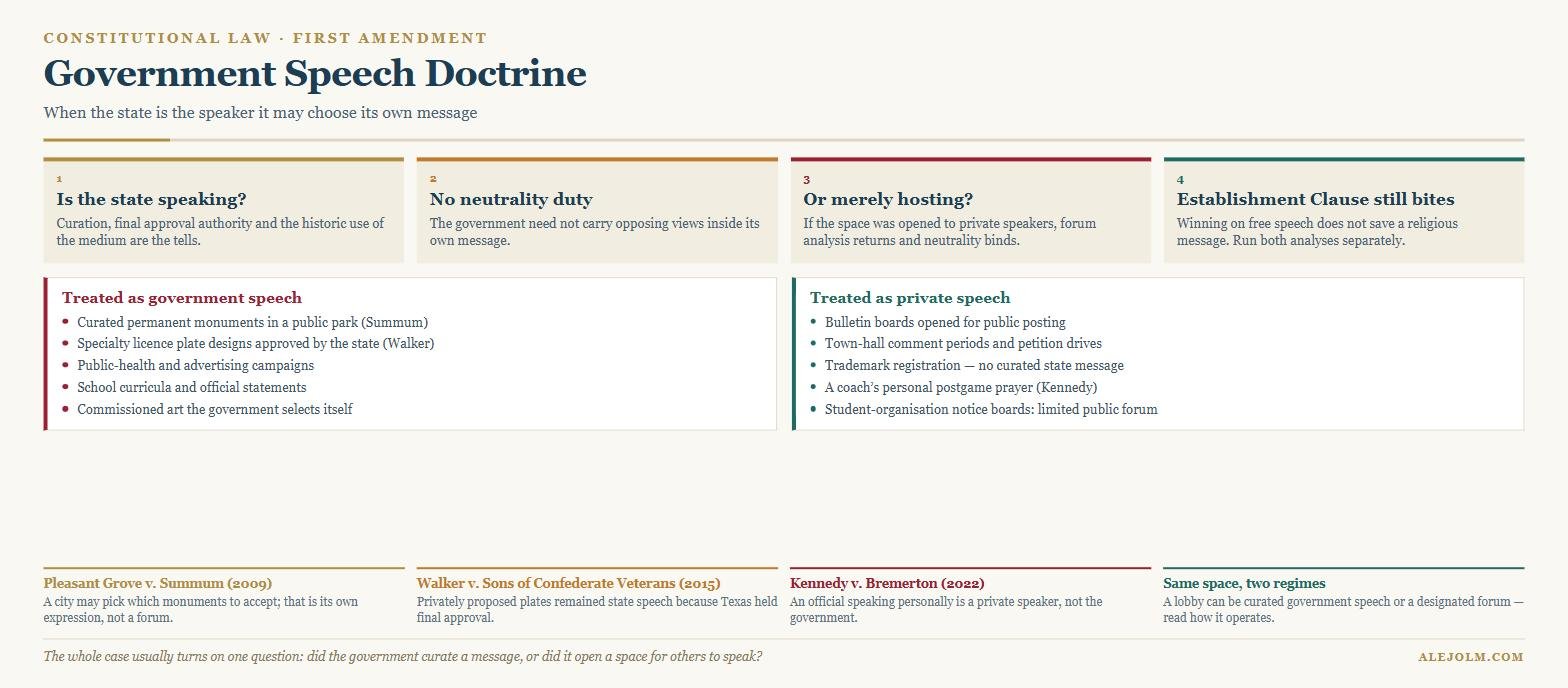
The trigger: is the government actually speaking?
The doctrine has one gateway question, and it is factual rather than doctrinal. Has the government adopted and curated a message of its own, or has it made a space available for others to express theirs? Courts look at a cluster of indicators: whether the government selects among submissions on the merits, whether it retains final approval authority, whether the medium has historically been used to convey official messages, and whether a reasonable observer would attribute the message to the state.
None of those factors is decisive alone, and private involvement does not defeat the classification. A message can be drafted by a private party, funded by a private party and physically displayed by a private party and still be government speech, provided the state controls what goes in. Conversely, a space owned and maintained entirely by the government can be a forum for private expression if the government has thrown it open without curating content.
Once the classification lands on government speech, the free-speech analysis effectively stops. There is no viewpoint-neutrality requirement, no tiers of scrutiny, no narrow-tailoring inquiry — because the government is not restricting anybody’s expression. It is exercising its own. A citizen who wants the state to carry a contrary message has no First Amendment claim; the remedy is political, at the ballot box or in the legislature, not judicial.
Summum and the curated monument
Pleasant Grove City v. Summum (2009) is the anchor. A city park contained a number of permanent monuments, most donated by private groups and accepted by the city. A religious organisation offered its own monument and the city refused. The group argued that by accepting some private donations the city had created a forum and could not then discriminate.
The Court disagreed. Accepting a permanent monument is an act of adoption: the city chooses what will stand in its park indefinitely, and observers reasonably read the collection as the city’s statement about its own history and values. Because the city curated rather than hosted, it was speaking, and it could select freely. The practical rationale is worth noting — parks are finite, permanent monuments are effectively irreversible, and a neutrality rule would force a city either to accept every submission or to accept none.
Contrast the counterfactual the Court itself drew. Had the city designated the park as a space where any group could erect a temporary display, viewpoint neutrality would have applied in full and the refusal would have been unconstitutional. The same lawn, the same city, opposite results — determined entirely by how the programme was operated.
Walker, licence plates and final approval authority
Walker v. Texas Division, Sons of Confederate Veterans (2015) pushed the doctrine to its outer edge. Texas rejected a specialty plate design featuring the Confederate battle flag. The design had been proposed by a private group and would have been displayed on privately owned cars by drivers who chose it. On any intuitive reading that looks like private speech.
The Court held otherwise, resting on two features. Licence plates have long served as a medium for state-selected messages — slogans, mottos, commemorations — so observers associate them with the state. And Texas retained final approval authority over every design, which meant nothing appeared on a plate without the state’s endorsement. Because Texas curated, the plates were government speech and the rejection raised no free-speech problem.
It is instructive to compare trademark registration, which the Court has treated as private speech rather than government speech. Registering a mark involves no curation of a message — the office applies statutory criteria and confers a legal benefit; it does not adopt the mark as its own. The distinction shows that state involvement is not enough. What matters is whether the state is selecting content in order to say something.
Exam tip: when the facts feature a government programme that accepts private submissions, do not guess. Ask whether the government selects on the merits and keeps final approval. If it does, you are in government speech; if it merely opened the door, run forum analysis.
The forum line is usually the whole case
Because the two regimes produce opposite answers, the drafting of a programme decides the litigation before the merits are reached. A city hall lobby where officials commission and select artworks is curated government speech. A notice board in the same lobby marked “open to community groups” is a designated or limited public forum, where the government may impose reasonable subject-matter limits but may never discriminate by viewpoint. One building, two constitutional regimes.
For that reason the useful habit is to read the facts for operational detail rather than for labels. Who decides what appears? Are there published criteria, or does an official choose? Is the selection described as representing the institution’s values, or as accommodating public participation? Is the display permanent and attributed, or temporary and rotating? Those answers, not the name of the programme, determine the outcome.
The Establishment Clause is a separate constraint
Government speech doctrine only disposes of the Free Speech Clause. It does not immunise the government from the rest of the Constitution, and the Establishment Clause is the constraint that matters most often, because religious displays and religiously themed programmes are exactly where the doctrine gets invoked. A monument or campaign can be entirely lawful as an exercise of the state’s own expression and still be unconstitutional because the state is promoting religion. Both analyses must be run, and they are genuinely independent.
Kennedy v. Bremerton School District (2022) shows the doctrine cutting the other way. A high-school coach prayed on the field after games. The school treated the prayer as its own speech and suppressed it to avoid an establishment problem. The Court held the prayer was the coach’s private religious speech — he was acting personally, not as the school’s mouthpiece — with the result that the school could not silence him on Establishment Clause grounds. The classification question therefore runs in both directions: sometimes calling something government speech expands state power, and sometimes, as here, insisting it is private speech protects the individual.
| Programme | Classification |
|---|---|
| Curated permanent monuments in a park | Government speech (Summum) |
| Specialty licence plate designs | Government speech (Walker) |
| Public-health or advertising campaign | Government speech |
| School curriculum and official statements | Government speech |
| Notice board opened to community groups | Limited public forum |
| Trademark registration | Private speech |
| Employee’s personal prayer or comment | Private speech (Kennedy) |
Worked example
City Y runs a public-art programme in the City Hall lobby. It commissions professional artists to produce pieces expressing the city’s stated values of civic engagement, diversity and progress, and a city committee selects every work. A residents’ group asks to commission and install a sculpture criticising immigration policy, arguing that the city’s diversity theme sidelines their concerns. The city refuses. The group sues for viewpoint discrimination.
Classify first. The city commissions the artists, sets the thematic brief and selects each piece through a committee — that is curation with final approval authority, and the display sits in a government building where observers will attribute it to the city. On the Summum and Walker indicators this is government speech. It follows that the viewpoint-discrimination claim fails at the threshold rather than on the merits. The city is not regulating the group’s expression at all; the group remains free to speak anywhere else, including on the pavement outside. The city is choosing what it says, and the First Amendment does not require a speaker — even a governmental one — to voice the opposite of what it believes. The group loses.
Change one fact. Suppose the city had instead announced that the lobby walls were available to any resident artist on a first-come basis, with staff checking only for size and safety. Now the city has opened a designated forum, viewpoint neutrality binds it, and rejecting the immigration sculpture because of its message would be unconstitutional. Note also that if the city’s own curated programme had installed a sculpture of the Ten Commandments, the free-speech analysis would be unchanged — still government speech — but an Establishment Clause challenge would then have to be assessed entirely separately.
Common mistakes that cost points
- Applying forum analysis to genuine government speech. If the state is the speaker, viewpoint neutrality simply does not enter the picture.
- Assuming private involvement defeats the classification. Privately proposed and privately displayed messages were still state speech in Walker.
- Treating government speech as constitutionally unconstrained. It defeats free-speech claims only; the Establishment Clause and equal protection still apply.
- Forgetting to run the Establishment Clause separately whenever the state’s own message touches religion.
- Assuming every statement by an official is government speech. Kennedy confirms an official may speak personally as a private citizen.
- Ignoring how the programme actually operates. The same physical space can be curated speech or an open forum; read the mechanics, not the label.
- Overlooking final approval authority, which is often the single most telling fact in the problem.
- Concluding that a losing free-speech claim means the challenger has no case at all. A different clause may still deliver the remedy.
Frequently asked questions
Does the government have to be viewpoint-neutral in its own message?
No. That is the entire point of the doctrine. When the state speaks it selects content freely and owes no duty to present competing positions, because it is not regulating anybody’s expression. The check on a message people dislike is political rather than judicial.
How do I tell government speech from a designated public forum?
Look at how the programme runs. Curation on the merits, retained final approval, historic use of the medium for official messages and likely public attribution to the state all point to government speech. Open access with only logistical screening points to a forum, where viewpoint neutrality binds.
Can government speech still be unconstitutional?
Yes. The doctrine answers only the Free Speech Clause. A curated display promoting a particular faith raises no free-speech problem yet may violate the Establishment Clause, and a programme that classifies by race or sex remains subject to equal protection. Always run the other clauses independently.
Government speech in Los Angeles County practice, 2026
When government speaks for itself it may choose its message, and the Free Speech Clause imposes no viewpoint neutrality requirement. The difficulty is identifying when a programme is government speech rather than a forum for private expression, and Shurtleff v. Boston (2022) showed how easily a jurisdiction can lose that argument by administering a scheme without meaningful control.
Los Angeles County faces the question in several recurring settings. County public health campaigns are plainly the county’s own message and may take a position. Advertising space sold on county transit is different: courts have generally treated it as a limited or non-public forum, so the operator may exclude categories of content but may not discriminate on viewpoint within them. Ceremonial flag raisings and proclamations at county facilities now require attention to whether the county has retained genuine editorial control or simply opened a channel to applicants.
The factors courts weigh:
- History of the medium. Monuments and official emblems have long conveyed government messages; bulletin boards and advertising panels have not.
- Public perception of the speaker. Would a reasonable observer attribute the message to the county?
- Degree of control. Case-by-case approval by an official with discretion points to government speech; automatic approval on application points to a forum.
- Permanent monuments in county parks are government speech. A donor cannot demand equal placement under Pleasant Grove City v. Summum.
- Public art programmes need written criteria. Without them, selection decisions become viewpoint discrimination claims.
- Establishment Clause limits still apply. Government speech is free of neutrality obligations under the Free Speech Clause, not of religion clause constraints, as county seal litigation demonstrated.
For 2026, decide the characterisation before the standard, because everything follows from it. Read with public forum doctrine, the Establishment Clause and government employee speech.
Next steps
This doctrine is defined by its boundary, so read it against its neighbour: public forum doctrine supplies the regime that applies the moment the government stops speaking and starts hosting. Place both inside the First Amendment analysis to see where the classification question sits, and note that the same distinction between institutional and personal expression drives government employee speech. Where the state instead controls expression through permits or advance approval, the relevant framework is prior restraint and licensing.
The opinions in Summum and Walker are short and readable, and both are freely available through Justia’s First Amendment collection. Cornell’s Legal Information Institute keeps a concise entry with current citations, and candidates should confirm the tested scope against the outlines published by the State Bar of California.
Related guides
- Advisory Opinions: Article III and Declaratory Relief
- Access to the Courts: When Filing Fees Are Unconstitutional
- Other Enumerated Powers: Postal, Bankruptcy, Admiralty
- Franchise Amendments: Congress and the Right to Vote
- Property Clause: Congress and Federal Lands Explained
- No Federal Police Power: Enumerated Powers and Enclaves
- Contracts Clause: When States May Impair Agreements
- Takings Clause: Lucas, Penn Central and Just Compensation
- Free Exercise Clause: Smith, Lukumi and Fulton Applied
- Establishment Clause: Church, State and the New Test
- Freedom of Association: Scrutiny, Dale and Disclosure
- Freedom of the Press: Publication Liability and Limits
- Campaign Finance and Anonymous Speech: The Core Rules
- Unconstitutional Conditions: Benefits and Rights Waivers
- Vagueness and Overbreadth: Facial Challenges Explained
- Prior Restraint and Licensing: The Freedman Safeguards
- Symbolic Conduct and the O’Brien Test: The Pivot Question
- Government Employee Speech: Garcetti and Pickering Rules
- Commercial Speech and the Central Hudson Four-Part Test
- Actual Malice and the Three Tracks of Defamation Law
- Public Forum Doctrine and the Time, Place, Manner Test
- First Amendment: The Three-Question Speech Framework
- One Person, One Vote: Voting Rights Under Equal Protection
- Alienage Classifications: Strict Scrutiny and Its Pockets
- Equal Protection: The Three-Step Classification Test
- Second Amendment: The Bruen Text-and-History Standard
- Substantive Due Process After Dobbs: A Two-Step Test
- Procedural Due Process: Notice, Hearing and Mathews
- Incorporation Doctrine: Which Rights Bind the States
- Full Faith and Credit: Recognising Sister-State Judgments
- The Complete Auto Test: Taxing Interstate Commerce
- The Right to Travel: Durational Residency Explained
- Article IV Privileges and Immunities: The Comity Rule
- Federal Preemption: The Three-Step Ladder Explained
- The Supremacy Clause: Floors, Ceilings and Preemption
- Intergovernmental Immunity: The Shield Runs One Way
- The Presidential Pardon Power: Four Limits That Matter
- Executive Privilege: A Qualified Right That Must Yield
- Presidential Immunity: Criminal, Civil and Private Acts
- The Removal Power: At-Will Firing and Its Exceptions
- The Appointment Power: Principal and Inferior Officers
- Take Care Clause: Enforcement Discretion and Its Limits
- Commander-in-Chief Power: Deploy Without Declaring War
- Executive Agreements: The President’s Sole Foreign Power
- The Treaty Power: Senate Advice and Consent Explained
- The Presidential Veto Power, Override and Pocket Veto
- Bicameralism and Presentment: Two Vetoes Struck Down
- The Nondelegation Doctrine and the Intelligible Principle
- Speech or Debate Clause: Absolute but Narrow Immunity
- The Impeachment Power: House Majority, Senate Two-Thirds
- Congress’s Naturalization Power and Citizenship Limits
- Congressional War Powers: Declare, Fund and Command
- Anti-Commandeering Doctrine and the Tenth Amendment
- Section 5 Enforcement Power: Remedy, Do Not Redefine
- The Spending Power and the Five Dole Test Conditions
- Congress’s Taxing Power: When a Penalty Is Really a Tax
- The Necessary and Proper Clause: Congress’s Multiplier
- Ex Post Facto Clause: Retroactive Criminal Laws Barred
- Bills of Attainder: Legislative Punishment Explained
- The Writ of Habeas Corpus: Testing Unlawful Detention
- Supreme Court Jurisdiction: Original vs Appellate Power
- Abstention Doctrine: 4 Ways Federal Courts Step Aside
- Dormant Commerce Clause: Discrimination vs Pike Balancing
- The Commerce Clause: 3 Categories and 2 Hard Limits
- State Action Doctrine: The Government Conduct Threshold
- The Eleventh Amendment and State Sovereign Immunity
- Political Question Doctrine: What Courts Will Not Decide
- Ripeness and Mootness: Timing Rules in Federal Court
- Standing in Federal Court: The 3-Part Article III Test
- Marbury v. Madison and the Power of Judicial Review
- The Youngstown Framework: Presidential Power in 3 Zones
- The IRAC Method: How to Structure a Bar Exam Answer
- Piercing the Corporate Veil: A Two-Prong Alter Ego Test
- Defamation Elements, Fault Standards and Privileges
- The Parol Evidence Rule: Integration and Exceptions
- Recording Acts: Race, Notice and Race-Notice Explained
- Partner Liability and Authority Under RUPA Explained
- Trustee Duties: Care, Loyalty, Impartiality, Accounts
- Specific Performance: A Six-Element Bar Exam Framework
- Will Execution Requirements: Formalities and Rescue
- Community Property Presumptions in California Explained
- Easements Explained: Creation, Scope and Termination
- Products Liability: The Three Defect Theories Explained
- Miranda Rights: Custody, Interrogation and Invocation
- The Character Evidence Rules: Propensity Bar and Doorways
- Adverse Possession Elements: OCEAN and the Tax Rule
- Business Judgment Rule and Directors’ Fiduciary Duties
- The Statute of Frauds: MYLEGS and How to Satisfy It
- Res Judicata vs Collateral Estoppel: Bar Exam Guide
- The Erie Doctrine Explained: A 4-Step Bar Exam Guide
- Conflicts of Interest: A 6-Step Decision Tree for the Bar
- The Rule Against Perpetuities Explained Step by Step
- Murder and Manslaughter: The Homicide Ladder Explained
- Consideration in Contract Law: Rules and Exceptions
- The Four Elements of Negligence: Bar Exam Breakdown
- The Hearsay Rule Explained: Exceptions and Exemptions
- Personal Jurisdiction: The 3-Step Bar Exam Framework
- 3 Levels of Scrutiny in Constitutional Law Explained
- The Citizenship Clause After Trump v. Barbara