
In rem jurisdiction is judicial power founded on property rather than on the person. Instead of asking whether the court can bind a defendant, it asks whether the court can determine rights in a thing located within its territory. For most of American history this was a completely separate track from personal jurisdiction, with its own rules and its own logic.
That separation ended in 1977. Understanding what survived, what did not, and how California actually implements property-based jurisdiction through attachment and lis pendens is essential for anyone litigating title, probate, forfeiture or creditor disputes in Los Angeles County.
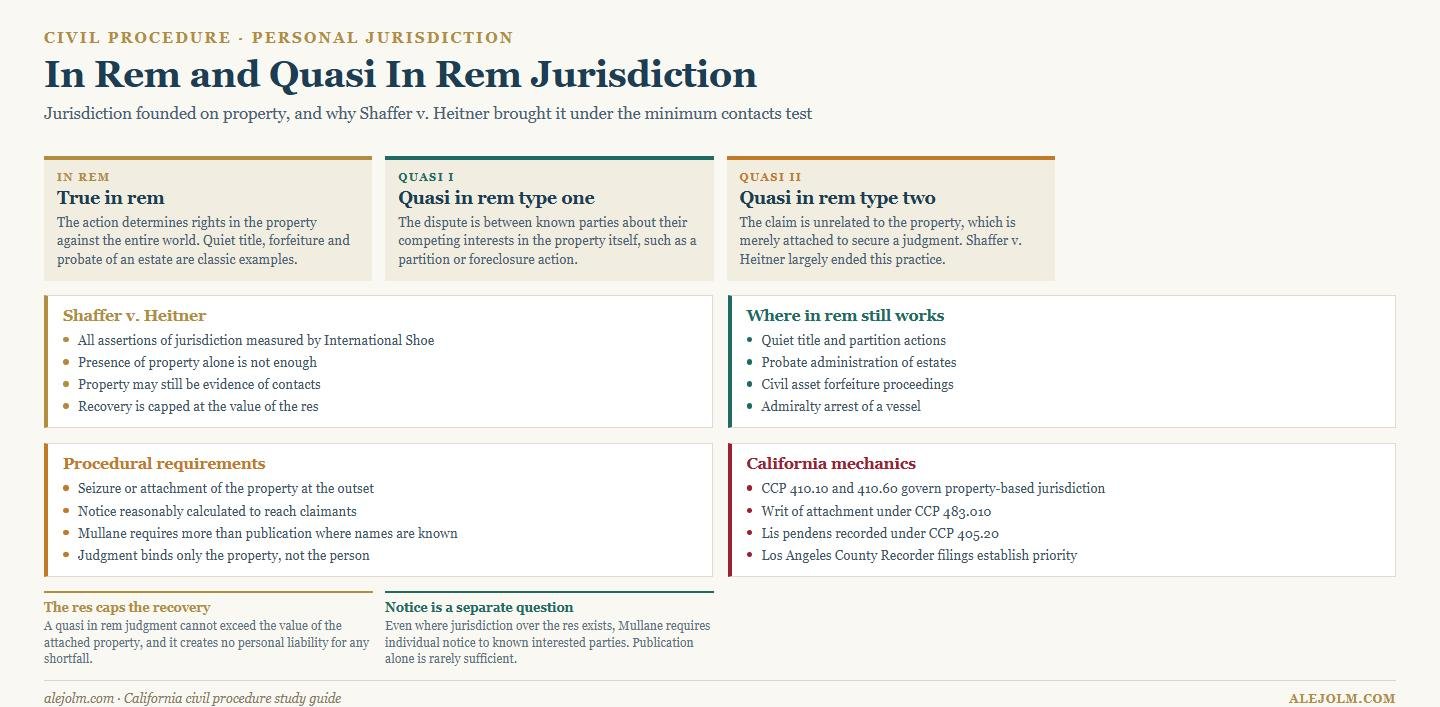
The three traditional categories
True in rem
A true in rem action determines interests in property against the entire world, not just against named opponents. Quiet title actions, civil forfeiture proceedings, admiralty arrests of a vessel and the probate administration of an estate all work this way. Anyone who might claim an interest is bound by the result, provided the notice requirements were satisfied.
Quasi in rem type one
Here the dispute is between identified parties over their competing claims to the property itself. A partition action between co-owners, a judicial foreclosure, or a suit to enforce a mechanic’s lien fall into this category. The judgment resolves the parties’ rights in that specific asset but does not bind strangers to the action.
Quasi in rem type two
This is the category that caused all the trouble. The plaintiff’s claim has nothing to do with the property; the property is simply attached at the outset to create a jurisdictional hook and to secure any eventual recovery. A creditor with a contract claim would attach a bank account or a parcel of land in the forum and sue there, even though the defendant had no other connection to the state.
Shaffer v. Heitner changed the rules
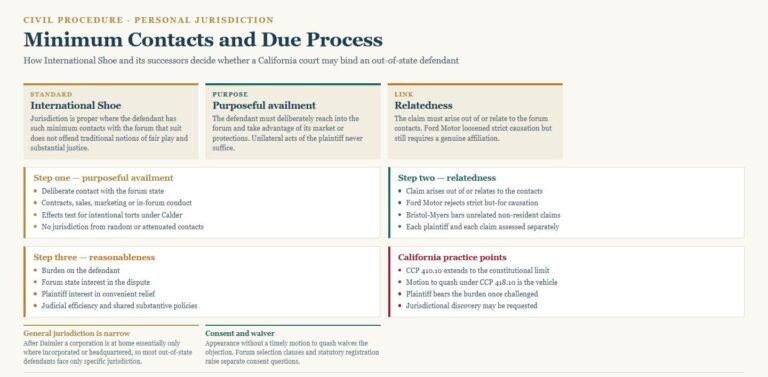
Shaffer v. Heitner involved a shareholder derivative suit filed in Delaware, where jurisdiction rested on the sequestration of stock in a Delaware corporation held by directors who otherwise had no Delaware contacts. The Supreme Court held that all assertions of state court jurisdiction, including those based on property, must be evaluated under the International Shoe minimum contacts standard.
The practical effect was to eliminate most quasi in rem type two jurisdiction. If the defendant has minimum contacts with the forum, the court can simply exercise personal jurisdiction and enter a full judgment; if it does not, attaching an unrelated asset cannot manufacture jurisdiction. True in rem and quasi in rem type one survived largely intact, because in those cases the property is the subject of the dispute and its presence in the forum is itself a meaningful contact.
After Shaffer, property is evidence of contacts rather than a substitute for them.
| Category | What it decides |
|---|---|
| True in rem | Rights in the property against the world |
| Quasi in rem type one | Competing claims to the property |
| Quasi in rem type two | Unrelated claim, property as security |
| Personal jurisdiction | Personal liability of the defendant |
Notice is a separate requirement
Even where jurisdiction over the res is proper, due process independently requires notice reasonably calculated under all the circumstances to apprise interested parties of the action. Mullane v. Central Hanover Bank and Trust Co. established that publication is adequate only for parties whose names and addresses are genuinely unknown. Where a claimant is identifiable from the record, individual mailed notice is required.
- Known claimants: personal service or mailed notice to the last known address.
- Recorded interests: search the county recorder and serve everyone holding a recorded lien or encumbrance.
- Unknown claimants: publication is permitted only after a diligent search, which must be documented.
- Tenants and occupants: often require separate notice in real property actions.
- Government liens: tax authorities and code enforcement agencies must generally be named.
- Proof matters: defective notice makes the resulting judgment vulnerable to collateral attack years later.
A worked example
A supplier in Arizona is owed 300,000 dollars by a Nevada distributor under a contract negotiated and performed entirely in Phoenix. The distributor owns a small warehouse in the City of Industry, in Los Angeles County. The supplier files suit in Los Angeles Superior Court and records a lis pendens against the warehouse, hoping that the property gives the California court jurisdiction.
This is classic quasi in rem type two and it fails. The claim has no connection to the warehouse or to California, and under Shaffer the presence of the property cannot substitute for minimum contacts. The lis pendens is also improper, because Code of Civil Procedure section 405.4 permits it only in an action asserting a real property claim, and a pure contract debt is not one. Expect a successful motion to quash and a motion to expunge the lis pendens, with an award of attorney fees against the supplier. The correct route is to sue in Arizona or Nevada, obtain a judgment, and then domesticate and enforce it against the California warehouse under the Sister State Money Judgments Act.
In Rem Jurisdiction in California and Los Angeles County in 2026
California addresses property-based jurisdiction through Code of Civil Procedure sections 410.10 and 410.60, which permit jurisdiction over a defendant’s interest in property located in the state on any basis not inconsistent with the state or federal constitutions. Because section 410.10 already reaches the constitutional maximum, the analysis again reduces to Shaffer and minimum contacts.
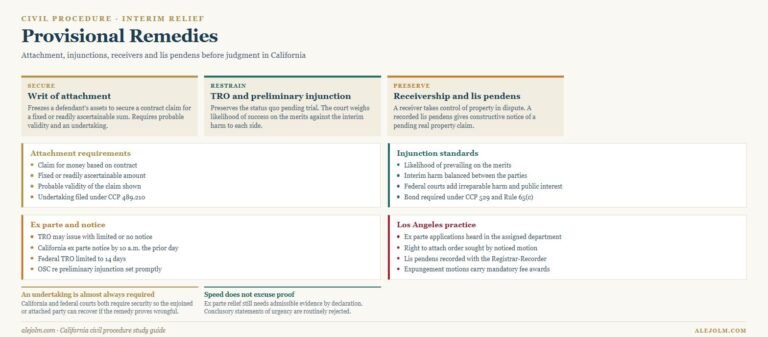
The two workhorse mechanisms in Los Angeles County are the writ of attachment and the notice of pendency of action. Attachment under Code of Civil Procedure section 483.010 is available only in an action for money based on contract where the amount is fixed or readily ascertainable, and against a defendant who is not a natural person unless the obligation arose from that person’s trade or business. It requires a noticed hearing, a showing of probable validity, and an undertaking. Lis pendens under section 405.20 requires a real property claim, must be recorded with the Los Angeles County Registrar-Recorder and served on all parties, and is subject to a powerful expungement motion under section 405.30 in which the claimant bears the burden.
Probate is the other major arena. A Los Angeles Superior Court probate proceeding administering a decedent’s estate is a true in rem action over the assets, handled at the Stanley Mosk Courthouse and the outlying probate departments. Quiet title actions under sections 760.010 and following are likewise in rem as to the property, and the required lis pendens and notice steps must be followed precisely or the judgment can be attacked later by an omitted claimant.
- CCP 483.010: attachment is limited to contract claims for a fixed or readily ascertainable sum.
- Probable validity hearing: attachment requires a noticed motion and an undertaking, not an ex parte filing.
- CCP 405.4: a lis pendens is available only where the pleading asserts a genuine real property claim.
- CCP 405.30: expungement shifts the burden to the claimant and carries mandatory attorney fees against the loser.
- Registrar-Recorder: record in Los Angeles County and serve every party, or the notice is void.
- Judgment caps: a quasi in rem judgment cannot exceed the value of the property and creates no personal liability.
For 2026, verify the current undertaking amounts, recording fees and the Registrar-Recorder’s document formatting requirements before filing, as these are adjusted periodically. Confirm too whether the probate department you are assigned to has its own standing order. Related guides: minimum contacts and due process, service of process and provisional remedies.
Common mistakes to avoid
- Using attachment to create jurisdiction. Shaffer foreclosed that, and the motion to quash will succeed.
- Recording a lis pendens on a money claim. Section 405.4 requires a real property claim, and expungement carries a fee award.
- Relying on publication where claimants are identifiable. Mullane requires a documented diligent search first.
- Expecting a personal judgment from an in rem action. Recovery is capped at the value of the res.
- Skipping the title search. Recorded lienholders who were never served can attack the judgment collaterally.
Frequently asked questions
What is the difference between in rem and personal jurisdiction?
In rem jurisdiction determines rights in property located in the forum and caps any recovery at the value of that property. Personal jurisdiction reaches the defendant directly and supports a judgment enforceable against all of their assets.
Did Shaffer v. Heitner abolish in rem jurisdiction?
No. It required all jurisdiction to satisfy minimum contacts, which eliminated most quasi in rem type two cases but left true in rem and quasi in rem type one actions intact.
Can I attach California property to sue an out-of-state defendant here?
Not as a way of creating jurisdiction. Attachment secures a claim in a case where jurisdiction already exists; it cannot manufacture it.
When is a lis pendens proper in California?
Only when the underlying pleading asserts a real property claim under Code of Civil Procedure section 405.4. Recording one improperly exposes you to expungement and mandatory attorney fees.
Is probate an in rem proceeding?
Yes. Administration of a decedent’s estate operates against the property itself and binds all claimants who received proper notice, which is why the notice requirements are enforced strictly.
Related guides
 Subject Matter Jurisdiction in Federal Court Explained
 Service of Process Under Rule 4: Methods and Waiver
 Stream of Commerce Jurisdiction in California Courts
 Minimum Contacts and Due Process in California Courts
 Easements Explained: Creation, Scope and Termination
 Full Faith and Credit: Recognising Sister-State Judgments
 Provisional Remedies in California Civil Litigation
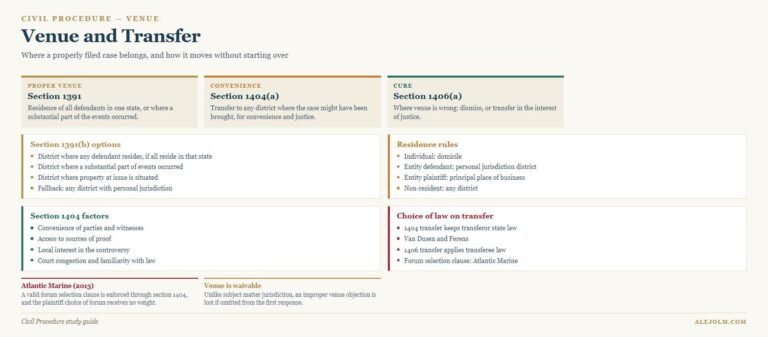 Federal Venue Rules and Transfer Under Section 1404
- The California Long-Arm Statute and Motion to Quash
- Adverse Possession Elements: OCEAN and the Tax Rule
- Specific vs General Personal Jurisdiction Explained
Next steps
Read minimum contacts and due process for the standard that now governs every form of jurisdiction, and provisional remedies for the attachment and injunction mechanics in detail. Recording requirements are published by the Los Angeles County Registrar-Recorder/County Clerk, and the statutes are available at California Legislative Information.