
Service of process is the formal act that brings a defendant under a court’s authority. Without it, personal jurisdiction does not attach, a default judgment is void, and years of work can be undone by a defendant who was never properly told the case existed.
This guide covers what must be served, who may serve it, the methods available for individuals and entities under Federal Rule 4, the ninety-day deadline in Rule 4(m), the waiver procedure that costs a defendant money if refused, and the parallel California statutes that a Los Angeles case will usually run on.
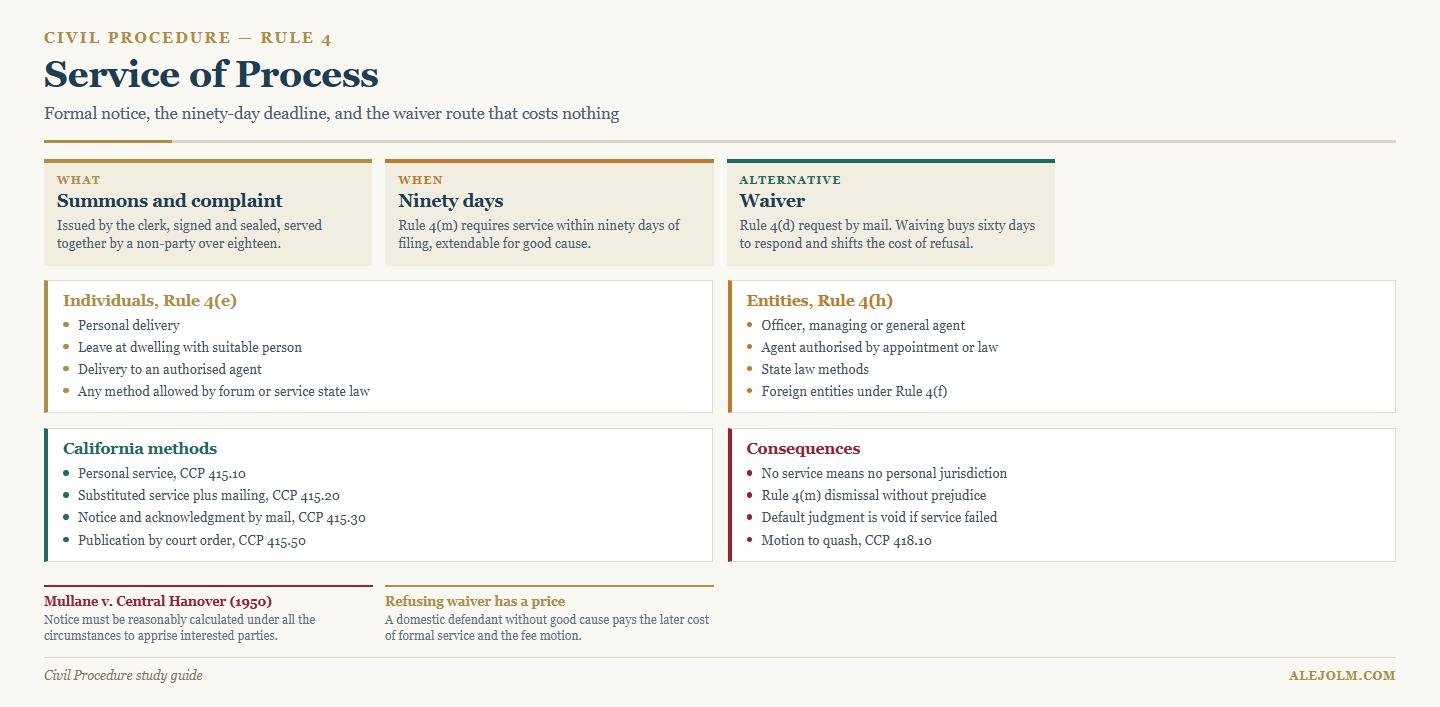
What is served, and by whom
The summons is issued by the clerk, signed and sealed, and served together with a copy of the complaint. Any person who is at least eighteen years old and not a party may effect service; a party never may. The server then files proof of service, normally by affidavit, and a failure of proof does not invalidate otherwise proper service but can be fatal on a default application.
Methods for individuals: Rule 4(e)
- Personal delivery. Handing the papers to the defendant directly, wherever found within the state.
- Abode service. Leaving copies at the defendant’s dwelling or usual place of abode with someone of suitable age and discretion who resides there.
- Agent service. Delivering to an agent authorised by appointment or by law to receive process.
- Borrowed state law. Any method permitted by the law of the state where the district court sits or where service is made, which is why California methods matter in federal cases filed in Los Angeles.
Methods for entities: Rule 4(h)
A domestic or foreign corporation, partnership or association is served by delivering to an officer, a managing or general agent, or an agent authorised by appointment or law, or by any borrowed state law method. Foreign defendants abroad are served under Rule 4(f), which routes through the Hague Service Convention where it applies, through letters rogatory, or through any other means the court orders that is not prohibited by international agreement.
The ninety-day deadline and waiver
Rule 4(m) requires service within ninety days after the complaint is filed. Missing it means dismissal without prejudice or an order setting a new deadline, and the court must extend for good cause. Because a dismissal without prejudice can be fatal where the limitation period has since run, the deadline deserves a calendar entry on the day of filing.
Rule 4(d) offers an alternative. The plaintiff mails a written request to waive service with two copies of the waiver form and a prepaid means of return. A defendant who waives gets sixty days to respond instead of twenty-one, and ninety if outside the United States. A domestic defendant who refuses without good cause must pay the expenses of formal service and the fees of any motion to collect them.
The constitutional floor
Mullane v. Central Hanover Bank & Trust (1950) supplies the due process standard: notice must be reasonably calculated, under all the circumstances, to apprise interested parties of the pendency of the action and afford them an opportunity to present their objections. Publication is acceptable only for parties whose names and addresses are genuinely unknown. Jones v. Flowers (2006) adds that when the sender learns notice has failed, it must take additional reasonable steps.
Federal and California methods compared
| Method | Federal rule |
|---|---|
| Personal delivery | Rule 4(e)(2)(A) |
| Substituted service | Rule 4(e)(2)(B), abode |
| Mail with acknowledgment | Not a stand-alone method |
| Publication | Borrowed state law |
| Corporations | Rule 4(h) |
| Deadline | 90 days, Rule 4(m) |
| Waiver of service | Rule 4(d) |
A worked example
A plaintiff files in the Central District of California and tries three times to serve an individual defendant at his Glendale home. On the fourth attempt the process server leaves the papers with the defendant’s adult sister, who lives there, and mails a copy to the same address the next day. The defendant later moves to quash, saying he never received the papers.
The service stands. Rule 4(e)(1) borrows Code of Civil Procedure section 415.20, which allows substituted service after reasonable diligence by leaving copies with a competent member of the household at least eighteen years old, followed by first-class mail. Actual receipt is not required; what is required is a method reasonably calculated to give notice, which this was. Had the sister been a visitor rather than a resident, the analysis would be different.
Service of process in California and Los Angeles County in 2026
California service law is codified in Code of Civil Procedure sections 413.10 through 417.40, and Los Angeles cases use it constantly — in the superior court because it is the governing law, and in the Central District because Rule 4(e)(1) borrows it. The workhorse is substituted service under section 415.20, which permits leaving papers with a competent adult at the defendant’s dwelling, usual place of business, or usual mailing address other than a post office box, followed by mailing, after reasonable diligence at personal service. Service by that route is deemed complete on the tenth day after mailing.
Two California features have no federal counterpart. Section 415.30 allows service by first-class mail with a notice and acknowledgment of receipt, which is effective only if the defendant signs and returns it, and which exposes a defendant who refuses without good cause to the cost of subsequent service. And the outer deadline is not ninety days but three years under section 583.210, with a mandatory dismissal under section 583.250 if it is missed — although the three-year rule sits alongside the five-year rule for bringing an action to trial, and both should be calendared at intake.
Practical points for a Los Angeles case in 2026:
- Document reasonable diligence. Substituted service requires a genuine effort at personal service first, and Los Angeles judges expect the declaration to describe dates, times and locations.
- Serve entities through the registered agent. Check the current agent on the Secretary of State business search the week you serve, not the week you drafted the complaint.
- Do not skip the mailing. Substituted service is incomplete without it, and the ten-day rule delays the response deadline accordingly.
- Use publication only as a last resort. Section 415.50 requires a court order supported by a declaration of diligence, and defective publication is the most common ground for setting aside a default.
- Watch gated communities and secured buildings. California case law treats a gate guard as a proper substituted service recipient in some circumstances; document the attempt carefully.
- Calendar the dismissal statutes. Three years to serve, five years to bring to trial, and confirm the current text and any tolling before relying on the dates.
For 2026, treat service as evidence-building rather than errand-running. The proof of service declaration is the document a Los Angeles judge will read years later when a defendant asks to set aside a default. Continue with the California long-arm statute and motion to quash, personal jurisdiction and procedural due process.
Common mistakes to avoid
- Letting a party serve the papers. The server must be a non-party at least eighteen years old.
- Treating abode service as delivery to anyone present. The recipient must be of suitable age and discretion and must reside there.
- Assuming waiver is service. A returned waiver dispenses with service; an unreturned request does nothing.
- Missing Rule 4(m). Ninety days passes quickly, and dismissal without prejudice can be effectively with prejudice once the statute of limitations runs.
- Serving a foreign defendant informally. The Hague Convention governs where it applies, and shortcuts produce vacated judgments.
Frequently asked questions
Who may serve process in federal court?
Any person who is at least eighteen years old and is not a party to the action. A United States marshal may be appointed to serve in certain circumstances.
What happens if service is not made within ninety days?
Under Rule 4(m) the court must dismiss without prejudice or order service within a specified time, and it must extend the deadline if the plaintiff shows good cause.
Is a defendant required to waive service?
No, but a domestic defendant who refuses without good cause must pay the expenses of formal service and the fees incurred in any motion to recover them.
Does actual notice cure defective service?
Generally no. Courts require compliance with an authorised method, although some jurisdictions apply substantial compliance where the defect is technical and actual notice is undisputed.
How is a California corporation served?
Usually by delivering the papers to the registered agent for service of process, or to an officer or general manager, under Code of Civil Procedure sections 415.10 and 416.10.
Related guides
 Subject Matter Jurisdiction in Federal Court Explained
 Personal Jurisdiction: The 3-Step Bar Exam Framework
 Federal Venue Rules and Transfer Under Section 1404
- Removal and Remand: Moving a Case to Federal Court
- Res Judicata vs Collateral Estoppel: Bar Exam Guide
- The California Long-Arm Statute and Motion to Quash
- Substantive Due Process After Dobbs: A Two-Step Test
- Specific vs General Personal Jurisdiction Explained
- Access to the Courts: When Filing Fees Are Unconstitutional
- Procedural Due Process: Notice, Hearing and Mathews
- The IRAC Method: How to Structure a Bar Exam Answer
Next steps
With the defendant properly before the court, attention shifts to the pleadings and the motions that test them. Read venue and transfer for where the case will be heard, and the motion to quash for how a defendant attacks defective service.