
Counterclaims and cross-claims are how a defendant stops being purely defensive. A counterclaim goes back against the plaintiff; a cross-claim goes sideways against a co-defendant. One of them can be lost forever if it is not pleaded on time, which makes this one of the few procedural rules where an oversight destroys a substantive right.
California abolished the terminology entirely and folded both devices into a single instrument called the cross-complaint. The concepts survive, but the labels and some of the deadlines differ, and practitioners who move between the Central District of California and the Los Angeles Superior Court need to keep the two systems apart.
Compulsory counterclaims under Rule 13(a)
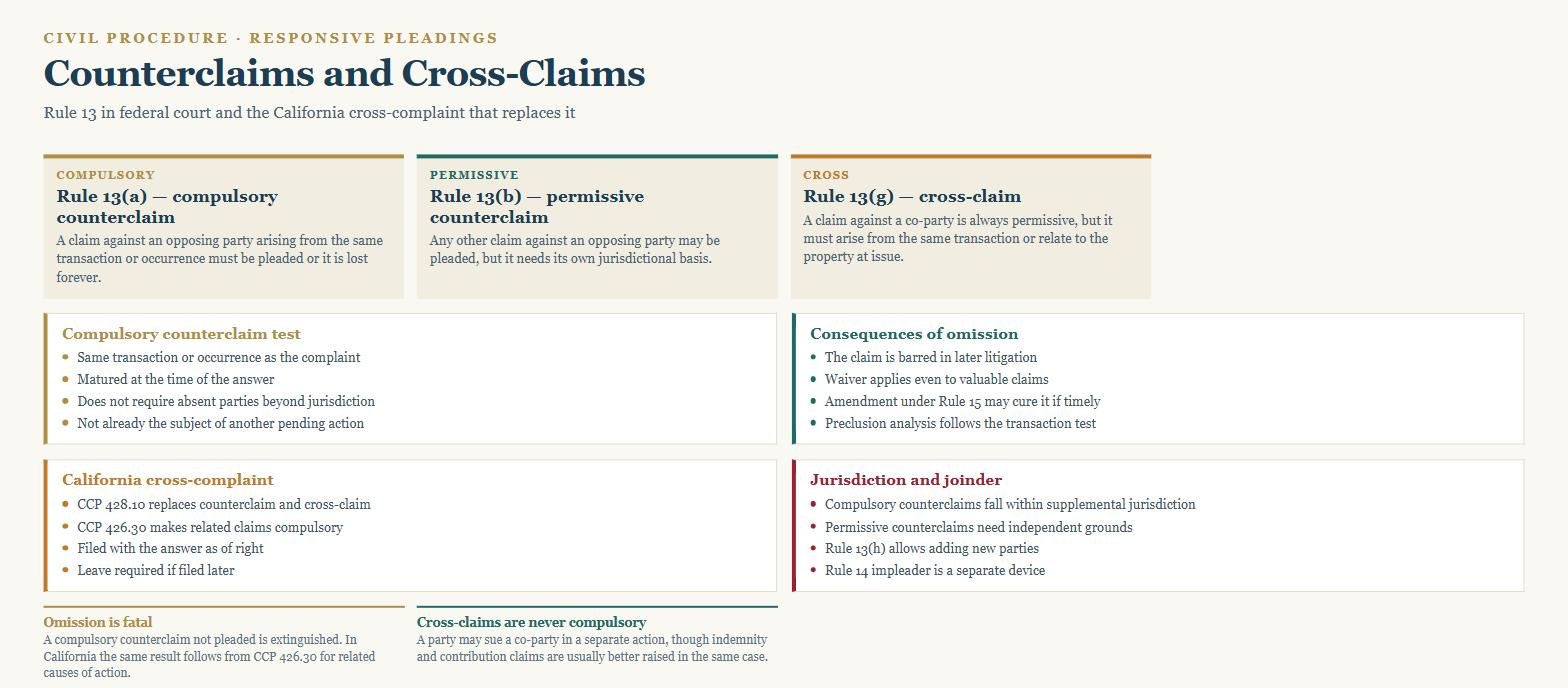
A counterclaim is compulsory if it arises out of the same transaction or occurrence that is the subject matter of the opposing party’s claim, and does not require adding a party over whom the court cannot acquire jurisdiction. If it is compulsory and it is not pleaded, it is barred. The defendant cannot bring it later as a separate action, and the bar applies even where the omitted claim was worth more than the original suit.
Courts apply the same transaction or occurrence test flexibly. The usual questions are whether the issues of fact and law are largely the same, whether res judicata would bar a later suit anyway, whether substantially the same evidence supports or refutes both claims, and whether there is a logical relationship between them. Two exceptions matter: a claim that had not yet matured when the answer was served is not compulsory, and neither is a claim that was already the subject of another pending action.
Permissive counterclaims under Rule 13(b)
Any claim that is not compulsory may still be pleaded. The catch is jurisdictional. A compulsory counterclaim shares a common nucleus of operative fact with the main claim and therefore falls within supplemental jurisdiction under 28 U.S.C. section 1367. A permissive counterclaim, by definition, does not arise from the same transaction, so it generally needs its own independent basis of federal jurisdiction.
Cross-claims under Rule 13(g)
A cross-claim is asserted against a co-party rather than an opposing party. It must arise out of the transaction or occurrence that is the subject matter of the original action or of a counterclaim, or relate to property that is the subject matter of the action. Unlike counterclaims, cross-claims are never compulsory. A defendant may sue a co-defendant for indemnity in a separate case, though there is rarely a good reason to.
The most common cross-claims are for indemnity, contribution and equitable apportionment among joint tortfeasors. Rule 13(h) permits adding new parties to a counterclaim or cross-claim under Rules 19 and 20, and Rule 14 impleader is a related but distinct device for bringing in a non-party who may be liable to the defendant for all or part of the plaintiff’s claim.
| Device | Federal rule |
|---|---|
| Compulsory counterclaim | Rule 13(a) |
| Permissive counterclaim | Rule 13(b) |
| Cross-claim | Rule 13(g) |
| Impleader | Rule 14 |
A worked example
A general contractor sues a Los Angeles restaurant owner for 180,000 dollars in unpaid progress payments. The owner believes the kitchen build-out was defective and that repairs will cost 400,000 dollars. She files an answer denying the allegations, raises the defective work as an affirmative defence of failure of consideration, but pleads no affirmative claim. The case settles on the payment claim. Eighteen months later she sues the contractor for construction defect.
In federal court the second suit is barred. The defect claim arises from the same construction contract and the same work, so it was a compulsory counterclaim under Rule 13(a), and raising the facts as a defence does not preserve the affirmative claim. California reaches the same result through Code of Civil Procedure section 426.30, which bars a later action on any related cause of action the defendant had against the plaintiff at the time of the answer and failed to plead by cross-complaint. Note the practical lesson: pleading the facts defensively is not the same as pleading the claim, and the two must both be done.
Counterclaims and Cross-Claims in California and Los Angeles County in 2026
California does not use the words counterclaim or cross-claim. Code of Civil Procedure section 428.10 authorises a single instrument, the cross-complaint, which can be directed at the plaintiff, at a co-defendant, or at an entirely new party. Section 428.10(a) covers claims against the plaintiff and imposes no relatedness requirement, mirroring the permissive counterclaim. Section 428.10(b) covers claims against co-parties and new parties and requires that the claim arise from the same transaction or occurrence or involve the same property.
The compulsory element lives in section 426.30, the compulsory cross-complaint statute. If a defendant fails to plead a related cause of action it had against the plaintiff at the time it answered, it cannot assert that cause of action in any later lawsuit. Timing is governed by section 428.50: a cross-complaint against the plaintiff must be filed with the answer to be filed as of right, and a cross-complaint against a co-party may be filed at any time before the court sets a trial date. After those windows, leave of court is required and the standard is whether the party acted in good faith.
In Los Angeles Superior Court a cross-complaint requires a first-appearance filing fee from each new cross-defendant and triggers a fresh round of service, which can materially affect the case schedule and the five-year rule under Code of Civil Procedure section 583.310. Construction defect, insurance coverage and multi-party personal injury cases in Los Angeles routinely generate layered cross-complaints, and the court may designate the matter complex if the party structure grows large enough.
- CCP 428.10: the single cross-complaint device replacing both counterclaims and cross-claims.
- CCP 426.30: related causes of action against the plaintiff are compulsory and lost if omitted.
- CCP 428.50: file with the answer as of right; otherwise seek leave and show good faith.
- Good faith standard: California courts are liberal in granting late leave, but do not rely on it.
- New parties: each cross-defendant owes a first appearance fee and must be served afresh.
- Five-year rule: section 583.310 keeps running while cross-complaints expand the case.
For 2026, verify the current Los Angeles Superior Court first appearance and cross-complaint filing fees, which are adjusted periodically, and confirm the current complex case designation criteria before filing a multi-party cross-complaint. Related guides: joinder of claims and parties, pleading standards and res judicata and collateral estoppel.
Common mistakes to avoid
- Pleading the facts only as a defence. An affirmative defence does not preserve an affirmative claim, and the claim is then barred.
- Assuming permissive counterclaims are free. In federal court they usually need their own jurisdictional basis.
- Missing the CCP 428.50 window. Filing with the answer is a right; filing later is a request.
- Confusing a cross-claim with impleader. Rule 13(g) reaches existing co-parties, Rule 14 brings in a new one.
- Overlooking unmatured claims. A claim that had not accrued when the answer was served is not compulsory and can be brought later.
Frequently asked questions
What makes a counterclaim compulsory?
It arises out of the same transaction or occurrence as the plaintiff’s claim, had matured when the answer was served, and does not require joining a party outside the court’s jurisdiction.
What happens if I forget a compulsory counterclaim?
It is barred. You cannot bring it in a later action, and courts apply the bar even where the omitted claim is worth far more than the original suit.
Does California use counterclaims?
No. California replaced counterclaims and cross-claims with a single cross-complaint under Code of Civil Procedure section 428.10, though the compulsory concept survives in section 426.30.
Are cross-claims ever compulsory?
No. A claim against a co-party may always be brought separately, though indemnity and contribution claims are almost always better resolved in the same action.
Can I add a new party by cross-complaint?
Yes. Rule 13(h) allows joinder of additional parties to a counterclaim or cross-claim, and California section 428.10(b) expressly permits a cross-complaint against a person not already a party.
Related guides
 Class Actions Under Rule 23: Certification Explained
 Federal Discovery Rules: Scope, Tools and Sanctions
 Diversity Jurisdiction: Citizenship and Amount Rules
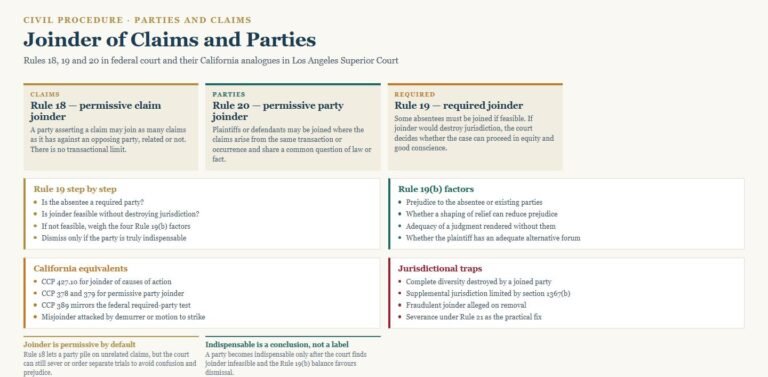 Joinder of Claims and Parties in California Lawsuits
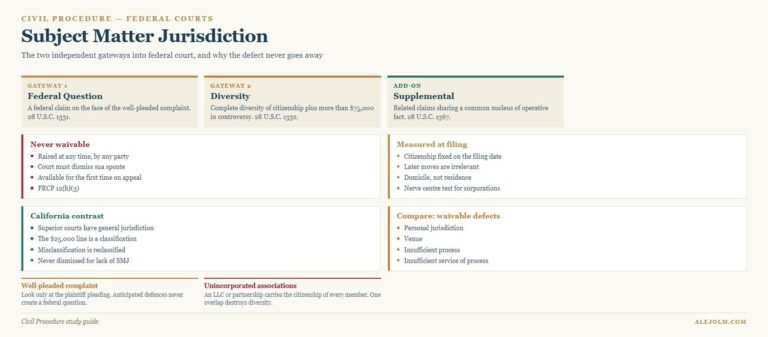 Subject Matter Jurisdiction in Federal Court Explained
- Supplemental Jurisdiction: Common Nucleus Explained
- Dismissal and Default Judgment in California Courts
- Summary Judgment Under Rule 56: Standard and Proof
- Federal Pleading Standards After Twombly and Iqbal
- Res Judicata vs Collateral Estoppel: Bar Exam Guide
- Interpleader Actions in California and Federal Courts
Next steps
Read pleading standards for what a cross-complaint must actually allege, then joinder of claims and parties for the rules on bringing additional parties into the case. The Federal Rules are published by the United States Courts, and Los Angeles filing information is available from the Los Angeles Superior Court.