
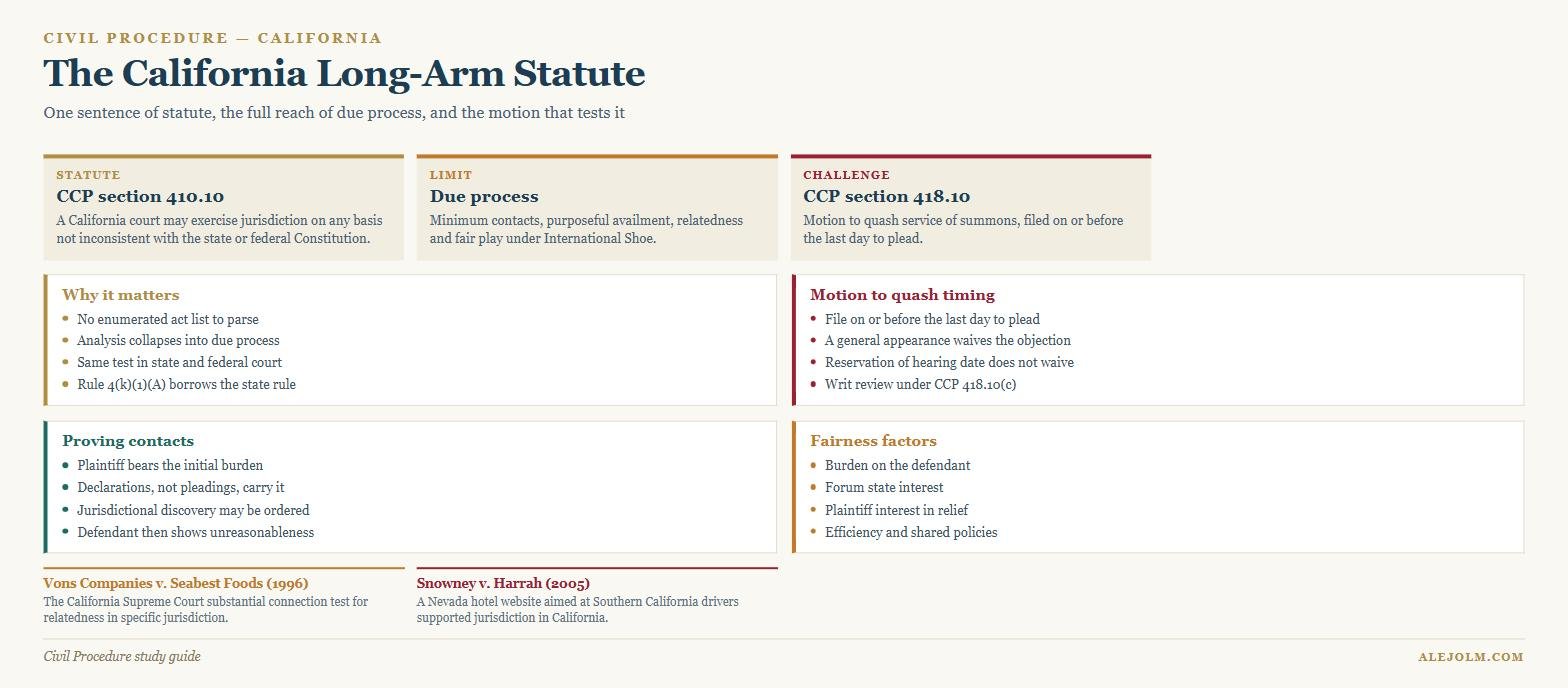
Most states list the acts that expose an out-of-state defendant to suit. California does not. The California long-arm statute is a single sentence in Code of Civil Procedure section 410.10, and it says only that a California court may exercise jurisdiction on any basis not inconsistent with the state or federal Constitution.
That drafting choice has a large consequence: in California there is no statutory analysis separate from the constitutional one. The whole question is due process. This guide explains how that plays out, how the burden of proof shifts, and how a defendant challenges jurisdiction through a motion to quash under section 418.10 without accidentally submitting to the court.
A statute that delegates everything to the Constitution
Enumerated long-arm statutes create two questions: does the defendant’s conduct fall within a listed category, and if so does the exercise of jurisdiction satisfy due process. A defendant can win on either. California collapses the two. Because section 410.10 authorises jurisdiction to the constitutional maximum, a California court asks only whether International Shoe Co. v. Washington (1945) and its successors permit the exercise.
This matters in federal court as well. Rule 4(k)(1)(A) of the Federal Rules borrows the long-arm statute of the state in which the district court sits, so a district judge in the Central District of California applies the same constitutional analysis a superior court judge would.
What due process requires
Specific jurisdiction
California courts use a three-part formulation. The defendant must have purposefully availed itself of California benefits or purposefully directed conduct at California. The controversy must be related to or arise out of those contacts — the California Supreme Court adopted a substantial connection standard in Vons Companies v. Seabest Foods (1996). And the exercise must comport with fair play and substantial justice.
General jurisdiction
After Daimler AG v. Bauman (2014), a corporation is subject to all-purpose jurisdiction only where it is essentially at home: its state of incorporation, its principal place of business, or the exceptional case. Substantial and continuous California sales are not enough, which is why general jurisdiction arguments now fail in most California filings.
The motion to quash under section 418.10
A defendant who wants to contest jurisdiction files a motion to quash service of summons on or before the last day to plead, or within any further time the court allows. The motion is the exclusive vehicle, and it can be combined in the alternative with a motion to stay or dismiss for forum non conveniens.
- Timing. File on or before the last day to plead. Reserving a hearing date beyond that day does not extend the deadline unless the court grants an extension.
- No general appearance first. Answering, demurring or moving to strike before the motion to quash waives the objection. Section 418.10(e) preserves the objection where the motion is filed with other responses in the proper order.
- Evidence, not allegations. The plaintiff bears the initial burden of proving jurisdictional facts by a preponderance, using declarations rather than the complaint.
- Burden shifting. Once minimum contacts are shown, the defendant must present a compelling case that jurisdiction would be unreasonable.
- Jurisdictional discovery. A court may permit limited discovery aimed at the contacts before deciding.
- Review. Section 418.10(c) allows a petition for writ of mandate within ten days after service of the written notice of the order denying the motion.
How the analysis differs from the federal default
| Question | California |
|---|---|
| Statutory analysis | None separate from due process |
| Statute | CCP § 410.10 |
| Challenge vehicle | Motion to quash, CCP § 418.10 |
| Waiver by general appearance | Yes, unless order of filings preserved |
| Interlocutory review | Writ of mandate within 10 days |
| Federal borrowing | Rule 4(k)(1)(A) adopts § 410.10 |
A worked example
An Arizona equipment manufacturer sells through independent distributors. It has no California office, employees or property, but it runs Spanish and English advertising aimed at Southern California contractors, ships directly to job sites in Los Angeles County when asked, and provides warranty service through a Van Nuys repair shop it certifies and trains. A worker injured on a Los Angeles site sues in the superior court.
A motion to quash should fail. The advertising and the certified service arrangement are purposeful direction at California rather than the unilateral activity of a third party, and the claim relates to precisely those contacts. General jurisdiction would be a different matter — nothing here makes the manufacturer at home in California — but the plaintiff does not need it.
The long-arm statute in California and Los Angeles County in 2026
Section 410.10 has been on the books since 1970, and the interesting movement is entirely in the case law. Two decisions from California courts shaped modern practice. Vons Companies v. Seabest Foods (1996) rejected a strict causation test for relatedness in favour of a substantial connection between the forum contacts and the claim, a position the United States Supreme Court effectively vindicated in Ford Motor Co. v. Montana Eighth Judicial District Court (2021). Snowney v. Harrah’s Entertainment (2005) held that Nevada hotels advertising to Southern California drivers had purposefully directed conduct at California.
Pulling the other way, two of the most restrictive modern decisions also came out of California. Daimler AG v. Bauman began in the Northern District of California and ended general jurisdiction based on substantial in-state sales. Bristol-Myers Squibb Co. v. Superior Court (2017) came out of a Los Angeles mass action and held that non-resident plaintiffs could not piggyback on the California claims of resident plaintiffs. Both are routinely cited in Los Angeles motions to quash.
Practical points for a Los Angeles filing in 2026:
- Do not plead general jurisdiction reflexively. After Daimler the at-home paradigms are narrow, and an unsupported general jurisdiction allegation weakens an otherwise strong specific jurisdiction case.
- Plead contacts as facts. A Los Angeles judge deciding a motion to quash reads declarations. Advertising, shipping records, service arrangements and website targeting belong in a declaration with exhibits.
- Watch the last day to plead. Calendar it from the actual service date, and remember that a stipulated extension to respond should expressly cover the motion to quash.
- Preserve the objection in the right order. Under section 418.10(e) a motion to quash may be filed together with other pleadings, but a stand-alone demurrer filed first is a general appearance.
- Consider forum non conveniens in the alternative. The same motion can ask the court to stay or dismiss on that basis, which sometimes succeeds where the jurisdictional challenge does not.
- Check the current writ deadline and local rules. The ten-day window in section 418.10(c) is short; confirm the filing requirements with the Second Appellate District before you need them.
For 2026, treat California jurisdictional practice as a due process exercise with a distinctive procedural wrapper. The constitutional test is the same one every federal court applies; what is different is the deadline, the vehicle and the way an inadvertent appearance forfeits the point. Continue with specific and general jurisdiction, the personal jurisdiction framework and procedural due process.
Common mistakes to avoid
- Looking for an enumerated act. There is no list in section 410.10; the analysis is constitutional from the first line.
- Appearing generally by accident. A demurrer, an answer or an unqualified motion to strike filed first waives the objection.
- Relying on the complaint. Jurisdictional facts must be proved by declaration, not alleged.
- Assuming a website is enough. A passive site rarely supports jurisdiction; targeting, interactivity and forum-specific commerce do.
- Missing the ten-day writ window. An order denying the motion is not appealable, and the writ deadline is unforgiving.
Frequently asked questions
What does California Code of Civil Procedure section 410.10 say?
It authorises California courts to exercise jurisdiction on any basis not inconsistent with the Constitution of California or of the United States, which means the statutory reach and the constitutional limit are identical.
Is a motion to quash the same as a motion to dismiss?
Not quite. In California a defendant challenges personal jurisdiction or defective service by moving to quash service of summons under section 418.10 rather than by demurrer, and the motion may be combined with a forum non conveniens request.
Who has the burden of proof?
The plaintiff must first establish jurisdictional facts by a preponderance of the evidence. If that is done, the defendant must show that jurisdiction would nonetheless be unreasonable.
Can a defendant obtain discovery before the hearing?
Yes. Courts may allow limited jurisdictional discovery where the plaintiff shows that discovery is likely to produce evidence of contacts.
Does the same statute apply in federal court in California?
Yes. Federal Rule 4(k)(1)(A) borrows the forum state long-arm statute, so a district court sitting in California applies section 410.10 and the same constitutional analysis.
Related guides
- Specific vs General Personal Jurisdiction Explained
- Personal Jurisdiction: The 3-Step Bar Exam Framework
- Subject Matter Jurisdiction in Federal Court Explained
- Removal and Remand: Moving a Case to Federal Court
- Diversity Jurisdiction: Citizenship and Amount Rules
- Procedural Due Process: Notice, Hearing and Mathews
- The Erie Doctrine Explained: A 4-Step Bar Exam Guide
- Full Faith and Credit: Recognising Sister-State Judgments
- Access to the Courts: When Filing Fees Are Unconstitutional
- Substantive Due Process After Dobbs: A Two-Step Test
- The IRAC Method: How to Structure a Bar Exam Answer
Next steps
With the statute out of the way, the substance of the analysis is the split between claim-linked and all-purpose contacts. Read specific and general jurisdiction next, then the full personal jurisdiction framework.