
Jurisdiction asks whether a court system may hear a case. Venue asks something narrower and more practical: which courthouse inside that system is the right one. A case can satisfy every jurisdictional requirement and still be in the wrong district.
This guide covers the venue options in 28 U.S.C. § 1391, how residence is calculated for individuals and entities, transfer for convenience under section 1404(a), cure of improper venue under section 1406(a), the choice of law consequences of each, and the special treatment of forum selection clauses after Atlantic Marine.
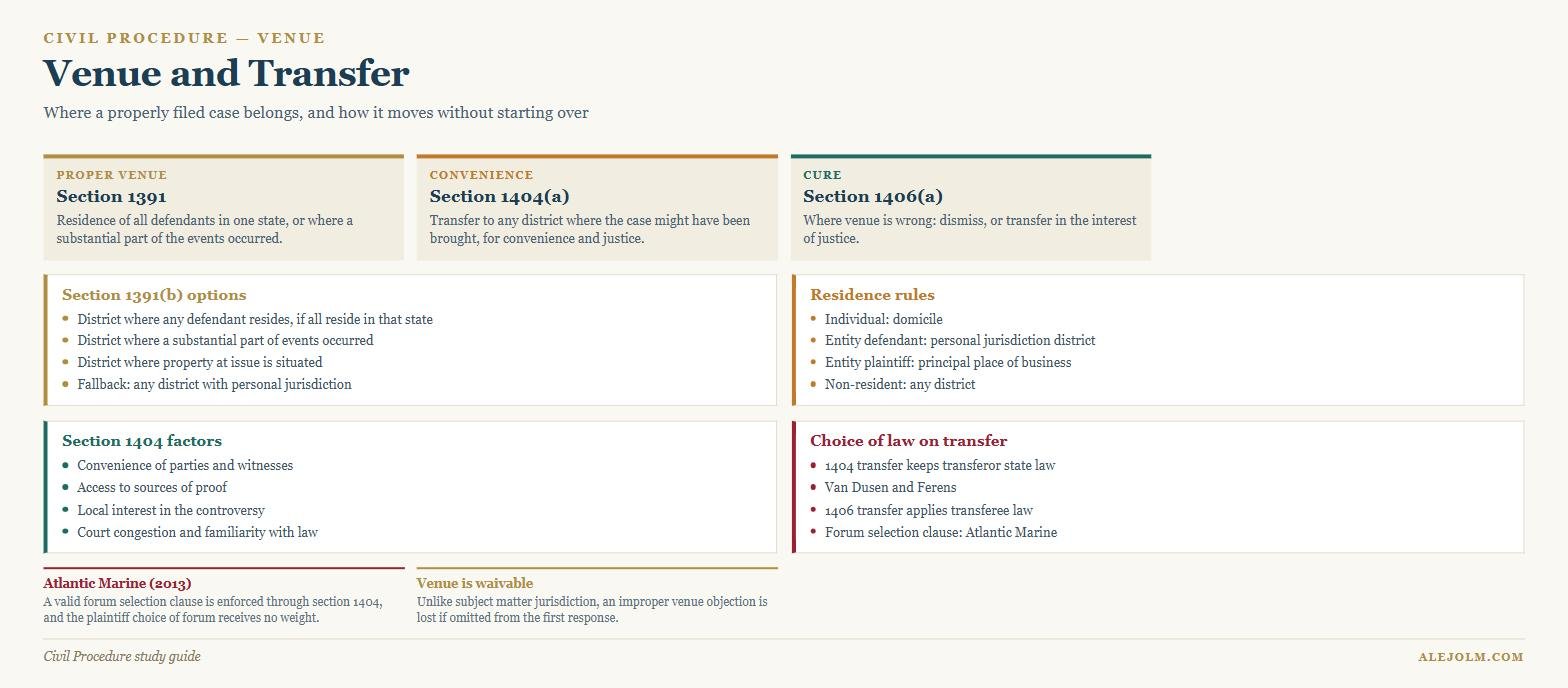
Where venue is proper
Section 1391(b) offers three possibilities, and the plaintiff may use any that fits.
- Defendant residence. A judicial district in which any defendant resides, provided all defendants reside in the same state.
- Events or property. A district in which a substantial part of the events or omissions giving rise to the claim occurred, or a substantial part of the property at issue is situated. More than one district can qualify.
- Fallback. If neither works anywhere, any district in which any defendant is subject to personal jurisdiction with respect to the action.
Residence is defined by section 1391(c). An individual resides in the district of her domicile. An entity defendant resides in any district where it is subject to personal jurisdiction with respect to the action, which in a multi-district state means the district-by-district contacts analysis of section 1391(d). An entity plaintiff resides only in the district of its principal place of business. A defendant not resident in the United States may be sued in any district.
Transfer for convenience: section 1404(a)
Where venue is proper but inconvenient, a district court may transfer to any other district where the action might have been brought, or to which all parties have consented, for the convenience of parties and witnesses and in the interest of justice. Courts weigh private factors — access to proof, availability of compulsory process, cost of attendance for willing witnesses, practical trial problems — and public factors including court congestion, the local interest in deciding local controversies, and the transferee court’s familiarity with the governing law.
The choice of law consequence
This is the part examiners love. Under Van Dusen v. Barrack (1964) and Ferens v. John Deere (1990), a section 1404(a) transfer carries the transferor state’s choice of law rules with it, whichever party moved. The transferee court applies the law the original court would have applied. A section 1406(a) transfer, by contrast, cures a defect, and the transferee court applies its own state’s choice of law rules.
Improper venue: section 1406(a) and Rule 12
A district in which venue is wrong must dismiss, or, in the interest of justice, transfer to any district in which it could have been brought. Transfer is usually preferred, particularly where refiling would be time-barred. The objection itself is waivable: under Rule 12(h)(1) improper venue is lost unless raised in the first Rule 12 motion or in the responsive pleading. That is the sharpest contrast with subject matter jurisdiction.
Forum selection clauses
Atlantic Marine Construction Co. v. U.S. District Court (2013) settled the mechanics. A valid clause does not make venue improper, so section 1406 and Rule 12(b)(3) are the wrong tools. The clause is enforced through section 1404(a), with three adjustments: the plaintiff’s choice of forum receives no weight, private interest factors are treated as having been resolved by the contract, and the transfer does not carry the original choice of law rules.
Venue compared with the other threshold defences
| Doctrine | Source |
|---|---|
| Subject matter jurisdiction | Art. III and statute |
| Personal jurisdiction | Due process and long-arm |
| Venue | 28 U.S.C. § 1391 |
| Inconvenient venue | 28 U.S.C. § 1404(a) |
| Forum non conveniens | Common law |
A worked example
A Nevada plaintiff sues two defendants over a construction failure at a warehouse in Fontana. One defendant is domiciled in San Diego, the other in Sacramento. The plaintiff files in the Southern District of California.
Venue is proper under section 1391(b)(1): both defendants reside in California, and one resides in the Southern District. But a substantial part of the events occurred in the Central District, where the building, the witnesses and the records are. A section 1404(a) motion is likely to succeed on the private and public factors, and because the transfer is for convenience rather than cure, California choice of law rules travel with the case — which changes nothing here, but would matter if the transfer crossed a state line.
Venue and transfer in California and Los Angeles County in 2026
California has four federal districts, and the Central District alone covers seven counties and more than nineteen million people. It is divided into the Western Division in downtown Los Angeles, the Southern Division in Santa Ana and the Eastern Division in Riverside, and its general order on assignment sends cases to a division based on where the events occurred or where the defendants reside. Intra-district transfer between divisions is common and is handled under the same section 1404(a) standard.
State court venue in California follows an entirely different statute. Code of Civil Procedure sections 392 to 401 fix venue by county rather than by district, with the general rule in section 395 pointing to the county where any defendant resides at the commencement of the action, and special rules for contract actions, personal injury, real property and corporate defendants. The challenge is a motion to transfer under section 397, and unlike the federal rule, a California defendant who moves for change of venue on the ground that the county is not proper may recover costs and, in some circumstances, attorney fees under section 396b.
Practical points for a 2026 Los Angeles matter:
- Check the division, not just the district. Filing a San Bernardino dispute in the Western Division invites an intra-district transfer and delay.
- In state court, plead the venue facts. California requires the complaint to show the county is proper, and a bare allegation invites a section 397 motion.
- Use the events option deliberately. Section 1391(b)(2) frequently makes Los Angeles proper for a nationwide defendant because contracting, marketing or performance happened here.
- Treat forum selection clauses as section 1404 problems. After Atlantic Marine, moving under Rule 12(b)(3) is a procedural error even when the clause plainly points elsewhere.
- Remember the entertainment and consumer clauses. Los Angeles contracts frequently designate Los Angeles County, and California has statutes restricting forum clauses in certain employment and consumer settings; verify the current text before drafting or opposing.
- Confirm current local rules and general orders. Both the Central District and the Los Angeles Superior Court revise assignment and filing rules regularly, so check them at the time of filing.
For 2026, treat venue as a strategic choice made at the drafting stage rather than a technicality resolved later. Deciding between the Stanley Mosk Courthouse, the Western Division and a distant district shapes the jury pool, the pace and sometimes the governing law. Continue with removal and remand, personal jurisdiction and the Erie doctrine.
Common mistakes to avoid
- Confusing venue with jurisdiction. Proper venue does not supply personal jurisdiction, and personal jurisdiction does not make venue proper.
- Assuming only one district qualifies. Section 1391(b)(2) frequently makes several districts proper at once.
- Reaching the fallback too soon. Section 1391(b)(3) applies only if neither of the first two options works in any district.
- Forgetting the choice of law difference. Section 1404 transfers carry the transferor law; section 1406 transfers do not.
- Waiving the objection. Improper venue must be raised in the first Rule 12 filing or it is gone.
Frequently asked questions
Can venue be proper in more than one district?
Yes. Where a substantial part of the events occurred in several districts, each is a proper venue, and the plaintiff chooses among them.
What is the difference between section 1404 and section 1406?
Section 1404 transfers a properly venued case for convenience. Section 1406 deals with improper venue, allowing dismissal or transfer in the interest of justice, and it changes the applicable choice of law rules.
Does transfer change the governing substantive law?
Under Van Dusen and Ferens a section 1404 transfer does not: the transferee court applies the transferor state choice of law rules. A section 1406 transfer does change them.
How are forum selection clauses enforced?
Through section 1404(a) after Atlantic Marine. The clause is given controlling weight in all but the most exceptional cases, and the plaintiff choice of forum is disregarded.
What is forum non conveniens today?
Because transfer handles domestic inconvenience, the common law doctrine now applies mainly where the more convenient forum is a foreign country or a state court that cannot receive a federal transfer.
Related guides
 Personal Jurisdiction: The 3-Step Bar Exam Framework
 Service of Process Under Rule 4: Methods and Waiver
 Subject Matter Jurisdiction in Federal Court Explained
 The Erie Doctrine Explained: A 4-Step Bar Exam Guide
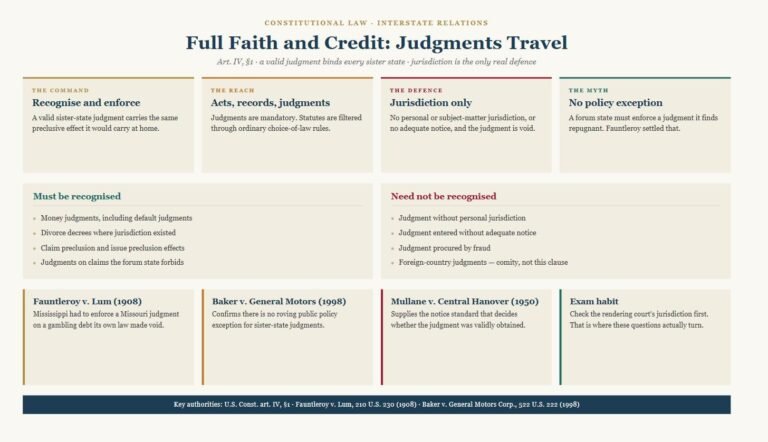 Full Faith and Credit: Recognising Sister-State Judgments
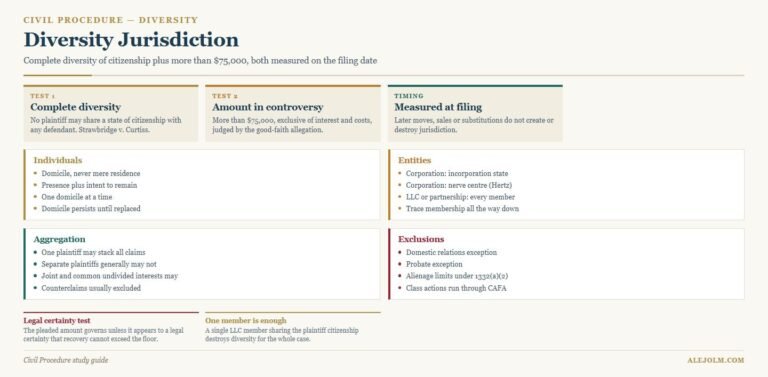 Diversity Jurisdiction: Citizenship and Amount Rules
- The California Long-Arm Statute and Motion to Quash
- Removal and Remand: Moving a Case to Federal Court
- The IRAC Method: How to Structure a Bar Exam Answer
- Res Judicata vs Collateral Estoppel: Bar Exam Guide
- Specific vs General Personal Jurisdiction Explained
Next steps
Venue decides where the case sits. The next mechanical step is telling the defendant it exists. Read service of process under Rule 4, which is where a surprising number of otherwise strong cases fall apart.