
Subject matter jurisdiction is the single question a federal court must answer before it does anything else: does this court have the power to decide this kind of dispute at all? Unlike almost every other procedural objection, it cannot be waived, bargained away or overlooked. A verdict returned after a four-week trial is worth nothing if the court never had subject matter jurisdiction in the first place.
This guide explains the two independent statutory gateways into federal court, the timing rule that decides citizenship, the supplemental jurisdiction add-on, and the way California superior courts handle the same problem from the opposite direction. It closes with a practical section on how the question actually plays out in Los Angeles County in 2026.
What subject matter jurisdiction actually is
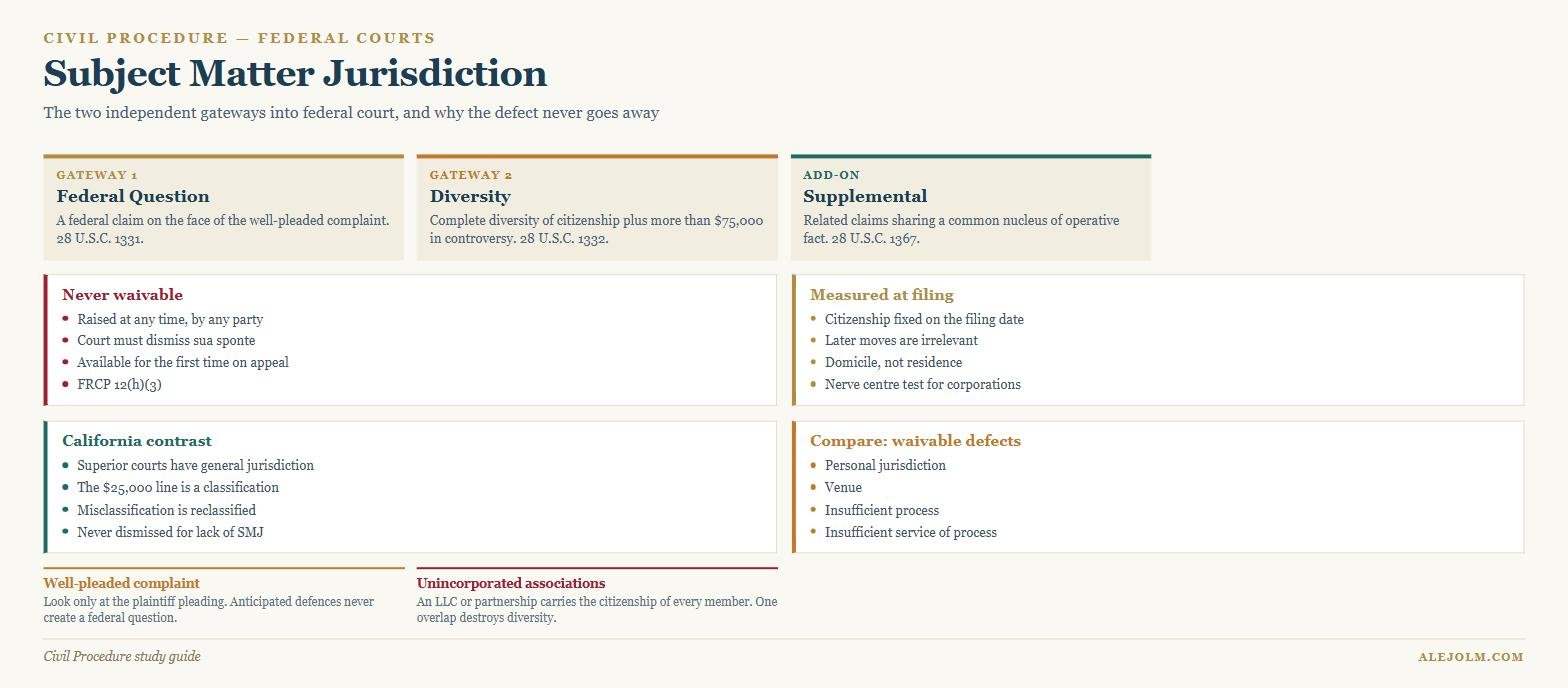
Federal courts are courts of limited jurisdiction. A case must fall inside the judicial power granted by Article III of the Constitution and inside a jurisdictional statute passed by Congress. Both conditions are necessary; neither alone is sufficient. State courts, by contrast, start from a presumption of competence and lose jurisdiction only where a subject has been committed exclusively elsewhere, such as bankruptcy or patent claims.
Because the limit is structural rather than personal, no party can create jurisdiction by agreement. A forum-selection clause naming a federal district court is unenforceable if the claim has no federal basis. A defendant who litigates for three years without objecting has forfeited nothing. And the judge has an independent duty to police the boundary, dismissing on her own motion under Rule 12(h)(3) the moment a defect appears.
Gateway one: federal question jurisdiction
Under 28 U.S.C. § 1331, district courts hear civil actions arising under the Constitution, laws or treaties of the United States. The test is the well-pleaded complaint rule from Louisville & Nashville R.R. v. Mottley (1908): the federal ingredient must appear on the face of the claim the plaintiff chose to plead.
That rule is narrower than it looks. An anticipated federal defence does not count. A federal counterclaim does not count. A plaintiff who could have pleaded a federal theory but deliberately pleaded only state law has, in the ordinary case, defeated federal question jurisdiction — a tactic often used to keep a case out of removal range. The narrow escape valve recognised in Grable & Sons Metal Products v. Darue Engineering (2005) applies only where a state-law claim necessarily raises a disputed and substantial federal issue that a federal forum can resolve without upsetting the balance struck by Congress.
Gateway two: diversity jurisdiction
28 U.S.C. § 1332 requires two things at once: complete diversity of citizenship under Strawbridge v. Curtiss (1806), and an amount in controversy exceeding $75,000. Complete diversity means no plaintiff shares a state of citizenship with any defendant — not a majority, not most, none.
How citizenship is calculated
- Individuals. Citizenship is domicile: physical presence plus intent to remain indefinitely. A software engineer who relocates from Texas to Los Angeles on a two-year contract while keeping a house and voter registration in Austin is probably still a Texan.
- Corporations. Dual citizenship — the state of incorporation and the principal place of business, which after Hertz Corp. v. Friend (2010) means the nerve centre where the officers direct and control the company, not where the most employees work.
- Unincorporated associations. An LLC, partnership or union carries the citizenship of every one of its members, traced all the way down. A single member in the plaintiff’s home state destroys diversity.
- Legal representatives. The representative of a decedent, infant or incompetent takes the citizenship of the person represented, not her own.
Citizenship is fixed at the moment of filing. A defendant who moves across the country the week after service changes nothing. The amount in controversy is judged by the plaintiff’s good-faith allegation and fails only if it appears to a legal certainty that recovery cannot exceed the threshold. A single plaintiff may aggregate all of her claims against a single defendant; separate plaintiffs generally may not aggregate distinct claims.
The add-on: supplemental jurisdiction
Section 1367 lets a court that already has jurisdiction over one claim reach related claims forming part of the same case or controversy — the common nucleus of operative fact test from United Mine Workers v. Gibbs (1966). Two limits matter. Subsection (b) withdraws supplemental jurisdiction over certain claims by plaintiffs in diversity cases, so the complete diversity rule cannot be circumvented through joinder. Subsection (c) gives the court discretion to decline where the state claim raises a novel issue, substantially predominates, or the anchor federal claim has been dismissed early.
Waivable and non-waivable defects side by side
| Defect | Rule |
|---|---|
| Subject matter jurisdiction | FRCP 12(b)(1), 12(h)(3) |
| Personal jurisdiction | FRCP 12(b)(2) |
| Venue | FRCP 12(b)(3) |
| Insufficient process | FRCP 12(b)(4) |
| Insufficient service | FRCP 12(b)(5) |
| Failure to state a claim | FRCP 12(b)(6) |
A worked example
A California resident sues a Delaware corporation headquartered in Sacramento and a New York LLC in the Central District of California, pleading only state-law fraud, and invokes diversity. The parties litigate for two years and the plaintiff wins a jury verdict of $2.1 million. On appeal the defendants reveal for the first time that one member of the New York LLC is domiciled in California.
The result is severe. The corporation is already a California citizen through its nerve centre, so complete diversity failed at filing regardless of the LLC. The appellate court must consider the objection even though nobody raised it below, must vacate the judgment, and must order dismissal. Two years of work and a seven-figure verdict evaporate — the clearest possible demonstration of why counsel should map citizenship of every entity member before filing rather than after.
Subject matter jurisdiction in California and Los Angeles County in 2026
California approaches the same question from the opposite direction. Article VI, section 10 of the California Constitution gives superior courts original jurisdiction in all causes except those given by statute to other trial courts. There is no federal-style gatekeeping, no amount-in-controversy floor, and no need to identify a statutory grant before filing. The Superior Court of Los Angeles County — the largest unified trial court in the United States, with roughly three dozen courthouses from Chatsworth to Long Beach — can hear essentially any civil dispute a Californian brings to it.
What California does have is a classification system, and this is where practitioners trained on federal doctrine most often stumble. Code of Civil Procedure sections 85 to 88 divide civil cases into limited and unlimited. Senate Bill 71 raised the limited civil ceiling from $25,000 to $35,000 with effect from 1 January 2024, and small claims limits moved at the same time; confirm the figure that applies to your filing date on the Los Angeles Superior Court website, because these amounts are revisited by the Legislature. Crucially, filing in the wrong track is not a jurisdictional defect. Under section 403.040 the case is reclassified, not dismissed, and Ytuarte v. Superior Court (2005) sets the standard the court applies.
The federal side of the same map matters just as much in Los Angeles. Cases removed from the Stanley Mosk Courthouse land in the United States District Court for the Central District of California, one of the busiest districts in the country, and the entity-citizenship traps described above bite hardest here because so many Los Angeles businesses are structured as LLCs with members scattered across several states. Points to keep in front of you in 2026:
- Never plead the federal amount in a superior court complaint. The $75,000 diversity threshold has no California analogue, and reciting it invites an unnecessary removal fight.
- Check the limited or unlimited box deliberately. Limited civil cases carry sharply restricted discovery, so a mis-classified case can lose depositions it needed; reclassification under CCP section 403.040 fixes the track but not lost time.
- Trace every LLC member before filing in Los Angeles. A single member domiciled in California defeats diversity and makes removal from the Mosk Courthouse impossible.
- Watch the thirty-day removal clock. Removal to the Central District runs from service of the initial pleading, or from the first paper revealing removability, and Los Angeles service-of-process patterns often make that second trigger the operative one.
- Remember probate, family and juvenile assignments. These are departments of the same superior court, not separate jurisdictions, so a jurisdictional objection is almost always really a venue or assignment argument.
- Confirm current filing fees and the electronic filing rules. Los Angeles mandates e-filing in most civil case types and the fee schedule changes; verify both with the court before the deadline rather than after.
For 2026, treat California general jurisdiction and federal limited jurisdiction as two different operating systems rather than two versions of the same rule. If your matter may end up in federal court, run the citizenship analysis before you draft; if it will stay in Los Angeles, focus on classification and assignment instead. Related reading: the personal jurisdiction framework, the Erie doctrine and the abstention doctrines.
Common mistakes to avoid
- Treating all Rule 12 defences alike. Only subject matter jurisdiction survives silence. Personal jurisdiction, venue, process and service are gone if omitted from the first response.
- Looking at the defence for a federal question. The well-pleaded complaint rule confines you to the plaintiff’s own pleading.
- Treating an LLC like a corporation. It is not a two-citizenship entity; it takes on the citizenship of every member.
- Letting post-filing events matter. Diversity is measured once, at filing, and later changes are irrelevant absent bad faith.
- Assuming supplemental jurisdiction is automatic. Section 1367(b) carves out plaintiff-side claims in diversity cases and 1367(c) leaves the court discretion to decline.
Frequently asked questions
Can the parties agree to give a federal court subject matter jurisdiction?
No. Consent, stipulation, waiver and forfeiture are all ineffective. The limit protects the constitutional allocation of judicial power, not the parties, so only Congress and Article III can supply it.
What happens if the defect is found after judgment?
The judgment is vacated and the case dismissed without prejudice to refiling in a competent court, although the limitations period may have run in the meantime. This is why the objection is so dangerous late in a case.
Does a California superior court ever lack subject matter jurisdiction?
Rarely, and only where a subject is committed exclusively to another forum — bankruptcy, most patent and copyright claims, and certain federal statutory schemes. Filing in the wrong civil track is a classification error, not a jurisdictional one.
Is the amount in controversy ever relevant in California?
Not for jurisdiction. It determines whether a case is limited or unlimited civil, which governs discovery and procedure, and it determines small claims eligibility. Confirm the current thresholds with the court, as the Legislature adjusts them.
How does removal interact with subject matter jurisdiction?
A case may be removed only if the federal court would have had original jurisdiction. If it would not, the case is remanded, and a remand for lack of subject matter jurisdiction may be ordered at any time before final judgment.
Related guides
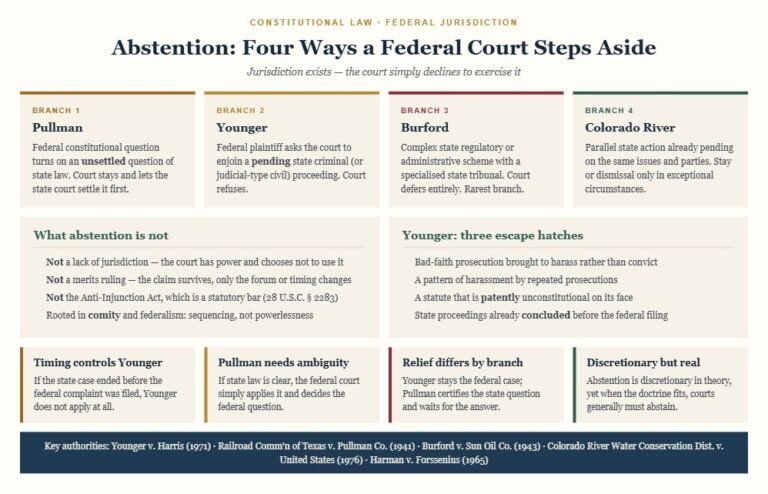 Abstention Doctrine: 4 Ways Federal Courts Step Aside
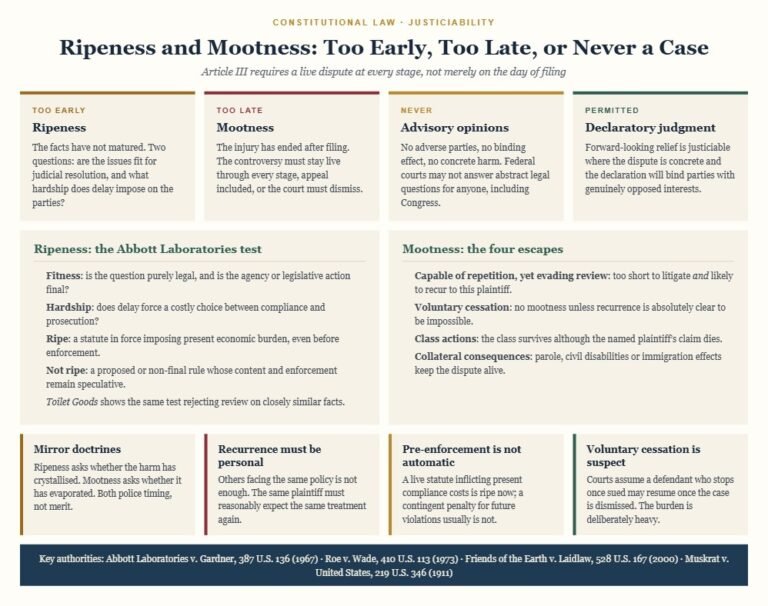 Ripeness and Mootness: Timing Rules in Federal Court
 Personal Jurisdiction: The 3-Step Bar Exam Framework
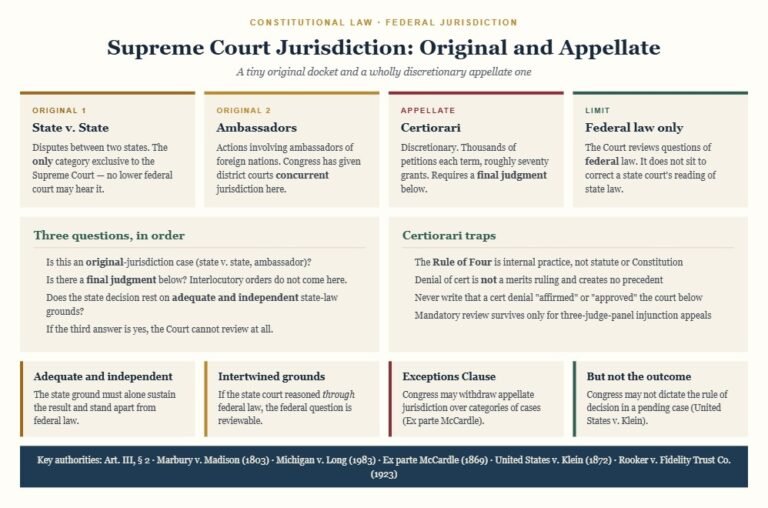 Supreme Court Jurisdiction: Original vs Appellate Power
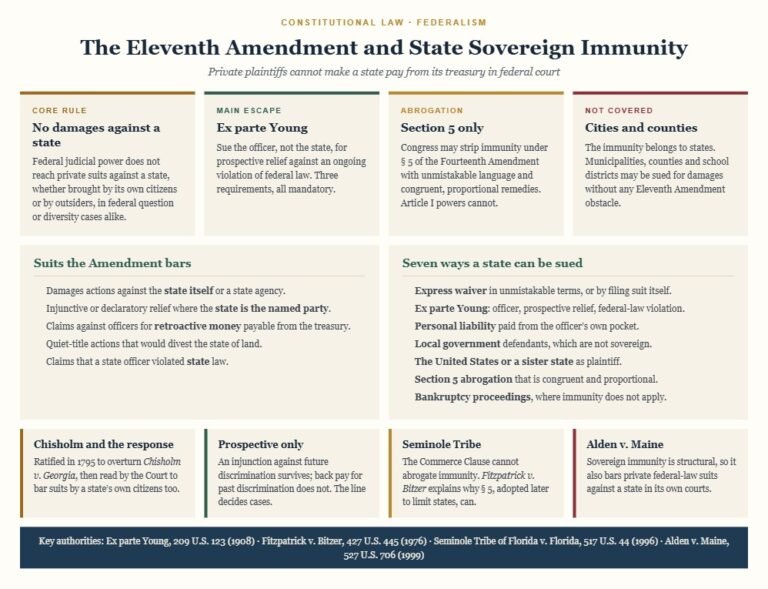 The Eleventh Amendment and State Sovereign Immunity
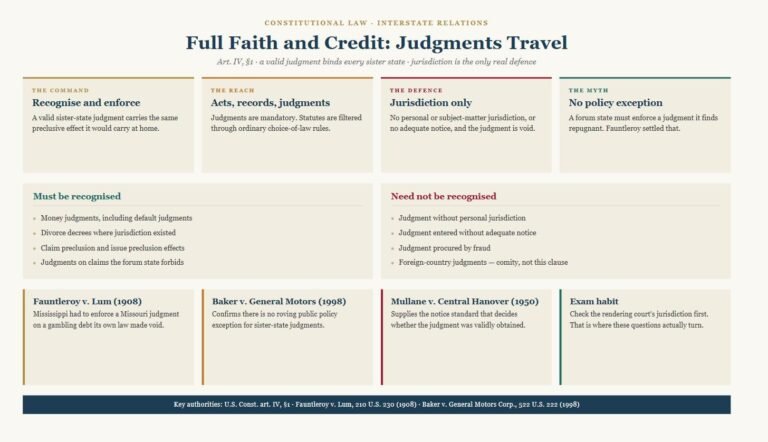 Full Faith and Credit: Recognising Sister-State Judgments
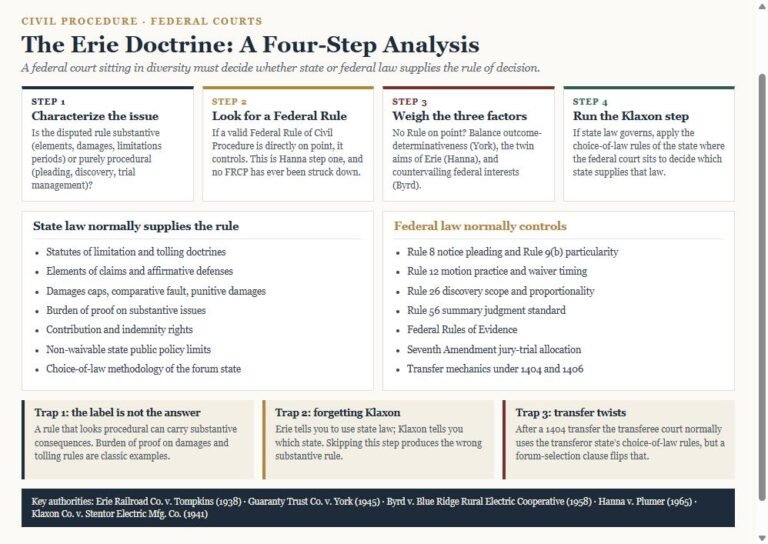 The Erie Doctrine Explained: A 4-Step Bar Exam Guide
- The IRAC Method: How to Structure a Bar Exam Answer
- Access to the Courts: When Filing Fees Are Unconstitutional
- Standing in Federal Court: The 3-Part Article III Test
- Res Judicata vs Collateral Estoppel: Bar Exam Guide
Next steps
Build the habit of running the jurisdictional checklist before anything else: identify the statutory basis, fix citizenship as of the filing date, trace entity members, and confirm that the classification or track matches the relief sought. Then move on to personal jurisdiction, which asks an entirely different question about the defendant rather than the case.