
Provisional remedies are the tools that keep a lawsuit from becoming worthless before it is decided. Litigation takes years. Assets can be moved, buildings can be demolished, trade secrets can be published, and a defendant who sees a judgment coming has both the time and the motive to make itself judgment proof.
California provides a specific and well-defined set of interim measures for each of those problems, and each carries its own showing, its own undertaking requirement and its own risk if you get it wrong. This guide covers attachment, temporary restraining orders and preliminary injunctions, receivership and lis pendens, with the Los Angeles Superior Court mechanics that govern how these applications are actually heard.
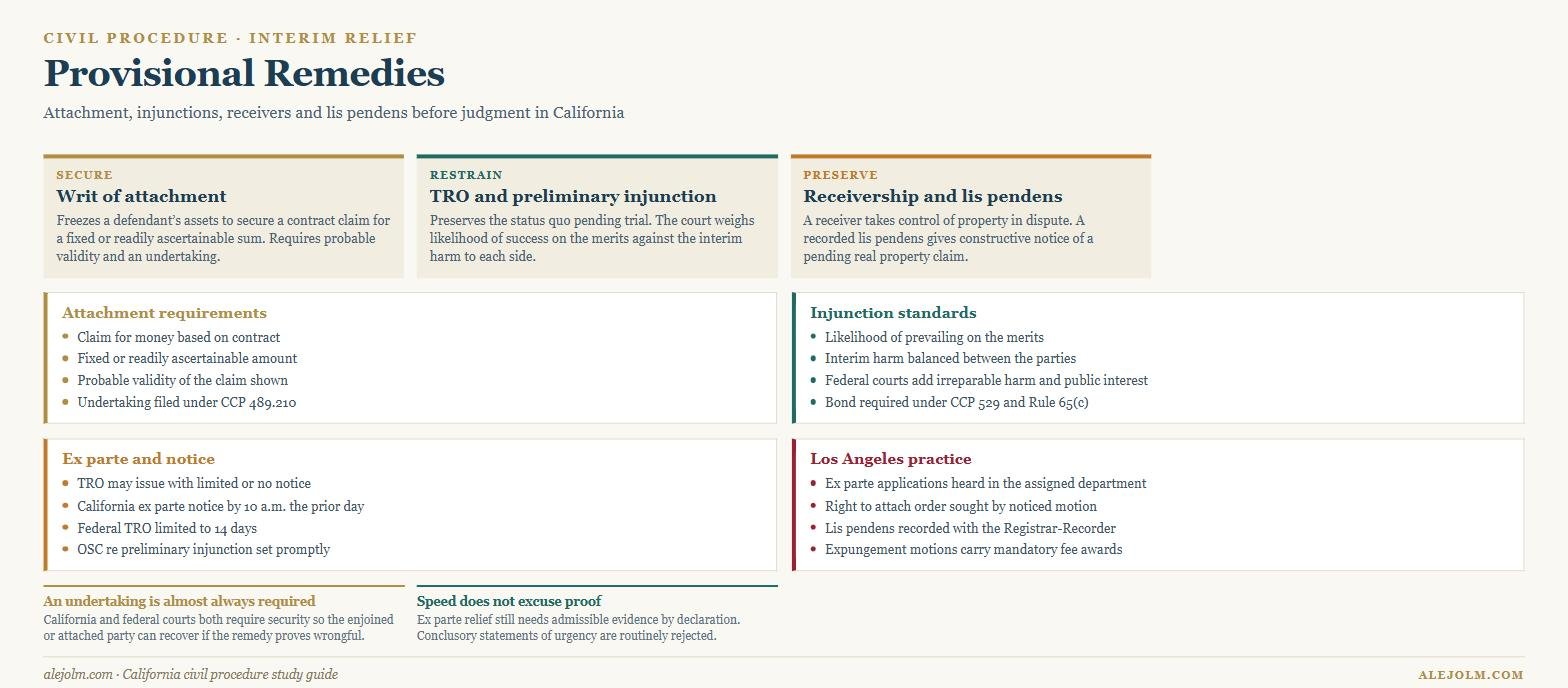
Writ of attachment
Attachment creates a lien on the defendant’s property to secure an eventual judgment. Code of Civil Procedure section 483.010 limits it sharply: the claim must be for money, based on contract, in a fixed or readily ascertainable amount of at least 500 dollars, and unsecured. Against a natural person, attachment is available only where the obligation arose out of that person’s trade, business or profession.
The plaintiff must establish the probable validity of the claim, meaning it is more likely than not to obtain a judgment. This is done on a noticed application for a right to attach order, supported by declarations. An undertaking is required under section 489.210, and the defendant may claim exemptions. Ex parte attachment exists under section 485.010 but requires a showing of great or irreparable injury, such as evidence the defendant is about to conceal or dissipate assets.
Temporary restraining orders and preliminary injunctions
California courts evaluate injunctive relief by weighing two interrelated factors: the likelihood that the applicant will prevail on the merits at trial, and the interim harm the applicant is likely to suffer if the injunction is denied compared to the harm the opposing party is likely to suffer if it is granted. The stronger the showing on one, the less is required on the other, though a complete failure on likelihood of success is fatal.
Federal courts use the four-part Winter v. Natural Resources Defense Council formulation: likelihood of success, likely irreparable harm, balance of equities, and the public interest. The Ninth Circuit also recognises a sliding scale variant where serious questions going to the merits combined with a balance of hardships tipping sharply toward the plaintiff can suffice, provided the other elements are met. A bond is required under Rule 65(c) and under Code of Civil Procedure section 529.
| Remedy | What it does |
|---|---|
| Writ of attachment | Liens the defendant’s assets |
| Temporary restraining order | Freezes conduct for days |
| Preliminary injunction | Restrains conduct until trial |
| Receivership | Places property under court control |
| Lis pendens | Clouds title, warns purchasers |
| Claim and delivery | Recovers specific personal property |
Receivership and lis pendens
- Receivership: under Code of Civil Procedure section 564 a court may appoint a receiver to take control of disputed property where it is in danger of being lost, removed or materially injured.
- Rents and profits: receivers are common in commercial foreclosure and partnership dissolution, collecting rents while the dispute is resolved.
- Cost: receivers are expensive, are paid from the estate, and courts treat appointment as a drastic remedy of last resort.
- Lis pendens: section 405.20 allows a party asserting a real property claim to record a notice of pendency, giving constructive notice to anyone acquiring an interest.
- Expungement: under section 405.30 the claimant bears the burden of establishing the probable validity of the real property claim, and the prevailing party on the motion is generally awarded attorney fees.
- Undertaking: the court may condition denial of expungement on the claimant posting security for damages the owner may suffer.
A worked example
A Los Angeles textile supplier is owed 480,000 dollars under a series of written purchase orders by a downtown apparel wholesaler. The supplier learns that the wholesaler has begun transferring inventory to a newly formed entity controlled by the same family and has listed its warehouse for sale. The supplier wants security before the money disappears.
Attachment is the right tool. The claim is for money, based on contract, in a readily ascertainable amount, and the defendant is a business entity, so section 483.010 is satisfied. The supplier applies for a right to attach order supported by the purchase orders, the account statement and a declaration describing the transfers, and posts the undertaking. Given the evidence of dissipation, an ex parte application under section 485.010 may also be justified, though the court will still set an early noticed hearing. Note that attachment does not stop the warehouse sale outright; it creates a lien that follows the proceeds, so pairing the attachment with a lis pendens is not available here because a pure money claim is not a real property claim under section 405.4.
Provisional Remedies in California and Los Angeles County in 2026
California’s provisional remedy statutes are unusually detailed and the courts enforce them literally. The Attachment Law in Code of Civil Procedure sections 481.010 through 493.060 is a complete code, and an application that does not track its requirements will be denied regardless of how sympathetic the facts are. The same is true of the lis pendens statutes at sections 405.1 through 405.61, where the expungement remedy is deliberately designed to be quick and to shift fees onto a claimant who overreached.
In Los Angeles Superior Court, ex parte applications are heard in the assigned independent calendar department, and notice must ordinarily be given to all parties by 10 a.m. on the court day before the appearance, with the substance of the relief sought described. The court expects a declaration explaining why the matter cannot wait for a noticed motion. Applications that could plainly have been brought on regular notice are routinely denied on that ground alone, without reaching the merits.
Lis pendens filings must be recorded with the Los Angeles County Registrar-Recorder and served on all parties, and an unserved notice is void. Because Los Angeles real property values are high, the stakes on an expungement motion are correspondingly large: a wrongly recorded notice can collapse a sale or a refinancing, and the mandatory fee award under section 405.38 can be substantial.
- CCP 483.010: attachment is confined to unsecured contract claims for a fixed or readily ascertainable sum.
- CCP 485.010: ex parte attachment requires evidence of imminent dissipation or concealment.
- CCP 529: an undertaking is required before an injunction issues, and the amount is set by the court.
- 10 a.m. notice rule: Los Angeles ex parte applications require notice by 10 a.m. the prior court day.
- CCP 405.4: record a lis pendens only where the pleading states a genuine real property claim.
- CCP 405.38: the prevailing party on an expungement motion is generally awarded attorney fees.
For 2026, confirm the current undertaking amounts, receiver bond requirements and the Los Angeles Superior Court ex parte procedures for your assigned department, since departments vary and the rules have been amended repeatedly. Related guides: in rem jurisdiction, interpleader and default judgment.
Common mistakes to avoid
- Seeking attachment on a tort claim. Section 483.010 covers contract claims only, and a negligence or fraud claim will not qualify.
- Recording a lis pendens to pressure a money defendant. Expungement plus mandatory fees is the predictable result.
- Going ex parte without justification. Los Angeles departments deny applications that could have been noticed, without reaching the merits.
- Underestimating the undertaking. An inadequate bond can mean the order is dissolved or never issues.
- Treating a receiver as a routine ask. Courts view it as a drastic remedy and expect evidence that no lesser measure will work.
Frequently asked questions
What are provisional remedies?
They are interim court orders obtained before final judgment that preserve assets, property or the status quo so that any eventual judgment is meaningful. Attachment, injunctions, receivership and lis pendens are the main examples.
When can I get a writ of attachment in California?
Only on an unsecured claim for money based on contract, in a fixed or readily ascertainable amount of at least 500 dollars, and against a natural person only where the debt arose from their trade or business.
What must I show for a preliminary injunction?
In California, the likelihood of prevailing on the merits weighed against the relative interim harm to each party. Federal courts apply the four Winter factors, adding irreparable harm and the public interest.
Is a bond always required?
Almost always. Code of Civil Procedure section 529 requires an undertaking before an injunction issues, section 489.210 requires one for attachment, and Federal Rule 65(c) requires security for a TRO or injunction.
What happens if I record a lis pendens improperly?
The other side can move to expunge under section 405.30, you bear the burden of proving the probable validity of a real property claim, and the prevailing party is generally awarded attorney fees.
Related guides
 In Rem and Quasi In Rem Jurisdiction in California
 Federal Discovery Rules: Scope, Tools and Sanctions
 Joinder of Claims and Parties in California Lawsuits
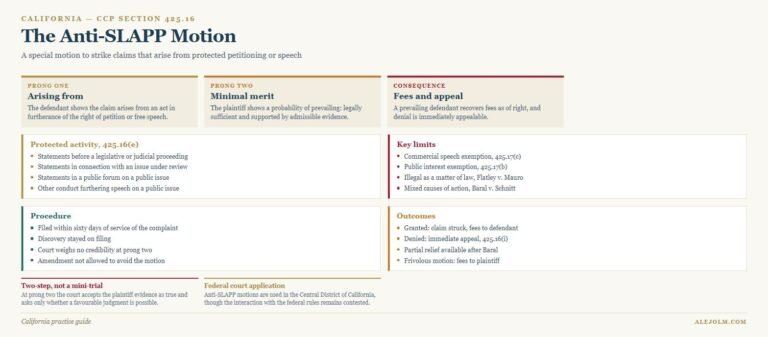 The California Anti-SLAPP Motion: Strike and Appeal
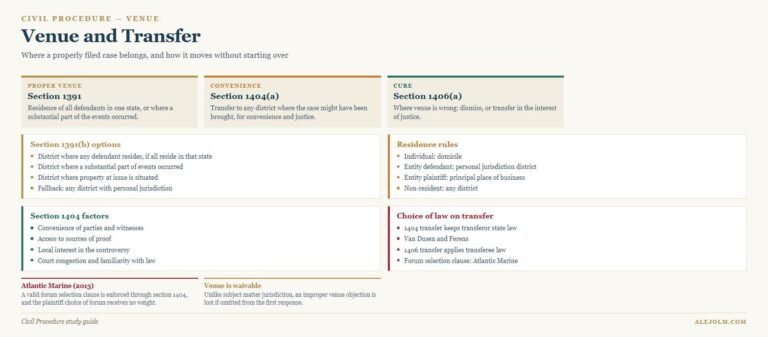 Federal Venue Rules and Transfer Under Section 1404
- Interpleader Actions in California and Federal Courts
- Dismissal and Default Judgment in California Courts
- Relief From Judgment Under Rule 60 and CCP 473
- Pretrial Conferences and Scheduling Orders Explained
- Limited vs Unlimited Civil Cases in California Courts
- Summary Judgment Under Rule 56: Standard and Proof
Next steps
Read in rem jurisdiction for the constitutional limits on property-based relief, and interpleader for the situation where a disputed fund needs depositing rather than freezing. The Attachment Law is published at California Legislative Information, and recording requirements are set out by the Los Angeles County Registrar-Recorder/County Clerk.