
Personal jurisdiction comes in two varieties, and confusing them is the most common analytical error in the whole field. Specific jurisdiction depends on a link between the defendant’s forum contacts and the particular claim. General jurisdiction ignores the claim entirely and asks whether the defendant belongs to the forum.
Over the last decade the Supreme Court has narrowed general jurisdiction sharply while loosening the relatedness requirement for specific jurisdiction. The net effect is that almost every modern fight is a specific jurisdiction fight. This guide maps both tests, the leading cases and the practical consequences for a Los Angeles filing.
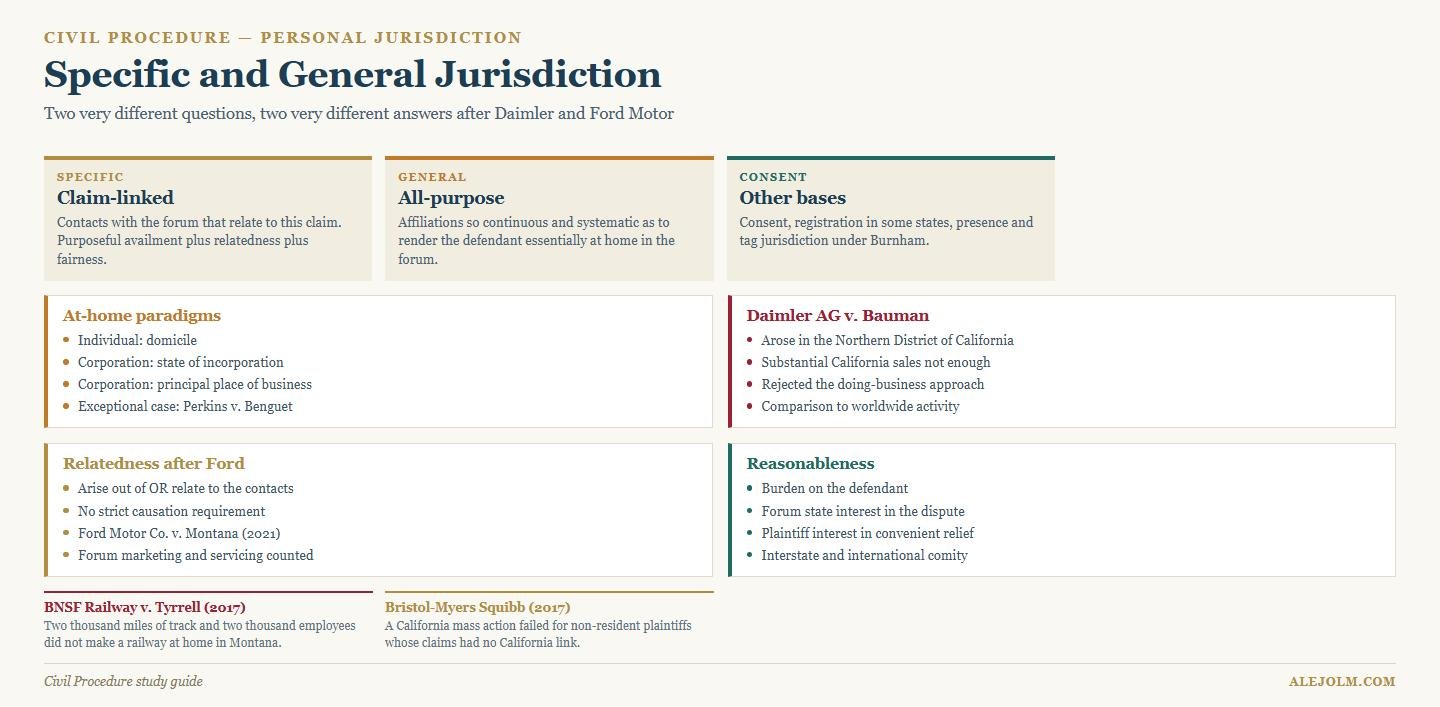
General jurisdiction: is the defendant at home?
Goodyear Dunlop Tires v. Brown (2011) and Daimler AG v. Bauman (2014) replaced the old doing-business standard with an at-home test. An individual is at home at her domicile. A corporation is at home where it is incorporated and where it has its principal place of business. Anything beyond those paradigms requires an exceptional case of the Perkins v. Benguet Consolidated Mining (1952) kind, where a company’s worldwide operations were temporarily run from the forum.
BNSF Railway v. Tyrrell (2017) shows how demanding this is. A railway with more than two thousand miles of track and two thousand employees in Montana was not at home there, because those figures were small relative to its nationwide operations. The comparison is not to other companies in the forum; it is to the defendant’s own activity everywhere.
Specific jurisdiction: is the claim connected?
Purposeful availment
The defendant must have deliberately reached into the forum — Hanson v. Denckla (1958) requires an act by which it purposefully avails itself of the privilege of conducting activities there. Contacts created by the unilateral activity of the plaintiff or a third party do not count. In intentional tort cases the Calder v. Jones (1984) effects test applies, but Walden v. Fiore (2014) confirms the defendant’s own conduct must connect it to the forum, not merely to a person who lives there.
Relatedness after Ford Motor
Ford Motor Co. v. Montana Eighth Judicial District Court (2021) resolved a long-running dispute. The requirement that a claim arise out of or relate to the contacts is disjunctive: some relationships suffice without strict causation. Ford had marketed, sold and serviced the model in the forum states for years, and that was enough even though the specific vehicles were designed, manufactured and first sold elsewhere.
Reasonableness
Asahi Metal Industry v. Superior Court (1987) — itself a California case — supplies the fairness factors: the burden on the defendant, the forum state’s interest, the plaintiff’s interest in convenient and effective relief, the interstate judicial system’s interest in efficiency, and the shared interest of the states in substantive social policies. Once minimum contacts exist, the defendant must make a compelling case that these factors defeat jurisdiction.
Side by side
| Feature | Specific jurisdiction |
|---|---|
| Question asked | Does this claim relate to forum contacts? |
| Leading case | Ford Motor Co. v. Montana (2021) |
| Corporate paradigms | Not required |
| Claim connection | Required |
| Typical proof | Marketing, sales, service, contracts in forum |
| Frequency of success | Common |
A worked example
A German appliance maker with no United States subsidiary sells through a national distributor. It advertises in American trade publications, attends a trade show in Anaheim every year, and maintains a warranty hotline for United States customers. A Los Angeles restaurant sues over a fire caused by one of its ovens, purchased from a Southern California dealer.
General jurisdiction fails immediately: the company is at home in Germany. Specific jurisdiction is a real question. Under Ford, marketing and warranty support directed at the American market, combined with a distribution chain that predictably delivers ovens to California dealers, relate closely enough to a claim about an oven sold and used in Los Angeles. The manufacturer’s best argument is reasonableness, drawing on Asahi and the burden of defending abroad.
Specific and general jurisdiction in California and Los Angeles County in 2026
California has supplied more of this doctrine than any other state. Asahi Metal Industry Co. v. Superior Court arose from a motorcycle accident in Solano County and produced the reasonableness factors every court still recites. Daimler AG v. Bauman began in a California district court and ended the era of general jurisdiction based on in-state sales volume. Bristol-Myers Squibb Co. v. Superior Court came out of a coordinated Los Angeles proceeding and held that hundreds of non-resident plaintiffs could not attach their claims to California ones. Vons Companies v. Seabest Foods, decided by the California Supreme Court in 1996, anticipated the flexible relatedness approach the United States Supreme Court adopted in Ford.
For Los Angeles practice the combined effect is concrete. A mass action against a national manufacturer must now be built plaintiff by plaintiff, with California-specific purchase, exposure or injury facts for each. A defendant that is neither incorporated in California nor headquartered here will almost always defeat a general jurisdiction theory, so the pleading must do the specific jurisdiction work instead.
Practical points for 2026:
- Build the contacts claim by claim. After Bristol-Myers Squibb, a Los Angeles complaint joining out-of-state plaintiffs needs an independent California connection for each of them.
- Use Ford affirmatively. Forum advertising, dealer networks, recalls, service centres and parts supply now support jurisdiction without proving that the specific unit was sold here.
- Do not rely on a registered agent. Registering to do business in California and designating an agent for service is not consent to all-purpose jurisdiction under current California authority; check the position before relying on it either way.
- Remember tag jurisdiction. Burnham v. Superior Court (1990), another California case, confirms that personal service on an individual physically present in the state supports jurisdiction even for unrelated claims.
- Watch the alter ego route. Where a foreign parent operates through a California subsidiary, the alter ego and representative services theories remain contested; plead the underlying facts rather than the label.
- Move promptly. The challenge is made by motion to quash under Code of Civil Procedure section 418.10, on or before the last day to plead, and the writ deadline afterwards is only ten days.
For 2026, assume general jurisdiction is unavailable unless the defendant is incorporated or headquartered in California, and invest the pleading effort in relatedness instead. Continue with the California long-arm statute, the personal jurisdiction framework and procedural due process.
Common mistakes to avoid
- Calling substantial sales general jurisdiction. After Daimler and BNSF that argument fails almost everywhere.
- Requiring strict causation. Ford confirms that relate to is an independent basis alongside arise out of.
- Relying on the plaintiff’s contacts. Walden v. Fiore insists the defendant, not the plaintiff, must create the forum link.
- Skipping reasonableness. It rarely defeats jurisdiction, but it is a genuine second stage, especially for foreign defendants.
- Forgetting the other bases. Consent, waiver, presence and appearance still supply jurisdiction without any contacts analysis.
Frequently asked questions
What does essentially at home mean?
It describes affiliations with a forum so continuous and systematic that the defendant may be sued there on any claim. For corporations that normally means the state of incorporation and the principal place of business.
Did Ford Motor overrule Bristol-Myers Squibb?
No. Ford loosened the causal link between contacts and claim, while Bristol-Myers Squibb still requires that each plaintiff have a connection to the forum. Both remain good law and are frequently argued together.
Can a corporation consent to general jurisdiction by registering to do business?
Some states treat registration as consent and others do not. The question has returned to the Supreme Court in recent years, so confirm the current rule in the relevant state before relying on it.
Is tag jurisdiction still valid?
Yes. Burnham v. Superior Court upheld jurisdiction based on personal service upon an individual voluntarily present in the state, even for claims unrelated to the forum.
Does an interactive website create specific jurisdiction?
Only if it targets the forum. Courts look at whether the site does business with forum residents, ships there, or is directed at that market, rather than at mere accessibility.
Related guides
- The California Long-Arm Statute and Motion to Quash
- Personal Jurisdiction: The 3-Step Bar Exam Framework
- Subject Matter Jurisdiction in Federal Court Explained
- Diversity Jurisdiction: Citizenship and Amount Rules
- Removal and Remand: Moving a Case to Federal Court
- Procedural Due Process: Notice, Hearing and Mathews
- Substantive Due Process After Dobbs: A Two-Step Test
- The Erie Doctrine Explained: A 4-Step Bar Exam Guide
- Full Faith and Credit: Recognising Sister-State Judgments
- Access to the Courts: When Filing Fees Are Unconstitutional
- The IRAC Method: How to Structure a Bar Exam Answer
Next steps
Once you can place a defendant in the right column, the remaining questions are procedural: how the objection is raised, how service is accomplished, and where the case should sit. Read the California long-arm statute and motion to quash for the mechanics, then removal and remand.