
Joinder of claims and parties determines how much of a dispute fits inside a single lawsuit. Get it right and one action resolves everything. Get it wrong and you face duplicative litigation, inconsistent judgments, a destroyed basis for federal jurisdiction, or a dismissal because someone essential was left out.
The federal system splits the question into three rules that are easy to confuse: Rule 18 governs how many claims you may stack, Rule 20 governs who may voluntarily be joined, and Rule 19 governs who must be joined. California reaches broadly similar results through Code of Civil Procedure sections 427.10, 378, 379 and 389. This guide sets out both systems and the traps that appear most often in Los Angeles practice.
Joinder of claims: Rule 18
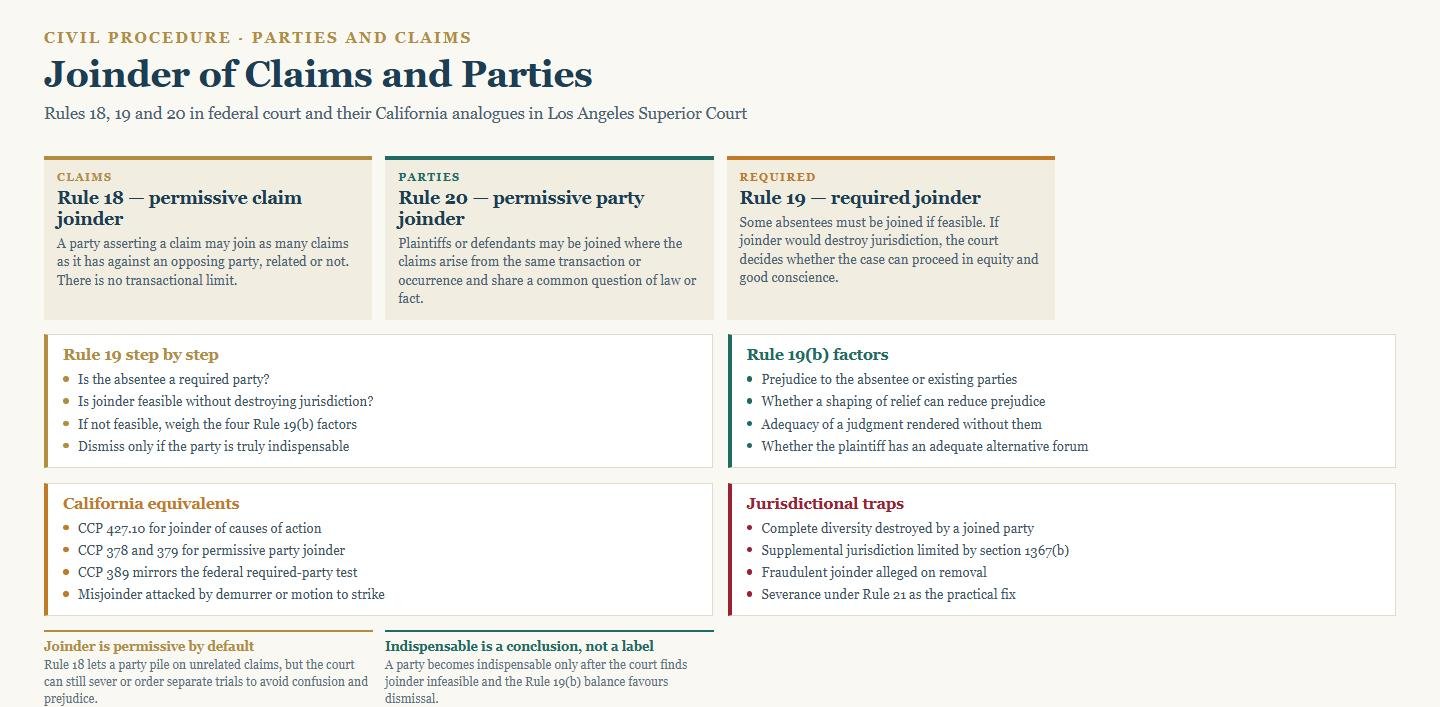
Rule 18 is the most permissive rule in the Federal Rules. A party asserting a claim may join as many claims as it has against an opposing party, whether or not the claims are related. A plaintiff suing a former business partner for breach of a partnership agreement may join an entirely unrelated claim about a car accident between the same two people.
The generosity is limited by two things. First, every claim still needs an independent basis for subject-matter jurisdiction, or supplemental jurisdiction under 28 U.S.C. section 1367. Second, the court retains power under Rule 42(b) to order separate trials, and under Rule 21 to sever claims, whenever combining them would confuse the jury or prejudice a party. California section 427.10 is similarly permissive, allowing a plaintiff to unite any causes of action it has against a defendant.
Permissive party joinder: Rule 20
Rule 20 has two requirements that both must be met. The claims by or against the joined parties must arise out of the same transaction, occurrence, or series of transactions or occurrences, and there must be a question of law or fact common to all of them. Multiple plaintiffs injured in the same collision satisfy this easily. Multiple plaintiffs who bought the same defective product in different states over five years are a much harder case.
California sections 378 and 379 track the same logic. Section 378 governs joinder of plaintiffs and section 379 governs defendants, and both use the same-transaction-plus-common-question structure. Where the parties are improperly joined, the response in California is a demurrer for misjoinder or a motion to strike, while in federal court the vehicle is a Rule 21 motion to sever.
Required joinder: Rule 19
Step one: is the absentee required?
An absent person is required if complete relief cannot be accorded among existing parties without them, or if they claim an interest in the subject of the action and disposing of the case in their absence would impair that interest or leave an existing party exposed to inconsistent obligations. A co-owner of the disputed property, a co-obligee on a contract, or an insurer whose coverage is the real subject of the fight are typical examples.
Step two: is joinder feasible?
If the person is required, the court orders them joined. Joinder is infeasible if the court lacks personal jurisdiction over them, if they are protected by sovereign immunity, or if adding them would destroy complete diversity and thereby defeat subject-matter jurisdiction. That last scenario is the one that generates most of the litigation.
Step three: the Rule 19(b) balance
Where joinder is not feasible, the court decides whether in equity and good conscience the action should proceed among the existing parties or be dismissed. The factors are the extent of prejudice, whether protective provisions in the judgment can lessen it, whether a judgment rendered without the absentee would be adequate, and whether the plaintiff would have an adequate remedy if the action were dismissed. Only if the balance favours dismissal is the absentee properly called indispensable.
| Issue | Federal rule |
|---|---|
| Joining claims | Rule 18 — unlimited, related or not |
| Joining plaintiffs | Rule 20(a)(1) |
| Joining defendants | Rule 20(a)(2) |
| Required parties | Rule 19 |
| Attacking misjoinder | Rule 21 motion to sever |
| Separate trials | Rule 42(b) |
A worked example
Three siblings inherit a commercial building in Boyle Heights as tenants in common. Two of them sue a contractor in federal court for defective seismic retrofit work, invoking diversity jurisdiction because the contractor is a Nevada entity. The third sibling, who lives in Nevada, refuses to join as a plaintiff. The contractor moves to dismiss under Rule 19, arguing the third sibling is a required party whose joinder would destroy complete diversity.
The court first asks whether the absent sibling is required. As a co-owner with an interest in the building and in any recovery, she almost certainly is. Joinder is not feasible, because adding a Nevada co-owner on either side of the caption destroys diversity. So the court reaches the Rule 19(b) balance. The decisive factor is usually the fourth one: the plaintiffs have a perfectly adequate alternative forum in Los Angeles Superior Court, where all three siblings and the contractor can be joined without any jurisdictional problem. Dismissal is the likely outcome, and the case is refiled in state court.
Joinder of Claims and Parties in California and Los Angeles County in 2026
California’s joinder provisions are functionally similar to the federal rules but the procedural mechanics differ in ways that matter. Section 389 mirrors Rule 19 almost word for word, including the equity and good conscience balance. Because California state courts are courts of general jurisdiction and have no diversity requirement, the infeasibility problem that dominates federal Rule 19 practice largely disappears, which is precisely why so many multi-party disputes belong in Los Angeles Superior Court rather than the Central District.
Misjoinder in California is attacked by demurrer on the ground of defect or misjoinder of parties, or by motion to strike. In Los Angeles County these motions go to the assigned independent calendar department and are subject to the meet-and-confer requirement in Code of Civil Procedure section 430.41, which requires a real conversation before the demurrer is filed and a declaration describing it. Skipping that step is one of the most common reasons a demurrer is taken off calendar.
Complex multi-party cases in Los Angeles may be assigned to the court’s complex civil litigation program at the Spring Street Courthouse, which applies its own case management procedures. Related cases can also be consolidated or coordinated, and a party facing scattered filings across several California counties should consider a petition for coordination rather than trying to solve the problem through joinder alone.
- Section 389: California’s required-party statute tracks Rule 19, including the four-factor equity balance.
- Sections 378 and 379: permissive joinder of plaintiffs and defendants on the same-transaction plus common-question test.
- Section 430.41: meet and confer before any demurrer attacking misjoinder, and file the declaration.
- Section 1048: the court may consolidate related actions or order separate trials of any cause of action.
- Complex designation: multi-party construction, mass tort and coordinated cases may be routed to the complex program.
- Fictitious defendants: CCP 474 Doe amendments let a plaintiff add parties later and relate back to the original filing.
For 2026, confirm the current Los Angeles Superior Court local rules on complex case designation and reservation of demurrer hearing dates, since both have been revised repeatedly. Verify the current statutory filing fee for each newly added party as well, because appearance fees are charged per party. Related reading: subject matter jurisdiction, supplemental jurisdiction and class actions.
Common mistakes to avoid
- Calling a party indispensable at the outset. That label is a conclusion reached only after the Rule 19(b) balance, not a starting premise.
- Forgetting section 1367(b). In diversity cases, supplemental jurisdiction is unavailable over claims by plaintiffs joined under Rules 19 or 20 when it would defeat complete diversity.
- Assuming Rule 18 solves jurisdiction. Unlimited claim joinder still requires a jurisdictional basis for each claim.
- Filing a California demurrer without meeting and conferring. Section 430.41 makes the declaration mandatory.
- Overlooking severance. When misjoinder is arguable, severance under Rule 21 or CCP 1048 is often a better ask than dismissal.
Frequently asked questions
Can I sue someone for two completely unrelated things at once?
Yes. Rule 18 and California section 427.10 both allow a party to join any claims it has against an opposing party regardless of relationship, subject to the court’s power to order separate trials.
What makes a party required under Rule 19?
A party is required if complete relief is impossible without them, or if their absence would impair their own interest or expose an existing party to inconsistent obligations.
What is the difference between required and indispensable?
Required is the first-stage finding. Indispensable is the label applied only after the court concludes that joinder is infeasible and that the case cannot fairly proceed without the absentee.
How do I challenge improper joinder in California?
By demurrer for misjoinder of parties or by motion to strike, after complying with the meet-and-confer requirement in Code of Civil Procedure section 430.41.
Does adding a party affect diversity jurisdiction?
It can. Adding a non-diverse party in a diversity case may destroy complete diversity, which is why Rule 19 disputes so often end with dismissal and refiling in state court.
Related guides
 Minimum Contacts and Due Process in California Courts
 Class Actions Under Rule 23: Certification Explained
 Counterclaims and Cross-Claims in California Practice
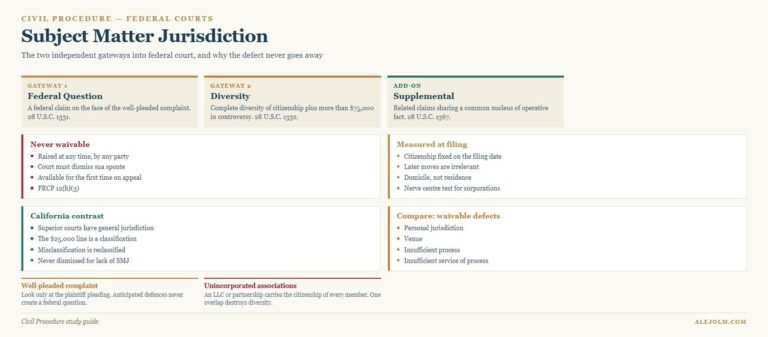 Subject Matter Jurisdiction in Federal Court Explained
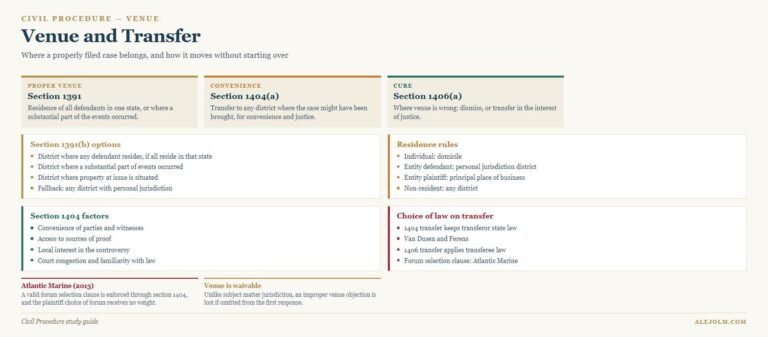 Federal Venue Rules and Transfer Under Section 1404
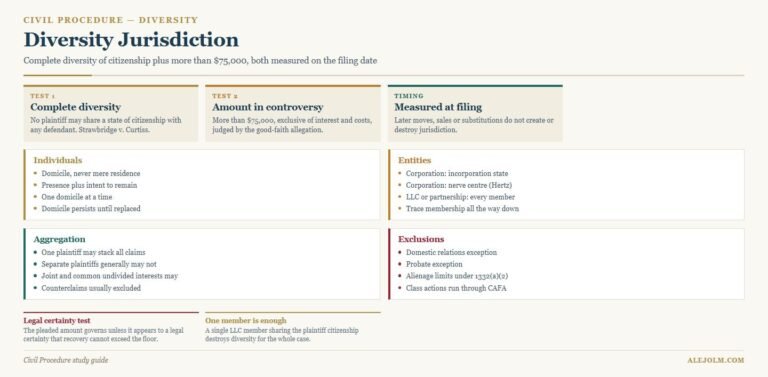 Diversity Jurisdiction: Citizenship and Amount Rules
- Res Judicata vs Collateral Estoppel: Bar Exam Guide
- Supplemental Jurisdiction: Common Nucleus Explained
- Interpleader Actions in California and Federal Courts
- Federal Pleading Standards After Twombly and Iqbal
- Removal and Remand: Moving a Case to Federal Court
Next steps
Read supplemental jurisdiction to understand the section 1367(b) limits that constrain joinder in diversity cases, then look at counterclaims and cross-claims for the defendant’s side of the same problem. The current rule text is published by the United States Courts, and California’s statutes are at California Legislative Information.