
Interpleader solves a specific and genuinely awkward problem. Someone holds money or property that two or more other people claim, and paying either one risks a lawsuit from the other. Interpleader lets that neutral holder deposit the stake with the court, be discharged from liability, and leave the rival claimants to fight it out among themselves.
Escrow companies, banks, life insurers, title companies and employee benefit plan administrators use the device constantly, and Los Angeles County produces a steady volume of these actions because of the size of its real estate and insurance markets. This guide sets out the two federal routes, the California procedure under Code of Civil Procedure section 386, and the practical steps that get a stakeholder discharged with its fees paid.
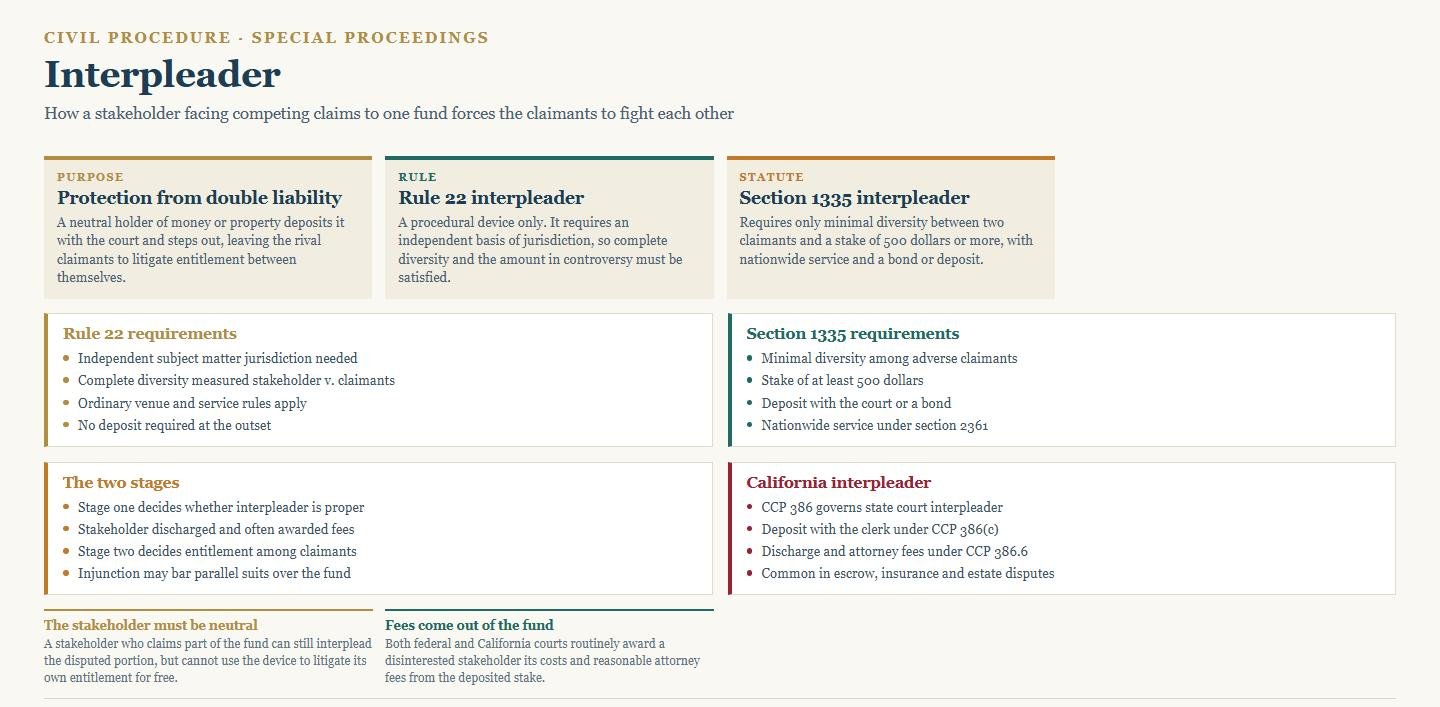
The two federal routes
Rule interpleader
Rule 22 of the Federal Rules of Civil Procedure is purely a procedural device. It permits joinder of claimants but supplies no jurisdiction of its own, so the action must independently satisfy federal subject-matter jurisdiction. In a diversity case that means complete diversity measured between the stakeholder and the claimants, and an amount in controversy exceeding 75,000 dollars. Ordinary venue and service rules apply, and no deposit is required at the outset.
Statutory interpleader
28 U.S.C. section 1335 is far more generous. It requires only minimal diversity, meaning that two adverse claimants are citizens of different states, and a stake of 500 dollars or more. In exchange, the stakeholder must deposit the money with the court or post a bond in that amount. Section 2361 then provides nationwide service of process and authorises the court to enjoin claimants from prosecuting any other action affecting the fund, and section 1397 lays down a permissive venue rule allowing suit where any claimant resides.
The two stages of an interpleader action
Stage one asks whether interpleader is proper: is there a single identifiable fund, are there genuine adverse claims to it, and does the stakeholder face a real risk of multiple liability? If the answer is yes, the court accepts the deposit, discharges the stakeholder from further liability, typically awards it costs and reasonable attorney fees out of the fund, and often enjoins parallel litigation over the stake.
Stage two is an ordinary contest between the remaining claimants over entitlement to the deposited money. The stakeholder is gone. Discovery, motions and if necessary a trial proceed among the claimants, and the fund is distributed according to the judgment.
- A single fund: the dispute must concern one identifiable stake, not a series of separate obligations.
- Adverse claims: at least two claimants must assert entitlement to the same money or property.
- Real exposure: the stakeholder must face genuine risk of inconsistent liability, not mere inconvenience.
- Neutrality: a disinterested stakeholder gets the cleanest discharge and the strongest fee claim.
- Deposit or bond: mandatory under section 1335 and under California section 386(c).
- Notice to all claimants: anyone with a known interest must be joined and served.
A worked example
A Los Angeles escrow company holds 250,000 dollars from the sale of a duplex in Highland Park. The seller demands release of the funds. A judgment creditor of the seller has served a notice of levy, and a contractor has recorded a mechanic’s lien against the property claiming 60,000 dollars for unpaid work. All three demand payment and threaten suit. The escrow company has no interest of its own in the money beyond its earned fee.
This is a textbook interpleader. The escrow company files under Code of Civil Procedure section 386 in Los Angeles Superior Court, deposits the full amount with the clerk, names the seller, the judgment creditor and the contractor as defendants, and moves for discharge. Assuming the deposit is complete and the claimants are properly served, the court discharges the company, awards it costs and reasonable attorney fees from the fund under section 386.6, and the three claimants then litigate priority among themselves. Note the fee point: the award comes out of the stake, so the claimants effectively pay for the stakeholder’s exit, which is one reason claimants sometimes agree on a distribution rather than let the action proceed.
| Requirement | Rule 22 |
|---|---|
| Jurisdictional basis | Independent, complete diversity |
| Amount threshold | Over 75,000 dollars in diversity cases |
| Deposit or bond | Not required initially |
| Service reach | Ordinary rules |
| Injunction power | General equitable powers |
| Stakeholder fees | Discretionary |
Interpleader in California and Los Angeles County in 2026
California interpleader is governed by Code of Civil Procedure section 386. Subdivision (a) allows a defendant already being sued to bring in a competing claimant, and subdivision (b) allows a person against whom conflicting claims are made to file an interpleader action before being sued at all. Subdivision (c) permits the stakeholder to deposit the money with the clerk of the court, which stops interest running against it and is the practical trigger for discharge.
Section 386.5 provides a streamlined route: where the stakeholder alleges it has no interest in the fund and is willing to deposit it, it may obtain discharge on a noticed motion rather than by waiting for a full hearing on the merits. Section 386.6 then authorises the court to award the stakeholder its costs and reasonable attorney fees out of the deposited stake, which is what makes the device economically viable for escrow and title companies handling routine disputes.
Los Angeles County generates a large share of California interpleader filings because of the volume of residential and commercial escrow closings, the density of mechanic’s lien activity, and the concentration of insurers and benefit plan administrators. A recurring complication is federal preemption: where the disputed fund is a benefit under an ERISA-governed plan, the action generally belongs in the Central District of California rather than the Superior Court, and filing in the wrong forum invites removal and delay.
- CCP 386(b): a stakeholder can file first, before any claimant sues, which is usually the better strategy.
- CCP 386(c): deposit with the clerk to stop interest accruing and to support discharge.
- CCP 386.5: a noticed motion route to early discharge for a genuinely disinterested stakeholder.
- CCP 386.6: costs and reasonable attorney fees awarded from the fund, not from the stakeholder.
- Name every claimant: an omitted lienholder or levying creditor can attack the distribution later.
- Check ERISA: benefit plan funds usually belong in federal court, so screen for preemption before filing.
For 2026, confirm the current Los Angeles Superior Court procedure for depositing funds with the clerk and the current filing fees, both of which have been revised in recent years, and verify whether your assigned department requires a reservation for the discharge motion. See also counterclaims and cross-claims, joinder of claims and parties and provisional remedies.
Common mistakes to avoid
- Filing under Rule 22 without complete diversity. Rule interpleader supplies no jurisdiction of its own, and the case will be dismissed.
- Forgetting the section 1335 deposit. Statutory interpleader requires the money or a bond up front, not later.
- Claiming part of the fund while seeking discharge. A stakeholder with its own claim is not disinterested and its fee request will suffer.
- Omitting a known claimant. The discharge is only as good as the notice, and an omitted lienholder can reopen the distribution.
- Missing ERISA preemption. Filing a plan-benefit dispute in state court leads to removal, wasted fees and delay.
Frequently asked questions
What is an interpleader action?
It is a lawsuit filed by someone holding money or property that two or more others claim. The holder deposits the stake with the court, is discharged from liability, and the claimants litigate entitlement between themselves.
What is the difference between Rule 22 and section 1335 interpleader?
Rule 22 is a procedural device requiring independent jurisdiction and complete diversity. Section 1335 is a jurisdictional statute requiring only minimal diversity between claimants and a 500 dollar stake, but it mandates a deposit or bond.
Can the stakeholder recover its attorney fees?
Usually yes for a disinterested stakeholder. California Code of Civil Procedure section 386.6 expressly authorises costs and reasonable fees from the deposited fund, and federal courts award them as a matter of discretion.
Does interpleader stop other lawsuits over the same money?
It can. Section 2361 expressly empowers a federal court in a statutory interpleader case to enjoin claimants from prosecuting other actions affecting the fund, and California courts have comparable equitable authority.
When should I file interpleader instead of just paying one claimant?
Whenever two or more claimants assert genuinely adverse rights to the same fund and paying either one would expose you to liability to the other. Waiting until you are sued only increases the cost.
Related guides
- Counterclaims and Cross-Claims in California Practice
- Joinder of Claims and Parties in California Lawsuits
- Provisional Remedies in California Civil Litigation
- In Rem and Quasi In Rem Jurisdiction in California
- Subject Matter Jurisdiction in Federal Court Explained
- Diversity Jurisdiction: Citizenship and Amount Rules
- Removal and Remand: Moving a Case to Federal Court
- Service of Process Under Rule 4: Methods and Waiver
- Dismissal and Default Judgment in California Courts
- Class Actions Under Rule 23: Certification Explained
- Summary Judgment Under Rule 56: Standard and Proof
Next steps
Read joinder of claims and parties for the rules on bringing every claimant into one action, and provisional remedies for the alternatives when a fund needs protecting before judgment. Section 386 is available at California Legislative Information, and federal filing procedures are published by the U.S. District Court for the Central District of California.