
For half a century a federal complaint had only to give the defendant fair notice. Two decisions changed that. Bell Atlantic Corp. v. Twombly (2007) and Ashcroft v. Iqbal (2009) replaced the old formula with a plausibility standard, and federal pleading standards have been contested ever since.
This guide explains what Rule 8 requires today, the two-step method Iqbal prescribes, the heightened particularity rule for fraud, the response and amendment rules that follow, and the very different fact pleading regime a Los Angeles state court applies.
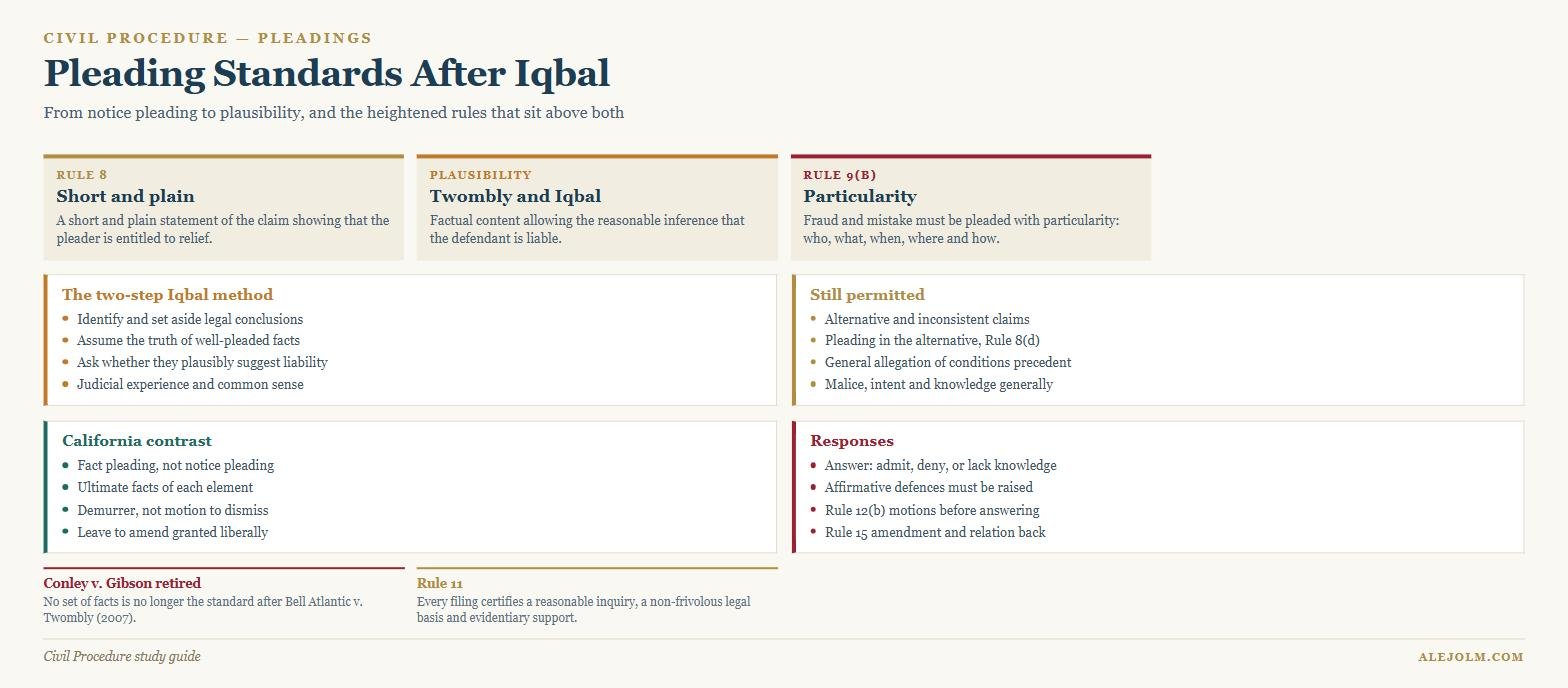
What Rule 8 says
A pleading stating a claim for relief must contain a short and plain statement of the grounds for jurisdiction, a short and plain statement of the claim showing that the pleader is entitled to relief, and a demand for the relief sought. Rule 8(d) adds that each allegation must be simple, concise and direct, and that a party may plead alternatively and even inconsistently.
The plausibility standard
Twombly retired the sentence from Conley v. Gibson (1957) that a complaint should not be dismissed unless no set of facts would entitle the plaintiff to relief. In its place, a complaint must contain enough factual matter, accepted as true, to state a claim that is plausible on its face. Iqbal confirmed that the standard applies in every civil case, not merely in antitrust.
The two-step method
- Step one. Identify allegations that are no more than legal conclusions or threadbare recitals of the elements. These are not entitled to the assumption of truth.
- Step two. Assume the truth of the remaining well-pleaded factual allegations and ask whether they plausibly give rise to an entitlement to relief, drawing on judicial experience and common sense.
Plausibility sits above possibility but below probability. Where the facts alleged are just as consistent with lawful conduct as with unlawful conduct, the complaint has not crossed the line — that was the core of Twombly, where parallel business behaviour was equally consistent with independent decision-making.
Heightened pleading under Rule 9(b)
In alleging fraud or mistake, a party must state with particularity the circumstances constituting the fraud or mistake. Courts summarise the requirement as the who, what, when, where and how of the misconduct. Malice, intent, knowledge and other conditions of a person’s mind may be alleged generally — a point Iqbal clarified does not mean without any factual support at all.
Responding to a complaint
| Response | Rule |
|---|---|
| Motion to dismiss | Rule 12(b)(6) |
| Lack of personal jurisdiction | Rule 12(b)(2) |
| Improper venue | Rule 12(b)(3) |
| Answer | Rule 8(b) |
| Affirmative defences | Rule 8(c) |
| Amendment as of right | Rule 15(a)(1) |
Amendment and relation back
Rule 15(a)(2) directs the court to give leave to amend freely when justice so requires, and Foman v. Davis (1962) lists the reasons for refusing: undue delay, bad faith, repeated failure to cure, undue prejudice and futility. Rule 15(c) allows an amendment to relate back to the original filing date where the claim arose from the same conduct, transaction or occurrence, and where a change of party is involved, only if the new party had notice within the Rule 4(m) period and knew that but for a mistake the action would have been brought against it.
A worked example
A complaint alleges that a bank “engaged in a pattern of discriminatory lending” and that “defendant intentionally targeted minority borrowers with predatory terms”, but supplies no loan, date, branch or term.
Both sentences are legal conclusions, discarded at step one. Nothing remains to assume true, so the complaint fails. The same claim survives if it alleges that between March and September the plaintiff and three named comparators applied at the same branch, that the plaintiff received a rate two points higher on identical credit metrics, and that a named officer said the branch reserved its best pricing for a different neighbourhood. The facts do the work, not the labels.
Pleading in California and Los Angeles County in 2026
California never adopted notice pleading, so Twombly and Iqbal did not change anything in the Stanley Mosk Courthouse. Code of Civil Procedure section 425.10 requires a statement of the facts constituting the cause of action in ordinary and concise language, and California courts have long required the ultimate facts of each element. The practical result is that a California complaint is usually longer and more specific than the federal complaint it competes with, and that a claim dismissed under Rule 12(b)(6) may well have been adequately pleaded had it been filed in state court.
The vehicle is different too. There is no motion to dismiss in California civil practice; a defendant demurs under section 430.10, and since 2016 must first meet and confer in person or by telephone under section 430.41 and file a declaration describing that effort. Motions to strike under section 435 handle irrelevant or improper matter, and a defendant may also move for judgment on the pleadings. Leave to amend is granted very liberally, and an appellate court will reverse a sustained demurrer without leave if there is any reasonable possibility the defect can be cured.
Points to keep in front of you for a 2026 Los Angeles filing:
- Plead ultimate facts, not conclusions or evidence. California courts reject both extremes, and the middle register takes practice.
- Use the Judicial Council form complaints where they fit. Form pleadings for personal injury, contract and unlawful detainer are demurrer-resistant and are used heavily in Los Angeles.
- Calendar the meet and confer. Section 430.41 requires it at least five days before the responsive pleading is due, and a failure grants an automatic thirty-day extension rather than excusing the demurrer.
- Watch fraud and negligent misrepresentation. California requires specificity beyond the ordinary standard, including the who, what, when, where and by what means, and pleads corporate fraud even more strictly.
- Do not import federal plausibility language. Citing Iqbal in a California demurrer signals that counsel has the wrong standard in mind.
- Confirm current deadlines and local rules. Response times, reservation systems and the Los Angeles Superior Court e-filing requirements change; check them at the time of filing.
For 2026, the practical consequence in Los Angeles is that forum choice and pleading standard are linked. A claim that needs room to develop through discovery may fare better in the superior court, where a demurrer tests legal sufficiency rather than factual plausibility. Continue with summary judgment, removal and remand and the IRAC method.
Common mistakes to avoid
- Reciting elements. A formulaic recitation is exactly what step one of Iqbal discards.
- Pleading evidence. Rule 8 asks for a short and plain statement, not a narrative of the proof.
- Ignoring Rule 9(b). Fraud allegations buried inside a contract claim still need particularity.
- Missing the amendment window. Rule 15(a)(1) gives twenty-one days as of right; afterwards leave is needed.
- Forgetting relation back for new defendants. The notice and mistake requirements of Rule 15(c)(1)(C) are strict and are frequently fatal to Doe substitutions.
Frequently asked questions
What is the plausibility standard?
A complaint must plead factual content that allows the court to draw the reasonable inference that the defendant is liable. It requires more than a possibility of misconduct but less than a probability.
Does Iqbal apply to all cases?
Yes. Iqbal confirmed that the plausibility standard governs every civil action in federal court, not only antitrust cases like Twombly.
What must be pleaded with particularity?
Rule 9(b) covers fraud and mistake. Conditions of mind such as malice, intent and knowledge may be alleged generally, though some factual support is still expected.
How is California pleading different?
California uses fact pleading and requires the ultimate facts of each element. The challenge is a demurrer rather than a motion to dismiss, and a pre-filing meet and confer is required.
Can a complaint be amended after dismissal?
Usually yes. Courts grant leave to amend freely unless amendment would be futile, unduly delayed, in bad faith, or unfairly prejudicial to the opposing party.
Related guides
- Summary Judgment Under Rule 56: Standard and Proof
- Service of Process Under Rule 4: Methods and Waiver
- Federal Venue Rules and Transfer Under Section 1404
- Removal and Remand: Moving a Case to Federal Court
- Subject Matter Jurisdiction in Federal Court Explained
- Personal Jurisdiction: The 3-Step Bar Exam Framework
- The Erie Doctrine Explained: A 4-Step Bar Exam Guide
- Res Judicata vs Collateral Estoppel: Bar Exam Guide
- The IRAC Method: How to Structure a Bar Exam Answer
- Access to the Courts: When Filing Fees Are Unconstitutional
- The California Long-Arm Statute and Motion to Quash
Next steps
A complaint that survives the pleading stage still has to survive the evidence. Read summary judgment under Rule 56, which asks whether the facts you promised in the complaint actually exist.