
Class actions let one plaintiff litigate on behalf of many. That power is exceptional, because absent members are bound by a judgment they took no part in obtaining. Rule 23 therefore sets a demanding entry test, and certification is usually the single most important ruling in the case.
This guide works through the four prerequisites in Rule 23(a), the three categories in Rule 23(b), the rigorous analysis certification requires, notice and opt-out rights, settlement approval, appellate review under Rule 23(f), and the jurisdictional overlay created by the Class Action Fairness Act.
The four prerequisites
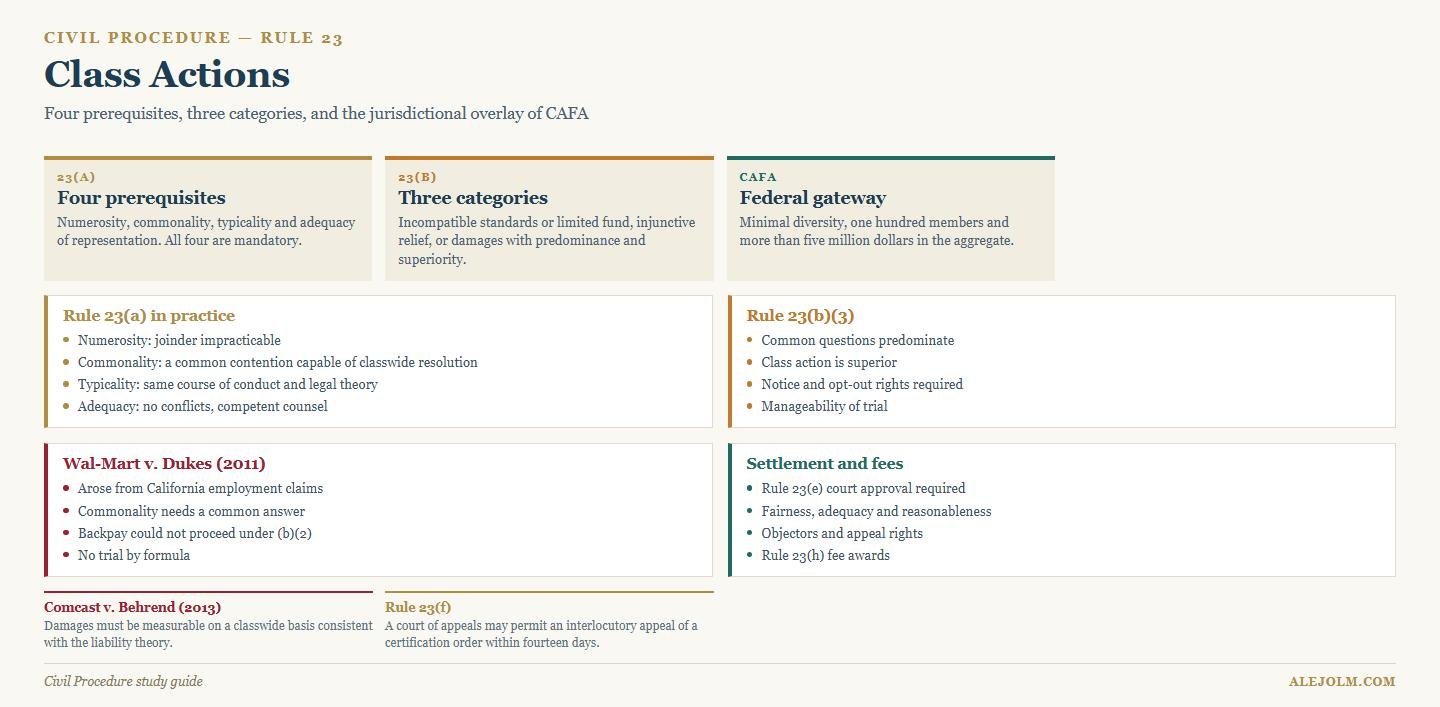
- Numerosity. The class is so numerous that joinder of all members is impracticable. There is no magic number, though classes above forty are usually comfortable.
- Commonality. There are questions of law or fact common to the class. After Wal-Mart Stores v. Dukes (2011) this means a common contention capable of classwide resolution — a common answer, not merely a common question.
- Typicality. The representative’s claims arise from the same course of conduct and rest on the same legal theory as those of the class.
- Adequacy. The representative and counsel will fairly and adequately protect the interests of the class, with no disabling conflicts.
Courts also apply implicit requirements: an ascertainable class definition, and standing on the part of the named representative for each claim asserted.
The three categories
Rule 23(b)(1)
Separate actions would risk inconsistent standards of conduct for the party opposing the class, or would as a practical matter dispose of the interests of absent members — the classic limited fund case.
Rule 23(b)(2)
The party opposing the class has acted on grounds generally applicable to the class, so that final injunctive or corresponding declaratory relief is appropriate for the class as a whole. Dukes held that claims for individualised monetary relief such as backpay cannot be shoehorned into this category.
Rule 23(b)(3)
Common questions predominate over individual ones and a class action is superior to other available methods. This is the damages class, and it is the only one that requires the best notice practicable and an opportunity to opt out. Comcast Corp. v. Behrend (2013) requires a damages model consistent with the liability theory and capable of measurement across the class.
Rigorous analysis, notice and settlement
A court must be satisfied after a rigorous analysis that the Rule 23 requirements are met, and that analysis frequently overlaps with the merits. Certification orders must define the class, the claims and the issues, and appoint class counsel under Rule 23(g). Rule 23(e) requires court approval of any settlement, voluntary dismissal or compromise of certified class claims, on a finding that the resolution is fair, reasonable and adequate. Rule 23(h) governs attorney fees, and Rule 23(f) allows a court of appeals to permit an interlocutory appeal from a certification order if a petition is filed within fourteen days.
A worked example
Delivery drivers allege they were misclassified as independent contractors. The proposed class covers everyone who drove for the company nationwide over four years. The company shows that supervision, scheduling and equipment practices varied significantly by region and by depot.
Commonality survives if the classification decision was made centrally, because the lawfulness of that decision produces a common answer. Predominance under Rule 23(b)(3) is the real battleground: if liability turns on how each driver was actually controlled day to day, individual issues swamp the common ones. A narrower class limited to a single region operating under one written policy is far more likely to be certified, which is why sophisticated plaintiffs often plead the narrower class from the outset.
Class actions in California and Los Angeles County in 2026
California is the centre of gravity for American class litigation, and Los Angeles County produces more of it than anywhere else in the state. Wal-Mart Stores v. Dukes itself grew out of California employment claims. The state has its own class action authority in Code of Civil Procedure section 382, interpreted through Sav-On Drug Stores v. Superior Court (2004) and Brinker Restaurant Corp. v. Superior Court (2012), and California courts have historically been more receptive to certification of wage and hour classes than their federal counterparts.
Sitting alongside the class device is the Private Attorneys General Act, which allows an aggrieved employee to bring a representative action for civil penalties without satisfying Rule 23 or section 382 at all. Viking River Cruises v. Moriana (2022) and the California Supreme Court’s response in Adolph v. Uber Technologies (2023) reshaped how individual PAGA claims interact with arbitration agreements, and the area has continued to move; confirm the current position with the California Courts before relying on any summary of it, including this one.
Practical points for a Los Angeles class filing in 2026:
- Expect a CAFA removal attempt. Minimal diversity, one hundred members and five million dollars in the aggregate will usually be satisfied, so plaintiffs relying on state court should study the local controversy and home state exceptions carefully.
- Define the class by county where you can. A class limited to Los Angeles County employees strengthens the local controversy exception and simplifies manageability.
- Plan the damages model early. Comcast requires a model tied to the liability theory, and expert work on that point belongs before the certification motion, not after.
- Anticipate arbitration agreements. Most Los Angeles employers use them, and the enforceability analysis often decides the case before certification is briefed.
- Use the complex litigation programme. The Los Angeles Superior Court assigns class actions to designated complex departments with their own procedures and fees; check the current requirements with the court.
- Budget for notice. Rule 23(b)(3) requires the best notice practicable, and in a class drawn from a county of ten million people that cost is a real strategic factor.
For 2026, treat forum selection, class definition and the arbitration analysis as a single connected decision made before filing. In Los Angeles they determine each other. Continue with diversity jurisdiction, removal and remand and the discovery rules.
Common mistakes to avoid
- Treating commonality as a low bar. After Dukes the question is whether classwide resolution produces a common answer.
- Seeking damages under Rule 23(b)(2). Individualised monetary relief belongs in a (b)(3) class with notice and opt-out rights.
- Ignoring predominance. A class can satisfy every Rule 23(a) prerequisite and still fail because individual issues dominate.
- Defining the class by liability. A fail-safe class whose membership depends on winning is routinely rejected.
- Missing the Rule 23(f) window. Fourteen days is short, and the deadline is not extended by a motion for reconsideration.
Frequently asked questions
What is the difference between commonality and predominance?
Commonality under Rule 23(a)(2) requires at least one issue capable of classwide resolution. Predominance under Rule 23(b)(3) is a comparative test asking whether the common issues outweigh the individual ones.
Do class members have to opt in?
No. In a Rule 23(b)(3) class, members are included unless they opt out after receiving the best notice practicable. Classes under Rule 23(b)(1) and (b)(2) generally carry no opt-out right.
What is CAFA?
The Class Action Fairness Act of 2005, which gives federal courts jurisdiction over class actions with minimal diversity, at least one hundred members and more than five million dollars in aggregate, subject to local controversy and home state exceptions.
Can a certification order be appealed immediately?
Rule 23(f) permits a court of appeals to allow an interlocutory appeal if a petition is filed within fourteen days of the order. Permission is discretionary.
Must a class settlement be approved by the court?
Yes. Rule 23(e) requires notice to the class and a finding that the settlement is fair, reasonable and adequate before any certified class claims may be resolved.
Related guides
 Diversity Jurisdiction: Citizenship and Amount Rules
 Federal Discovery Rules: Scope, Tools and Sanctions
 Subject Matter Jurisdiction in Federal Court Explained
- Res Judicata vs Collateral Estoppel: Bar Exam Guide
- Summary Judgment Under Rule 56: Standard and Proof
- The IRAC Method: How to Structure a Bar Exam Answer
- Removal and Remand: Moving a Case to Federal Court
- Standing in Federal Court: The 3-Part Article III Test
- Defamation Elements, Fault Standards and Privileges
- Federal Pleading Standards After Twombly and Iqbal
- Products Liability: The Three Defect Theories Explained
Next steps
Certification decides who is bound. What that binding effect actually means in later litigation is the province of preclusion doctrine. Read res judicata and collateral estoppel, then the discovery rules.