
A default judgment is what a plaintiff gets when the defendant never responds. It is the fastest way to win a lawsuit and the easiest way to lose one, and because courts strongly prefer decisions on the merits, a great deal of California practice consists of undoing defaults that should never have been entered.
Dismissal is the mirror image: the case ends without a merits ruling because the plaintiff abandoned it, failed to prosecute it, or chose to walk away. This guide covers both, in federal court under Rules 41 and 55 and in California under Code of Civil Procedure sections 581, 585 and 473, with the Los Angeles County mechanics that decide most of these disputes in practice.
Voluntary dismissal
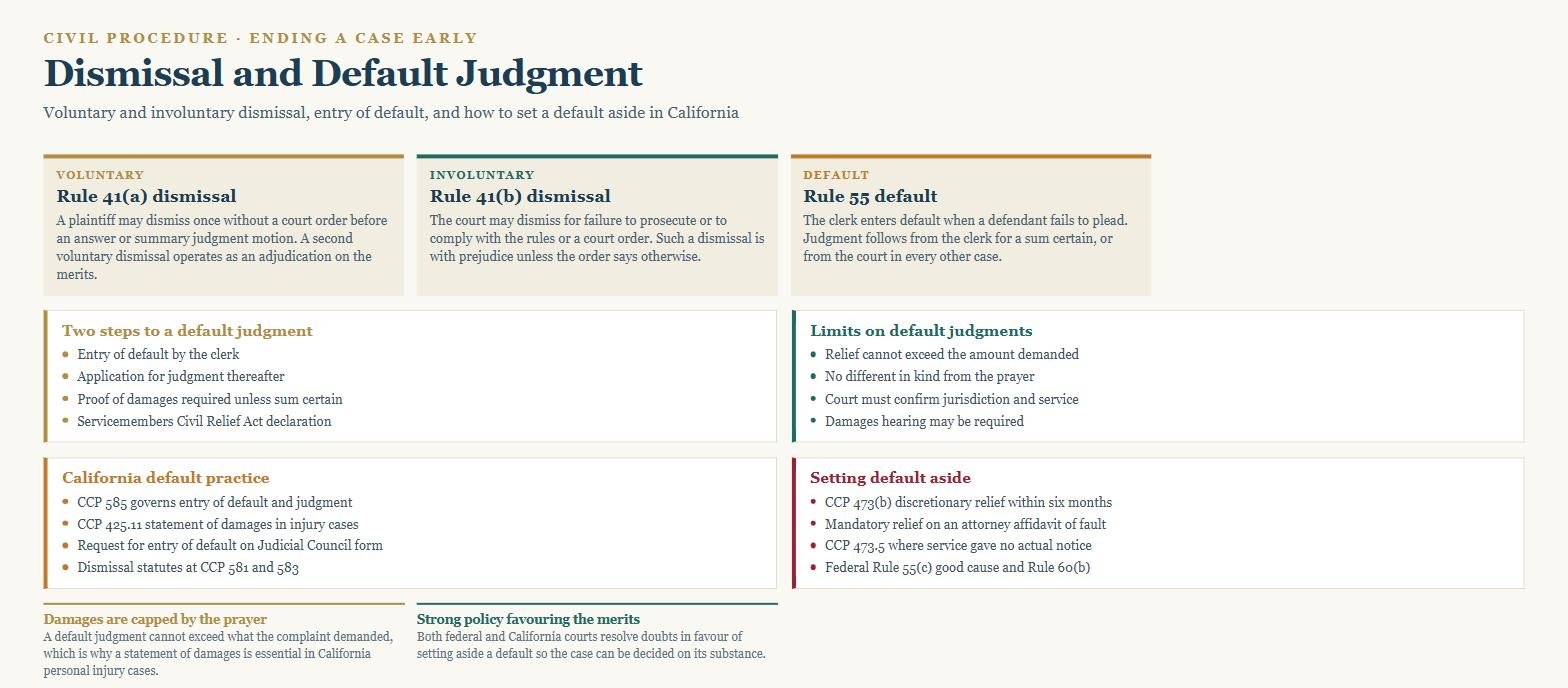
Under Rule 41(a)(1) a plaintiff may dismiss without a court order by filing a notice before the opposing party serves an answer or a motion for summary judgment, or by filing a stipulation signed by all parties who have appeared. The first such dismissal is without prejudice. The two-dismissal rule then bites: a second voluntary dismissal of the same claim operates as an adjudication on the merits and bars refiling.
California’s section 581 is broadly similar but the cut-off is different and matters enormously. A plaintiff can dismiss without prejudice at any time before the actual commencement of trial, which in a jury case means before the first witness is sworn. After that point the dismissal generally must be with prejudice, and a dismissal taken to avoid an adverse ruling on a dispositive motion will not preserve the claim.
Involuntary dismissal
Rule 41(b) allows the court to dismiss for failure to prosecute or to comply with the rules or any court order. Unless the order states otherwise, such a dismissal operates as an adjudication on the merits, with the exception of dismissals for lack of jurisdiction, improper venue or failure to join a required party. California’s equivalent machinery lives in sections 583.110 through 583.430 and includes the mandatory five-year rule requiring an action to be brought to trial within five years of filing.
The two steps to a default judgment
Step one: entry of default
Default is entered by the clerk on a showing that the defendant was properly served and has failed to plead or otherwise defend within the time allowed. This is a ministerial act, not a judgment. Once default is entered the defendant loses the right to participate: it cannot file an answer, take discovery, or oppose the damages application unless and until the default is set aside.
Step two: entry of judgment
The clerk may enter judgment only where the claim is for a sum certain or a sum that can be made certain by computation, the defendant is not a minor or incompetent person, and the defendant has not appeared. In every other case the plaintiff must apply to the court, prove up damages by declaration or at a hearing, and satisfy the court that jurisdiction and service were proper. A declaration under the Servicemembers Civil Relief Act is also required.
The central limit is that a default judgment cannot grant relief exceeding in amount, or differing in kind, from what the complaint demanded. This is a due process rule: the defendant was entitled to decide whether to defend based on what was claimed against it.
| Question | Federal |
|---|---|
| Entry of default | Rule 55(a), by the clerk |
| Clerk judgment available | Sum certain, no appearance |
| Court judgment | Rule 55(b)(2) with prove-up |
| Cap on relief | Rule 54(c), limited to the demand |
| Personal injury demand | Stated in the complaint |
| Setting aside | Rule 55(c) good cause; Rule 60(b) |
Setting a default aside
- Discretionary relief: Code of Civil Procedure section 473(b) allows relief from a default taken through mistake, inadvertence, surprise or excusable neglect, on application made within a reasonable time and no later than six months.
- Mandatory relief: where the application is accompanied by an attorney’s sworn affidavit attesting to their own mistake or neglect, relief is mandatory rather than discretionary if the six month deadline is met.
- No actual notice: section 473.5 provides relief where service did not result in actual notice in time to defend, on a longer outside deadline.
- Void judgments: a judgment void for lack of jurisdiction or defective service can be attacked at any time under section 473(d).
- Federal route: Rule 55(c) applies a good cause standard before judgment, and Rule 60(b) applies afterwards.
- Attach the pleading: a motion under section 473(b) must include the proposed answer or it will be denied.
A worked example
A plaintiff sues a Van Nuys auto body shop for negligence following a collision, pleading damages “according to proof” without stating an amount, as California pleading rules require in personal injury cases. The shop is served but never answers. The plaintiff requests entry of default and then applies for a judgment of 350,000 dollars supported by medical records and a lost earnings declaration. The court enters judgment.
That judgment is vulnerable. Because the complaint did not state a dollar amount, Code of Civil Procedure section 425.11 required the plaintiff to serve a separate statement of damages on the defendant before default could be taken, giving the defendant notice of the exposure. Without it, the judgment exceeds the demand and violates section 580. The shop can move to vacate, and courts routinely grant that relief because the defect goes to due process rather than to excusable neglect. Note that the plaintiff can usually cure by serving the statement and starting the default process over, so the practical cost is delay rather than loss of the claim.
Default Judgment in California and Los Angeles County in 2026
California default practice runs on Judicial Council forms and is unforgiving about paperwork. Entry of default is requested on form CIV-100, which combines the request for entry of default with the application for a clerk’s judgment where one is available. The request must include a declaration of mailing to the defendant’s last known address, and the clerk will reject the filing if the proof of service of summons on file is defective in any respect.
In personal injury and wrongful death cases the statement of damages under section 425.11 is the step most often missed. Because the complaint cannot state a damages figure in those cases, the statement must be served on the defendant, in the same manner as a summons if the defendant has not appeared, before default is taken. Section 425.115 imposes a parallel requirement for punitive damages. Skipping either step caps the recoverable judgment at zero for that category.
Los Angeles Superior Court also enforces the dismissal statutes actively. The two-year discretionary and five-year mandatory rules under sections 583.410 and 583.310 are tracked by the court, and Order to Show Cause hearings regarding dismissal for failure to prosecute or failure to serve are routine. A plaintiff who takes a default and then sits on the prove-up can find the whole case dismissed on the court’s own motion.
- CCP 585: the entry of default and default judgment statute, with clerk and court routes.
- Form CIV-100: the Judicial Council request for entry of default, including the mailing declaration.
- CCP 425.11: serve a statement of damages before default in personal injury and wrongful death cases.
- CCP 425.115: a separate notice is required to preserve punitive damages on default.
- CCP 580: relief is capped at the amount demanded, and exceeding it makes the judgment voidable.
- CCP 583.310: the five-year rule continues to run, so prove up the default promptly.
For 2026, confirm the current Judicial Council form revisions and the Los Angeles Superior Court default prove-up procedures, including whether your department accepts declarations in lieu of a hearing, as these have changed repeatedly. See also service of process, relief from judgment and pleading standards.
Common mistakes to avoid
- Taking default on defective service. The judgment is void and can be attacked years later, after enforcement costs have piled up.
- Skipping the statement of damages. In a California personal injury case this alone will void the judgment.
- Asking for more than the complaint demanded. Section 580 and Rule 54(c) both cap relief at the prayer.
- Filing a section 473 motion without a proposed answer. The motion is incomplete and will be denied.
- Letting a default sit. The five-year rule keeps running and an Order to Show Cause dismissal can end the case.
Frequently asked questions
What is a default judgment?
It is a judgment entered against a defendant who was properly served but failed to respond within the time allowed. It requires two steps: entry of default, then entry of judgment.
Can a default judgment be set aside in California?
Yes. Code of Civil Procedure section 473(b) allows relief for mistake, inadvertence, surprise or excusable neglect within six months, and relief is mandatory where an attorney submits an affidavit of fault.
Can the judgment exceed what the complaint asked for?
No. Section 580 and Federal Rule 54(c) both limit a default judgment to the amount and kind of relief demanded, which is why the damages demand must be stated or separately served.
What is a statement of damages?
It is the notice required by Code of Civil Procedure section 425.11 in personal injury and wrongful death cases, telling the defendant the amount claimed, because the complaint itself cannot state a figure.
What is the two-dismissal rule?
Under Federal Rule 41(a)(1), a plaintiff’s second voluntary dismissal of the same claim counts as a decision on the merits and bars any further action on that claim.
Related guides
- Service of Process Under Rule 4: Methods and Waiver
- Relief From Judgment Under Rule 60 and CCP 473
- Federal Pleading Standards After Twombly and Iqbal
- Summary Judgment Under Rule 56: Standard and Proof
- Pretrial Conferences and Scheduling Orders Explained
- The Final Judgment Rule and Interlocutory Appeal Routes
- Counterclaims and Cross-Claims in California Practice
- Limited vs Unlimited Civil Cases in California Courts
- Minimum Contacts and Due Process in California Courts
- Res Judicata vs Collateral Estoppel: Bar Exam Guide
- Interpleader Actions in California and Federal Courts
Next steps
Confirm the service requirements in service of process before requesting any default, and read relief from judgment for the full range of post-judgment remedies. Judicial Council forms are published by the California Courts, and local default procedures are described by the Los Angeles Superior Court.