
Intentional infliction of emotional distress is the tort that catches conduct so far beyond the bounds of decency that the law will impose liability even though no one was touched, no property was taken, and no defamatory word was published. It exists because the older intentional torts left a gap, and courts eventually decided that the gap was letting genuinely outrageous behavior go unremedied.
The tort is powerful in the right case and almost impossible in the wrong one. Courts guard it carefully, precisely because everyone suffers distress and the legal system cannot become a forum for ordinary rudeness. Understanding IIED means understanding where that line sits, and how California in particular has drawn it in employment, insurance, debt collection, and family disputes.
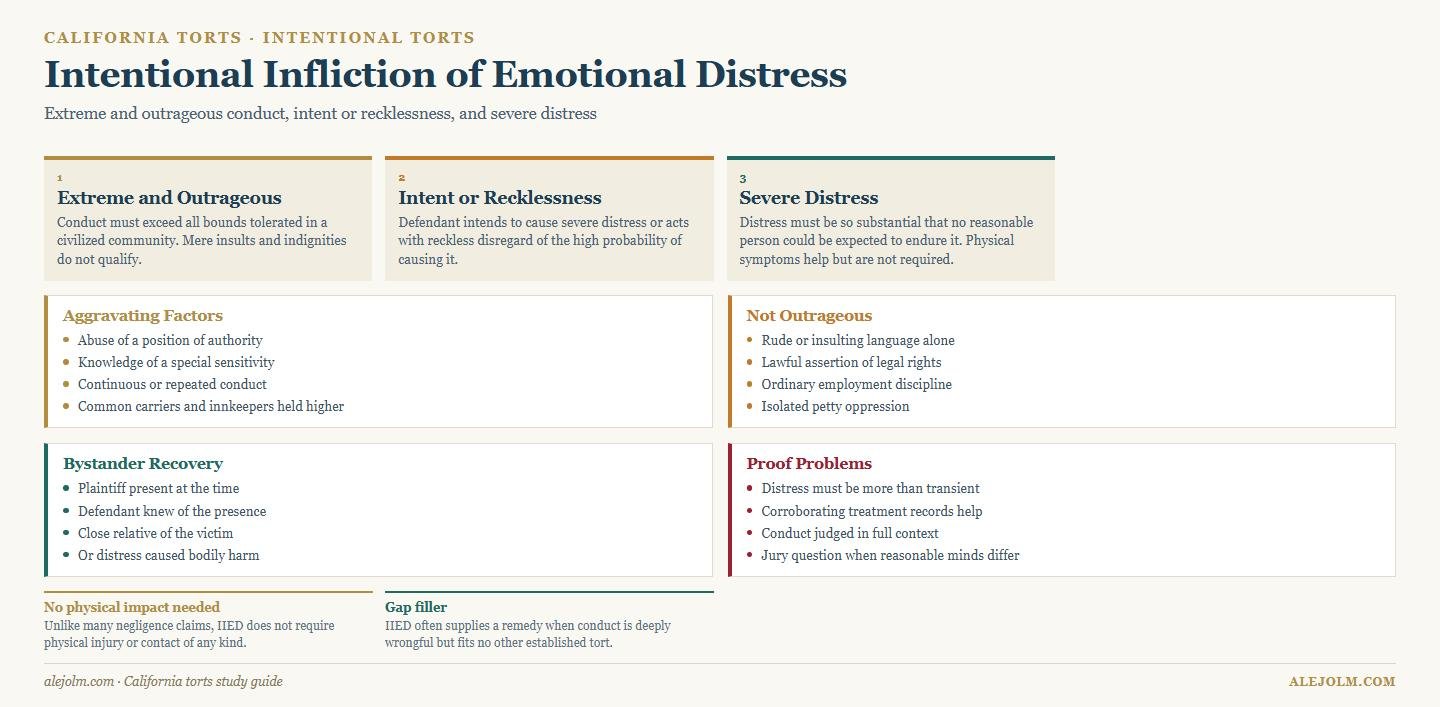
Extreme and outrageous conduct
This is the gatekeeping element. Conduct qualifies only when it goes beyond all possible bounds of decency and would be regarded as atrocious and utterly intolerable in a civilized community. Insults, indignities, threats, annoyances, petty oppressions, and other trivialities are not enough, however genuinely upsetting they are to the person on the receiving end.
Courts do not assess conduct in a vacuum. Three contextual factors reliably push otherwise borderline behavior across the line, and their absence usually keeps it below.
Abuse of a position of power
Where the defendant occupies a position of actual or apparent authority over the plaintiff — employer, landlord, police officer, creditor, school official — the same words carry more coercive weight. A supervisor who repeatedly threatens an employee with deportation is treated very differently from a stranger saying the same thing on the street.
Knowledge of a particular susceptibility
Conduct that would be merely unkind toward a typical adult can become outrageous when directed at someone the defendant knows to be especially vulnerable: a child, an elderly person, a pregnant woman, or a person with a known psychiatric condition. The defendant must actually know of the susceptibility; the plaintiff’s hidden fragility does not retroactively make ordinary conduct outrageous.
Common carriers and innkeepers
A minority of authority holds these defendants to a heightened standard, allowing recovery for gross insults that would not support liability against an ordinary defendant. The rule is a survival of the special public duties historically imposed on those trades.
Intent or recklessness
The defendant must either desire to cause severe emotional distress or act in reckless disregard of a high probability that severe distress will follow. Recklessness distinguishes IIED from the other intentional torts, which generally require purpose or substantial certainty. It substantially widens the tort: a defendant who did not care whether the plaintiff was devastated can be liable just as readily as one who set out to devastate them.
| Mental state | Sufficient for IIED? |
|---|---|
| Purpose to cause severe distress | Yes |
| Substantial certainty of severe distress | Yes |
| Reckless disregard of high probability | Yes |
| Negligence | No |
| No awareness of the plaintiff at all | No |
Severe emotional distress
The distress must be so severe that no reasonable person could be expected to endure it. Transient upset, embarrassment, and anger do not qualify. Physical manifestations — sleeplessness, weight loss, nausea, hypertension — are not required, but they are powerful evidence, and plaintiffs who sought treatment are in a far stronger position than those who did not.
The outrageousness of the conduct and the severity of the distress interact. The more extreme the conduct, the more readily a court will accept that severe distress followed, sometimes treating the conduct itself as evidence of the injury. Conversely, extraordinary distress from mild conduct signals a susceptibility problem rather than an outrageousness problem.
No physical injury, no physical impact, and no threat of physical contact is required. IIED is the intentional tort that protects peace of mind directly rather than as a byproduct of protecting the body.
Bystander recovery
A plaintiff who was not the target of the conduct may still recover when the defendant directs outrageous conduct at a third person. The classic requirements are that the plaintiff was present at the time, that the defendant knew of the plaintiff’s presence, and that the plaintiff is a close relative of the primary victim. Where the plaintiff is not a close relative, most authority requires that the distress actually result in bodily harm.
This pathway should not be confused with negligent infliction of emotional distress, which has its own presence-and-relationship framework. Our guide to negligent infliction of emotional distress sets out that separate test.
A worked example
A debt collector learns that a debtor is undergoing chemotherapy. Over three weeks the collector calls the debtor’s hospital room eleven times, tells a nurse the debtor is a fraud, and finally tells the debtor that his family will be left destitute and that the collector will make sure his employer knows. The debtor develops insomnia and panic attacks and stops a treatment cycle. His adult daughter, present in the room for the last call, hears it on speakerphone and is also badly shaken.
The debtor’s claim is strong. The collector abused a position of economic leverage, knew of an acute susceptibility, and engaged in repeated rather than isolated conduct — all three aggravating factors. The distress is documented and severe. The daughter’s claim runs through the bystander pathway: she was present, the collector knew she was on the line, and she is a close relative. Note that many jurisdictions would resolve the daughter’s claim on the knowledge element alone, since a caller cannot always be charged with knowing who else is listening, which is why proving that the defendant was told of the plaintiff’s presence is usually the decisive evidentiary task.
Intentional Infliction of Emotional Distress in California and Los Angeles County in 2026
California states the elements in CACI 1600: extreme and outrageous conduct by the defendant with the intention of causing, or reckless disregard of the probability of causing, emotional distress; the plaintiff suffering severe or extreme emotional distress; and actual and proximate causation by the outrageous conduct. California courts have long held that the conduct must be directed at the plaintiff, or occur in the presence of a plaintiff of whom the defendant is aware, which is how the state channels bystander-type claims.
Two California-specific limits matter more than anything in the general doctrine. The first is workers’ compensation exclusivity. Where the alleged outrageous conduct is part of the normal risks of the employment relationship — discipline, criticism, demotion, termination — the exclusive remedy provisions of the Labor Code generally bar a civil IIED claim against the employer, and the employee is left with the compensation system. Conduct that falls outside the normal scope of employment, such as harassment motivated by a protected characteristic, is treated differently, and IIED counts are routinely pleaded alongside Fair Employment and Housing Act claims.
The second is the anti-SLAPP statute, Code of Civil Procedure section 425.16. Because IIED claims are so often built on speech, petitioning, or litigation-related conduct, defendants in Los Angeles County file anti-SLAPP motions against IIED counts with great frequency. A plaintiff who loses one pays the defendant’s fees. Related to this is Civil Code section 47(b), the litigation privilege, which is absolute and defeats IIED claims founded on statements made in or in connection with judicial proceedings.
- Statute of limitations. Code of Civil Procedure section 335.1 supplies two years for personal injury, which California applies to IIED; continuing conduct may extend accrual.
- Anti-SLAPP exposure. Section 425.16 motions must generally be filed early in the case and stay discovery; confirm the current filing window and fee-shifting rules before pleading an IIED count based on speech.
- Litigation privilege. Civil Code section 47(b) is absolute and bars IIED claims resting on communications connected to a judicial or quasi-judicial proceeding.
- Workers’ compensation exclusivity. Labor Code sections 3600 and 3602 generally bar IIED against an employer for conduct within the normal employment relationship.
- Elder and dependent adult plaintiffs. Welfare and Institutions Code section 15657 provides enhanced remedies where abuse of an elder or dependent adult is proven by clear and convincing evidence.
- Punitive damages. Civil Code section 3294 requires clear and convincing proof of malice, oppression, or fraud, a standard that outrageous conduct frequently satisfies.
For 2026, verify the current anti-SLAPP filing deadlines, Los Angeles Superior Court departmental rules for law and motion, and any amendments to Labor Code exclusivity directly with the court and the current statutes, since these procedural details change and any static summary can go stale. To build out the surrounding doctrine, read our guides to assault, false imprisonment, and defamation, which are the counts most often filed alongside IIED in Los Angeles County.
Common mistakes to avoid
- Pleading rudeness as outrageousness. Insults, profanity, and unfair treatment are not enough. Plead facts showing authority, susceptibility, or repetition.
- Skipping the severity proof. Conclusory allegations of distress invite demurrer. Document treatment, duration, and functional impairment.
- Suing an employer for ordinary personnel decisions. Workers’ compensation exclusivity will usually bar the claim in California; identify conduct outside the normal employment relationship.
- Basing the claim on litigation conduct. Civil Code section 47(b) is absolute, and an anti-SLAPP motion will follow with fee exposure.
- Confusing IIED with NIED. If the defendant was merely careless, the intent element fails and the claim belongs in the negligent infliction framework.
Frequently asked questions
Do I need physical injury to bring an IIED claim?
No. IIED protects mental tranquility directly, so no physical impact or injury is required. Physical symptoms are strong evidence of severity, however, and claims supported by medical records are far more likely to survive a demurrer or summary judgment.
Can insults alone ever be outrageous?
Rarely, and generally only where the defendant holds power over the plaintiff, knows of a particular vulnerability, or repeats the conduct over time. A minority of authority also allows recovery for gross insults by common carriers and innkeepers.
What is the difference between IIED and NIED?
IIED requires intent or recklessness as to causing severe distress and extreme and outrageous conduct. NIED requires only negligence but imposes its own restrictions on who may recover, based on presence at the event and relationship to the victim.
Can I recover if the conduct targeted my family member?
Sometimes. The bystander pathway requires that you were present, that the defendant knew you were present, and generally that you are a close relative. Non-relatives usually must show the distress caused bodily harm.
Does the anti-SLAPP statute apply to IIED claims?
It can. If the claim arises from protected speech or petitioning activity, Code of Civil Procedure section 425.16 applies and a losing plaintiff may owe the defendant attorney fees. Confirm the current procedural requirements before filing.
Related guides
- The Four Elements of Negligence: Bar Exam Breakdown
- Battery in Tort Law: Elements, Defenses and Damages
- Defamation Elements, Fault Standards and Privileges
- The Transferred Intent Doctrine in Tort Law Explained
- Duty of Care in Negligence: Who Owes What to Whom
- Assault in Tort Law: Apprehension of Imminent Harm
- Negligent Infliction of Emotional Distress in California
- Wrongful Death Claims in California: Who Can Sue
- Actual Malice and the Three Tracks of Defamation Law
- False Imprisonment in California: Elements and Defenses
- Malicious Prosecution Claims: Elements and Defences
Next steps
Compare the intentional and negligent routes to emotional harm by reading our guide to negligent infliction of emotional distress, then review transferred intent to see why IIED sits outside the transferred-intent family that covers the older trespass torts.
For primary sources, consult the Judicial Council of California civil jury instructions and the text of the anti-SLAPP statute at Code of Civil Procedure section 425.16.