
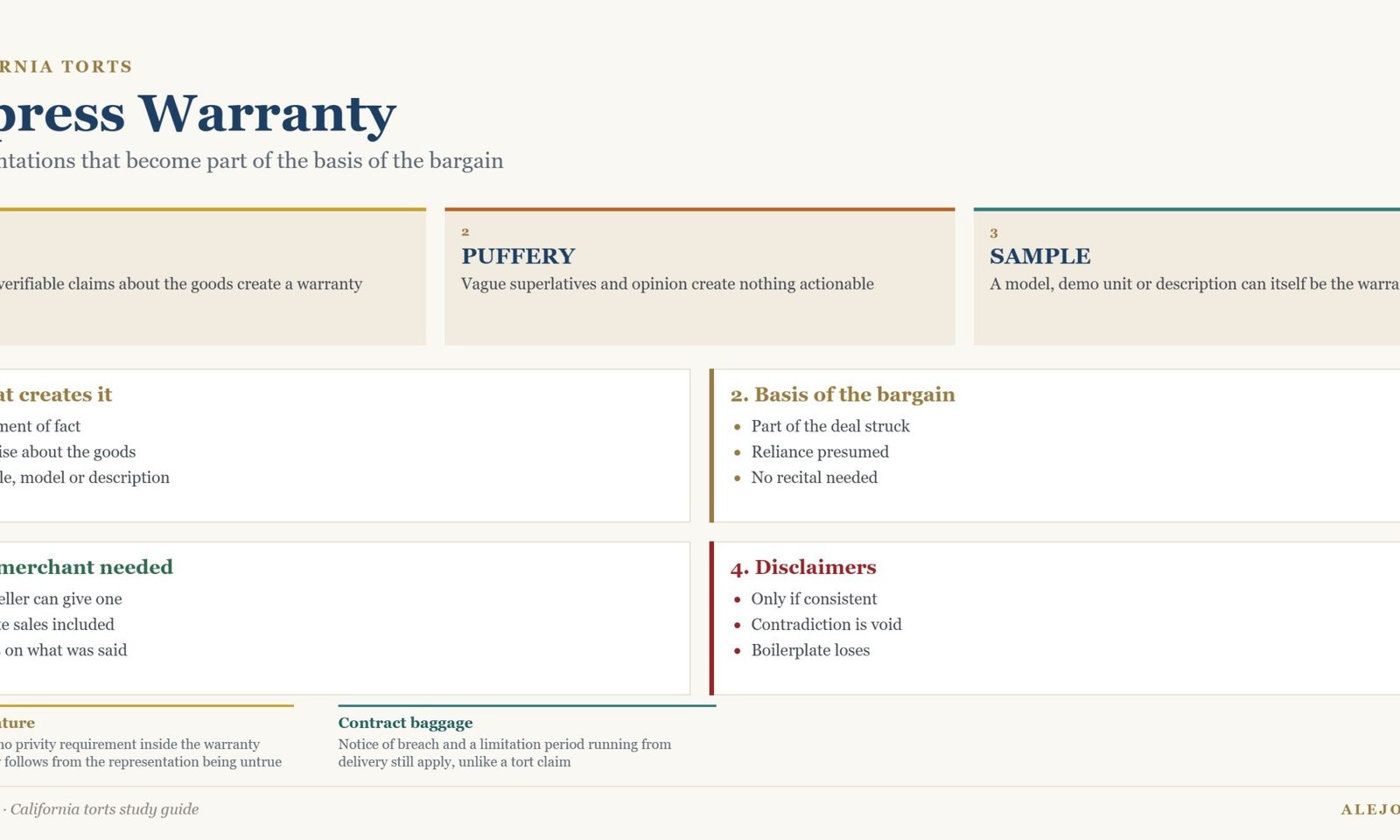
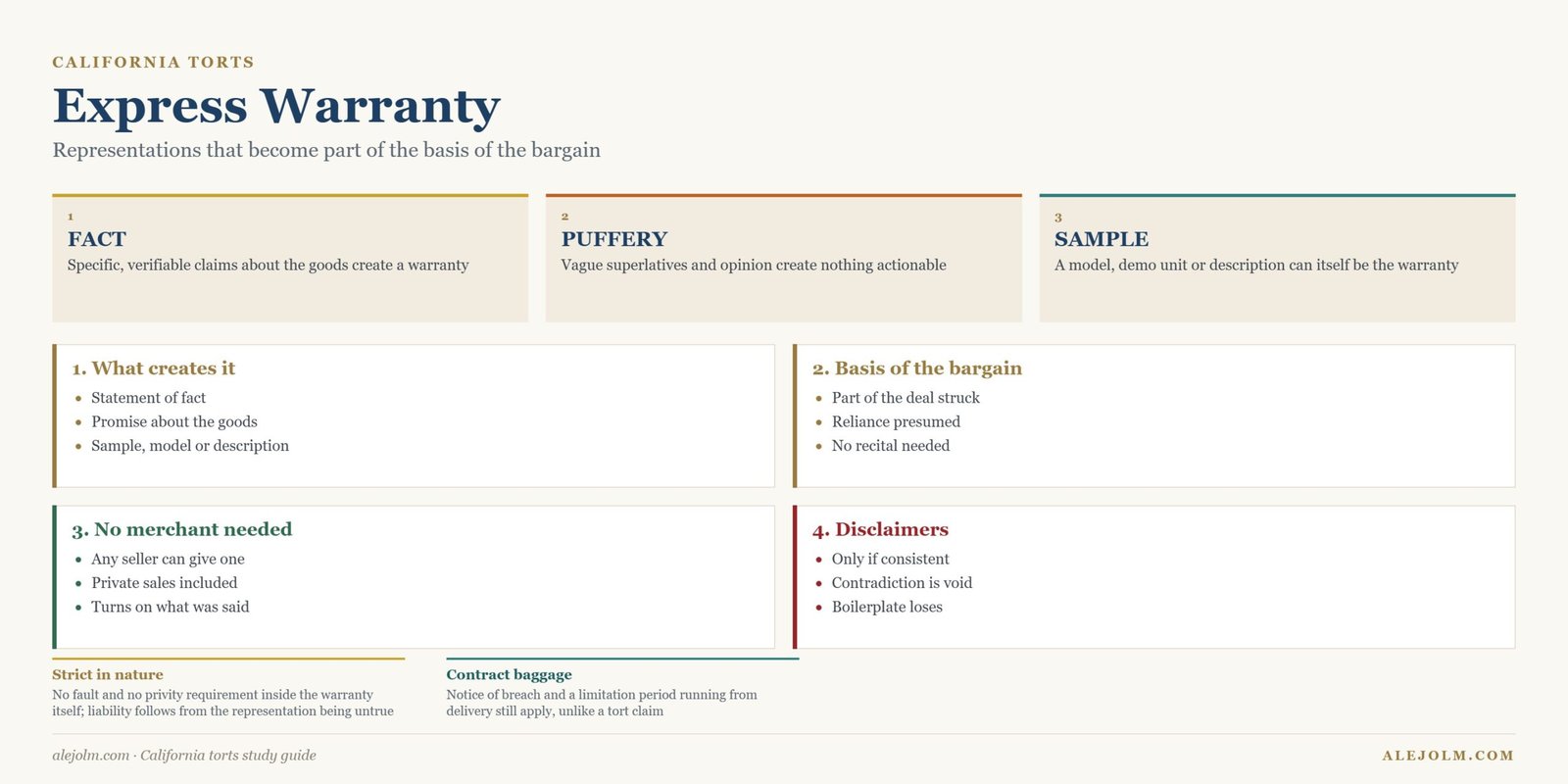
Express warranty arises when a seller makes a statement of fact or a promise about goods, or shows a sample or model, and that representation becomes part of the basis of the bargain. The seller is then bound to deliver goods that conform to it. No fault is required, and the buyer does not have to show that the seller was careless or dishonest.
The whole difficulty lies in separating actionable factual assertions from sales talk that no reasonable buyer treats as a guarantee. This guide draws that line, explains how samples and catalogue descriptions create warranties without a word being spoken, sets out the narrow scope for disclaimers, and places the theory alongside strict products liability in California practice.
What creates an express warranty
Three routes exist. An affirmation of fact or a promise relating to the goods creates a warranty that the goods will conform to it. A description of the goods creates a warranty that they will match the description. A sample or model creates a warranty that the whole of the goods will conform to what was shown.
The second and third routes are the ones most often missed, because the word express suggests something said or written. A demonstration unit on a shop floor, a specification sheet, a catalogue entry or the wording on packaging can each create a binding representation.
Fact against puffery
A statement is actionable only if it is a specific and verifiable assertion about the goods. Claims that tyres are rated for sixty thousand miles, or that a ladder holds three hundred pounds, or that a truck can tow a stated weight, are all testable and all binding if untrue.
By contrast, the finest set of tyres you can buy, best in class and amazing quality are opinion and sales talk. No reasonable buyer treats a vague superlative as a factual guarantee, so nothing is warranted. The dividing question is whether the statement could be proved right or wrong by measurement.
Basis of the bargain
The representation must have become part of the basis of the bargain. That does not require the buyer to prove that the statement was remembered, repeated or expressly relied upon at the moment of sale. Once a statement made during the negotiation is found to have formed part of the deal, reliance is effectively presumed, and it falls to the seller to show the statement played no part.
| Question | Express warranty | Implied warranty of merchantability |
|---|---|---|
| Source of the obligation | What the seller said or showed | Operation of law on the transaction |
| Merchant status needed | No | Yes |
| Fault required | No | No |
| Disclaimer | Only if consistent with the warranty | Conspicuous, must name merchantability |
Disclaimers are narrow
Because the warranty was created by the words of the seller, a later disclaimer is given effect only so far as it can reasonably be reconciled with those words. Where the two cannot be read together, the warranty prevails and the disclaimer is disregarded.
That rule defeats the familiar pattern in which a salesperson makes a precise factual promise and the printed contract then purports to exclude all warranties, express or implied. Boilerplate does not silently swallow a specific bargained representation.
No merchant requirement
Unlike merchantability, express warranty does not depend on the status of the seller. A private individual who describes goods in factual terms creates a warranty just as a dealer does. The cleanest way to sort the two theories is to ask whether liability flows from what the seller said, which is express, or from the nature of the transaction, which is implied.
A worked example
A buyer in Los Angeles purchases a roof ladder after the salesperson states that it is rated to hold three hundred pounds. The buyer weighs less than that, the ladder collapses and he is injured. The statement was specific and verifiable, it formed part of the bargain and the goods did not conform. Express warranty is established without any need to prove that the seller knew the rating was wrong.
Change the statement. Suppose the salesperson had said only that it was the sturdiest ladder in the shop. That is comparative sales talk rather than a measurable claim, so no express warranty arises. The buyer would have to run the claim on merchantability or on strict products liability for a design or manufacturing defect instead.
Express warranty in California and Los Angeles County in 2026
California enacts the sales article of the Uniform Commercial Code in its Commercial Code, and the express warranty provision states the three routes of affirmation, description and sample. The Song-Beverly Consumer Warranty Act then adds obligations for consumer goods, including rules about what an express warranty must contain and the consequences of a failure to repair within a reasonable number of attempts.
California also decided Greenman v Yuba Power Products, which established strict liability in tort so that injured consumers would not be defeated by warranty notice and privity requirements. Express warranty nevertheless remains valuable because it can capture purely economic disappointment that tort law will not reach.
- Statutory basis — the Commercial Code sets out affirmation, description and sample as the routes to an express warranty.
- Consumer statute — the Song-Beverly Act regulates express warranties on consumer goods.
- Advertising claims — statements in advertising and packaging can create warranties.
- Economic loss — warranty reaches disappointment in value that tort claims exclude.
- Notice — the buyer must notify the seller of breach within a reasonable time.
- Limitation — the period generally runs from tender of delivery.
For 2026, confirm the current California authority on express warranty formation, consumer warranty obligations and limitation periods directly with current authority, since these continue to develop.
Common mistakes to avoid
- Treating puffery as a warranty — only specific and verifiable assertions qualify.
- Overlooking samples and descriptions — a demonstration unit or catalogue entry can create the warranty.
- Requiring merchant status — any seller who makes a factual representation can be bound.
- Accepting boilerplate disclaimers — a disclaimer that contradicts the warranty is disregarded.
- Demanding proof of specific reliance — once the statement is part of the bargain, reliance is effectively presumed.
- Forgetting the contract defences — notice and the delivery based limitation period still apply.
Frequently asked questions
Is advertising an express warranty in California?
It can be. A specific factual claim in advertising or on packaging about what goods will do can become part of the basis of the bargain, while general praise and superlatives will not. The test is whether the statement is measurable.
Does the buyer have to prove reliance?
Not in the strict sense. The requirement is that the representation became part of the basis of the bargain, and once that is established the buyer need not show that the statement was consciously relied upon at the moment of purchase.
Can a written contract cancel a salesperson promise?
Only where the two can be reconciled. A printed exclusion that flatly contradicts a specific factual promise is disregarded, and the warranty controls. Sellers cannot use general boilerplate to erase a particular representation.
Does express warranty require the seller to be at fault?
No. The theory is strict within its own terms. Liability follows from the goods failing to conform to the representation, regardless of whether the seller knew or should have known that it was inaccurate.
How does it differ from fraud?
Fraud requires knowledge of falsity or reckless indifference and produces tort remedies including punitive damages in appropriate cases. Express warranty requires no such mental state, but it carries contract limits such as notice of breach and a limitation period running from delivery.
Related guides
- Implied Warranties
- Products Liability
- Design Defect
- Manufacturing Defect
- Warning Defect
- Strict Liability
- Fraud
- Negligent Misrepresentation
Next steps
Read this with implied warranties to see the two UCC routes side by side, and then fraud for the tort claim that covers deliberate falsehoods.
For primary sources, read California Commercial Code section 2313 and the civil jury instructions published by the Judicial Council of California.