
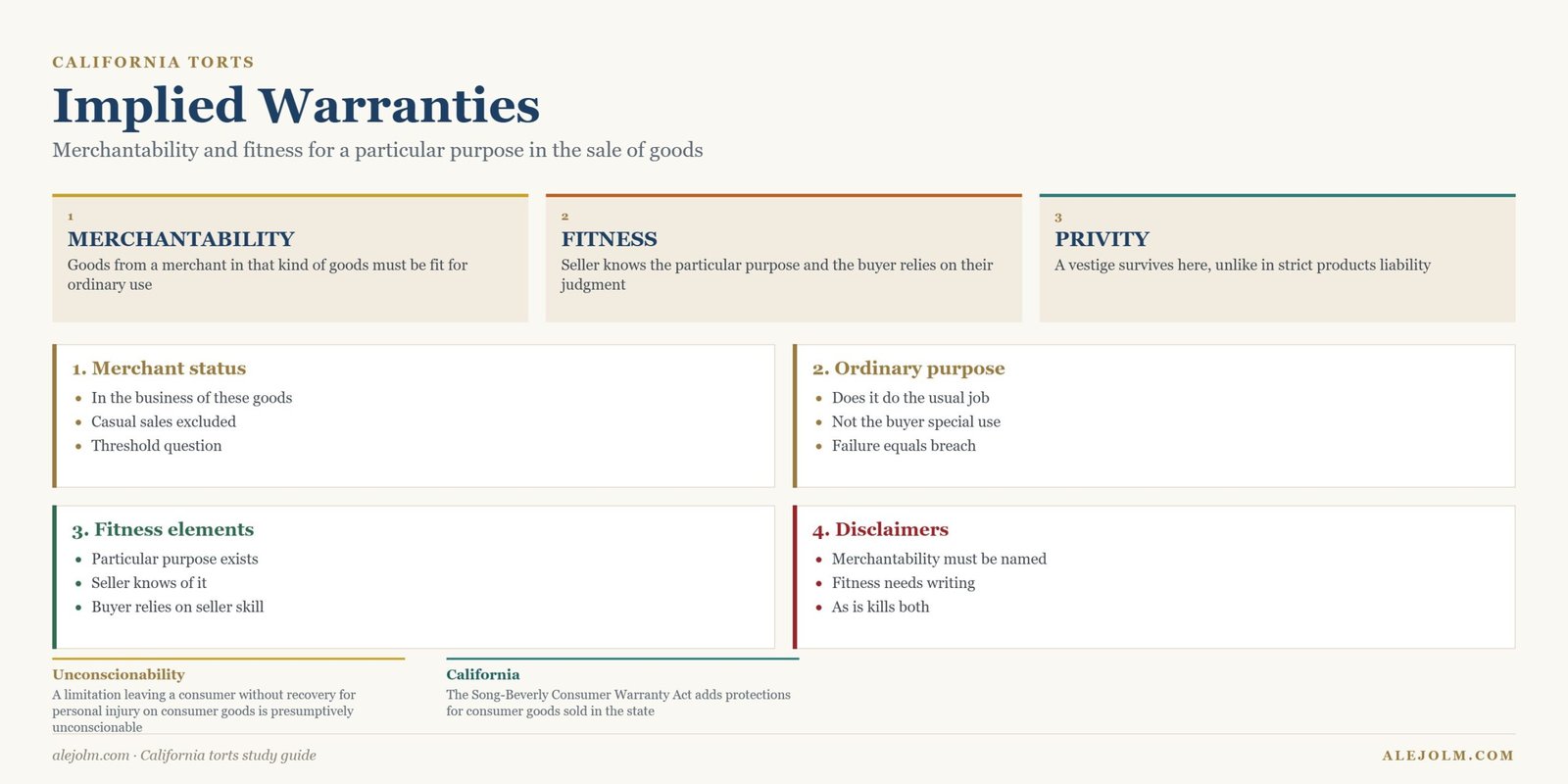
Implied warranties are the contract based obligations that the law reads into a sale of goods without either party saying anything. Two matter most: the warranty of merchantability, which requires goods sold by a merchant to be fit for their ordinary purpose, and the warranty of fitness for a particular purpose, which applies where the buyer relied on the seller to choose something suitable for a specific need.
These theories run alongside strict products liability rather than replacing it, and California claimants routinely plead both. The differences matter, because warranty claims carry contract baggage that tort claims do not. This guide sets out each warranty, the disclaimer rules, the surviving privity limit and the California consumer statute that overlays the whole area.
Warranty of merchantability
Goods sold by a merchant must be fit for the ordinary purposes for which such goods are used. The test is functional rather than aspirational: a product that does the usual job is merchantable even if it disappoints in other respects, and a product that fails at its ordinary use is not merchantable however elegant it may be.
The merchant threshold
The warranty arises only where the seller is a merchant with respect to goods of that kind, meaning someone in the business of selling those particular goods. A private individual selling a used car does not give this warranty, even though the same sale could still support a negligence or fraud claim if a known defect was concealed.
Warranty of fitness for a particular purpose
This warranty arises where the buyer has a particular purpose for the goods, the seller knows or has reason to know of that purpose, and the buyer relies on the skill or judgement of the seller to select suitable goods. All three conditions must be present.
The distinction from merchantability is easily blurred. A customer who asks a hardware store for a paint that will survive on a boat hull and is sold ordinary interior paint has a fitness claim, not a merchantability claim, because interior paint is perfectly merchantable for interior walls. The failure lies in the selection, not in the product.
| Feature | Merchantability | Fitness for particular purpose | Strict products liability |
|---|---|---|---|
| Seller must be a merchant | Yes | No, but expertise is relied on | Any commercial supplier |
| Standard | Ordinary purpose | The communicated purpose | Defective and unreasonably dangerous |
| Privity | Limited by statute | Limited by statute | Not required |
| Disclaimer | Must name merchantability | Written and conspicuous | Cannot be disclaimed for injury |
Disclaimers and limitations
A seller can exclude the warranty of merchantability only by a conspicuous disclaimer that actually uses the word merchantability. Fitness can be disclaimed in writing and conspicuously, without any particular form of words. Language such as sold as is or with all faults eliminates implied warranties generally.
Formal validity is not the end of the analysis. A limitation of remedies is generally enforceable for economic loss, but a limitation that would leave a consumer without recovery for personal injury caused by consumer goods is presumptively unconscionable. Courts strike those clauses even where the mechanics of the disclaimer were faultless.
Who can sue
Warranty theories retain a statutory privity rule, which strict products liability abandoned entirely. The Uniform Commercial Code offers three alternatives. The most widely adopted extends the warranty to the buyer, family and household members and guests who suffer personal injury. Broader versions reach any natural person reasonably expected to use or be affected by the goods, or any person at all.
The practical consequence is that a bystander with no household connection to the buyer often cannot recover on a warranty theory even though the identical injury would support a strict liability claim. That gap is the single most important reason both theories are pleaded together.
A worked example
A restaurant in Los Angeles buys a commercial fryer from a catering equipment dealer. The thermostat fails, the oil overheats and a member of staff is burned. The dealer is a merchant in goods of that kind and a fryer that cannot regulate temperature is not fit for its ordinary purpose, so merchantability is breached. The injured employee, being neither buyer nor household member, may face a privity obstacle on the warranty count while having a clear strict liability claim.
Change the transaction. Suppose the restaurant had explained that it needed equipment capable of continuous use for twelve hour services and relied on the dealer to choose a suitable model, and the dealer supplied a light duty unit that failed under that load. The unit is merchantable for ordinary use, so the claim runs on fitness for a particular purpose instead.
Implied warranties in California and Los Angeles County in 2026
California enacts the sales article of the Uniform Commercial Code in its Commercial Code, so merchantability and fitness apply in the familiar form. Layered on top is the Song-Beverly Consumer Warranty Act, which gives consumers additional protections for consumer goods sold in California, restricts the ability of a manufacturer or retail seller to disclaim implied warranties where an express warranty is given, and sets a minimum duration for implied warranty coverage.
California also decided Greenman v Yuba Power Products, the case that established strict liability in tort precisely so that consumers would no longer depend on warranty doctrine with its notice and privity constraints. Both routes remain available and are commonly pleaded together in Los Angeles County product claims.
- Commercial Code — merchantability and fitness are codified in the California sales provisions.
- Song-Beverly Act — adds consumer protections and limits disclaimers for consumer goods.
- Vehicle claims — the consumer statute supplies the framework for defective vehicle disputes.
- Notice of breach — a warranty claim requires notice within a reasonable time, unlike a tort claim.
- Limitation period — the warranty period generally runs from tender of delivery rather than discovery of injury.
- Parallel tort claims — strict liability avoids privity and notice, which is why both are pleaded.
For 2026, confirm the current California authority on the Song-Beverly Act, disclaimer limits and warranty limitation periods directly with current authority, since these continue to develop.
Common mistakes to avoid
- Treating every seller as a merchant — the warranty of merchantability requires a dealer in goods of that kind.
- Confusing the two warranties — ordinary purpose and particular purpose require different facts.
- Assuming a valid disclaimer always works — clauses removing personal injury recovery on consumer goods are presumptively unconscionable.
- Forgetting privity — warranty theories retain a statutory limit that strict liability does not.
- Overlooking notice — a buyer who fails to give timely notice of breach can lose the claim.
- Missing the limitation trap — the warranty clock often starts at delivery rather than at injury.
Frequently asked questions
Does a private seller give an implied warranty in California?
Not of merchantability, because that warranty requires a merchant dealing in goods of that kind. A private seller can still face a fraud or negligence claim if a known defect was concealed, and can create an express warranty by making factual statements.
Can a seller disclaim implied warranties?
Sometimes. Merchantability requires a conspicuous disclaimer that uses that word, and fitness requires a conspicuous written disclaimer. California consumer legislation restricts disclaimers for consumer goods, particularly where an express warranty has been given.
Why plead warranty when strict liability is available?
Because they cover different gaps. Warranty can reach purely economic loss that tort law excludes, while strict liability avoids privity and notice requirements. Pleading both gives the claimant the benefit of whichever framework the facts support.
Can a bystander sue on a warranty theory?
Often not. The most widely adopted privity alternative extends the warranty to the buyer, family, household members and guests, so an unconnected bystander usually has to rely on strict products liability instead.
What is the Song-Beverly Act?
A California consumer warranty statute that supplements the Commercial Code for consumer goods sold in the state. It regulates express and implied warranty obligations, restricts disclaimers and provides remedies where a product cannot be repaired after a reasonable number of attempts.
Related guides
- Products Liability
- Express Warranty
- Design Defect
- Manufacturing Defect
- Warning Defect
- Strict Liability
- Learned Intermediary Doctrine
- Fraud
Next steps
Read this with express warranty for the representation based route, and then products liability for the tort theory that made warranty doctrine optional.
For primary sources, read California Commercial Code section 2314 and the civil jury instructions published by the Judicial Council of California.