
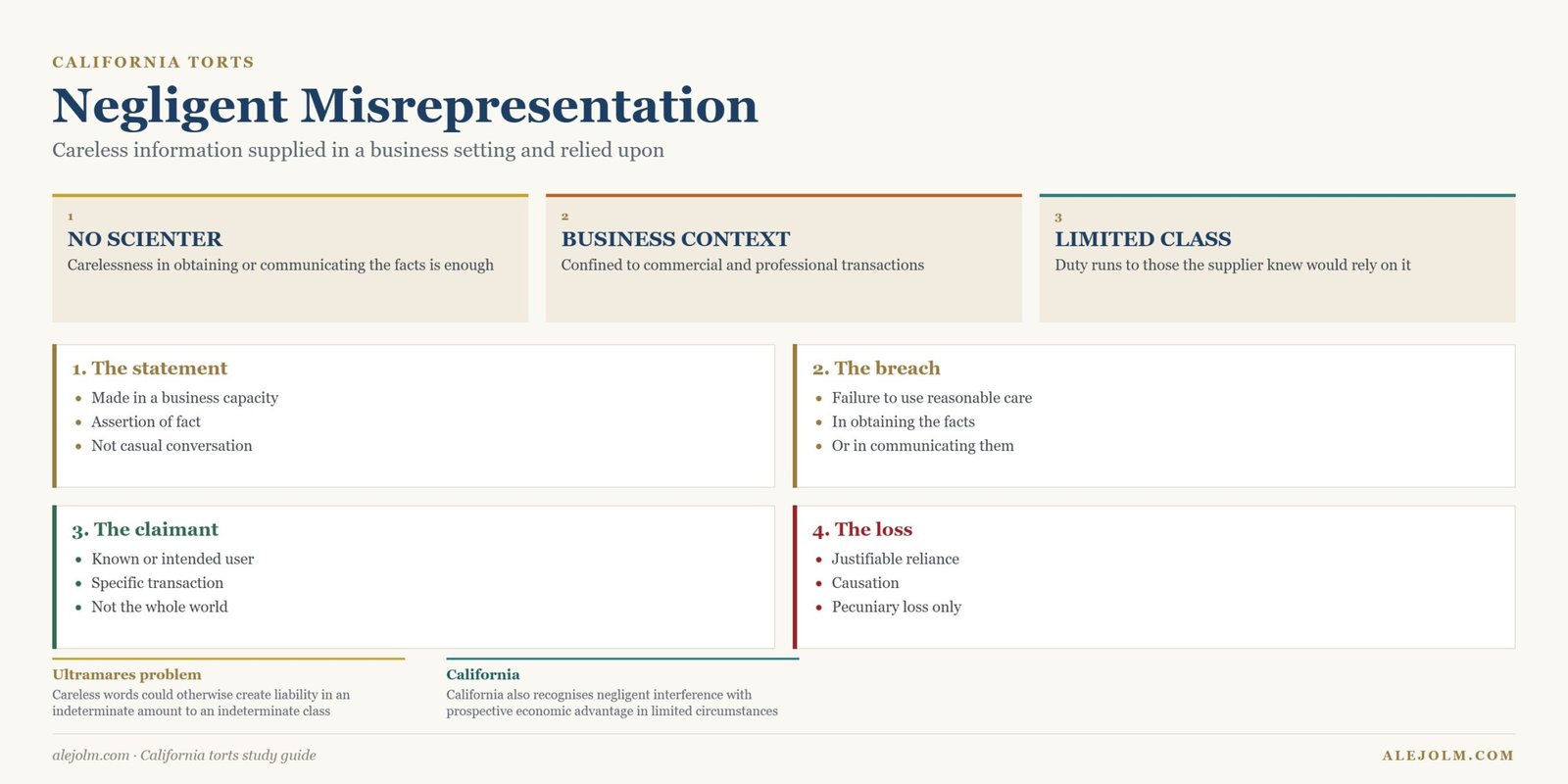
Negligent misrepresentation is the carelessness based sibling of fraud. It arises where a person supplies information in a business or professional capacity, fails to use reasonable care in obtaining or communicating it, and someone entitled to rely on that information suffers financial loss as a result.
The trade off with fraud is precise. Negligent misrepresentation demands far less of the claimant on the question of state of mind, since no knowledge of falsity is required, but it is confined to commercial settings and to a defined class of people who were meant to rely on the information. This guide sets out the elements, the class limitation, and how California treats the claim.
The elements
- Business or professional capacity — the information was supplied in a commercial transaction rather than in casual conversation.
- Breach of duty — a failure to use reasonable care in obtaining or communicating the information.
- Justifiable reliance — the claimant relied and that reliance was reasonable.
- Causation — the reliance produced the loss.
- Pecuniary damage — actual financial harm, not distress or personal injury.
- Within the class — the claimant was someone the supplier knew or intended would rely on it.
Why the class limitation exists
Careless words travel further than careless acts. A negligently prepared report can be copied, forwarded and relied upon by people the author never contemplated, so ordinary foreseeability would expose an information supplier to liability in an indeterminate amount, for an indeterminate time, to an indeterminate class. Courts respond by confining the duty.
The duty runs to the person the defendant was informing, and to a limited group the defendant knew would receive the information and rely on it for a particular transaction. An accountant who prepares statements knowing that a specific named lender will see them owes that lender a duty. The same accountant does not automatically owe a duty to a stranger who obtains the statements later and relies on them for something else.
| Feature | Fraud | Negligent misrepresentation |
|---|---|---|
| Mental state | Knowledge of falsity or recklessness | Failure to use reasonable care |
| Setting | Any context | Business and professional transactions |
| Who may claim | Anyone intended to be induced | Known or intended class of users |
| Damages | Pecuniary loss, punitive possible | Pecuniary loss only |
Typical settings
The recurring cases involve information professionals. A surveyor who misstates boundary lines, an appraiser who overstates value, a title examiner who misses an encumbrance and an accountant who certifies inaccurate figures are the standard examples. In each, the professional was engaged precisely to supply information for use in a transaction, which is what generates the duty.
A casual remark between friends about what a property is probably worth will not support the claim, even if it is wrong and even if it was relied upon. The commercial or professional context is not decorative; it is the reason the duty exists.
Justifiable reliance
Reliance is scrutinised more closely here than in an ordinary negligence claim. It is not justifiable where the falsity was obvious, or where the claimant had independent access to the underlying material and the expertise to evaluate it. A sophisticated commercial buyer who held the same data cannot always claim to have reasonably relied on a summary prepared by someone else.
A worked example
A buyer in Los Angeles engages a surveyor, whose report understates an easement crossing the rear of the property. The surveyor knew the report was commissioned for this purchase and that the buyer would rely on it. The buyer completes and later discovers that the usable area is materially smaller. The report was prepared without reasonable care, the buyer was the intended user and the loss is financial, so the claim succeeds without any need to show that the surveyor knew the report was wrong.
Change the recipient. Suppose the report had been commissioned years earlier by a different owner for an unrelated refinancing, and the buyer obtained a copy from a third party. The surveyor did not know of this transaction or this buyer, so the class limitation is likely to defeat the claim even though the same carelessness caused the same kind of loss.
Negligent misrepresentation in California and Los Angeles County in 2026
California treats negligent misrepresentation as a species of deceit under the Civil Code, which includes the assertion as a fact of something that is not true by one who has no reasonable ground for believing it to be true. That statutory framing explains a distinctive feature of California law: the claim generally requires a positive assertion, and mere non-disclosure or an implied representation is often insufficient.
California also goes further than most states in recognising negligent interference with prospective economic advantage in defined circumstances, which frequently appears alongside a misrepresentation claim in commercial disputes in Los Angeles County.
- Statutory basis — the Civil Code deceit provisions include assertions made without reasonable ground.
- Positive assertion — California generally requires an affirmative statement rather than silence.
- Class limitation — the duty extends to those the supplier intended to influence.
- Economic loss rule — recovery is confined to financial loss, not distress or injury.
- Professional standards — the standard of care is that of the relevant profession.
- Parallel claims — fraud, warranty and interference theories are commonly pleaded together.
For 2026, confirm the current California authority on the assertion requirement, the class of persons owed a duty and the economic loss rule directly with current authority, since these continue to develop.
Common mistakes to avoid
- Ignoring the class limitation — not every foreseeable reader is owed a duty.
- Applying it outside commerce — casual, non-commercial statements do not support the claim.
- Requiring scienter — carelessness is enough, and knowledge of falsity belongs to fraud.
- Overlooking claimant sophistication — independent access to the facts can defeat justifiable reliance.
- Claiming distress or injury — damages are confined to pecuniary loss.
- Relying on silence — California generally requires a positive assertion for this claim.
Frequently asked questions
How does it differ from fraud?
By mental state and by context. Fraud requires knowledge of falsity or reckless indifference and applies in any setting. Negligent misrepresentation requires only a failure to use reasonable care but is generally confined to business and professional transactions.
Who can sue an accountant or surveyor?
The client, and those the professional knew would receive and rely on the information for a particular transaction. A stranger who later obtains the report for an unrelated purpose usually falls outside the duty.
Can silence amount to negligent misrepresentation in California?
Generally no. California frames the claim around the positive assertion of something as a fact without reasonable ground for believing it, so pure non-disclosure is usually addressed through other theories such as concealment based fraud where a duty to disclose exists.
Are emotional distress damages available?
Not ordinarily. The claim protects economic interests and recovery is limited to pecuniary loss, so distress and personal injury flowing from the same careless statement are not recoverable on this theory.
Does the claimant have to investigate?
Not usually, but sophistication matters. Where the falsity was obvious or the claimant had independent access to the underlying material and the expertise to assess it, reliance may not be justifiable.
Related guides
- Fraud
- Interference with Business Relations
- Express Warranty
- Implied Warranties
- Special Standards of Care
- Damages in Negligence
- Elements of Negligence
- Defamation
Next steps
Read this with fraud to keep the scienter line sharp, and then interference with business relations for the neighbouring economic tort that often appears on the same facts.
For primary sources, read California Civil Code section 1710 and the civil jury instructions published by the Judicial Council of California.