
Fraud is the intentional tort that protects money rather than dignity or bodily safety. A defendant who knowingly lies about a material fact, intending that another person act on the lie, answers for the financial harm that follows. California calls the tort deceit, and Civil Code sections 1709 and 1710 state the basic rule that one who wilfully deceives another with intent to induce reliance is liable for the damage suffered.
Because fraud sits on the boundary between hard bargaining and wrongdoing, courts police it with six defined elements rather than a general sense of unfairness. This guide works through each element as California applies it, explains when silence becomes a misrepresentation, separates fraud from negligent misrepresentation and defamation, and shows how damages are measured in a typical Los Angeles County transaction.
What fraud protects
Most torts protect the body, the land or the reputation. Fraud protects the economic decision. The wrong is not simply that the defendant told a lie; it is that the lie was aimed at the claimant decision-making and succeeded, moving money from one pocket to another on false premises. That framing explains every limit the courts have built around the tort.
It explains why an honest mistake is not fraud, why an opinion is usually not enough, why the claimant must have actually relied, and why a lie that costs nothing produces no claim. Each element narrows the tort to the case where a deliberate falsehood caused a measurable financial loss.
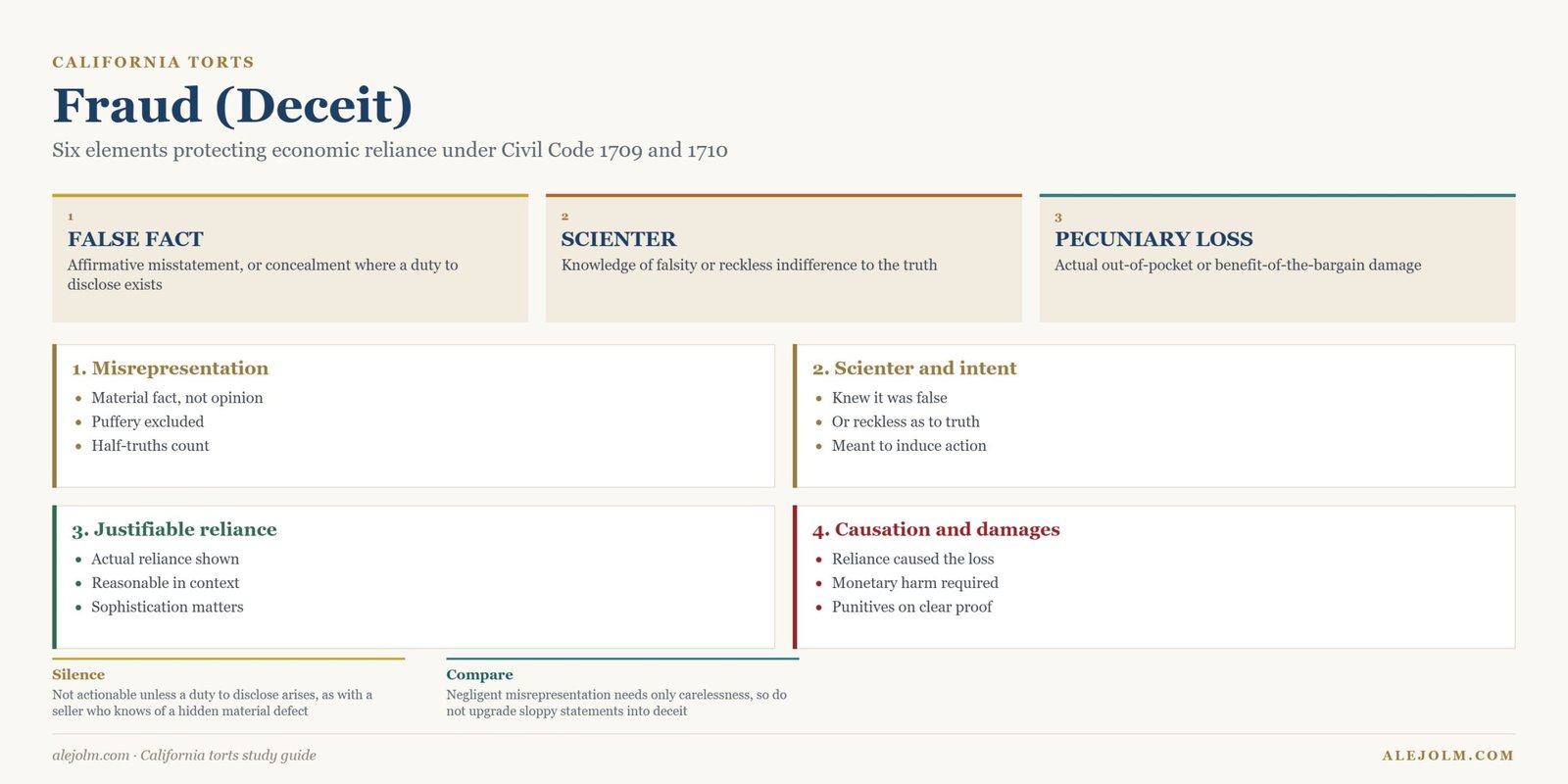
The six elements of fraud
California courts and the standard jury instructions break deceit into six requirements. A claim fails if any one of them is missing, so the disciplined approach is to walk each element in order rather than argue that the defendant behaved badly overall.
- Misrepresentation of a material fact — an affirmative false statement, or concealment where a duty to disclose exists.
- Scienter — knowledge that the statement was false, or reckless indifference to whether it was true.
- Intent to induce reliance — the defendant meant the claimant to act on the statement.
- Justifiable reliance — the claimant did rely, and that reliance was reasonable.
- Causation — the reliance produced the loss.
- Damages — actual pecuniary loss, measured in money.
Misrepresentation and materiality
A material fact is one that would reasonably influence the decision at hand. Materiality is judged by what a reasonable person in the claimant position would weigh, with room for facts the defendant knew this particular claimant cared about. A misstatement about a detail nobody would act on is not material, however false it may be.
Scienter
Scienter is the element that separates deceit from carelessness. It is satisfied by actual knowledge of falsity and also by reckless indifference, meaning the defendant asserted something as fact while consciously disregarding whether it was true. A defendant who genuinely believed the statement, even unreasonably, has not committed fraud.
Intent to induce reliance
The defendant must have intended that the claimant, or a class of people including the claimant, act on the statement. A false statement broadcast without any purpose of prompting action rarely satisfies this element, while a statement made in a sales negotiation almost always does.
Justifiable reliance
Reliance must be both actual and reasonable. California does not require a claimant to investigate every assertion, and a defendant cannot escape by saying the truth was discoverable. But reliance loses its justification where the falsity was obvious, where the claimant is a sophisticated party who knew better, or where the claimant did not in fact care about the statement.
Causation and damages
The reliance must be the cause of the loss, and the loss must be financial. A claimant who would have entered the same transaction anyway has no causal link. A claimant who was lied to but lost nothing has no damages, and therefore no claim.
Express misstatement, concealment and opinion
Express misstatement
The clearest case is a positive statement of fact that is untrue. A seller who states that a truck is rated to tow ten thousand pounds when the rated capacity is six thousand has made an express misrepresentation, and the remaining elements usually fall into place quickly.
Concealment and the duty to disclose
Silence alone is not deceit. It becomes deceit once a duty to disclose attaches. California recognises that duty most prominently for sellers of real property, who must disclose known material defects that a buyer would not reasonably discover. Duties also arise from fiduciary relationships, from active concealment such as painting over water damage, and from telling a half-truth that creates a misleading impression.
Opinion, prediction and puffery
Statements of opinion, sales talk and optimistic predictions are not facts. Best deal in town and finest quality are puffery on which no reasonable buyer justifiably relies. An opinion becomes actionable only when it carries an implied assertion of undisclosed facts, as when a speaker who says he thinks someone is a thief implies knowledge of a specific theft.
| Doctrine | Mental state | Interest protected | Damages |
|---|---|---|---|
| Fraud (deceit) | Knowledge of falsity or recklessness | Economic reliance | Out-of-pocket or benefit of the bargain, punitives possible |
| Negligent misrepresentation | Failure to use reasonable care | Economic reliance | Usually out-of-pocket only |
| Defamation | Fault varies with the claimant status | Reputation | Reputational harm, no reliance needed |
| Breach of warranty | No fault required | Contract expectation | Contract measure of loss |
How damages are measured
California allows two measures. The out-of-pocket rule returns the difference between what the claimant paid and the actual value received, restoring the claimant to the pre-transaction position. The benefit-of-the-bargain rule gives the difference between the value as represented and the actual value, putting the claimant where the promise would have placed them.
Consequential losses flowing from the fraud may be added where they were a foreseeable result of the reliance. Punitive damages are available where the deceit is proved by clear and convincing evidence, which is one practical reason claimants plead fraud alongside contract theories.
A worked example
A homeowner in Pasadena sells a house after a plumbing leak caused hidden damage behind a wall. The seller repairs the drywall, paints over the stain and says nothing. The buyer inspects, sees fresh paint, and buys. When the wall is opened a year later the damage is found. The seller knew of the defect, it was material, it was not reasonably discoverable, and California imposes a disclosure duty on sellers of real property. Concealment plus that duty supplies the misrepresentation element, and the repair cost supplies the loss.
Change one fact. Suppose the seller had never seen any leak and the damage predated the ownership. Now there is no knowledge and no reckless disregard, so scienter fails and the fraud claim collapses. Depending on what the seller said and what enquiry a reasonable seller would have made, the buyer may still have a negligent misrepresentation claim, but the label matters because the damages measure and the availability of punitive damages both change.
Fraud in California and Los Angeles County in 2026
California codifies deceit in Civil Code sections 1709 and 1710, which describe the wrong and list its forms, including the suggestion of a falsehood by one who does not believe it to be true and the suppression of a fact by one bound to disclose it. The Judicial Council civil jury instructions then translate those provisions into the element-by-element charge a jury actually hears.
Practice in Los Angeles County adds procedural texture. Fraud must be pleaded with particularity, meaning the complaint should identify who said what, to whom, when and by what means, and general allegations of dishonesty will not survive a demurrer.
- Statutory basis — Civil Code sections 1709 and 1710 define deceit and its four recognised forms.
- Pleading standard — fraud requires specific factual allegations rather than general assertions.
- Real property disclosure — statutory transfer disclosure obligations sit alongside the common law duty.
- Limitation period — the fraud period runs from discovery of the facts constituting the fraud.
- Punitive damages — available on clear and convincing proof of fraud, oppression or malice.
- Parallel claims — deceit is often pleaded with contract, warranty and unfair competition theories.
For 2026, confirm the current California authority on disclosure duties, pleading particularity and the limitation period directly with current authority, since these continue to develop.
Common mistakes to avoid
- Skipping scienter — treating any false statement as fraud when an honest or merely careless error is negligent misrepresentation at most.
- Finding fraud in bare silence — silence is actionable only where a recognised duty to disclose exists.
- Treating puffery as fact — sales talk and optimistic opinion are not assertions of fact unless they imply undisclosed knowledge.
- Ignoring the reasonableness limit — a sophisticated claimant who disregards an obvious falsehood may not have relied justifiably.
- Awarding damages without loss — being lied to is not enough; the claim needs measurable financial harm.
- Merging fraud with defamation — the two protect different interests and have different elements and remedies.
Frequently asked questions
Is fraud the same as deceit in California?
Yes. California uses the statutory term deceit in Civil Code sections 1709 and 1710, while courts, practitioners and jury instructions commonly refer to the same tort as fraud or intentional misrepresentation.
Can a seller be liable for saying nothing at all?
Only if a duty to disclose applies. For sellers of residential real property in California that duty is well established for known material defects that a buyer would not reasonably discover, and both statutory and common law obligations may apply.
Does the claimant have to investigate before relying?
Generally no. California does not require a claimant to verify assertions made to induce a transaction. Reliance becomes unjustified only where the falsity was obvious or where the claimant sophistication makes unquestioning reliance unreasonable.
Are punitive damages available for fraud?
They can be. Where fraud is proved by clear and convincing evidence, punitive damages may be awarded in addition to compensatory loss, which is a significant reason the claim is pleaded alongside contract theories.
What is the difference between fraud and negligent misrepresentation?
The mental state. Fraud requires knowledge of falsity or reckless indifference to the truth, while negligent misrepresentation requires only a failure to use reasonable care in ascertaining the facts.
Related guides
- Negligent Misrepresentation
- Defamation
- Actual Malice Standard
- Conversion
- Trespass to Chattels
- Intentional Infliction of Emotional Distress
- Malicious Prosecution
- Interference with Business Relations
Next steps
Read fraud next to negligent misrepresentation so the scienter line stays sharp, then compare it with defamation to see how the protected interest changes the entire analysis.
For primary sources, read California Civil Code section 1709 and the civil jury instructions published by the Judicial Council of California.