
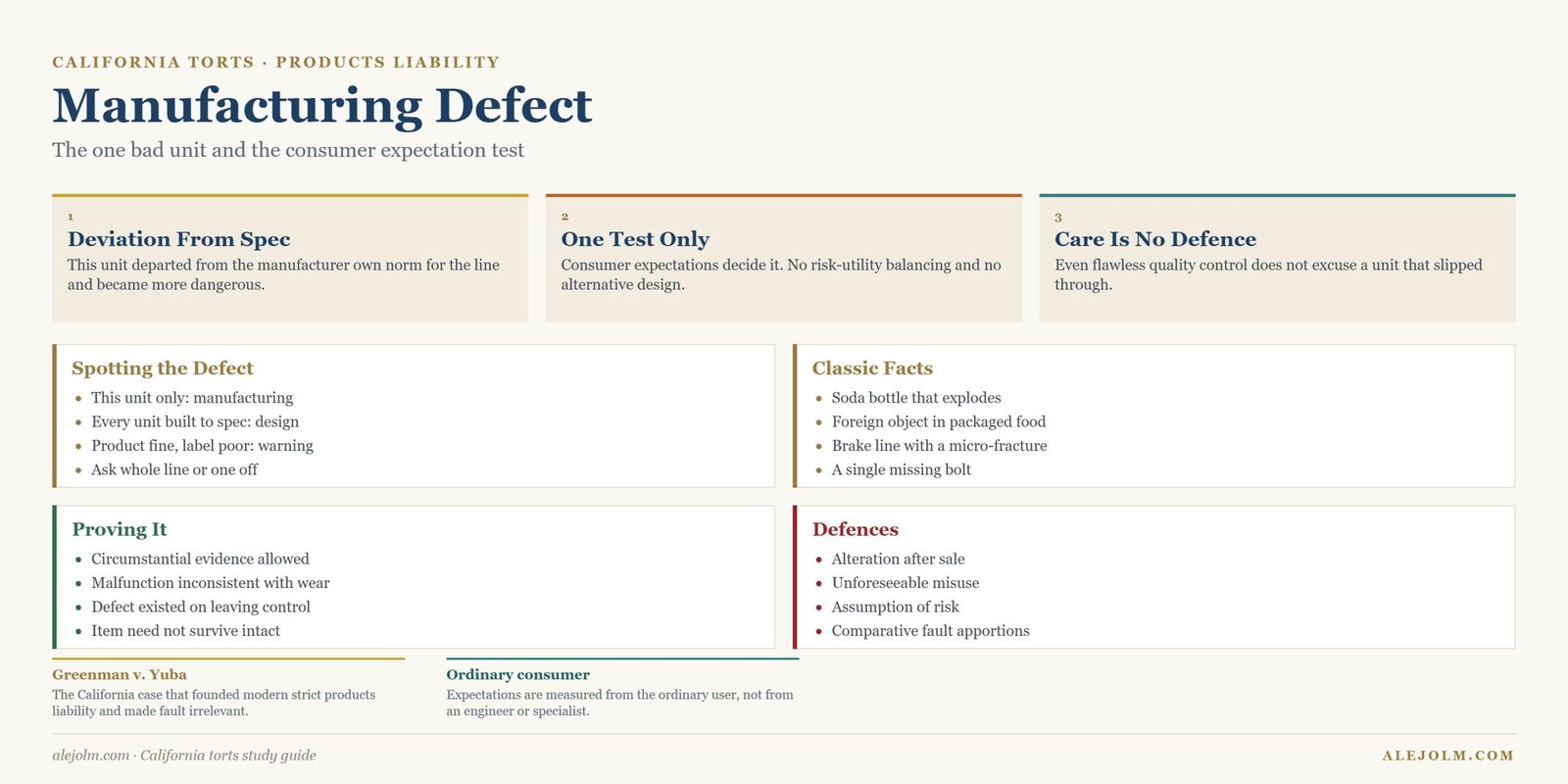
Manufacturing defect is the simplest of the three products liability theories. One unit came off the line different from all the others, that difference made it more dangerous, and someone was hurt. The design was sound, the warnings were fine, and the manufacturer may have run an exemplary quality system. None of that matters.
Because the flaw is unit specific, there is no design decision to weigh and no safer alternative to propose. The claimant needs only to show that the product did not perform as safely as an ordinary consumer would expect and that the deviation existed when the product left the defendant control.
Classifying the defect
The whole analysis begins with a single question: is this a one off or a whole line problem? A flaw shared by every unit built to specification is a design defect and attracts the risk-utility machinery. A product that is physically sound but inadequately explained is a warning defect. Only a deviation from the manufacturer own norm is a manufacturing defect.
Getting this wrong costs more than any other error in products liability, because applying risk-utility analysis to a single contaminated bottle, or consumer expectations alone to a whole line design decision, produces an answer that is wrong from the first sentence.
| Facts | Theory | Test |
|---|---|---|
| One unit deviates from specification | Manufacturing defect | Consumer expectations |
| Every unit shares the flaw | Design defect | Consumer expectations or risk-utility |
| Product sound, information inadequate | Warning defect | Adequacy and knowability |
The consumer expectation test
The question is whether the product performed less safely than an ordinary consumer would expect in ordinary or reasonably foreseeable use. A soda bottle that bursts while being carried, a food can containing a fragment of metal, a new vehicle whose brake line fails on the first journey: in each case ordinary expectation supplies the answer without expert evidence.
The perspective is the ordinary user, not a specialist. A metallurgist might know that a particular alloy can fail under stress; the consumer holding the bottle knows only that bottles are not supposed to explode.
Strict liability means strict
The manufacturer exercise of all possible care is not a defence. That is the entire premise of the doctrine as it was established in California in Greenman v. Yuba Power Products, which placed the loss on the enterprise that put the product into commerce rather than on the person injured by it. Everyone in the distribution chain, from manufacturer to retailer, may be liable, with indemnity flowing back up the chain as our guide to joint tortfeasors explains.
Proving the defect
The defective item is often destroyed, consumed or discarded, and the law accommodates that. A claimant may prove the defect circumstantially by showing a malfunction inconsistent with ordinary wear, excluding other reasonable causes, and establishing that the product had not been altered since it left the defendant hands. What must be tied down is timing: a defect introduced by later mishandling or modification is not the manufacturer responsibility.
A worked example
A customer bites into a packaged sandwich and fractures a tooth on a fragment of machine metal. There is no need to consider whether sandwiches could be designed differently or whether the packaging should have carried a warning. The unit deviated from the norm for the line, an ordinary consumer expects food not to contain metal, and the defect plainly existed when the product left the factory. The claim is complete.
Change the facts so that every sandwich in the range contains an ingredient to which a small proportion of people react badly. That is not a deviation at all. The claim moves to design and to warnings, and the tests change accordingly.
Manufacturing Defect in California and Los Angeles County in 2026
California created modern strict products liability, and manufacturing defect is where the doctrine operates in its purest form. Greenman established that a manufacturer is liable when an article it places on the market proves to have a defect that causes injury, regardless of negligence or warranty. Later cases extended liability throughout the chain of distribution, including retailers and, in appropriate cases, lessors.
Practical disputes in Los Angeles County concern food and beverage contamination, automotive and component failures, consumer electronics and battery incidents, and construction materials. The recurring issues are preservation of the item, proof that the defect predated the sale, and apportionment where a subsequent repairer or modifier may have introduced the flaw. The commercial supplier requirement also matters: casual and occasional sellers fall outside the doctrine.
- Greenman. Liability without fault for a defective article placed on the market, whatever care was taken.
- Chain of distribution. Manufacturers, distributors and retailers may all be liable, with indemnity running upstream.
- Commercial sellers only. An occasional private seller is not subject to strict products liability.
- Circumstantial proof. A malfunction inconsistent with ordinary use can establish the defect without the item itself.
- Spoliation. Preserving the product matters, and its loss can carry evidentiary consequences for either side.
- Comparative fault. Misuse and claimant carelessness apportion under comparative negligence rather than barring recovery.
For 2026, confirm the current California authority on circumstantial proof of defect, retailer liability and component supplier exposure directly with current authority, since these continue to develop.
Common mistakes to avoid
- Using risk-utility analysis. That test belongs to design defect, not to a unit specific deviation.
- Treating care as a defence. The deviation itself establishes the defect regardless of the process behind it.
- Calling a line-wide flaw a manufacturing defect. If every unit shares it, the claim is about the design.
- Applying an expert perspective. Consumer expectations are those of the ordinary user.
- Forgetting the timing element. The defect must have existed when the product left the defendant control.
- Overlooking the chain. Retailers and distributors are proper defendants even though they made nothing.
Frequently asked questions
What is a manufacturing defect?
A departure from the manufacturer own specification in a particular unit that makes it more dangerous than the others in the line, even where all possible care was taken in production.
Which test applies to manufacturing defects?
The consumer expectation test alone. There is no risk-utility balancing and no requirement to propose a feasible safer alternative design.
Is careful quality control a defence?
No. Strict liability means the manufacturer answers for the defective unit whatever its systems, because the loss is placed on the enterprise rather than the injured consumer.
What if the product was destroyed in the accident?
The defect can be proved circumstantially by showing a malfunction inconsistent with ordinary use and excluding other reasonable explanations, provided the product was not altered after sale.
Can a retailer be sued for a manufacturing defect?
Yes. Everyone in the commercial chain of distribution may be strictly liable, and a blameless retailer can then seek indemnity from the manufacturer.
Related guides
- Products Liability: The Three Defect Theories Explained
- Design Defect: Consumer Expectations and Risk-Utility
- Warning Defects: Failure to Warn and Adequate Labels
- Strict Liability in Tort Law: Liability Without Fault
- Res Ipsa Loquitur: When the Accident Speaks for Itself
- Joint Tortfeasors: Joint and Several Liability Explained
- The Four Elements of Negligence: Bar Exam Breakdown
- Comparative Negligence in California: How Fault Is Split
Next steps
Read our guide to design defect for the theory that condemns a whole product line, then warning defects, where the product is sound but the information is not.
For primary sources, read California Civil Code section 1792 and the products liability instructions published by the Judicial Council of California.