
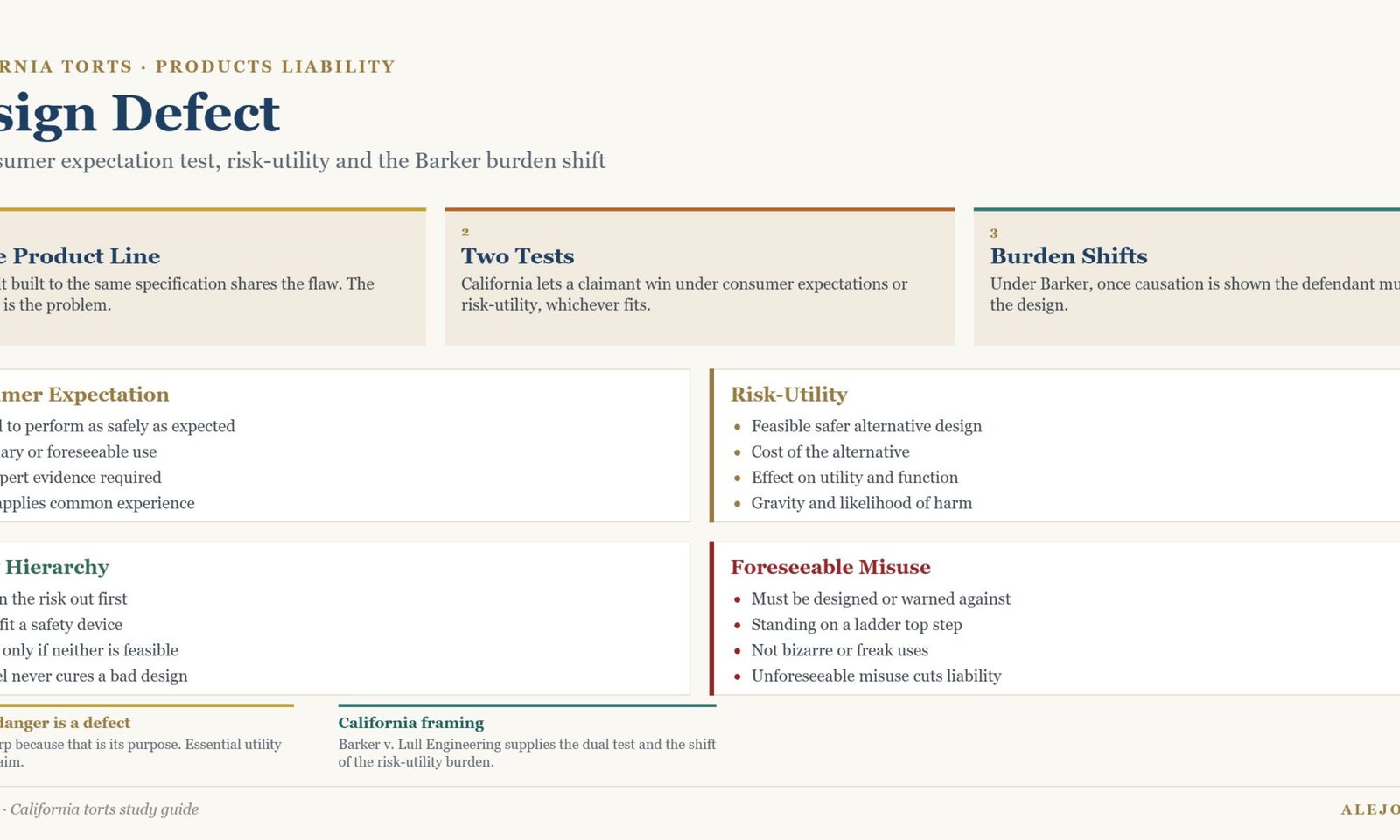
Design defect is the branch of products liability that attacks the blueprint rather than the workshop. Every unit made to the specification carries the same flaw, so the claim is not that something went wrong in production but that the product should never have been built this way.
That makes it the most consequential and most contested defect theory. A manufacturing defect claim concerns one bad item. A design defect claim, if it succeeds, condemns an entire product line, and courts have developed two competing tests for deciding when it should.
Classify the defect first
Before anything else, ask whether the flaw exists in every unit or in one. A deviation from the manufacturer own specification is a manufacturing defect and is judged by consumer expectations alone. A flaw shared by the whole line is a design defect and attracts the dual test. Misclassifying at this stage produces the wrong analysis throughout, and it is the single most common error in this area.
The consumer expectation test
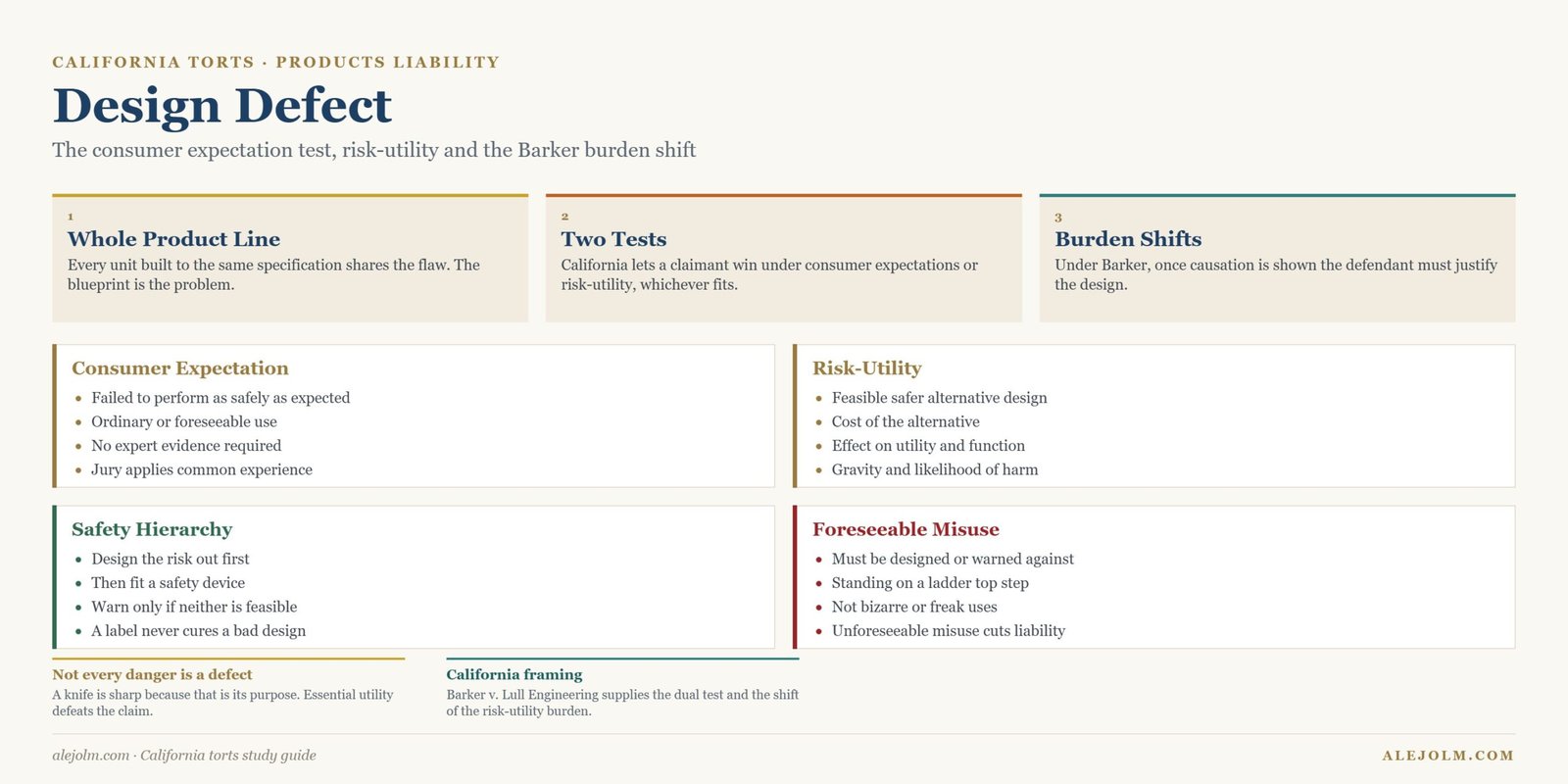
A product is defective in design if it failed to perform as safely as an ordinary consumer would expect when used in an intended or reasonably foreseeable manner. The test is deliberately plaintiff friendly. No expert evidence about alternative designs is required, and the jury applies ordinary experience. It works best for products whose safe behaviour everyone understands, such as a car that bursts into flame after a modest rear impact.
Its limit is that some products are too complex for ordinary expectations to mean anything. Nobody has an intuition about how a hydraulic control system or a pharmaceutical should behave, and in those cases the test cannot do the work.
The risk-utility test
Here the question is whether the benefits of the challenged design outweigh its risks, measured against a feasible safer alternative. Courts weigh the gravity and likelihood of the danger, the technical and economic feasibility of a different design, its cost, and the adverse consequences of adopting it, including effects on utility, function and appearance. The analysis resembles negligence, which is why some commentators regard this branch of strict liability as strict in name only.
| Test | What the claimant must show | Expert evidence |
|---|---|---|
| Consumer expectation | The product was less safe than an ordinary consumer would expect | Not required |
| Risk-utility | A feasible alternative design whose benefits outweigh its costs | Usually required |
| California approach | Either test; and under Barker the defendant justifies the design | Depends on the route chosen |
The safety hierarchy
Manufacturers must address risk in a fixed order. Design the danger out where that is feasible. If it is not, fit a guard or other safety device. Only where neither is possible does a warning become the answer. The order matters because a defendant cannot defeat a design defect claim by pointing to a label. If a feasible safer design or device existed, the warning is not enough, and our guide to warning defects explains where labels do become decisive.
Foreseeable misuse
Manufacturers must design for, or warn against, uses that are foreseeable even if unintended. Standing on the top step of a stepladder is a use everybody has made, so it must be accounted for. Using the same ladder as a bookshelf is not. Genuinely bizarre misuse breaks the chain in the same way as a superseding cause.
A worked example
A domestic food processor has a blade that continues turning for several seconds after the lid is removed. A user reaching in to clear a blockage is badly cut. Under consumer expectations the claim is straightforward: an ordinary user expects the blade to stop when the lid comes off. Under risk-utility the claimant points to an interlock costing a few pounds per unit that competing machines already use. Both routes lead to the same place.
Compare a chef knife that cuts a careless user. Sharpness is the entire purpose of the product, and no alternative design could remove it without destroying the utility. That is not a design defect, and at most it raises a question about instructions.
Design Defect in California and Los Angeles County in 2026
California is the origin of the modern doctrine and remains distinctive. Barker v. Lull Engineering established that a claimant may prove design defect under either test, so a claimant unable to produce an expert alternative design can still succeed on consumer expectations where the product is one that ordinary users can form expectations about. That optionality does not exist in jurisdictions following the Third Restatement, which requires a reasonable alternative design in every case.
The second California feature is the burden shift. Once the claimant shows that the design proximately caused the injury, the burden moves to the defendant to establish, on the risk-utility factors, that the benefits of the design outweigh its dangers. This is a genuine shift of the burden of proof rather than a presentational nuance, and it is why design cases in Los Angeles County so often survive summary judgment and settle.
- Dual test. Either consumer expectations or risk-utility will support a design defect finding.
- Barker burden shift. On the risk-utility route the defendant must justify the design once causation is shown.
- Complex products. Consumer expectations are unavailable where ordinary users can form no reasonable expectation about performance.
- Component parts. Suppliers of raw materials and generic components have limited exposure for the finished design.
- Prescription drugs. California treats design claims for pharmaceuticals differently, channelling most claims into warnings.
- Comparative fault. Claimant misuse and carelessness apportion under comparative negligence rather than barring the claim.
For 2026, confirm the current California authority on the availability of the consumer expectation test for complex products, the treatment of component suppliers, and pharmaceutical design claims directly with current authority, since these continue to develop.
Common mistakes to avoid
- Confusing design with manufacturing defects. One flaw in the line, or one bad unit, changes the test.
- Applying only risk-utility in California. Consumer expectations remain an independent route to liability.
- Forgetting the burden shift. Treating risk-utility as the claimant burden throughout is a California specific error.
- Curing a design with a label. Warnings are the last resort, not a substitute for a feasible safer design.
- Calling essential features defects. A product whose danger is its purpose is not defective for having it.
- Ignoring foreseeable misuse. Common misuse must be designed around or warned against.
Frequently asked questions
What is a design defect?
A flaw shared by every unit built to the manufacturer specification, so that the product as designed is unreasonably dangerous even when made exactly as intended.
What is the consumer expectation test?
A product is defective if it failed to perform as safely as an ordinary consumer would expect in intended or reasonably foreseeable use. No expert alternative design evidence is required.
What is the risk-utility test?
The court weighs the danger of the design against its benefits, considering the feasibility, cost and consequences of a safer alternative. A feasible alternative that would have prevented the injury usually decides it.
Can a warning fix a design defect?
No, not where a feasible safer design or safety device existed. The hierarchy requires designing out the risk first, then guarding, and only then warning.
What is the Barker burden shift?
Under Barker v. Lull Engineering, once a California claimant shows the design caused the injury, the defendant bears the burden of proving that the benefits of the design outweigh its risks.
Related guides
- Products Liability: The Three Defect Theories Explained
- Manufacturing Defect: When One Unit Goes Wrong
- Warning Defects: Failure to Warn and Adequate Labels
- Strict Liability in Tort Law: Liability Without Fault
- The Four Elements of Negligence: Bar Exam Breakdown
- Superseding Cause: When the Chain of Causation Breaks
- Comparative Negligence in California: How Fault Is Split
- Joint Tortfeasors: Joint and Several Liability Explained
Next steps
Read our guide to products liability for the wider framework, then warning defects, the theory that takes over where a design cannot be improved.
For primary sources, read California Civil Code section 1714.45 and the products liability instructions published by the Judicial Council of California.