
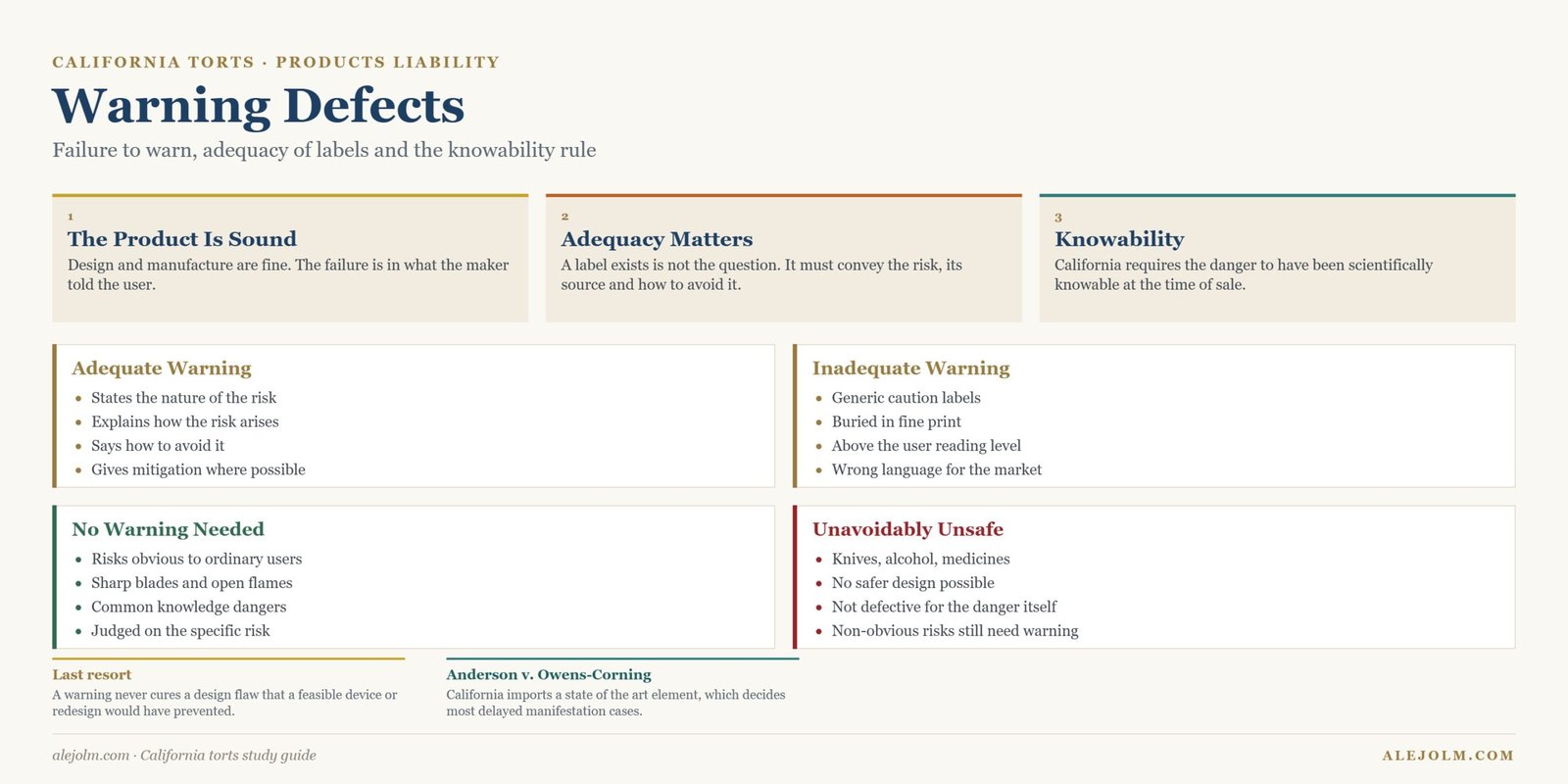
Warning defects are the third branch of products liability and the only one that concerns information rather than the physical product. The item was designed properly and built properly. What failed was the manufacturer duty to tell foreseeable users about a danger they could not be expected to discover for themselves.
The branch is easy to over-use. Because a better label is always imaginable, almost any accident can be framed as a warnings case. Courts resist that by insisting on the safety hierarchy: design the risk out, then guard against it, and only warn when neither is possible.
What makes a warning adequate
The existence of a label answers nothing. An adequate warning tells the user what the danger is, how it arises, what to do to avoid it, and what steps mitigate the harm if it occurs. A large red CAUTION with no content fails every part of that test, and so does a technically accurate paragraph placed where nobody will read it.
Adequacy is measured against the foreseeable audience. A warning pitched at an engineering readership on a consumer product is inadequate. A warning printed only in English may be inadequate where a substantial and foreseeable part of the market does not read English and pictograms or a second language were feasible. The point is communication, not compliance.
The safety hierarchy
A manufacturer cannot discharge its duty by labelling around a problem it could have fixed. If a feasible design change or a guard would have eliminated the danger, the case belongs in design defect and the warning is no answer. Warnings are reserved for risks that cannot be engineered away, which is why they dominate in pharmaceuticals, chemicals and inherently sharp or hot products.
Obvious risks and unavoidably unsafe products
There is no duty to warn of a danger obvious to the ordinary user. Knives cut, flames burn and heights are dangerous. The defence is narrower than it appears, because obviousness is assessed against the specific risk rather than the general riskiness of the product. A power tool obviously cuts; the fact that its dust causes a particular respiratory condition is not obvious at all.
Related to this is the category of unavoidably unsafe products, whose dangers cannot be removed without destroying their usefulness. Such products are not defective merely for being dangerous. But a non-obvious risk of an unavoidably unsafe product still requires a warning, and that is where most pharmaceutical litigation lives.
| Question | Test |
|---|---|
| Was a warning required? | Was the risk non-obvious to ordinary foreseeable users? |
| Was the warning adequate? | Did it convey the risk, its cause, avoidance and mitigation? |
| Was warning the right remedy? | Only if design and guarding were not feasible |
| Was the risk knowable? | In California, judged by scientific knowledge at the time of sale |
A worked example
A household cleaning product releases a toxic gas when mixed with another common cleaner. The bottle carries a general instruction to keep out of reach of children and nothing else. A user mixes the two and is hospitalised. The product is well designed and well made, the interaction is not obvious, and the manufacturer knew of it. The warning is inadequate because it never identified the risk, the circumstances that create it, or how to avoid it.
Change the facts so that the interaction was unknown to science when the product was sold and only identified years later. In California that defeats the claim, because a manufacturer cannot be held liable for failing to warn of a danger nobody could have known about.
Warning Defects in California and Los Angeles County in 2026
California adds a distinctive element. Under Anderson v. Owens-Corning Fiberglas Corp., a failure to warn claim requires the claimant to show that the risk was knowable in light of the scientific and technical knowledge available at the time of manufacture and sale. That injects a state of the art enquiry into what is otherwise a no-fault regime, and it makes this branch of products liability function much more like negligence than the other two.
The knowability rule is decisive in delayed manifestation litigation, where the injury emerges long after the sale and the real dispute is what the industry could have known and when. Asbestos, pharmaceutical and chemical exposure claims in Los Angeles County turn on precisely that historical question, fought through internal documents and contemporaneous scientific literature. Two further California features matter: the learned intermediary doctrine channels prescription drug warnings to the prescriber rather than the patient, and Proposition 65 imposes a separate statutory warning regime that is not the same thing as a tort duty.
- Knowability. Anderson requires the risk to have been scientifically knowable at the time of sale.
- Adequacy. Content, prominence, language and reading level are all assessed against the foreseeable user.
- Hierarchy. A warning does not answer a design defect that a feasible alternative would have prevented.
- Learned intermediary. Prescription drug warnings are owed to the prescribing physician rather than directly to the patient.
- Proposition 65. Statutory exposure warnings are a separate regime and compliance with it does not discharge the tort duty.
- Causation. The claimant must show an adequate warning would have altered the outcome, which is often the weakest link.
For 2026, confirm the current California authority on the knowability requirement, the learned intermediary doctrine and Proposition 65 warning standards directly with current authority, since these continue to develop.
Common mistakes to avoid
- Reaching for warnings first. If a feasible design fix existed, the case is a design defect case.
- Treating the claim as pure strict liability. California requires the risk to have been knowable at the time of sale.
- Accepting any label as sufficient. A generic caution that conveys no information is inadequate.
- Over-reading the obvious danger defence. Obviousness is judged risk by risk, not product by product.
- Forgetting the audience. Language, literacy and placement all bear on adequacy.
- Skipping causation. The claimant must show a proper warning would have made a difference.
Frequently asked questions
What is a failure to warn claim?
A products liability claim alleging that a properly designed and properly made product was defective because the manufacturer did not adequately warn foreseeable users about a non-obvious risk.
What makes a warning adequate?
It must identify the risk, explain how it arises, tell the user how to avoid it and describe any mitigating steps, in a form and language the foreseeable user can actually understand.
Is there a duty to warn about obvious dangers?
No. Risks apparent to the ordinary user require no warning, though obviousness is assessed against the specific risk rather than the general dangerousness of the product.
What is the knowability requirement in California?
Anderson v. Owens-Corning requires the claimant to prove the danger was knowable given the scientific and technical knowledge available when the product was sold, importing a state of the art element.
Can a warning cure a defective design?
No. Where a feasible safer design or safety device would have prevented the harm, a label is not a substitute and the design defect claim survives.
Related guides
- Products Liability: The Three Defect Theories Explained
- Design Defect: Consumer Expectations and Risk-Utility
- Manufacturing Defect: When One Unit Goes Wrong
- Strict Liability in Tort Law: Liability Without Fault
- The Four Elements of Negligence: Bar Exam Breakdown
- Negligence Per Se: Using a Statute to Prove Breach
- Actual Cause in Negligence: But-For and Substantial Factor
- Comparative Negligence in California: How Fault Is Split
Next steps
Read our guide to design defect to see why warnings are the last resort, then products liability for how the three theories fit together.
For primary sources, read California Health and Safety Code section 25249.6 and the failure to warn instructions published by the Judicial Council of California.