
Comparative negligence reduces a plaintiff’s recovery in proportion to the plaintiff’s own share of responsibility for the injury. It replaced a rule of startling harshness: at common law, a plaintiff who was negligent to any degree, however trivial, recovered nothing at all. That all-or-nothing structure produced results juries refused to accept, and courts spent a century building workarounds before abandoning it outright.
Today almost every American jurisdiction apportions rather than bars. The systems differ in one crucial respect — whether there is a threshold beyond which the plaintiff loses everything — and that difference decides real cases. California adopted the more generous version, and layered onto it a distinctive rule about how fault among multiple defendants translates into liability.
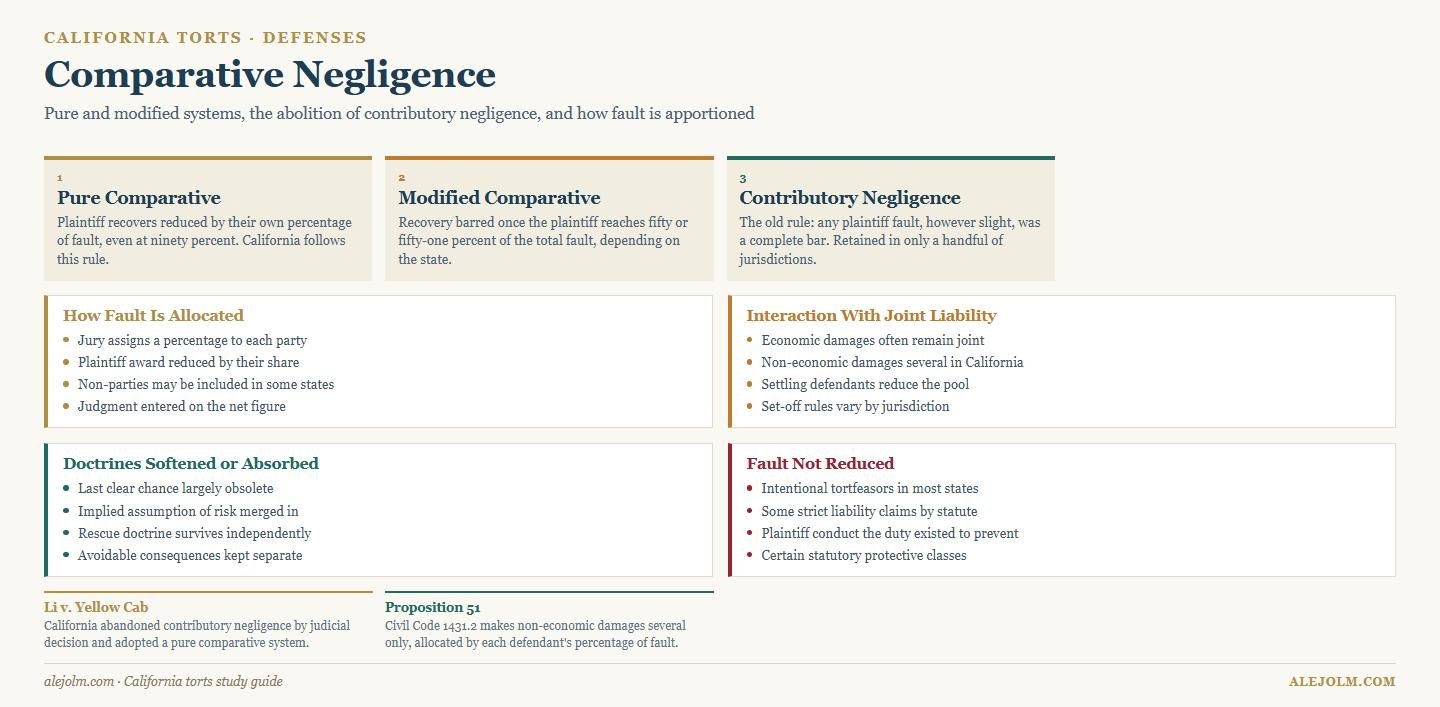
The three systems
Contributory negligence
Under the traditional rule, any negligence by the plaintiff that contributed to the injury barred recovery completely. A plaintiff found one percent at fault took nothing from a defendant found ninety-nine percent at fault. Only a small number of jurisdictions retain the rule today, and even there it is softened by exceptions.
Pure comparative fault
The plaintiff recovers damages reduced by the plaintiff’s percentage of fault, with no cutoff. A plaintiff found eighty percent responsible still collects twenty percent of the damages. This is California’s rule, and it is the most protective of injured plaintiffs.
Modified comparative fault
The majority approach in the United States. The plaintiff recovers a reduced amount up to a threshold, then nothing. In fifty percent bar states, a plaintiff who is fifty percent or more at fault recovers nothing. In fifty-one percent bar states, a plaintiff who is exactly fifty percent still recovers half. The single percentage point between the two systems has decided a great many trials.
| Plaintiff fault | Pure comparative |
|---|---|
| 0% | $100,000 |
| 20% | $80,000 |
| 49% | $51,000 |
| 50% | $50,000 |
| 51% | $49,000 |
| 80% | $20,000 |
What the shift absorbed
The adoption of comparative fault made several older doctrines redundant. Last clear chance, which allowed a contributorily negligent plaintiff to recover where the defendant had the final opportunity to avoid the accident, was a workaround for the all-or-nothing rule and has largely disappeared. Implied assumption of risk was merged into the comparative fault calculus in most states, so a plaintiff who unreasonably encountered a known danger has recovery reduced rather than eliminated.
Two doctrines survived intact. Express assumption of risk, resting on an actual agreement, remains a complete defense subject to the usual limits on exculpatory contracts. And the avoidable consequences rule, which addresses a plaintiff’s failure to mitigate after the injury, stays separate because it concerns post-injury conduct rather than fault in causing the accident. See our guide to assumption of risk for the surviving forms.
Allocation among multiple defendants
Where several defendants are at fault, the jury assigns each a percentage. What happens next depends on the jurisdiction’s joint and several liability rules. Under pure joint liability, any defendant can be made to pay the entire judgment and must seek contribution from the others, which protects the plaintiff against an insolvent defendant. Under pure several liability, each defendant pays only its own share and the plaintiff bears the insolvency risk.
The allocation question is not academic. Where one defendant is uninsured or bankrupt, whether liability is joint or several determines whether the plaintiff is compensated or not.
Many states, California among them, adopted a hybrid: joint liability for economic damages such as medical bills and lost earnings, and several liability for non-economic damages such as pain and suffering. The theory is that a plaintiff should never go without reimbursement for out-of-pocket loss, while subjective damages should track each defendant’s actual culpability.
A worked example
A cyclist riding at night without lights is struck at an intersection by a driver who ran a stop sign, and is then further injured because the city had allowed the intersection’s street lighting to fail for months. The jury awards $400,000 in economic damages and $600,000 in non-economic damages, and allocates fault at sixty percent to the driver, twenty-five percent to the city, and fifteen percent to the cyclist.
The cyclist’s total award is reduced by fifteen percent, giving $340,000 economic and $510,000 non-economic. Under California’s hybrid rule, the driver and the city are jointly liable for the full $340,000 of economic damages, so the cyclist can collect all of it from either. The $510,000 of non-economic damages is several, so the driver owes sixty percent of it and the city twenty-five percent. Note that if the driver were uninsured, the cyclist would still recover the entire economic figure from the city but only the city’s quarter share of the pain and suffering, which is why the economic and non-economic split so often drives settlement strategy.
Comparative Negligence in California and Los Angeles County in 2026
California abandoned contributory negligence by judicial decision rather than legislation, when the state Supreme Court replaced it with a system of pure comparative fault. The court declined to adopt a threshold, reasoning that partial fault should produce partial recovery at every level. CACI 405 and the related instructions present the allocation to the jury, which returns percentages on a special verdict form for the plaintiff and each defendant found at fault.
The second pillar is Proposition 51, codified at Civil Code section 1431.2. It provides that in any action for personal injury, property damage, or wrongful death based on principles of comparative fault, the liability of each defendant for non-economic damages is several only and is allocated in direct proportion to that defendant’s percentage of fault. Economic damages remain subject to joint and several liability. The distinction between the two categories therefore has to be built into the verdict form, and California trial lawyers litigate the characterization of particular damage items with real intensity.
Related mechanics matter as much as the doctrine. Code of Civil Procedure section 877 governs the effect of a good faith settlement by one defendant, reducing the plaintiff’s claim against the others and discharging the settling defendant from contribution liability, with the good faith determination made on a motion under section 877.6. In Los Angeles County these motions are routine in multi-defendant construction and premises cases, and the sequence in which defendants settle can substantially change what remains recoverable from those who go to trial.
- Pure comparative fault. California places no threshold on plaintiff fault; a plaintiff ninety percent responsible still recovers ten percent.
- Proposition 51. Civil Code section 1431.2 makes non-economic damages several only, allocated by each defendant’s percentage of fault.
- Economic damages. These remain joint and several, so the plaintiff may collect the full amount from any liable defendant.
- Good faith settlement. Code of Civil Procedure sections 877 and 877.6 govern set-off and the discharge of contribution claims; confirm current procedural requirements with the court.
- Immunities and caps. Public entity liability, MICRA limits in professional negligence cases, and statutory immunities interact with allocation; verify current figures for the applicable date.
- Verdict forms. Los Angeles Superior Court departments expect a special verdict separating economic from non-economic damages and allocating fault by party; check the department’s current requirements.
For 2026, confirm the current MICRA non-economic damages figure, good faith settlement procedures, and Los Angeles Superior Court special verdict form practices directly with the court and current statutes, since these are revised on schedules that any static summary will not track. For the related defenses and elements, see our guides to assumption of risk, the elements of negligence, and proximate cause.
Common mistakes to avoid
- Assuming a fifty percent bar in California. The state uses pure comparative fault with no threshold. Advising a client otherwise can cost a viable case.
- Failing to separate economic from non-economic damages. Proposition 51 makes the distinction dispositive, and a verdict form that blends them invites reversal.
- Pleading last clear chance. The doctrine was a workaround for contributory negligence and has no role in a comparative system.
- Confusing comparative fault with mitigation. Avoidable consequences addresses post-injury conduct and is analyzed separately from fault in causing the accident.
- Settling out of order. A good faith settlement by one defendant changes the arithmetic for everyone else, so model the set-off before agreeing to terms.
Frequently asked questions
Can I still recover if the accident was mostly my fault?
In California, yes. The state uses pure comparative fault, so a plaintiff found eighty percent responsible still recovers twenty percent of the damages. Many other states bar recovery once the plaintiff reaches fifty or fifty-one percent.
What is the difference between pure and modified comparative fault?
Pure systems reduce recovery by the plaintiff’s percentage with no cutoff. Modified systems do the same up to a threshold, usually fifty or fifty-one percent, beyond which the plaintiff recovers nothing.
What is Proposition 51?
It is the California initiative codified at Civil Code section 1431.2 that made non-economic damages several rather than joint, so each defendant pays only its proportionate share of pain and suffering while economic damages remain joint.
Does comparative fault apply to intentional torts?
Generally not. Most jurisdictions decline to reduce a plaintiff’s recovery against an intentional tortfeasor on the basis of the plaintiff’s own negligence, though the treatment of comparative fault among defendants varies.
Who decides the percentages?
The jury, on a special verdict form. The court then applies the reduction and, in California, separates economic from non-economic damages before entering judgment against each defendant.
Related guides
- Products Liability: The Three Defect Theories Explained
- The Four Elements of Negligence: Bar Exam Breakdown
- Res Ipsa Loquitur: When the Accident Speaks for Itself
- Wrongful Death Claims in California: Who Can Sue
- Duty of Care in Negligence: California Rules Explained
- Actual Cause in Negligence: But-For and Substantial Factor
- Premises Liability in California and Los Angeles County
- Respondeat Superior and Employer Liability Explained
- Assumption of Risk in California Personal Injury Law
- Negligence Per Se: Using a Statute to Prove Breach
- Proximate Cause: Foreseeability and Superseding Causes
Next steps
Read our guide to assumption of risk to see which forms of the defense survived the shift to comparative fault, then revisit the elements of negligence to place the defenses within the full prima facie case.
For primary sources, read California Civil Code section 1431.2 and the comparative fault instructions published by the Judicial Council of California.