
Proximate cause is the element that decides how far a defendant’s responsibility extends once it is established that the defendant’s conduct actually produced the injury. It is not a factual question at all. It is a legal limit, imposed because a purely factual chain of causation runs backward forever and would make every careless act the origin of an infinite series of liabilities.
Courts express this limit through foreseeability. A defendant answers for the harms that made the conduct negligent in the first place, and not for freak consequences that no one could have anticipated. The doctrine becomes genuinely difficult when something happens between the breach and the injury, which is why most of the case law concerns intervening and superseding forces.
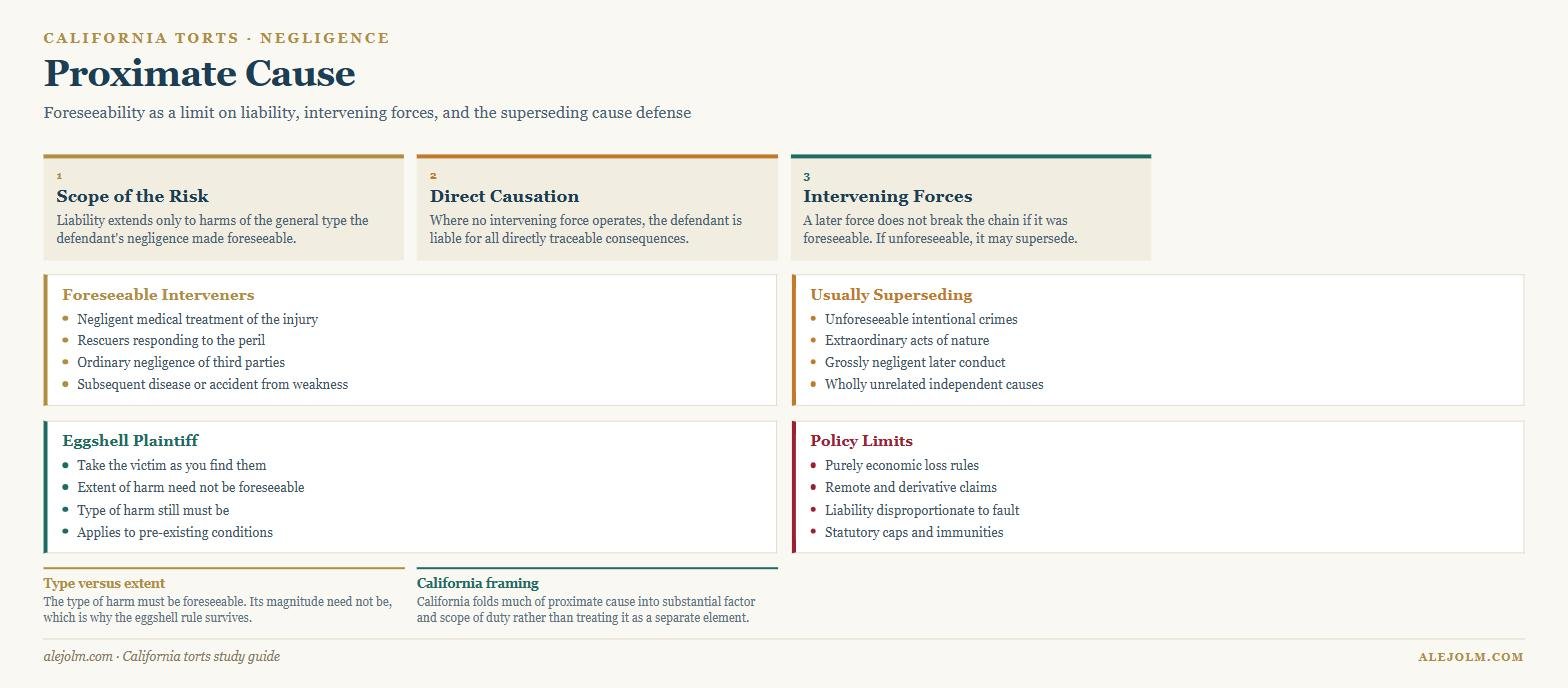
Scope of the risk
The modern formulation asks whether the harm that occurred was within the scope of the risk that made the defendant’s conduct negligent. A pharmacist who dispenses pills in an unlabeled container is negligent because someone might take the wrong medication. If the container instead falls off a shelf and breaks a customer’s toe, the harm is outside the scope of the risk, and the pharmacist is not liable for it even though but-for causation is satisfied.
This framing has largely displaced the older vocabulary of remoteness and directness, because it asks a question with a determinate answer: what were the dangers that made this behaviour careless? Anything on that list is recoverable. Anything off it is not.
Direct causation
Where the injury follows the breach with no independent force intervening, liability is broad. The defendant answers for all consequences that flow directly from the negligent act, and the only cases in which courts cut liability off are those where the result is so bizarre and unpredictable that imposing liability would offend common sense. In practice, direct causation cases are rarely lost on proximate cause.
Intervening and superseding forces
An intervening force is one that comes into operation after the defendant’s negligence and contributes to the harm. The critical question is whether it was foreseeable. A foreseeable intervening force does not relieve the defendant of liability. An unforeseeable one may be characterized as superseding, which cuts off responsibility entirely.
| Intervening force | Foreseeable? |
|---|---|
| Negligent medical treatment of the injury | Yes |
| Rescuer injured while helping | Yes |
| Ordinary negligence of a third party | Usually yes |
| Later illness caused by the weakened state | Yes |
| Unforeseeable criminal attack | Usually no |
| Extraordinary natural event | Usually no |
| Grossly negligent later conduct | Often no |
| Intentional tort enabled by the negligence | Depends |
Criminal acts of third parties
Intentional and criminal conduct by a third person is the hardest category. The general rule treats it as superseding, on the reasoning that deliberate wrongdoing is not an ordinary risk of carelessness. But where the very risk that made the defendant negligent was the risk of that crime — an apartment owner who leaves the security gate broken, a valet who leaves keys in an unattended car — the criminal act is foreseeable and liability survives.
Medical malpractice
Negligent medical treatment of an injury the defendant caused is treated as foreseeable almost everywhere. The original tortfeasor answers for the aggravation, subject to a right of contribution or indemnity against the treating provider.
The eggshell plaintiff rule
A defendant takes the victim as found. Where the type of harm was foreseeable but its extent is far greater than anyone would have predicted because of the plaintiff’s pre-existing fragility, the defendant is liable for the full extent. A minor collision that triggers a catastrophic outcome in a plaintiff with a rare bone condition produces full liability.
Foreseeability governs the type of harm, not its magnitude. This is the single distinction that reconciles the scope of the risk doctrine with the eggshell plaintiff rule.
A worked example
A landlord ignores repeated tenant reports that the lock on the building’s street door is broken. An intruder enters, assaults a tenant in the stairwell, and the tenant is taken to hospital, where a surgeon negligently perforates an artery during an otherwise routine repair. The tenant sues the landlord for everything.
The intruder’s criminal act would ordinarily supersede, but here the entire point of a working street lock is to exclude intruders, so the assault is squarely within the scope of the risk and the landlord remains liable. The surgical negligence is a foreseeable intervening force, so the landlord answers for that aggravation too. Note that the landlord will normally cross-complain against the surgeon for indemnity, and under California’s several liability rule for non-economic damages the jury’s fault allocation will determine each defendant’s share of the pain and suffering award even though both remain jointly responsible for the economic losses.
Proximate Cause in California and Los Angeles County in 2026
California does not present proximate cause to juries as a separate element with its own instruction. CACI 430 asks only whether the defendant’s conduct was a substantial factor in causing the harm, and the limiting work that other states perform through proximate cause is distributed between the substantial factor requirement and the scope of duty analysis the court conducts under the Rowland factors. The practical consequence is that a California defendant arguing remoteness usually makes the argument to the judge as a duty question rather than to the jury as a causation question.
Superseding cause does have its own instruction. CACI 432 tells the jury that a defendant is not responsible where a third person’s conduct was the sole cause or where the later conduct was not reasonably foreseeable, and California courts have repeatedly held that the foreseeability of the general category of harm, rather than the precise manner of its occurrence, is what matters. California also follows the eggshell plaintiff rule, instructed at CACI 3927, and the rule that a tortfeasor is liable for the aggravation caused by negligent medical treatment of the original injury.
In Los Angeles County the doctrine surfaces most sharply in third party criminal conduct cases. Claims against apartment owners, hotels, parking structures, and retail operators for assaults on the premises turn on whether prior similar incidents made the attack foreseeable, and California appellate law calibrates the required degree of foreseeability against the burden of the precautions sought — the heavier the burden, such as hiring armed guards, the higher the foreseeability showing must be. Los Angeles Superior Court personal injury departments see a steady volume of these motions, and they are commonly resolved on summary judgment.
- Jury instructions. CACI 430 states substantial factor causation; CACI 432 addresses superseding third party conduct; CACI 3927 covers the eggshell plaintiff.
- Duty as the limiting device. California channels most remoteness arguments through the scope of duty analysis, which is decided by the court as a matter of law.
- Third party crime. Foreseeability is measured on a sliding scale against the burden of the proposed precaution; prior similar incidents are the usual evidence.
- Several liability. Civil Code section 1431.2 makes non-economic damages several, so fault allocation directly determines each defendant’s exposure.
- Medical aggravation. The original tortfeasor remains liable for negligent treatment of the injury, subject to indemnity against the provider.
- Public entity defendants. Government Code section 835 claims for dangerous conditions require notice and a causal link to the condition; confirm current claim deadlines with the entity.
For 2026, confirm the current Los Angeles Superior Court personal injury department procedures and the latest appellate treatment of premises security foreseeability directly with the court and current authority, since this area of California law continues to develop. For the factual half of causation see our guide to actual cause, and for the surrounding elements see duty of care and premises liability.
Common mistakes to avoid
- Arguing remoteness to a California jury. There is no separate proximate cause instruction. Frame the argument as scope of duty and raise it on summary judgment.
- Requiring the precise manner of harm to be foreseeable. Only the general type must be. Insisting on more is a losing argument in most courts.
- Treating every criminal act as superseding. Where the risk of that crime is what made the conduct negligent, the act is foreseeable and liability survives.
- Using the eggshell rule to bridge a type gap. The rule extends the magnitude of a foreseeable type of harm; it does not make an unforeseeable type recoverable.
- Ignoring the burden side of foreseeability. California measures the required foreseeability showing against the cost of the precaution demanded.
Frequently asked questions
What is the difference between actual and proximate cause?
Actual cause is a factual inquiry into whether the conduct produced the injury. Proximate cause is a legal limit that asks whether the resulting harm was foreseeable enough to make liability fair.
Does the precise way the injury happened have to be foreseeable?
No. Courts require only that the general type of harm be foreseeable. The exact sequence of events and the magnitude of the injury need not have been anticipated.
When does a criminal act break the chain of causation?
Usually when it was not foreseeable. But where the defendant’s negligence consisted precisely in failing to guard against that kind of crime, such as leaving a security door broken, the act does not supersede.
What is the eggshell plaintiff rule?
It provides that a defendant is liable for the full extent of harm even where a pre-existing condition made the plaintiff unusually vulnerable. The type of harm must still have been foreseeable.
Does California have a separate proximate cause instruction?
No. California instructs juries on substantial factor causation and handles the limiting function through the court’s scope of duty analysis, with a separate instruction available for superseding third party conduct.
Related guides
- Actual Cause in Negligence: But-For and Substantial Factor
- Duty of Care in Negligence: California Rules Explained
- The Four Elements of Negligence: Bar Exam Breakdown
- Negligence Per Se: Using a Statute to Prove Breach
- Res Ipsa Loquitur: When the Accident Speaks for Itself
- Comparative Negligence in California Injury Cases
- Assumption of Risk in California Personal Injury Law
- Negligent Infliction of Emotional Distress in California
- Premises Liability in California and Los Angeles County
- Products Liability: The Three Defect Theories Explained
- Wrongful Death Claims in California: Who Can Sue
Next steps
Turn next to the defenses, beginning with comparative negligence and assumption of risk, which determine what happens to the award once duty, breach, and causation are all established.
For primary sources, review the causation and damages instructions in the Judicial Council of California civil jury instructions and the several liability provision at Civil Code section 1431.2.