
Conversion is an intentional exercise of dominion or control over another person’s personal property that so seriously interferes with the owner’s rights that the law requires the defendant to pay the property’s full value. It is the chattel counterpart to trespass to land, but with a distinctive remedy: a forced judicial sale in which the defendant buys the item, whether or not the defendant ever wanted it.
That remedy is what makes the severity question central. Every interference with a chattel is not conversion, because it would be absurd to make someone buy a car for briefly moving it. The doctrine therefore turns on a graded assessment of how badly the defendant intruded, with trespass to chattels catching everything that falls short. This guide works through the elements, the severity factors, and the California statutes that govern these claims in Los Angeles County.
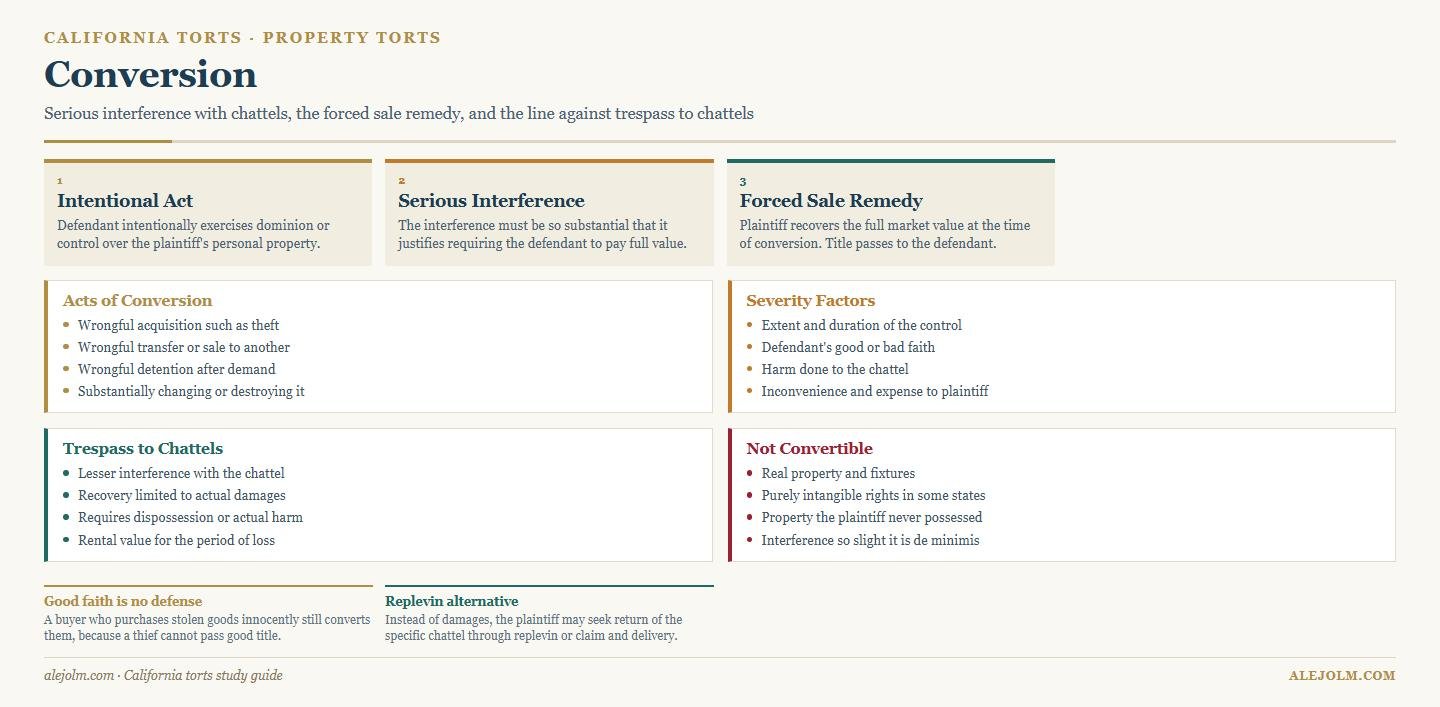
The intentional act
The defendant must intend the act of dominion — taking, using, transferring, altering, withholding. There is no requirement that the defendant know the property belongs to someone else or intend to deprive the owner of it. This is the single most consequential feature of the tort, because it means a good faith purchaser of stolen goods is a converter. A thief cannot pass good title, so the innocent buyer holds nothing and converts by exercising ownership over what remains the true owner’s property.
Negligence is not enough. A warehouse that carelessly loses a crate has not converted it in most courts; the owner sues in negligence or bailment. Some jurisdictions do treat a bailee’s misdelivery as conversion regardless of care, on the theory that delivering goods to the wrong person is itself an exercise of dominion.
Serious interference
Whether an interference is serious enough is a question of degree, and courts weigh a familiar set of factors: the extent and duration of the defendant’s exercise of control, the defendant’s intent to assert a right inconsistent with the owner’s, the defendant’s good or bad faith, the harm done to the chattel, and the inconvenience and expense caused to the owner.
| Conduct | Usual classification |
|---|---|
| Stealing a laptop | Conversion |
| Borrowing a bicycle for an hour | Trespass to chattels or nothing |
| Selling goods held as bailee | Conversion |
| Scratching a car door | Trespass to chattels |
| Destroying a painting | Conversion |
| Refusing to return after demand | Conversion |
| Buying stolen goods innocently | Conversion |
| Briefly blocking access to a vehicle | Usually neither |
Demand and refusal
Where the defendant acquired the chattel lawfully — as a bailee, a finder, or a purchaser — the conversion often does not occur until the owner demands return and the defendant refuses. The demand fixes the moment of conversion, which matters because damages are measured at that time and because the limitations period generally runs from it.
The forced sale remedy
The signature consequence of conversion is that the plaintiff recovers the full fair market value of the chattel measured at the time and place of the conversion, and title effectively passes to the defendant. The plaintiff is made whole and the defendant keeps the item. Where the value has fluctuated, courts in some jurisdictions allow the plaintiff to elect the highest value within a reasonable period after learning of the conversion, a rule developed mainly for securities.
A plaintiff who would rather have the item back may seek replevin, known in California as claim and delivery, which is a possessory action for return of the specific chattel plus damages for the period of detention. Choosing between the two is a strategic decision driven by whether the item is unique, whether it has appreciated, and whether the defendant is solvent.
Conversion forces the defendant to buy. Trespass to chattels forces the defendant only to compensate for what was actually lost or damaged.
Trespass to chattels
Trespass to chattels covers lesser interferences: dispossession for a short time, or intermeddling that causes actual damage to the chattel, impairs its condition or value, or deprives the owner of its use for a substantial time. Unlike conversion and unlike trespass to land, it generally requires actual harm — nominal damages are not available for a trivial touching. Recovery is limited to the diminution in value, the cost of repair, or the rental value for the period of dispossession.
The tort found a second life in disputes over computer systems, where unauthorized electronic access was analogized to physical intermeddling. Courts have generally required proof of actual impairment to the system rather than mere unauthorized contact, keeping the harm requirement meaningful.
A worked example
A jeweller accepts a customer’s heirloom ring for resizing. A staff member mistakenly places it in the consignment case and it sells for market value to a buyer who has no reason to suspect anything. The customer returns, demands the ring, and the jeweller offers a cash refund. The customer refuses and sues both the jeweller and the buyer.
The jeweller converted by selling property held as a bailee; the sale is a classic act of dominion inconsistent with the owner’s rights, and the mistake is irrelevant. The buyer also converted, despite complete innocence, because the jeweller had no authority to pass title and the buyer’s exercise of ownership over the ring is itself the tort. Note that the customer will usually prefer claim and delivery against the buyer rather than damages, since an heirloom has subjective value that market price cannot capture, and the buyer’s remedy is then an action against the jeweller on the sale.
Conversion in California and Los Angeles County in 2026
California states the elements in CACI 2100: the plaintiff owned or possessed or had a right to possess the personal property; the defendant substantially interfered with it by knowingly or intentionally taking possession, preventing the plaintiff from having access, destroying it, or refusing to return it after demand; the plaintiff did not consent; the plaintiff was harmed; and the defendant’s conduct was a substantial factor. California treats conversion as a strict liability tort in the sense that good faith and lack of knowledge are not defenses.
Two statutory features shape California practice. Civil Code section 3336 sets the measure of damages as the value of the property at the time of conversion with interest, or in the court’s discretion where the property has a fluctuating value, an amount sufficient to indemnify the party injured, plus a fair compensation for the time and money properly expended in pursuit of the property. That last clause is unusual and allows recovery of reasonable search and recovery expenses. Separately, Penal Code section 496(c) allows a civil plaintiff to recover treble damages and attorney fees where property was stolen or received with knowledge that it was stolen, a provision California courts have applied in ordinary business disputes and which materially raises the stakes of pleading conversion.
Los Angeles County sees a distinctive concentration of conversion litigation around the entertainment industry, where disputes over master recordings, film negatives, artwork, and production equipment are routine, and around the garment and jewelry districts downtown, where consignment relationships generate demand-and-refusal claims. Claim and delivery under Code of Civil Procedure sections 511.010 and following is the provisional remedy of choice when the chattel is unique, and it requires an application, notice, and usually an undertaking.
- Statute of limitations. Code of Civil Procedure section 338(c) provides three years for taking, detaining, or injuring goods or chattels, with a discovery rule for theft of certain articles.
- Damages measure. Civil Code section 3336 allows value plus interest and fair compensation for time and money spent pursuing the property.
- Treble damages. Penal Code section 496(c) may allow treble damages and fees where the property was stolen or knowingly received; confirm the current scope, since its reach in commercial cases has been actively litigated.
- Claim and delivery. Code of Civil Procedure section 511.010 and following govern the provisional remedy; verify the current undertaking requirements with the court.
- Intangibles. California has been comparatively willing to recognize conversion of intangible property such as domain names and shares where the interest is merged in or reflected in a document.
- Filing court. Los Angeles Superior Court; confirm the current limited civil threshold and filing fees before filing, as these figures are revised periodically.
For 2026, confirm the current limited civil threshold, claim and delivery undertaking amounts, and the state of the case law on Penal Code section 496(c) in commercial disputes directly with the Los Angeles Superior Court and current authority, since these points move and a static summary can mislead. For the surrounding doctrine, see our guides to trespass to land, transferred intent, and consent as a defense.
Common mistakes to avoid
- Assuming good faith is a defense. An innocent purchaser of stolen goods converts them. Advise clients to verify title, not merely to act honestly.
- Skipping the demand. Where possession began lawfully, a demand and refusal usually fixes the moment of conversion and starts the limitations clock. Document it in writing.
- Pleading conversion for trivial interferences. If the interference was slight, the claim is trespass to chattels and requires proof of actual damage.
- Ignoring Civil Code section 3336. California allows recovery of the reasonable time and money spent pursuing the property, which many plaintiffs never claim.
- Electing the wrong remedy. Damages pass title to the defendant. If the chattel is unique, pursue claim and delivery instead.
Frequently asked questions
What is the difference between conversion and theft?
Theft is a crime requiring criminal intent. Conversion is a civil tort that requires only an intentional act of dominion, so an honest mistake or an innocent purchase can be conversion without being theft.
Can I sue an innocent buyer of my stolen property?
Yes. A thief cannot pass good title, so a buyer who takes possession and exercises ownership converts the property even without any knowledge of the theft. The buyer’s recourse is against the seller.
Is conversion available for intangible property?
It depends on the jurisdiction and the type of interest. California has been relatively receptive where the intangible right is merged in or reflected in a document, and has recognized conversion of things such as domain names.
How are damages calculated?
The general measure is the fair market value at the time and place of the conversion. California Civil Code section 3336 adds interest and fair compensation for the time and money reasonably spent pursuing the property.
How long do I have to sue in California?
Code of Civil Procedure section 338(c) supplies three years for taking, detaining, or injuring goods. Where possession began lawfully, the period typically runs from the refusal to return after demand.
Related guides
 Intentional Infliction of Emotional Distress in California
- Self-Defense and Defense of Others in Tort Law
- The Transferred Intent Doctrine in Tort Law Explained
- Battery in Tort Law: Elements, Defenses and Damages
- Premises Liability in California and Los Angeles County
- Trespass to Land in California: Elements and Remedies
- Consent as a Defense to Intentional Torts Explained
- Defamation Elements, Fault Standards and Privileges
- Malicious Prosecution Claims: Elements and Defences
- The Four Elements of Negligence: Bar Exam Breakdown
- False Imprisonment in California: Elements and Defenses
Next steps
Read our guide to trespass to land to see how the same intent analysis operates on real property, and then consent as a defense, which is the privilege most often raised in bailment and consignment disputes.
For primary sources, review California Civil Code section 3336 on the measure of damages and the civil jury instructions published by the Judicial Council of California.