
Actual cause, also called cause in fact, asks a factual question: did the defendant’s conduct in fact bring about the plaintiff’s injury? It is the element that connects breach to harm, and it is entirely distinct from proximate cause, which is a policy judgment about how far liability should extend once the factual link is established.
The default test is simple to state and usually easy to apply. The difficulty arises in a small but doctrinally important set of cases where the standard test produces an absurd result, or where the plaintiff plainly was injured by negligence but cannot say whose. Courts have built specialized devices for those situations, and two of the most important were created by the California Supreme Court.
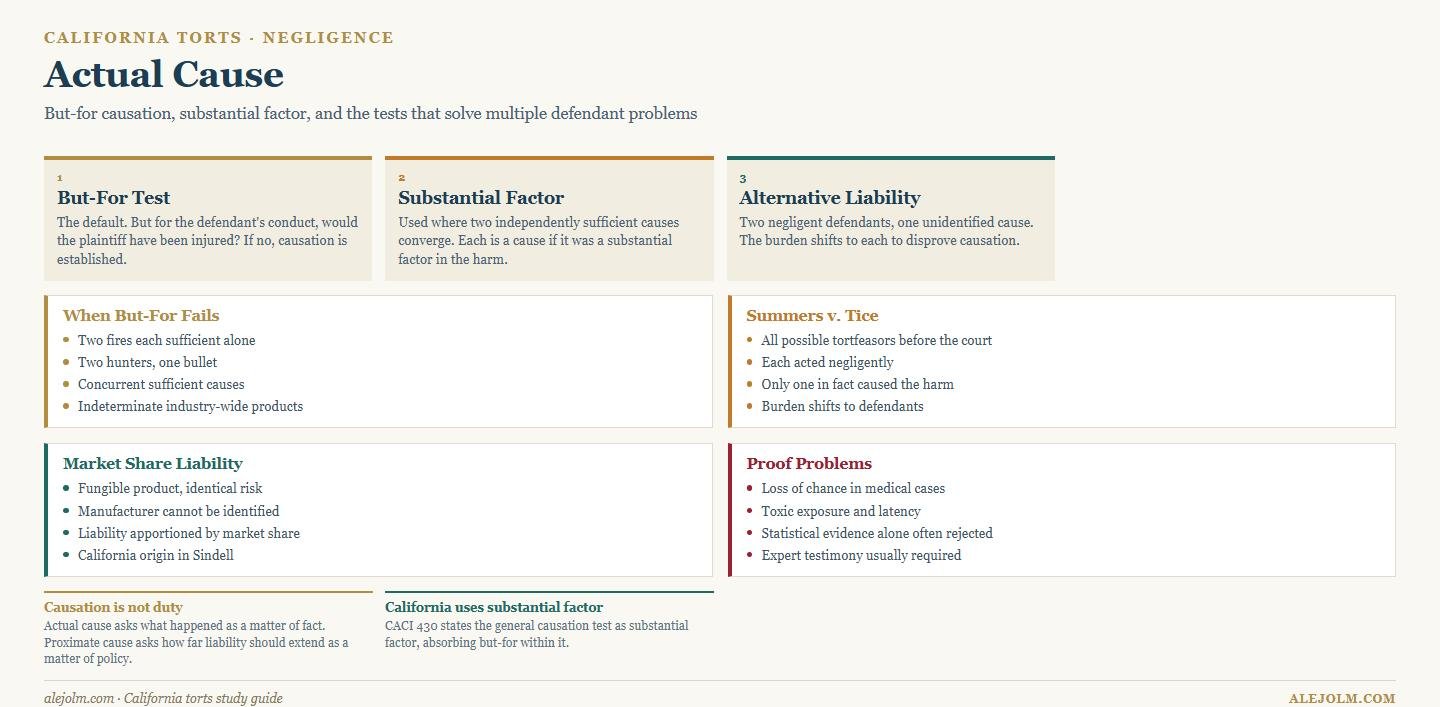
The but-for test
Ask whether the plaintiff would have been injured but for the defendant’s negligent conduct. If the answer is no — the injury would not have happened without it — actual cause is established. If the answer is yes, the injury would have occurred anyway, then the defendant’s conduct made no difference and causation fails, however careless the defendant was.
The test handles the overwhelming majority of cases, including those with multiple defendants whose separate acts combined to produce a single indivisible harm. Two drivers who each run a red light and collide, injuring a pedestrian, are both but-for causes, because removing either one from the scenario prevents the accident.
Where but-for breaks down
The test fails when two forces, each independently sufficient to cause the entire harm, converge at the same moment. Two fires, each large enough to destroy the house alone, merge and burn it down. Applying but-for mechanically exonerates both defendants, since removing either still leaves a fire that destroys the house. That result is intolerable, so courts substitute a different test.
The substantial factor test
Where two or more causes are each sufficient on their own, each is treated as an actual cause if it was a substantial factor in bringing about the harm. The test asks whether the conduct contributed materially rather than whether it was strictly necessary. It preserves liability in the concurrent sufficient cause cases without opening the door to defendants whose contribution was negligible.
| Scenario | Test applied |
|---|---|
| Single negligent driver hits pedestrian | But-for |
| Two negligent drivers, combined impact | But-for |
| Two fires, each sufficient alone | Substantial factor |
| One negligent fire, one natural fire | Substantial factor |
| Trivial contribution to a massive harm | Substantial factor |
| Two hunters, one bullet | Alternative liability |
| Generic drug, unknown maker | Market share |
Alternative liability
Two hunters negligently fire in the plaintiff’s direction and a single pellet causes the injury. Both were negligent, only one caused the harm, and the plaintiff cannot prove which. Requiring proof would leave a blameless victim without a remedy while both wrongdoers escape. The California Supreme Court’s answer was to shift the burden: where all possible tortfeasors are before the court and each acted negligently, each must exculpate itself or be held jointly liable.
The doctrine is narrow. It requires that every candidate be joined, that each have breached a duty to the plaintiff, and that the harm have been caused by one of them. Where a potential cause is absent from the litigation, or where some candidates were not negligent, the burden does not shift.
Alternative liability does not prove causation. It relocates the burden of disproving it onto the parties who are best positioned to know and whose wrongdoing created the evidentiary gap.
Market share liability
A further extension addresses harms from fungible products where the manufacturer of the specific unit cannot be identified, often because of a long latency period between exposure and disease. Under the market share approach, again developed in California, the plaintiff joins manufacturers representing a substantial share of the relevant market, and each is liable in proportion to its share rather than jointly for the whole.
The doctrine has been applied cautiously and rejected outright in some states and for some products. It requires genuine fungibility — the units must have posed identical risk — and a market that can be defined with reasonable accuracy. Courts have generally declined to extend it to products such as asbestos, where formulations and hazard levels varied substantially.
A worked example
A patient with a treatable condition is misdiagnosed by an urgent care physician. Eight weeks later a specialist makes the correct diagnosis, but the delay has reduced the patient’s survival probability from sixty percent to twenty-five percent. The patient dies. The estate sues the urgent care physician.
But-for causation is contested. The defence will argue that the patient had only a sixty percent chance even with prompt treatment, so it cannot be shown that the delay caused the death rather than merely coinciding with it. Because the initial probability exceeded fifty percent, most courts would let the case go to the jury on traditional causation, treating the loss of a better-than-even chance as sufficient. Note that had the initial probability been forty percent, the case would have turned on whether the jurisdiction recognizes loss of chance as a separate compensable injury, and jurisdictions are genuinely split on that question.
Actual Cause in California and Los Angeles County in 2026
California does not use the but-for formulation as its primary jury instruction. CACI 430 instructs that a substantial factor in causing harm is a factor that a reasonable person would consider to have contributed to the harm, that it must be more than a remote or trivial factor, and that it does not have to be the only cause of the harm. California courts describe the substantial factor test as subsuming the but-for test, so a defendant whose conduct was a but-for cause will ordinarily also be a substantial factor, while the instruction avoids the trap of the concurrent sufficient cause cases.
Both of the major burden-shifting doctrines originated in California. Alternative liability comes from the state’s two-hunter case, and market share liability was created by the California Supreme Court in the diethylstilbestrol litigation, where the court apportioned liability among manufacturers by their share of the relevant market. California has since limited market share liability to genuinely fungible products and has declined to extend it where the products differed in the risks they posed, which is why it has not taken hold in the state’s large volume of asbestos litigation.
Causation practice in Los Angeles County is shaped by case management as much as doctrine. The Superior Court maintains dedicated personal injury hub departments for standard personal injury cases and separate complex departments and coordinated proceedings for mass torts, where causation is typically the central battleground and expert exclusion motions are decisive. California applies the Sargon standard to expert testimony, which gives trial courts a gatekeeping role over the reasoning and methodology underlying causation opinions, so the admissibility fight often determines the outcome before any jury hears the evidence.
- Jury instruction. CACI 430 states the substantial factor test; CACI 431 addresses multiple causes and confirms that a defendant need not be the only cause.
- Expert gatekeeping. California trial courts screen the reasoning and methodology of causation experts under Evidence Code sections 801 and 802; confirm the current standard, as the case law continues to develop.
- Comparative fault. Once causation is established, Civil Code section 1431.2 limits non-economic damages to each defendant’s proportionate share of fault.
- Market share. Available in California for fungible products only; verify the current scope before pleading it.
- Case assignment. Los Angeles Superior Court routes standard personal injury cases to designated hub departments and complex cases separately; confirm current assignment rules with the court.
- Statute of limitations. Two years for personal injury under Code of Civil Procedure section 335.1, with delayed discovery available for latent injuries such as toxic exposures.
For 2026, confirm the current Los Angeles Superior Court personal injury hub and complex case assignment rules, and the latest appellate guidance on expert causation testimony, directly with the court and current authority, because both have been in motion and any summary here can date quickly. To complete the causation analysis, read our guide to proximate cause, and for the surrounding elements see duty of care and the elements of negligence.
Common mistakes to avoid
- Conflating actual and proximate cause. One is a factual inquiry, the other a policy limit. Argue them separately or you will lose both.
- Using but-for in concurrent sufficient cause cases. The test exonerates everyone. Switch to substantial factor whenever two independently adequate causes converge.
- Invoking alternative liability with a missing defendant. The doctrine requires all possible tortfeasors before the court. One absent candidate defeats the burden shift.
- Pleading market share for non-fungible products. California requires genuine fungibility, which is why the doctrine has not been extended to asbestos.
- Underinvesting in the expert. Causation is usually decided on the admissibility of expert opinion, not on the jury’s reaction to it.
Frequently asked questions
What is the difference between actual and proximate cause?
Actual cause is a factual question about whether the defendant’s conduct in fact produced the injury. Proximate cause is a legal limit that asks whether the harm was foreseeable enough that holding the defendant liable is fair.
Why does California use substantial factor instead of but-for?
California’s jury instruction uses substantial factor because it handles concurrent sufficient causes correctly while still capturing ordinary but-for causation. Courts describe the substantial factor test as absorbing but-for within it.
What is alternative liability?
Where multiple defendants each acted negligently, only one caused the harm, and all are before the court, the burden shifts to each defendant to prove it was not the cause. If none can, all may be held liable.
Does market share liability apply to asbestos?
California courts have declined to extend it to asbestos because the products varied in composition and in the level of risk they posed. The doctrine requires products that are genuinely fungible.
Can I recover for a lost chance of survival?
Jurisdictions are split. Where the original chance exceeded fifty percent, traditional causation usually suffices. Where it was lower, recovery depends on whether the state recognizes loss of chance as a compensable injury.
Related guides
- Proximate Cause and Foreseeability in Negligence Law
- Duty of Care in Negligence: California Rules Explained
- The Four Elements of Negligence: Bar Exam Breakdown
- Negligence Per Se: Using a Statute to Prove Breach
- Res Ipsa Loquitur: When the Accident Speaks for Itself
- Comparative Negligence in California Injury Cases
- Products Liability: The Three Defect Theories Explained
- Premises Liability in California and Los Angeles County
- Wrongful Death Claims in California: Who Can Sue
- Assumption of Risk in California Personal Injury Law
- Negligent Infliction of Emotional Distress in California
Next steps
Move on to proximate cause to see how courts limit liability once the factual link is proven, then review res ipsa loquitur, which solves an adjacent proof problem on the breach element rather than on causation.
For primary sources, review the causation instructions in the Judicial Council of California civil jury instructions and the comparative fault statute at Civil Code section 1431.2.