
Consent is the most fundamental of the intentional tort defenses, and in many formulations it is not a defense at all but the absence of an element. A contact the plaintiff agreed to is not offensive; an entry the possessor permitted is not a trespass. Either way, the practical effect is the same: where valid consent covers what the defendant did, there is no tort.
Almost all of the litigation concerns three questions. Was consent actually given, expressly or by implication? Was the person who gave it capable of giving it? And did what the defendant did stay within the boundaries of what was agreed to? This guide takes each in turn and then addresses the medical setting, where the rules are most developed.
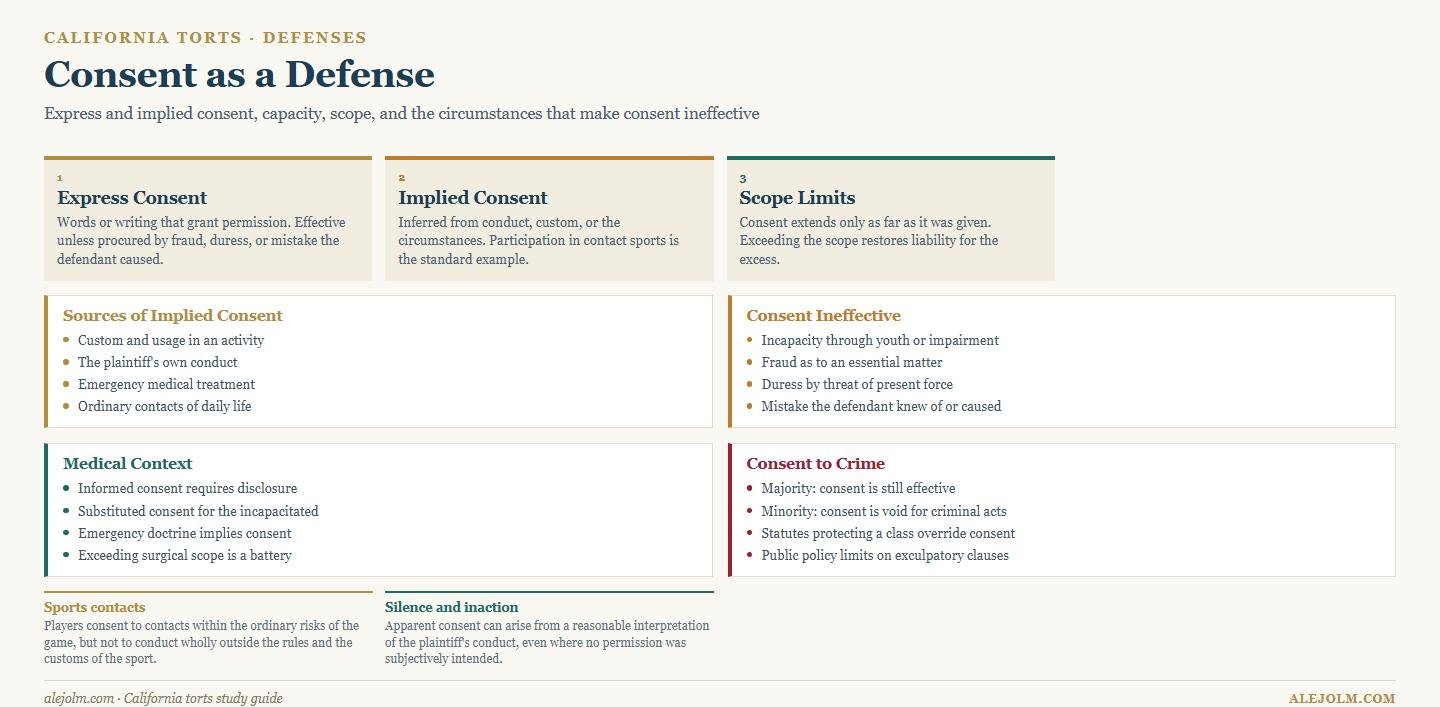
Express and implied consent
Express consent is stated in words or writing. It is the easiest to prove and the easiest to attack, because its terms are fixed and any conduct outside them is unprotected. Implied consent is inferred from the plaintiff’s conduct, the customs of the activity, or the surrounding circumstances, and it does most of the real work in tort law.
Consent implied from conduct
The classic illustration is a passenger who joins an inoculation line, watches others being vaccinated, and holds out an arm without saying anything. The conduct communicates agreement, and the defendant is entitled to rely on a reasonable interpretation of it. This is sometimes called apparent consent, and it protects a defendant who reasonably reads the plaintiff’s behaviour as permission even where the plaintiff subjectively intended none.
Consent implied by custom
Participants in an activity consent to the contacts customary within it. A footballer consents to a hard tackle, a passenger on a crowded train consents to jostling, and a boxer consents to being punched. The scope is set by the ordinary and expected incidents of the activity, so conduct wholly outside the rules and customs of a sport is not covered — a deliberate punch after the whistle remains a battery.
Consent implied by law
In an emergency, where the plaintiff is incapable of consenting and no authorized person is available, the law implies consent to treatment that a reasonable person would want. The privilege lasts only as long as the emergency and covers only what is reasonably necessary to address it.
Capacity
Consent is ineffective when the person giving it lacks the capacity to appreciate the nature and consequences of what is being agreed to. Youth, intoxication, unconsciousness, mental illness, and cognitive impairment can all defeat capacity, and the assessment is specific to the decision at hand rather than global. A minor may lack capacity to consent to surgery but have ample capacity to consent to a handshake.
| Circumstance | Consent effective? |
|---|---|
| Adult signs a waiver after reading it | Usually yes |
| Player tackled within the rules | Yes |
| Unconscious patient, life-threatening injury | Yes, implied by law |
| Child consents to major surgery | No |
| Consent obtained by threat of immediate force | No |
| Consent obtained by lie about a material fact | No |
| Patient consents to left knee, surgeon operates on right | No as to the right knee |
Scope
Consent protects only what was agreed to. Exceeding the scope restores liability for the excess, and the analysis is objective: what would a reasonable person in the defendant’s position have understood the permission to cover? A homeowner who invites a plumber to fix a sink has not consented to the plumber wandering through the bedrooms, and a patient who agrees to an appendectomy has not agreed to an unrelated procedure performed for convenience while the patient is already under anaesthetic.
Consent is a boundary, not a licence. The defendant is protected up to the edge of what was permitted and fully liable for everything beyond it.
When consent is ineffective
Even a capable person’s express agreement can be nullified. Fraud vitiates consent where the deception concerns an essential matter, though a lie about a collateral point, such as a promise of payment that is never honoured, generally does not. Duress vitiates consent where the plaintiff agreed under threat of immediate force to person or family; economic pressure and threats of future action are usually insufficient. And a mistake defeats consent where the defendant knew of the mistake or induced it.
Public policy also intervenes. Where a statute exists to protect a class of persons, a member of that class cannot consent away the protection. Exculpatory agreements are subject to their own limits, refused enforcement where they cover gross negligence or wilful misconduct, where the bargaining power is grossly unequal, or where the service is an essential public one. Our guide to assumption of risk addresses those agreements in detail.
A worked example
A patient signs a consent form for arthroscopic repair of a torn meniscus in the right knee. During the procedure the surgeon observes significant cartilage damage in the same knee and performs an additional unplanned repair, adding forty minutes to the operation. The patient recovers well but is furious, and sues for battery.
The written consent fixes the scope, and the additional repair falls outside its literal terms. The surgeon’s best arguments are that the extension was within the reasonable contemplation of consent to knee surgery on that joint, and that a genuine emergency arose. Neither is strong here, since the condition was not life-threatening and the patient could have been consulted after recovery. Note that the patient’s good outcome does not defeat the claim; a battery is complete on the unauthorized contact, and the absence of harm affects only the size of the award, not liability.
Consent in California and Los Angeles County in 2026
California treats lack of consent as an element the plaintiff must establish for several intentional torts rather than as an affirmative defense the defendant must prove. CACI 1300 on battery requires the plaintiff to show that he or she did not consent to the touching, and the trespass and false imprisonment instructions are framed the same way. That allocation matters at the pleading stage and on summary judgment, because it places the initial burden on the plaintiff.
Medical consent in California is governed by a distinctive framework. The state measures the adequacy of disclosure by what a reasonable patient would want to know rather than by what a reasonable physician would disclose, and a claim that disclosure was inadequate sounds in negligence rather than battery. Battery is reserved for the case where no consent was given at all or where the procedure performed was substantially different from the one authorized. The Health and Safety Code and the Probate Code supply the rules for surrogate decision-making, advance directives, and treatment of incapacitated adults, and the Family Code addresses when a minor may consent to particular categories of care without a parent.
In Los Angeles County the consent issues that recur most often are recreational and fitness waivers, which the county’s dense concentration of gyms, studios, and adventure operators generates in volume; medical battery claims arising from the region’s large hospital systems; and sports injury cases, where California’s primary assumption of risk doctrine frequently disposes of the claim before consent is even reached. Waivers are enforced in California subject to the public interest test and the rule that they cannot cover gross negligence.
- Burden allocation. California requires the plaintiff to plead and prove lack of consent for battery, trespass, and false imprisonment.
- Medical disclosure standard. California uses a patient-oriented standard for informed consent, and inadequate disclosure is litigated as negligence rather than battery.
- Minors. The Family Code allows minors to consent independently to certain categories of care; confirm the current provisions before relying on any specific age or category.
- Waivers. Civil Code section 1668 voids contracts exempting a party from responsibility for fraud, wilful injury, or violation of law; gross negligence cannot be waived.
- Elder and dependent adults. Welfare and Institutions Code protections cannot be consented away by a person the statute is designed to protect.
- Statute of limitations. Two years for personal injury under Code of Civil Procedure section 335.1; professional negligence claims run on the separate schedule in section 340.5.
For 2026, verify the current Family Code provisions on minor consent, the applicable professional negligence limitations periods, and Los Angeles Superior Court department practices on waiver enforcement directly with current statutes and the court, since these details are amended and any static summary will lag. For the related doctrines, see our guides to battery, assumption of risk, and self-defense.
Common mistakes to avoid
- Treating consent as unlimited. Permission for one act is not permission for another. Draft and read consent documents as boundaries.
- Relying on a signature from someone who lacked capacity. A form signed by an intoxicated, sedated, or underage person may be worthless.
- Assuming a waiver covers everything. California will not enforce an exculpatory clause as to gross negligence, wilful misconduct, or statutory violations.
- Pleading lack of consent as an afterthought. In California it is an element of the plaintiff’s case for battery and trespass, not a defense to be rebutted.
- Confusing informed consent with consent. Inadequate disclosure is a negligence theory in California; only an entirely unauthorized procedure is a battery.
Frequently asked questions
Is consent a defense or an element?
It varies by jurisdiction and by tort. California treats lack of consent as an element the plaintiff must prove for battery, trespass, and false imprisonment, which places the initial burden on the plaintiff.
Can consent be implied from silence?
Yes. Apparent consent can arise where a reasonable person in the defendant’s position would interpret the plaintiff’s conduct or inaction as permission, even if the plaintiff subjectively intended none.
Does a signed waiver always protect a business?
No. California will not enforce an exculpatory agreement covering gross negligence, wilful injury, fraud, or violation of law, and waivers affecting the public interest may be refused enforcement entirely.
What happens if a surgeon exceeds the scope of consent?
The unauthorized portion is a battery, and liability attaches even where the outcome was good. Only a genuine emergency or a procedure fairly within the authorized scope will protect the surgeon.
Can someone consent to a criminal act?
Most jurisdictions treat consent as effective in the civil case even where the conduct is criminal, but a minority hold otherwise, and consent is always ineffective where a statute exists to protect the class the plaintiff belongs to.
Related guides
 Conversion in Tort Law: California Elements and Remedies
 Intentional Infliction of Emotional Distress in California
- Assumption of Risk in California Personal Injury Law
- Transferred Intent in Tort Law: Rules and Limits Explained
- Battery in Tort Law: Elements, Defenses and Damages
- Assault in Tort Law: Apprehension of Imminent Harm
- Trespass to Land in California: Elements and Remedies
- The Four Elements of Negligence: Bar Exam Breakdown
- Premises Liability in California and Los Angeles County
- Self-Defense and Defense of Others in Tort Law
- False Imprisonment in California: Elements and Defenses
Next steps
Continue with self-defense and assumption of risk, the two defenses most often argued alongside consent, then revisit battery to see how the consent element is pleaded in practice.
For primary sources, read California Civil Code section 1668 on unenforceable exculpatory contracts and the intentional tort instructions published by the Judicial Council of California.