
Assumption of risk is the doctrine that denies recovery to a plaintiff who accepted the danger that caused the injury. It sounds like a single rule but it is really three, and they operate so differently that treating them as one is the most reliable way to get a case wrong. One is contractual, one is a rule about duty, and one is a comparative fault reduction.
The arrival of comparative negligence forced courts to sort the branches out, because a doctrine that completely barred recovery sat awkwardly alongside a system built on apportionment. California’s resolution has been especially influential, and it turns on a distinction between risks inherent in an activity and risks a defendant unreasonably added to it.
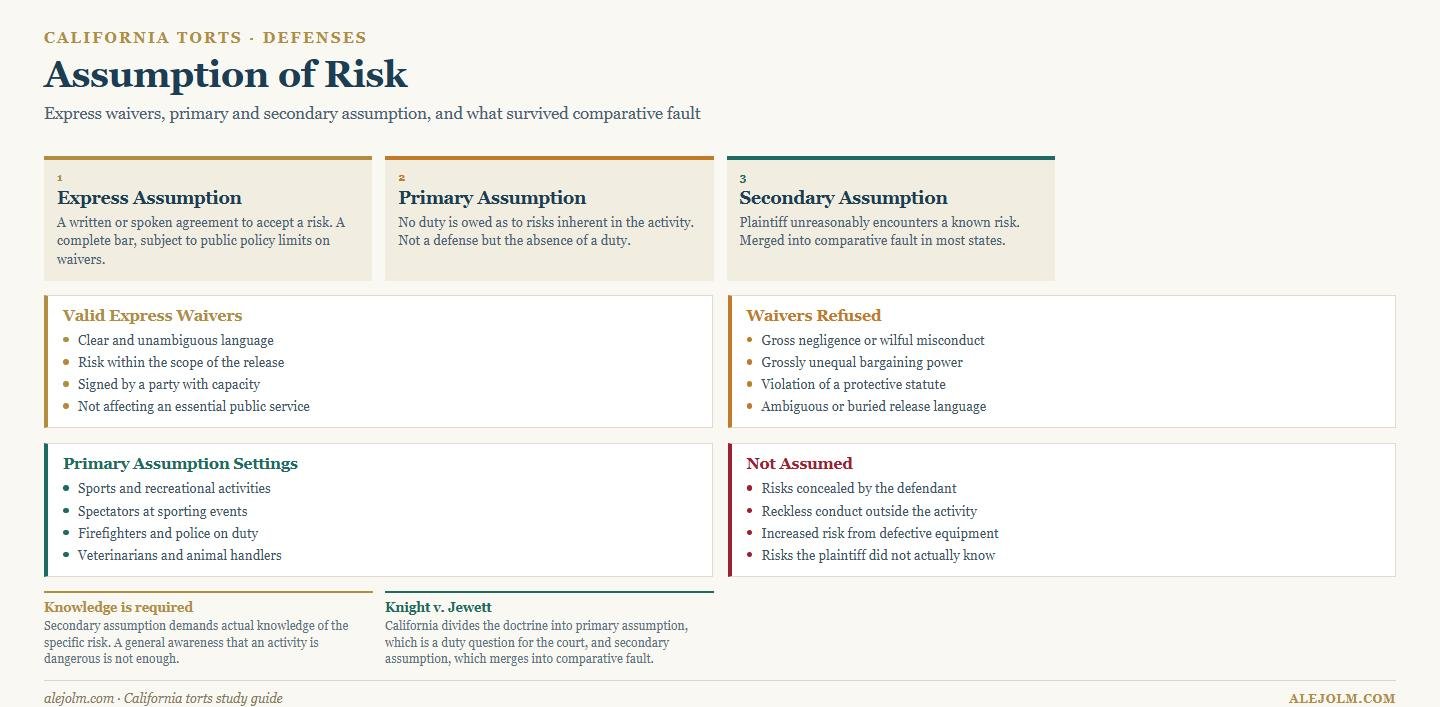
Express assumption of risk
This is an agreement. The plaintiff signs a release, or agrees in words, to accept a particular danger and give up the right to sue over it. Where the agreement is valid and the injury falls within its terms, it is a complete bar, and it survived the shift to comparative fault untouched because it rests on contract rather than on fault.
When waivers are enforced
Courts require clear and unambiguous language identifying the risk released, a signature by someone with the capacity to give it, and an injury genuinely within the scope of what was described. Releases buried in dense text, drafted in language a layperson would not understand, or covering risks nobody contemplated are construed against the drafter and frequently fail.
When waivers are refused
No jurisdiction enforces a release covering gross negligence, recklessness, or wilful misconduct. Beyond that, courts refuse enforcement where the transaction affects the public interest — where the service is of practical necessity, offered to the general public on standardized terms, with no realistic opportunity to bargain. Medical care, housing, and essential utilities sit within that category; recreational activities generally do not, which is why gym and adventure sport waivers are usually upheld.
Primary assumption of risk
Despite the name, this is not a defense. It is a statement that the defendant owed no duty in the first place with respect to risks inherent in the activity. A baseball spectator injured by a foul ball has no claim because the risk of a foul ball is part of what baseball is, and imposing a duty to eliminate it would change the game. Since duty is a question of law, primary assumption is resolved by the court and disposes of cases at summary judgment.
The critical limit is that the doctrine covers inherent risks only. A defendant who increases the risk beyond what the activity necessarily involves — defective equipment, an unreasonably dangerous facility, conduct entirely outside the range of the ordinary activity — owes a duty and can be liable. Our guide to duty of care sets out how courts frame that inquiry.
| Branch | Nature |
|---|---|
| Express | Contractual agreement |
| Primary | No duty as to inherent risks |
| Secondary | Unreasonably meeting a known risk |
Secondary assumption of risk
Here the defendant did owe a duty and did breach it, but the plaintiff knowingly and unreasonably chose to encounter the resulting danger anyway. A tenant who uses a stairway she knows the landlord has negligently left unlit, when a safe alternative exists, is in this territory. Before comparative fault this was a total bar. Today most jurisdictions, California included, fold it into the apportionment calculus, so the plaintiff’s recovery is reduced by a percentage rather than eliminated.
Two things must be shown. The plaintiff must have had actual knowledge of the specific risk, not merely a general sense that the situation was dangerous, and the choice to encounter it must have been unreasonable. A plaintiff who reasonably confronts a known danger — a parent entering a burning building to reach a child — is not making an unreasonable choice at all, and the rescue doctrine protects the decision.
Primary assumption asks whether a duty existed. Secondary assumption assumes it did, and asks how the plaintiff’s own choice should affect the award. Confusing the two costs cases.
A worked example
A recreational cyclist signs a waiver to join an organized ride. The release mentions falls, collisions with other riders, and road hazards. During the event she is injured when a marshal, texting on a phone, waves the pack through an intersection into cross traffic. She sues the organizer.
Express assumption fails as to this injury: the release covers ordinary riding hazards, and a marshal’s inattentive direction into live traffic is not a road hazard within the natural reading of those terms. Primary assumption also fails, because being waved into cross traffic is not a risk inherent in cycling — it is a risk the organizer added. Secondary assumption is unavailable because the cyclist had no actual knowledge of the specific danger. Note that if the evidence showed the marshal’s conduct amounted to gross negligence, the waiver would be unenforceable as to it even had the language been broad enough to cover the event.
Assumption of Risk in California and Los Angeles County in 2026
California restructured the doctrine after adopting comparative fault, and the resulting framework is the one most other states now debate. The California Supreme Court divided assumption of risk into primary assumption, which describes situations where the defendant owes no duty to protect the plaintiff from a particular risk, and secondary assumption, which describes situations where a duty exists and the plaintiff unreasonably encounters the known breach. Primary assumption is a complete bar decided by the court as a matter of law. Secondary assumption is merged into comparative fault and produces only a reduction.
California applies primary assumption most broadly in sport and recreation, where the state has held that co-participants owe each other a duty only to refrain from conduct so reckless as to be totally outside the range of the ordinary activity, and that operators and instructors owe a duty not to increase the risks inherent in the activity beyond those inherent in it. The state also recognizes the firefighter’s rule, which limits the duty owed to public safety officers as to the very risks that occasioned their presence, and the veterinarian’s rule for animal handlers.
Waiver enforcement in California is governed by Civil Code section 1668, which voids contracts exempting a party from responsibility for fraud, wilful injury, or violation of law, together with the public interest analysis California courts have applied for decades. California courts have consistently held that gross negligence cannot be released. In Los Angeles County these questions arise constantly given the density of gyms, climbing walls, martial arts studios, youth sports leagues, and film and television production, where injury claims by participants and crew routinely turn on whether the risk was inherent or added.
- Primary assumption. A no-duty rule decided by the court; the operator must not increase the risks inherent in the activity.
- Co-participant standard. Liability between participants in a sport requires conduct outside the range of the ordinary activity, not mere carelessness.
- Secondary assumption. Merged into comparative fault; reduces the award by the plaintiff’s percentage rather than barring recovery.
- Waivers. Civil Code section 1668 and the public interest analysis govern; gross negligence can never be released.
- Minors. The enforceability of a parent’s release on behalf of a minor is limited in California; confirm the current authority before relying on one.
- Firefighter’s rule. Limits duties owed to public safety officers, with statutory exceptions at Civil Code section 1714.9; verify the current scope.
For 2026, confirm the current California authority on parental waivers for minors, the statutory exceptions to the firefighter’s rule, and Los Angeles Superior Court summary judgment practices in recreation cases directly with current authority and the court, since these continue to develop. For the related doctrines, see our guides to comparative negligence, consent as a defense, and premises liability.
Common mistakes to avoid
- Treating primary assumption as a defense. It is a no-duty ruling for the court. Raise it on summary judgment, not as an affirmative defense for the jury.
- Assuming a signed waiver ends the case. Gross negligence is never released, and the injury must fall within the scope of the language actually used.
- Relying on general awareness of danger. Secondary assumption requires actual knowledge of the specific risk that caused the injury.
- Ignoring increased risk. Primary assumption covers inherent risks only. Defective equipment and unreasonably dangerous conditions fall outside it.
- Overlooking the minor problem. A parent’s signature on a release for a child is far less reliable than practitioners often assume in California.
Frequently asked questions
What is the difference between primary and secondary assumption of risk?
Primary assumption means no duty was owed as to a risk inherent in the activity, and it bars the claim entirely. Secondary assumption means a duty existed and was breached but the plaintiff unreasonably encountered the danger, which reduces recovery under comparative fault.
Are liability waivers enforceable in California?
Often, for recreational activities. But Civil Code section 1668 voids releases covering fraud, wilful injury, or violation of law, gross negligence can never be released, and agreements affecting the public interest are refused enforcement.
Can I sue another player who injured me in a game?
Only where the conduct was so reckless as to fall entirely outside the range of the ordinary activity. California holds that co-participants owe no duty as to the ordinary careless contacts inherent in a sport.
Does assumption of risk still bar recovery completely?
Express and primary assumption still do. Secondary assumption was merged into comparative fault in California and most other states, so it produces a percentage reduction rather than a bar.
Can a parent waive a child’s right to sue?
California limits the enforceability of parental releases on behalf of minors, and the answer depends on the context and the current state of the case law. Confirm the position before relying on such a release.
Related guides
- Comparative Negligence in California: How Fault Is Split
- Consent as a Defense in Tort Law: The California Rules
- The Four Elements of Negligence: Bar Exam Breakdown
- Duty of Care in Negligence: California Rules Explained
- Premises Liability in California and Los Angeles County
- Negligence Per Se: Using a Statute to Prove Breach
- Res Ipsa Loquitur: When the Accident Speaks for Itself
- Proximate Cause: Foreseeability and Superseding Causes
- Actual Cause in Negligence: But-For and Substantial Factor
- Products Liability: The Three Defect Theories Explained
- Wrongful Death Claims in California: Who Can Sue
Next steps
Read our guide to comparative negligence to see how secondary assumption is absorbed into apportionment, then premises liability, where primary assumption and the duties of an occupier interact most often.
For primary sources, read California Civil Code section 1668 and the assumption of risk instructions published by the Judicial Council of California.