
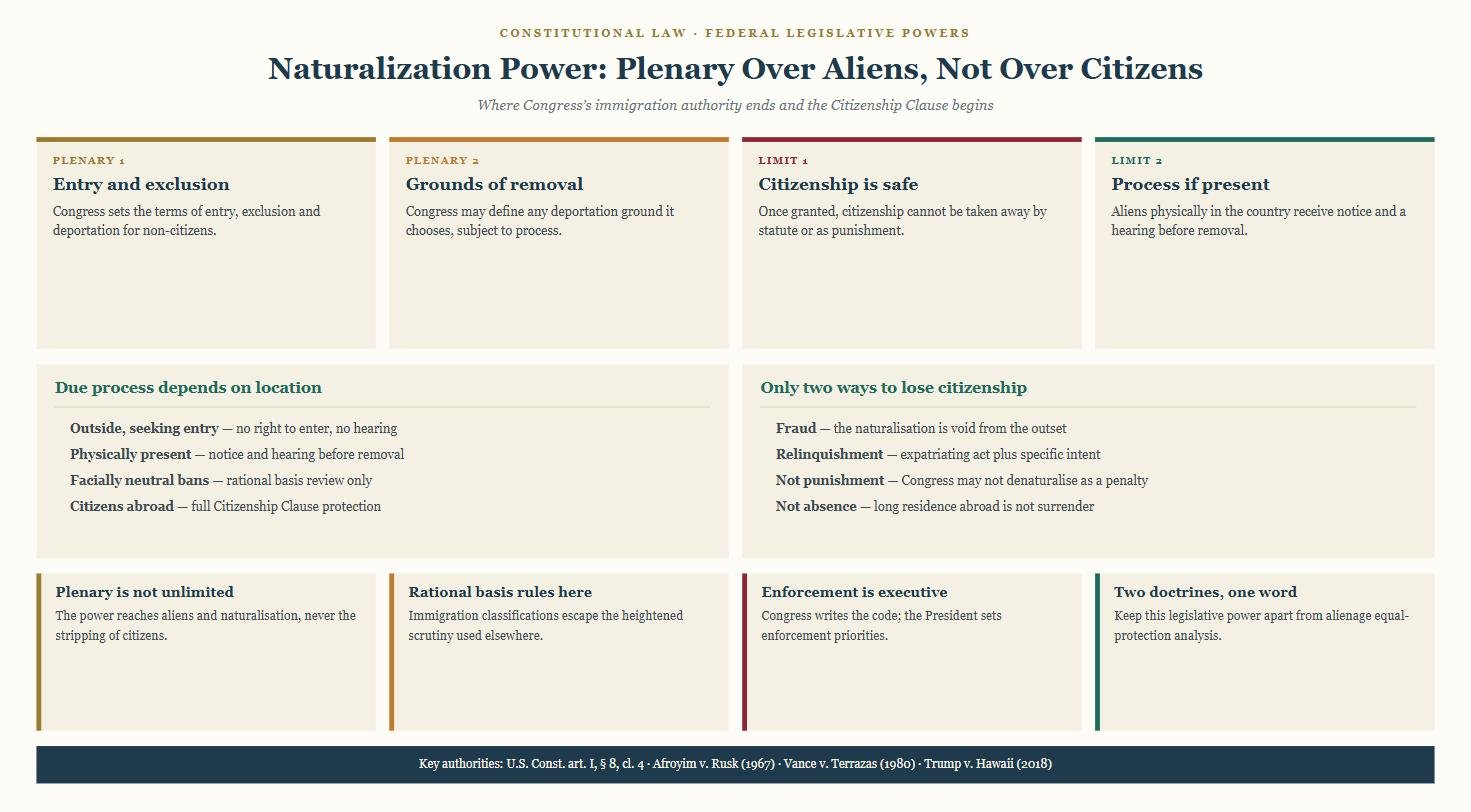
Congress holds a plenary naturalization power under Article I, section 8, clause 4, and the Supreme Court has read that clause together with national sovereignty to give Congress correspondingly broad authority over immigration generally. The same power stops abruptly at the point where citizenship has already been granted.
This guide explains what plenary really means in this context, why the standard of review is so deferential, how due process turns on where a non-citizen is physically located, and why Congress cannot take citizenship away from a citizen who has not agreed to give it up.
What the clause actually says
The text is narrow. Congress may establish a uniform rule of naturalization. From that sentence, reinforced by the structural idea that control of the borders is an attribute of sovereignty, the Court has built a power to decide who may enter the country, on what conditions, and who may be required to leave.
Two consequences follow. First, the power is exclusive: a state may not run its own admission or removal system. Second, the power is exercised in a zone of unusual judicial deference, so arguments that would succeed against a domestic statute frequently fail here.
Exam tip: ask first whether the person in the facts is a citizen. If they are, the plenary power arguments largely disappear.
Deference: the review standard is rational basis
Immigration is the great exception to the tiers of scrutiny. In Trump v. Hawaii the Court upheld an entry restriction that applied to nationals of several countries, applying a deferential review and declining to look behind a facially neutral justification. Whether an exclusion drawn explicitly on religious lines would survive remains unresolved.
The practical lesson for an answer is to identify the deference and then argue within it, rather than reaching for strict scrutiny by analogy to domestic equal protection cases.
Due process depends on where the person is
This is the distinction that decides most questions in this area, and it is geographic rather than formal.
- Outside the country, seeking admission. There is no constitutional right to enter. Congress may exclude on essentially any ground, including grounds that would be plainly unconstitutional if applied to a citizen, and no hearing is required.
- Physically present in the country. Notice and a hearing are required before removal. Congress still defines the grounds of deportability, but the government must show that the person actually falls within one.
- Lawful permanent residents. Present in the country, so entitled to process, and in practice the group where the notice-and-hearing requirement does the most work.
States retain their ordinary police power over aliens within their borders, but only to the extent federal law has not displaced the field and the state measure is otherwise constitutional.
Citizenship cannot be legislated away
Afroyim v. Rusk held that Congress has no power to divest a citizen of citizenship without that citizen’s assent. Vance v. Terrazas added the proof requirement: the government must establish both an expatriating act and a specific intent to relinquish citizenship. Loss of citizenship therefore happens in only two ways.
| Statute or action | Valid? | Reason |
|---|---|---|
| Excluding a foreign national abroad for past political speech | Yes | No right to enter; plenary power over admission |
| Deporting a lawful resident for criticism, with no hearing | No | Person is present, so process is owed |
| Denaturalising a citizen who lied about a disqualifying fact | Yes | Fraud voids the original grant |
| Stripping citizenship after six years living abroad | No | Absence is neither fraud nor intentional relinquishment |
| Denaturalisation imposed as a criminal penalty | No | Citizenship is not a punishment Congress may take |
| State statute creating its own deportation procedure | No | Immigration authority is exclusively federal |
Worked example: the ideological exclusion
Congress bars entry to any foreign national who has publicly criticised United States foreign policy. The statute is applied to a Canadian academic who wants to attend a conference in California. The issue is whether the exclusion is constitutional. The rule is that Congress’s power over admission is plenary and that a foreign national outside the country has no constitutional right to enter. Applying it, the academic is seeking admission from abroad, so Congress may set the condition even though it is expressly about speech. The exclusion stands.
Change one fact. The same statute is used to remove a lawful permanent resident already living in California. She is physically present, so she is entitled to notice and a hearing, and the government must prove she falls within a valid ground of deportability. Criticism alone is unlikely to be enough. The outcome flips because her location, not her nationality, changed the analysis.
Congress legislates, the President enforces
Sitting on top of the legislative power is executive enforcement discretion. The President cannot rewrite the immigration code, but the executive branch decides which cases to pursue and in what order, which is why large-scale enforcement-priority programmes have generated recurring litigation. Keep the two questions separate: whether Congress had the power to enact the rule, and whether the executive has the power to decline to enforce it.
Common mistakes that cost points
- Giving every non-citizen the same due process rights. Location controls.
- Applying strict scrutiny to an immigration classification. Deferential review governs this field.
- Treating denaturalisation as part of the plenary power. It is not.
- Sourcing the no-involuntary-loss rule to Article II. It comes from the Citizenship Clause as read in Afroyim.
- Forgetting the intent element from Vance v. Terrazas.
- Confusing this legislative power with alienage classifications under equal protection.
- Assuming the President may suspend the statutory scheme outright rather than set priorities.
- Missing that the power is exclusive, which is what dooms parallel state schemes.
Frequently asked questions
Can a naturalised citizen be treated differently from a citizen by birth?
Not once naturalisation is complete. The only distinction is that a naturalisation obtained by fraud can be voided, because the grant was never validly made.
Does the plenary power let Congress ignore the Bill of Rights?
It gives extraordinary latitude over admission decisions. It does not license the government to disregard process owed to people already inside the country.
Is this the same as alienage discrimination?
No. This topic is Congress’s affirmative power to legislate about immigration. Alienage classifications concern the scrutiny applied when a government discriminates on the basis of alien status.
The naturalization power and immigrant Los Angeles, 2026
Congress holds exclusive power to establish a uniform rule of naturalization, and California’s history supplied some of the harshest early applications of it. Chae Chan Ping v. United States (1889), the Chinese Exclusion Case, arose from a Chinese labourer refused re-entry at San Francisco and established the plenary power doctrine under which federal authority over admission and exclusion is subject to only minimal judicial review. That framework still shapes immigration litigation today.
Los Angeles County is now among the most significant naturalization jurisdictions in the country, with large ceremonies held regularly at county venues. What the county and the state cannot do is confer citizenship or alter eligibility. What California has done instead is build a parallel structure of state-funded services: legal assistance for naturalization applicants, professional licensing available without regard to immigration status, and benefit programmes financed by the state where federal eligibility rules exclude residents.
The division of authority in practice:
- Only Congress sets requirements. Residence periods, language and civics testing, and good moral character are federal criteria that no state may modify.
- Plenary power is not unlimited. Procedural due process applies to people within the United States, and denaturalization requires clear and convincing proof of fraud.
- State convictions have federal consequences. A plea in the Los Angeles Superior Court can trigger removability, which is why California created a statutory route to vacate convictions entered without adequate advice about immigration effects.
- Defence counsel must advise on immigration. Padilla v. Kentucky (2010) makes this part of effective assistance, and California codified the duty.
- Public charge rules affect county services. Changes in federal policy alter enrolment in county programmes even when eligibility is unchanged.
- Local cooperation is optional. California limits county assistance with federal enforcement, which anti-commandeering doctrine permits.
For 2026, keep federal eligibility and state services in separate columns. Read with alienage classifications, the Citizenship Clause and anti-commandeering.
Next steps
Pair this with the citizenship and federalism material. Read The Citizenship Clause After Trump v. Barbara, then 3 Levels of Scrutiny in Constitutional Law Explained and Congressional War Powers: Declare, Fund and Command.
For primary sources, read Afroyim v. Rusk and Vance v. Terrazas at Justia, the annotation to the Naturalization Clause at Cornell LII, and the examination scope published by the State Bar of California.
Related guides
 Executive Privilege: A Qualified Right That Must Yield
 Supreme Court Jurisdiction: Original vs Appellate Power
 Presidential Immunity: Criminal, Civil and Private Acts
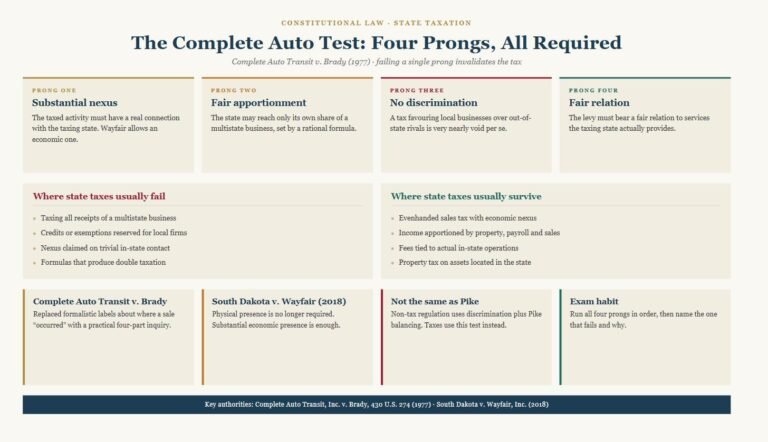 The Complete Auto Test: Taxing Interstate Commerce
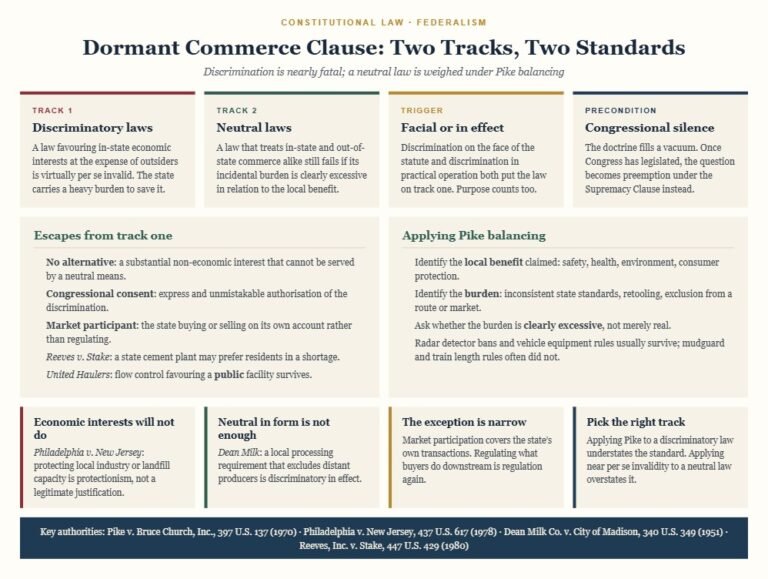 Dormant Commerce Clause: Discrimination vs Pike Balancing
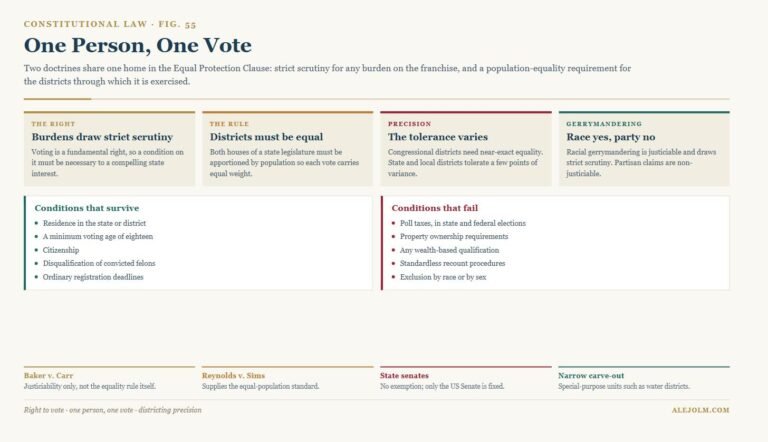 One Person, One Vote: Voting Rights Under Equal Protection
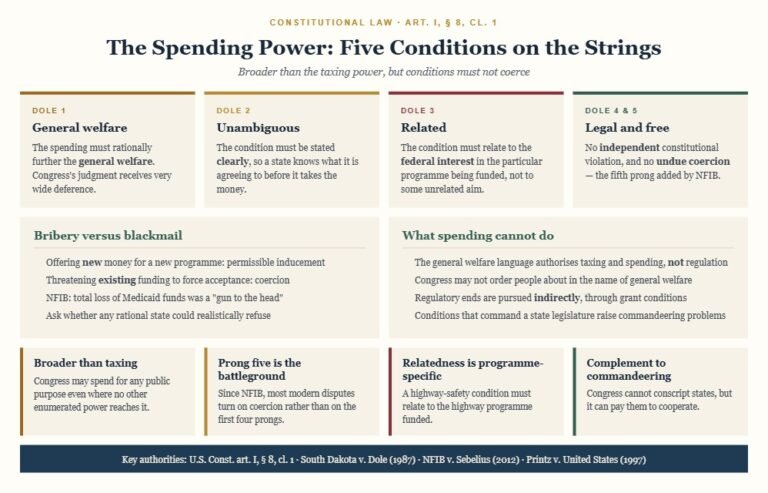 The Spending Power and the Five Dole Test Conditions
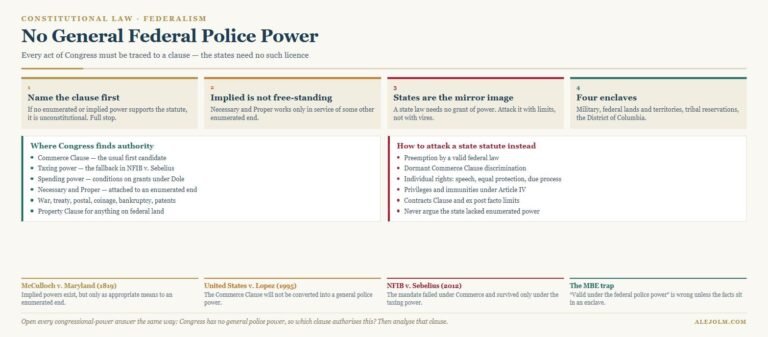 No Federal Police Power: Enumerated Powers and Enclaves
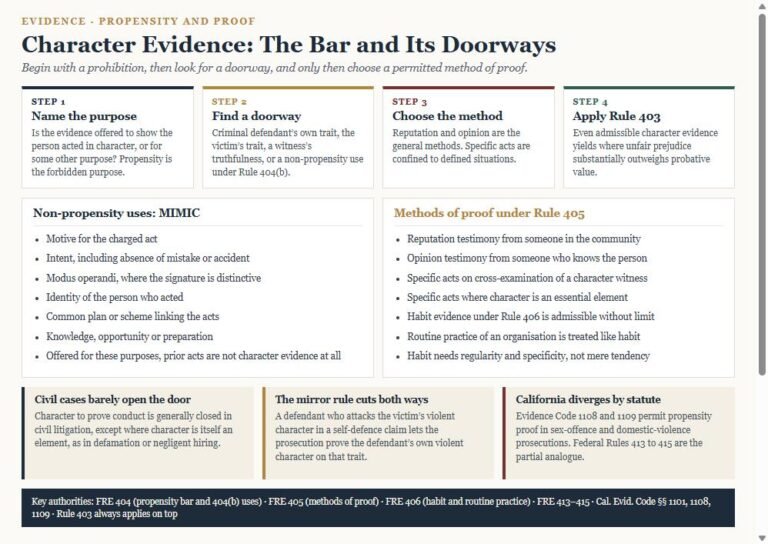 The Character Evidence Rules: Propensity Bar and Doorways
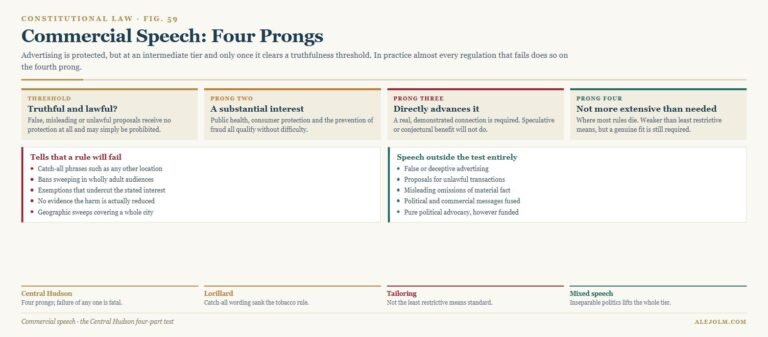 Commercial Speech and the Central Hudson Four-Part Test
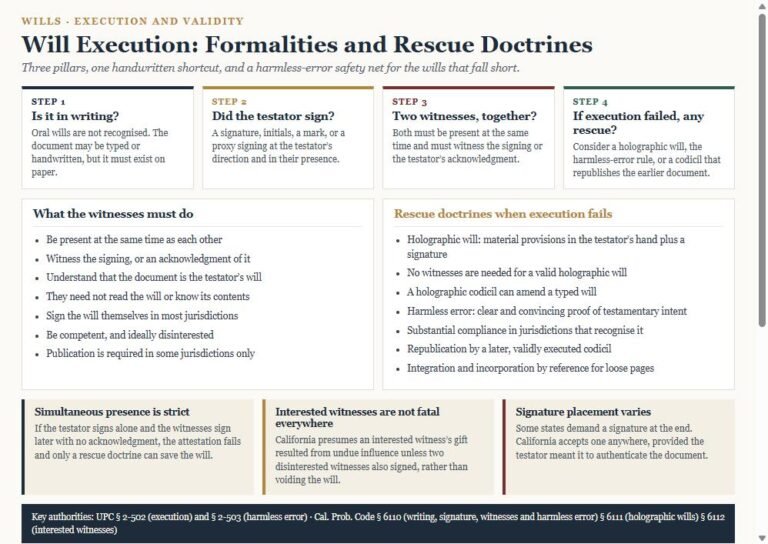 Will Execution Requirements: Formalities and Rescue
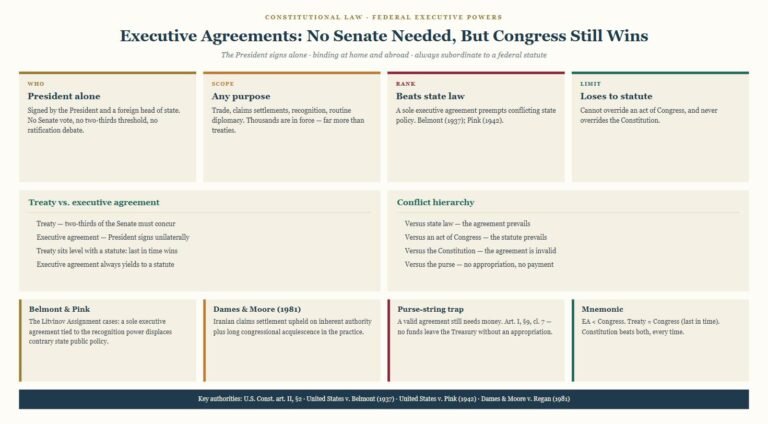 Executive Agreements: The President’s Sole Foreign Power