
Partner liability questions almost always begin with an act by one partner and end with a creditor knocking on another partner’s door. The route between the two runs through agency law, so the analysis has to establish authority before it can establish exposure, and then work out whose assets can actually be reached and in what order.
This guide follows that sequence: what counts as the ordinary course of business, how actual and apparent authority operate under the Revised Uniform Partnership Act, the scope of joint and several liability, the exhaustion rule and its exceptions, the different positions of incoming and departing partners, and partnership by estoppel.
Every partner is an agent
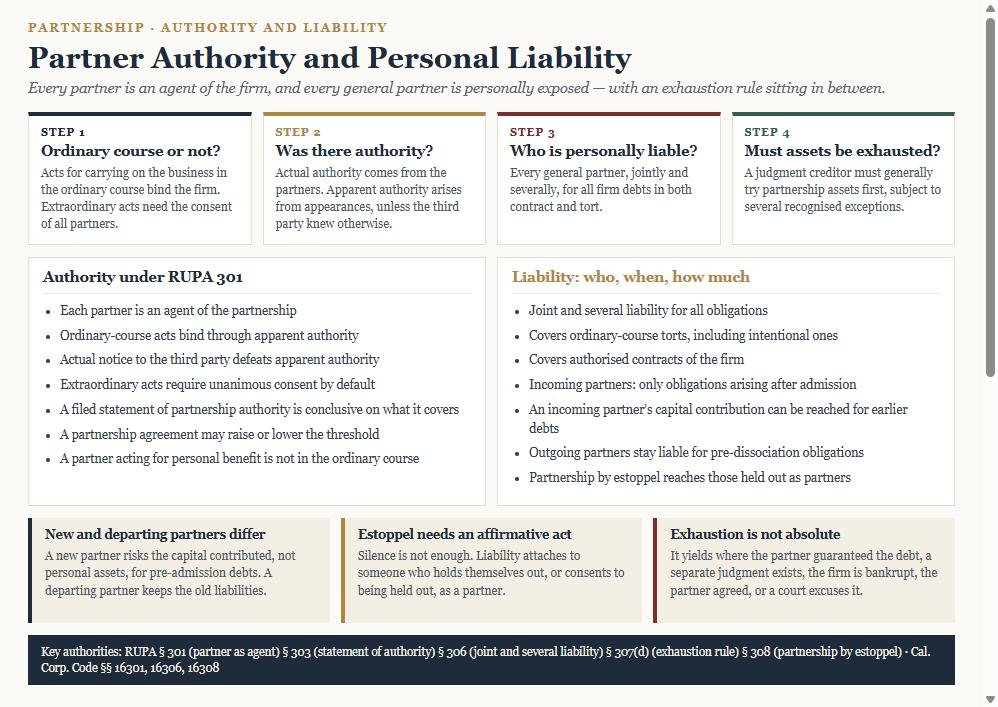
Under the Revised Uniform Partnership Act, each partner is an agent of the partnership for the purpose of carrying on its business. That single proposition drives everything else. It means the firm can be bound by a partner nobody consulted, and it means the other partners can be personally liable for a deal they never saw.
Because it is agency law, the two familiar sources of authority apply. Actual authority arises from what the partners have agreed or communicated among themselves. Apparent authority arises from how the transaction appears to the third party, and it is the more dangerous of the two.
The ordinary course test
An act for carrying on the partnership business in the ordinary course binds the firm through apparent authority, unless the third party knew or had been notified that the partner lacked authority. An act outside the ordinary course requires the consent of all the partners, or whatever threshold the partnership agreement sets.
So the first question in any fact pattern is which side of that line the transaction falls on. Buying inventory for a retail firm is ordinary; mortgaging the firm’s premises or selling its entire business is not. The nature of the particular partnership matters, because what is routine for a property developer is extraordinary for a dental practice.
What defeats apparent authority
- The third party actually knew the partner lacked authority.
- The third party had received notification of the limitation.
- The act was obviously outside the ordinary course, so no reasonable person would assume authority.
- The partner was plainly acting for personal benefit rather than for the firm.
- A statement of partnership authority filed with the state covers the matter, in which case the filing is conclusive on what it addresses.
The filed statement deserves attention because it is one of the few places where a public record does decisive work in this subject. Where it grants or restricts authority over the transaction in question, the parties are bound by what it says regardless of appearances.
Joint and several personal liability
Every general partner is personally liable, jointly and severally, for all obligations of the partnership. That covers authorised contracts and it covers torts committed by partners in the ordinary course of the firm’s business, including intentional torts arising out of partnership work. There is no limited liability shield in a general partnership; that is the price of the form.
Practically, this means a claimant may sue any partner for the whole obligation. Contribution among the partners then redistributes the loss according to the partnership agreement or, in its absence, the statutory default. Keep the two questions separate in an answer: liability to the outside world first, allocation among the partners second.
The exhaustion rule
A judgment creditor must generally attempt to collect from partnership assets before reaching a partner’s personal assets. The rule softens the harshness of joint and several liability by putting the firm’s property in the first line, and it is a common source of half-right answers, because candidates either forget it or treat it as absolute.
It is not absolute. Exhaustion is excused where the partner personally guaranteed the debt, where the creditor already holds a separate judgment against that partner individually, where the partnership is in bankruptcy, where the partner agreed that exhaustion would not be required, or where a court finds the requirement excessively burdensome in the circumstances.
| Status of the partner | Liable for debts arising before? | Liable for debts arising after? | Assets at risk |
|---|---|---|---|
| Continuing partner | Yes | Yes | Personal and capital |
| Incoming partner | No personal liability | Yes | Capital contribution only, for earlier debts |
| Departing partner | Yes, for pre-dissociation obligations | Generally no, subject to notice rules | Personal and capital |
| Person held out as a partner | Only where reliance is shown | Only where reliance is shown | Personal, by estoppel |
Exam tip: give the timeline its own sentence. “The obligation arose in March; the defendant joined in June” resolves the incoming-partner question immediately and shows the grader you understand that liability tracks dates, not membership.
Incoming and departing partners
A new partner is liable only for obligations that arise after admission. For obligations that predate it, the creditor may reach what the new partner contributed as capital, but not their personal assets. This is a deliberately narrow protection: the money they put in is at risk, their house is not.
A departing partner faces the opposite position. Dissociation does not erase liability for obligations that arose before it, and lingering exposure can continue for later transactions where a third party reasonably believed the partner was still a member and had no notice of the departure. Filing a statement of dissociation and notifying known creditors is how that tail is cut off.
Partnership by estoppel
Someone who is not a partner can still be liable if they hold themselves out as one, or consent to being held out, and a third party reasonably relies on that representation in dealing with the business. The doctrine protects creditors who extended credit on the strength of a name.
Two limits matter. Mere silence is not enough: liability requires an affirmative holding out or consent to it, so a person whom others describe as a partner without their participation is not caught. And because the doctrine rests on reliance, it does not readily extend to tort claimants who never relied on the firm’s existence when they were injured.
Fiduciary duties among partners
Partners owe each other duties of loyalty and care. The loyalty duty prohibits competing with the partnership, appropriating a partnership opportunity, and self-dealing without consent, and the prohibition on competing is absolute while the partnership continues. A partner planning to leave may prepare to compete but may not begin doing so until dissolution or dissociation.
Common mistakes that cost points
- Reaching liability before establishing that the act was within the ordinary course.
- Treating actual authority as necessary when apparent authority suffices.
- Ignoring a filed statement of partnership authority, which is conclusive on what it covers.
- Forgetting the exhaustion rule, or applying it as though it had no exceptions.
- Giving an incoming partner full retrospective liability, or none at all.
- Assuming dissociation ends a departing partner’s exposure automatically.
- Finding partnership by estoppel from silence rather than from an affirmative holding out.
- Confusing liability to third parties with contribution among the partners.
Frequently asked questions
Does a partnership need a written agreement to exist?
No. A general partnership arises from an association of two or more persons carrying on a business as co-owners for profit, whatever they call it and whether or not anything is signed. Sharing profits is strong evidence, though payments characterised as wages, rent or interest on a loan do not by themselves create a partnership.
Can the partnership agreement limit liability to outsiders?
It can allocate loss among the partners, but it cannot bind a creditor who is not a party to it. To limit exposure to third parties the participants must use a different form, such as a limited partnership, a limited liability partnership or a limited liability company.
Is a partner liable for another partner’s intentional tort?
Where the wrongful act was committed in the ordinary course of the partnership business, yes. A purely personal wrong unconnected with the firm’s work falls outside, so identify what the partner was doing when the tort occurred rather than simply labelling the tort.
Partnership liability in California: entity choice in 2026
California enacted the revised uniform partnership act in 1994, and the liability rules are found in the California Corporations Code. Partners in a general partnership are jointly and severally liable for all partnership obligations, but California adds an exhaustion requirement: a judgment creditor may not levy on a partner’s personal assets unless a judgment has also been obtained against the partner and partnership assets are insufficient or subject to other obstacles.
Two California restrictions on entity choice are unusual and catch out businesses formed elsewhere. Limited liability partnerships are available in California only to a narrow set of licensed professions, principally lawyers, accountants, architects, engineers and land surveyors. And California does not permit a limited liability company to render professional services requiring a licence, which is why medical and legal practices in Los Angeles County are organised as professional corporations or partnerships rather than as LLCs.
The practical points:
- Default is a general partnership. Two people carrying on a business for profit create one without any filing, and with it unlimited personal liability.
- Limited partners lose protection by managing. Participation in control can expose a limited partner, though the modern act narrows this considerably.
- Incoming partners are shielded for prior obligations. A new partner is not personally liable for debts incurred before joining.
- Dissociation does not end exposure. A departing partner remains liable for obligations incurred while a partner, and may be bound by later transactions absent notice of dissociation.
- Fictitious name filings are county-level. A partnership operating under a trade name must file with the Los Angeles County Registrar-Recorder/County Clerk and publish.
- Fiduciary duties are statutory. Loyalty and care are codified, and the partnership agreement may limit but not eliminate them.
In 2026, confirm that the intended entity form is permitted for the profession before organising. Read with alter ego liability, the business judgment rule and conflicts of interest.
Next steps
Business associations questions frequently combine forms, so read across the entity types. The business judgment rule and fiduciary duties shows how much more protection a corporate director receives than a general partner does, and the trustee duties and the prudent investor rule sets out the strictest version of fiduciary obligation, which makes a useful comparison with the partner’s duty of loyalty. Where a partner has committed a tort in the firm’s business, the elements of negligence supplies the elements the claimant must still prove.
For practice, take a single unauthorised contract and vary who signed it, whether the third party had been told about the limitation, whether a statement of authority was on file, and when each defendant joined the firm. Then read the partnership overview at Cornell’s Legal Information Institute and the agency materials alongside it, since the authority analysis is borrowed wholesale from agency law.
Related guides
 Campaign Finance and Anonymous Speech: The Core Rules
 Full Faith and Credit: Recognising Sister-State Judgments
 Marbury v. Madison and the Power of Judicial Review
 Personal Jurisdiction: The 3-Step Bar Exam Framework
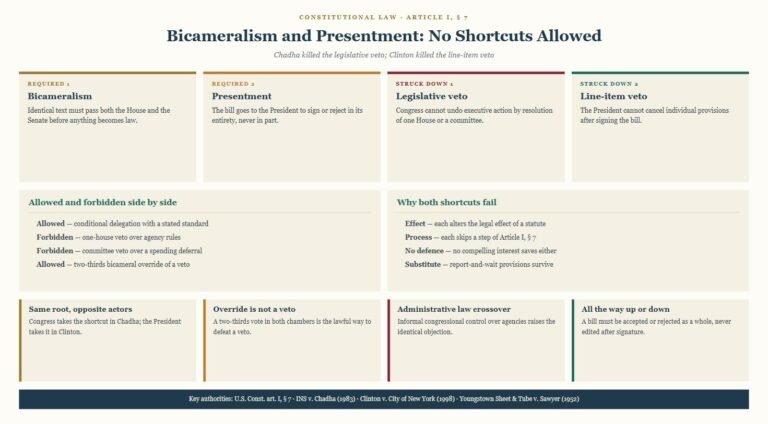 Bicameralism and Presentment: Two Vetoes Struck Down
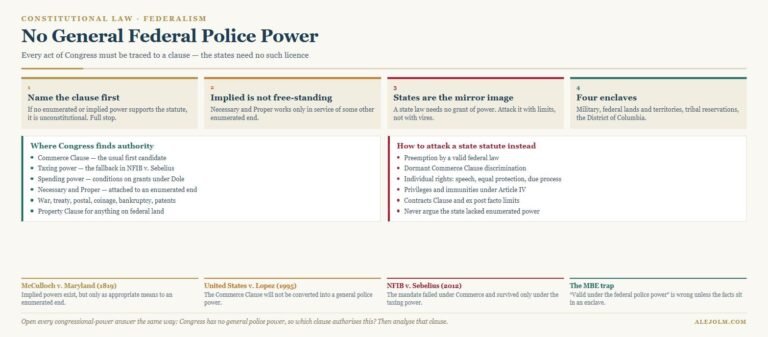 No Federal Police Power: Enumerated Powers and Enclaves
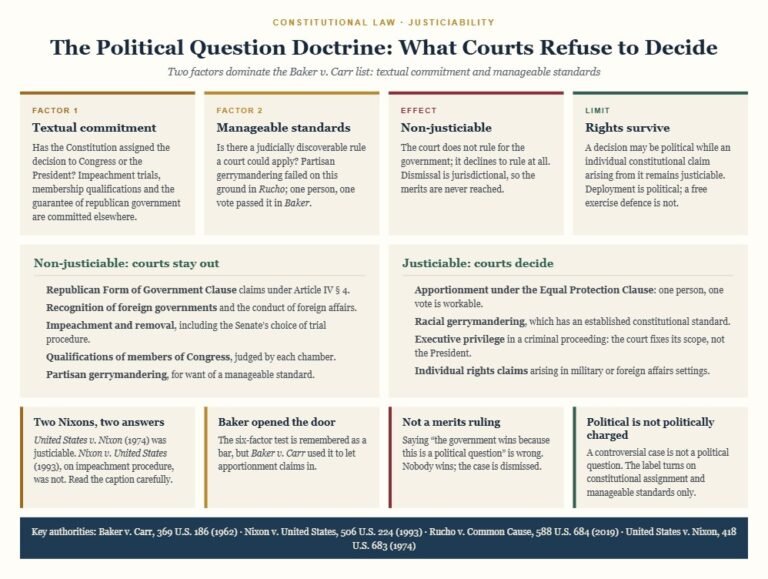 Political Question Doctrine: What Courts Will Not Decide
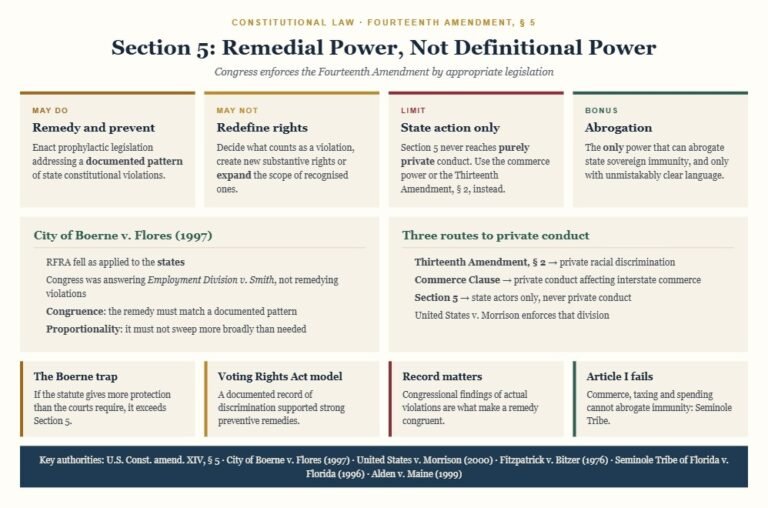 Section 5 Enforcement Power: Remedy, Do Not Redefine
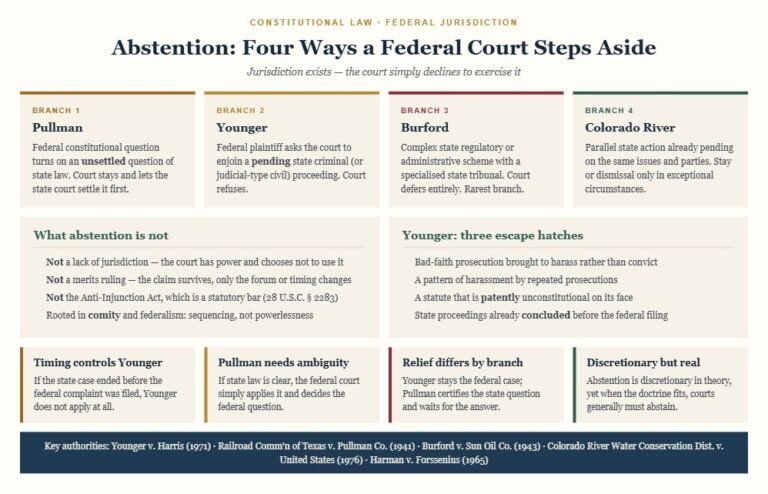 Abstention Doctrine: 4 Ways Federal Courts Step Aside
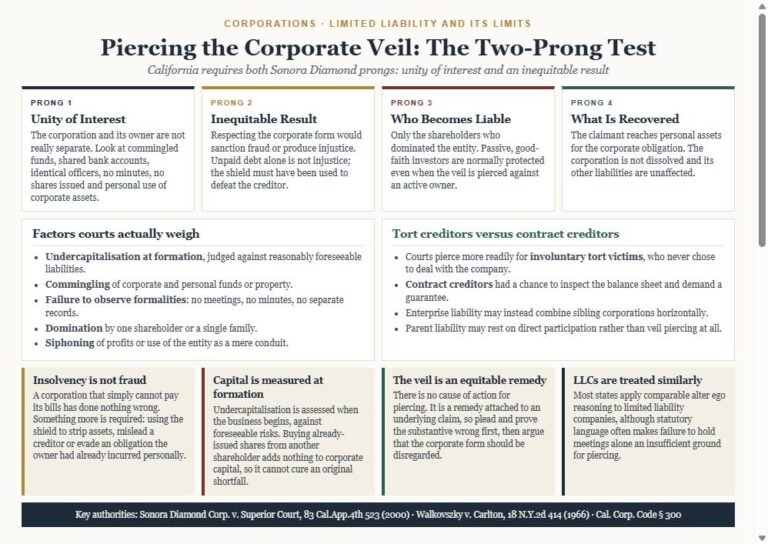 Piercing the Corporate Veil: A Two-Prong Alter Ego Test
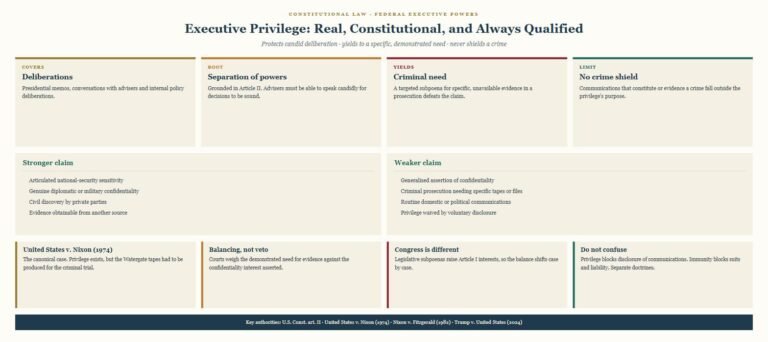 Executive Privilege: A Qualified Right That Must Yield
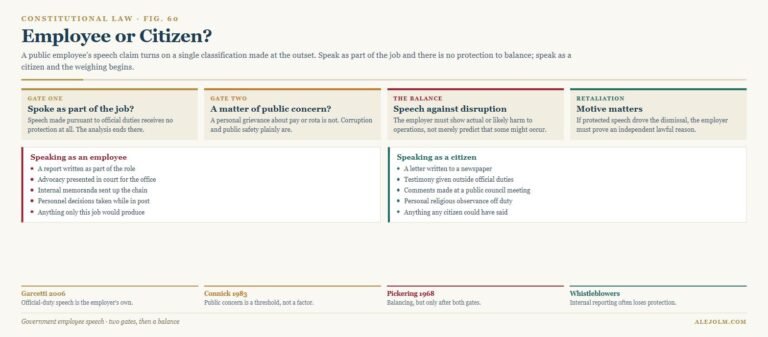 Government Employee Speech: Garcetti and Pickering Rules