
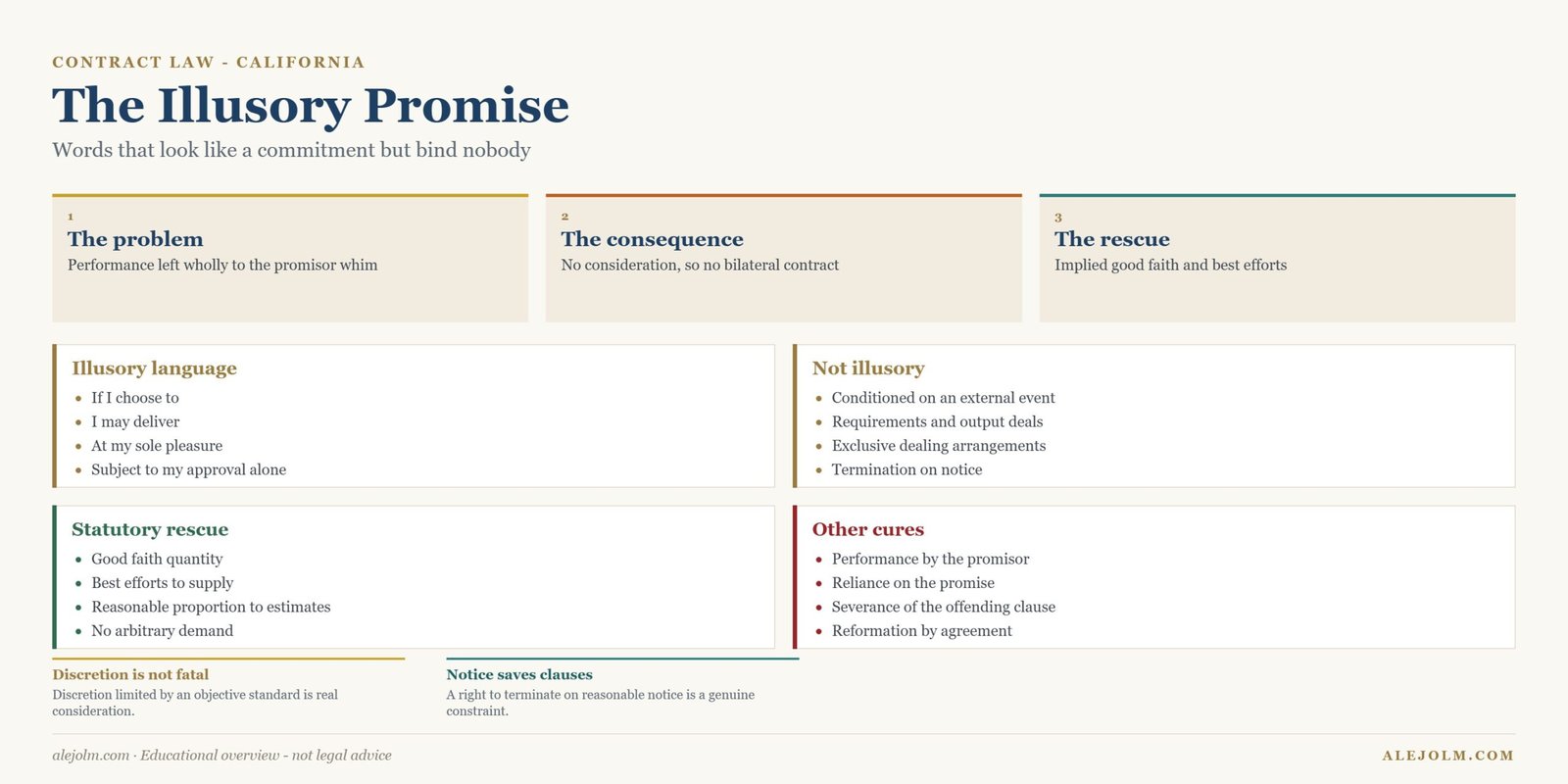
An illusory promise is a form of words that appears to commit the speaker to something while leaving performance entirely to their own will. Because the promisor gives up nothing, there is no legal detriment, no consideration and, in a bilateral agreement, no contract. The classic example is a promise to buy such quantities as the buyer may feel like ordering.
California resolves most of these problems by finding an implied constraint rather than by striking the deal down. Requirements and output arrangements, exclusive dealing appointments and termination clauses all survive because the Commercial Code and the common law read in obligations of good faith and reasonable effort. This guide explains where the line falls and how to draft on the right side of it.
Why an illusory promise fails
Consideration requires a bargained for exchange in which each side gives up something it was otherwise free to keep. A promise that reserves complete discretion gives up nothing. The promisor may perform, or may not, and no court could ever say that a failure to perform was a breach. Mutuality of obligation is missing, and a bilateral contract cannot rest on it.
Conditional is not the same as illusory
A promise tied to an external event is perfectly good consideration. An obligation to buy if the harvest exceeds a stated tonnage, or to pay if an index rises, constrains the promisor even though performance is uncertain. What matters is whether the trigger lies outside the promisor unfettered choice.
The commercial rescues
Three familiar commercial structures look illusory at first glance and are not.
- Requirements contracts. A buyer who agrees to take all it needs cannot arbitrarily decide it needs nothing; the quantity must reflect genuine good faith needs.
- Output contracts. A seller who agrees to supply everything it produces must produce in good faith and cannot simply stop.
- Exclusive dealing. The party granted exclusivity owes an implied obligation to use best efforts to exploit the right.
- Estimates and history. Quantities must bear a reasonable relationship to any stated estimate or to prior comparable dealings.
- Termination clauses. A right to end the contract on reasonable notice is a real limitation and not illusory.
- Satisfaction clauses. Approval judged by a reasonable commercial standard constrains the promisor sufficiently.
| Clause | Illusory | Why |
|---|---|---|
| I will buy if I wish | Yes | Unfettered discretion |
| I will buy all I require | No | Good faith constrains the quantity |
| I may cancel at any moment | Often yes | No constraint at all |
| I may cancel on thirty days notice | No | Notice is a genuine obligation |
| I will approve if satisfied, acting reasonably | No | Objective standard applies |
A worked example
A restaurant group in Los Angeles agrees to buy all the bread it requires for its outlets from a single bakery at a fixed price for a year. When flour prices fall the group tries to argue that it never promised anything, since it could always decide that it required no bread at all. The argument fails. The implied duty of good faith means the group must order in line with its genuine operating needs, and that duty is the consideration.
Change the wording. Suppose the agreement instead said that the group would order such quantities as it might in its absolute discretion determine, and expressly excluded any obligation of good faith. Now there is nothing holding the group to anything, the promise is illusory, and the bakery has no bilateral contract to enforce, although it may still be paid for deliveries actually accepted.
Illusory promises in California and Los Angeles County in 2026
The doctrine surfaces most often in California in two settings. The first is employment and arbitration: an employer that reserves the right to amend or revoke a dispute resolution policy at any time, without notice and with retroactive effect, risks having the whole promise treated as illusory. The second is distribution and franchising, where exclusivity is granted without any express performance obligation.
California courts have been notably willing to strike down employer promises that can be withdrawn unilaterally, and equally willing to imply best efforts where a distributor has been given an exclusive territory. Careful drafting in each case is a matter of adding a modest constraint rather than removing the discretion altogether.
- Give notice rights, not naked cancellation. Thirty days is usually enough to cure the problem.
- Say that amendments apply prospectively. Retroactive amendment powers attract the illusory label.
- State a minimum or an estimate. It anchors a requirements or output obligation.
- Spell out best efforts. Do not rely on the implication if the point matters.
- Use objective satisfaction standards. Commercial reasonableness beats sole discretion.
- Check mutuality in arbitration clauses. One sided provisions face both illusoriness and unconscionability challenges.
For 2026, confirm the current California authority on illusory promises, unilateral amendment powers and implied best efforts directly with current authority, since these continue to develop.
Common mistakes to avoid
- Assuming a requirements contract is illusory. Good faith supplies the missing constraint.
- Treating every conditional promise as illusory. External conditions are real consideration.
- Reserving unlimited amendment rights. It undermines the very promise being made.
- Ignoring implied terms. Courts often read in what the drafter left out.
- Forgetting that performance cures. A promisor who actually performs can create an enforceable arrangement.
- Overlooking reliance. A promise that fails for consideration may still be enforced on estoppel grounds.
Frequently asked questions
Is a requirements contract enforceable in California?
Yes. The Commercial Code implies a good faith standard, so the buyer cannot arbitrarily order nothing and the promise is supported by consideration.
Does a right to cancel make a contract illusory?
Only if the right is entirely unconstrained. A requirement of reasonable notice, or a limit on the grounds for cancellation, is enough to preserve the bargain.
What happens if only one side made an illusory promise?
A bilateral contract cannot form, because mutuality is missing. If the party who gave the illusory promise then performs, an enforceable arrangement can arise at that point.
Can an employer change a policy at will?
A power to amend without notice and with retroactive effect is likely to render the underlying promise illusory. Prospective amendment on notice is far safer.
Is best efforts implied in an exclusive distribution agreement?
Generally yes. The party granted exclusivity is expected to use reasonable efforts to exploit it, which supplies the consideration the express words omitted.
Related guides
- Consideration in contract law
- Good faith and fair dealing
- Contract formation in California
- Unconscionability
- Promissory estoppel
- Conditions precedent
- Modification of a contract
- Employment at will and fixed terms
Next steps
If a clause in your agreement gives one side complete freedom, decide whether that freedom is worth the risk of losing the contract altogether. Our guides to consideration and good faith and fair dealing explain what a court will imply if you do not say it.
For primary sources, read California Commercial Code section 2306 and the civil jury instructions published by the Judicial Council of California.