
A condition precedent is an event that must occur before a party becomes obliged to perform. California defines it in the Civil Code as a condition that is to be performed before some right dependent on it accrues or some act dependent on it is performed. If the condition never occurs, the duty simply never arises, and nobody has broken the contract.
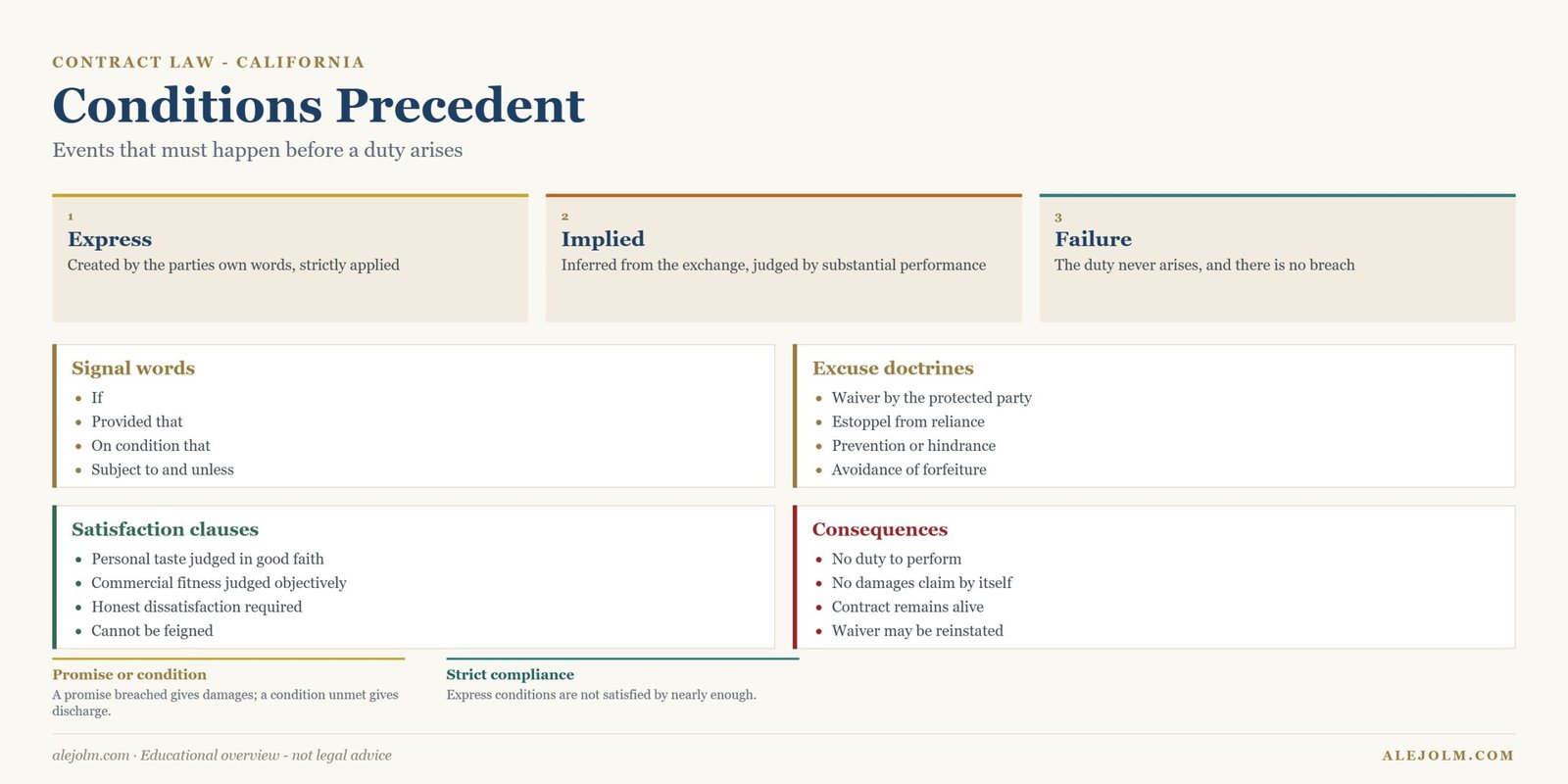
That is the doctrine defining feature and its most misunderstood one. A promise that goes unperformed is a breach and generates damages. A condition that goes unsatisfied produces discharge instead. This guide explains how to tell one from the other, why express conditions demand exact compliance, when a condition is excused, and how California treats satisfaction clauses.
Promise or condition?
Read the language. Words such as if, provided that, on condition that, subject to and unless point towards a condition. Words of undertaking such as agrees to, shall and will point towards a promise. The same event can be both, in which case failure produces discharge and a damages claim together.
Express and implied conditions
An express condition is created by the parties own words and demands strict compliance. Nearly satisfying it is not satisfying it. An implied or constructive condition is inferred from the structure of the exchange, such as the expectation that services are rendered before payment falls due, and is judged by the more forgiving standard of substantial performance.
When a condition is excused
- Waiver. The party the condition protects may give up the benefit of it, expressly or by conduct.
- Estoppel. Conduct that induces reliance on the condition being dispensed with may prevent it being asserted.
- Prevention. A party that wrongfully hinders the occurrence of the condition cannot rely on its failure.
- Avoidance of forfeiture. Where strict enforcement would cause disproportionate loss, the condition may be excused.
- Impossibility. Where the condition cannot occur through no fault of either party.
- Reinstatement. A waiver may be withdrawn for future performance unless the other side has already relied.
Satisfaction clauses
Clauses making performance conditional on one party being satisfied are common in construction, sale and services agreements. California distinguishes two situations. Where the subject matter involves personal taste or judgement, the test is honest and good faith dissatisfaction. Where it involves commercial utility, mechanical fitness or operative fitness, the test is objective and the dissatisfaction must be reasonable.
| Type | Standard of compliance | Effect of failure |
|---|---|---|
| Express condition | Strict | Duty never arises |
| Implied condition | Substantial performance | Duty may still arise |
| Promise | Substantial performance | Damages for breach |
| Satisfaction clause, taste | Good faith | Duty never arises |
| Satisfaction clause, utility | Reasonableness | Duty may still arise |
A worked example
A purchase agreement for a warehouse in Vernon makes the buyer obligation to close subject to obtaining finance at a stated maximum interest rate within sixty days. The best offer the buyer can secure is above that rate. The condition has failed, the duty to close never arose, and the buyer refusal to complete is not a breach.
Change the conduct. Suppose the seller had refused to allow the lender valuer onto the property, making it impossible to obtain the offer in time. The seller has prevented the condition from occurring and cannot rely on its failure, so the buyer position is preserved despite the missed deadline.
Conditions precedent in California and Los Angeles County in 2026
Residential and commercial property transactions in Los Angeles County run on conditions: finance, appraisal, inspection, title and, in commercial cases, permits and entitlements. Each is drafted as a condition precedent to closing with a stated deadline, and the removal of contingencies is the pivotal moment in the deal. A buyer who removes a contingency loses the protection it gave.
Construction and development agreements add permitting and approval conditions where the prevention doctrine matters most, because one party often controls the process on which the other depends. A party that must apply for an approval generally owes an implied obligation to use reasonable efforts to obtain it.
- Use condition language deliberately. Subject to and provided that carry consequences.
- State the deadline and the standard. Vague conditions invite disputes about satisfaction.
- Do not hinder the other side. Prevention excuses the condition entirely.
- Use reasonable efforts wording. It clarifies what the applying party must do.
- Confirm waivers in writing. Oral waivers create uncertainty about reinstatement.
- Watch forfeiture. Courts will excuse a condition rather than allow a disproportionate loss.
For 2026, confirm the current California authority on conditions, waiver, prevention and satisfaction clauses directly with current authority, since these continue to develop.
Common mistakes to avoid
- Treating a failed condition as a breach. Failure discharges the duty; it does not create damages by itself.
- Applying substantial performance to an express condition. Strict compliance is required.
- Assuming a waiver is permanent. It may be reinstated for future performance absent reliance.
- Relying on your own obstruction. Prevention removes the protection of the condition.
- Treating satisfaction as absolute discretion. Good faith or reasonableness always applies.
- Missing dual character. A term can be both a promise and a condition.
Frequently asked questions
What is a condition precedent in California?
An event that must occur before a right accrues or an act becomes due. Until it occurs the conditioned duty does not exist.
Does failure of a condition mean someone has breached?
Not by itself. The conditioned duty is discharged. A damages claim arises only if the same term was also a promise or if a party wrongfully prevented the condition.
Can a condition be waived?
Yes, by the party it protects. The waiver may be express or inferred from conduct, and may be withdrawn for future performance unless the other side has relied.
How are satisfaction clauses tested?
Where personal taste is involved the test is honest good faith dissatisfaction. Where commercial or mechanical fitness is involved the test is objective reasonableness.
What is the prevention doctrine?
A party that wrongfully hinders or prevents the occurrence of a condition cannot rely on its failure to escape performance.
Related guides
- Conditions subsequent
- Material breach
- Substantial performance
- Good faith and fair dealing
- Anticipatory repudiation
- Illusory promises
- Remedies for breach of contract
- Contract formation in California
Next steps
When drafting or reviewing a contingency, decide whether you want discharge or damages if it fails, and write it accordingly. Our guides to conditions subsequent and substantial performance explain the alternatives.
For primary sources, read California Civil Code section 1436 and the civil jury instructions published by the Judicial Council of California.