
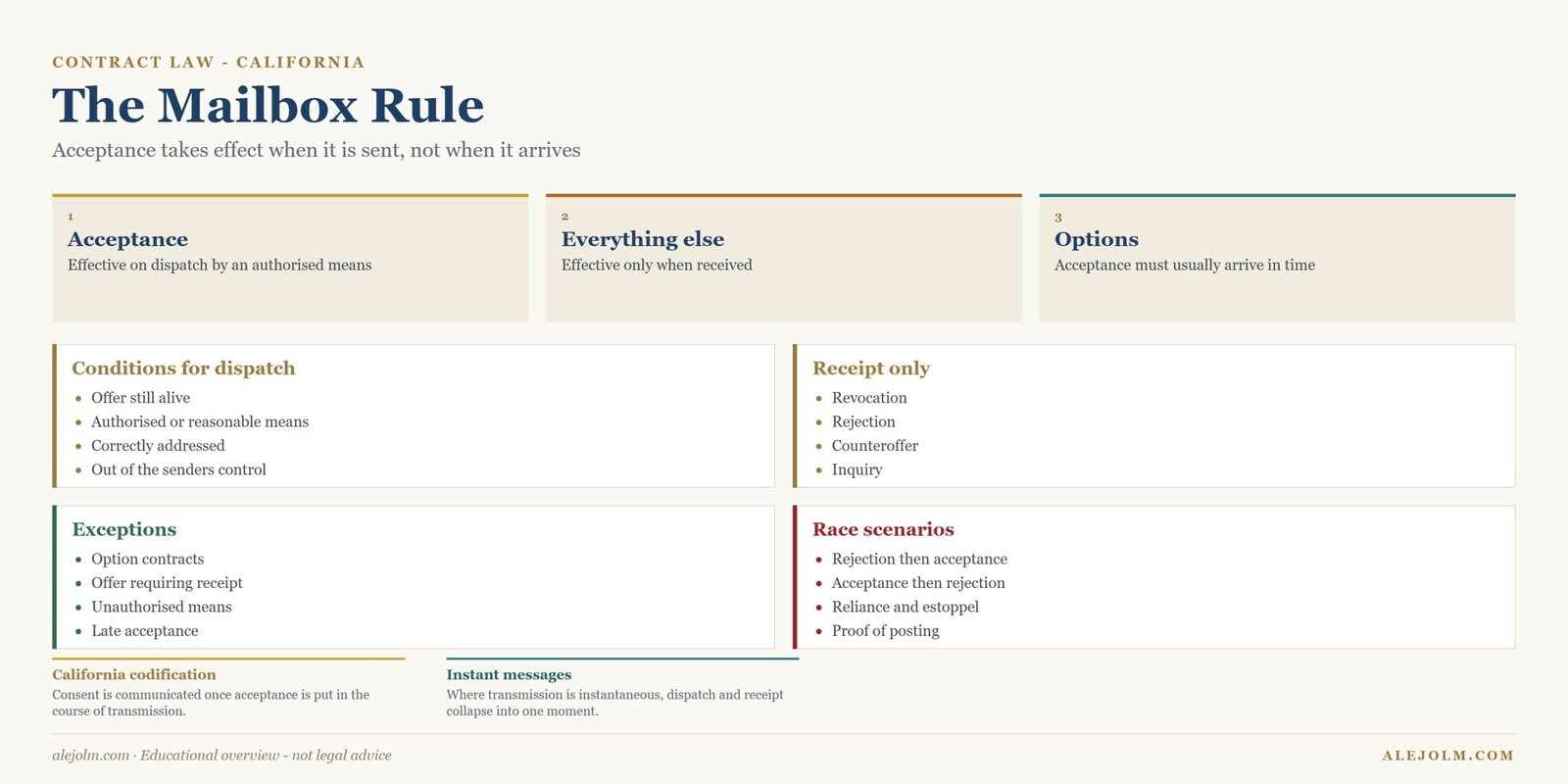
The mailbox rule holds that an acceptance takes effect the moment it leaves the offeree control, not when it lands on the offeror desk. California has codified the principle in the Civil Code, which deems consent fully communicated as soon as the accepting party has put the acceptance into the course of transmission by a proper means.
The rule protects the offeree. Once the letter is posted the deal is done, and a withdrawal that arrives afterwards changes nothing. Every other communication in the formation sequence works the opposite way and takes effect only on receipt. This guide explains the conditions, the exceptions, the awkward races that arise when two messages cross, and what the rule means when everything happens by email.
What the rule actually says
Three conditions must be satisfied. The offer must still be open at the moment of dispatch. The offeree must use a means of communication that the offer authorised or that is reasonable in the circumstances. And the acceptance must genuinely leave the offeree control, properly addressed and correctly directed.
When those conditions are met, delay, loss or misdelivery is the offeror problem. A contract exists from the moment of posting even if the letter never arrives, which is why an offeree who relies on the rule should keep proof of dispatch.
Why only acceptance gets this treatment
The asymmetry is deliberate. An offeror controls the terms and can require receipt if it wishes. An offeree has no such control and would otherwise be exposed to a withdrawal sent after it had committed. Revocation, rejection, counteroffers and inquiries therefore all take effect only when they arrive.
The exceptions
- Option contracts. Acceptance of a paid option generally must be received within the option period.
- Offers requiring receipt. An offeror may state that acceptance is effective only on arrival.
- Unauthorised means. Using a channel the offer excluded may push effectiveness to receipt or defeat it.
- Late acceptance. Dispatch after the offer has ended is a new offer, not an acceptance.
- Misaddressed messages. A carelessly directed acceptance may not qualify as properly dispatched.
- Instantaneous communication. Where transmission is immediate, the distinction largely disappears.
| Sequence | Effective date of acceptance | Result |
|---|---|---|
| Acceptance posted, no other message | On posting | Contract |
| Acceptance posted, revocation arrives later | On posting | Contract |
| Revocation received, acceptance posted after | Never | No contract |
| Rejection posted, acceptance posted later | Whichever arrives first | Depends on delivery |
| Acceptance posted, rejection posted later | On posting | Contract, subject to estoppel |
A worked example
A seller in Inglewood offers equipment to a buyer, the offer to remain open until Friday. The buyer posts an acceptance on Wednesday afternoon. On Thursday the seller sends a withdrawal, which the buyer receives Thursday morning, and the acceptance arrives Friday. A contract exists. The acceptance was effective on Wednesday, before the withdrawal took effect on receipt, and the later arrival is irrelevant.
Change the instrument. Suppose the buyer had paid for an option that required acceptance to be received by Friday at five. The dispatch rule does not apply to options, so the buyer must ensure delivery in time. Posting on Wednesday would still work, but only because the letter in fact arrived on Friday, not because it was sent.
The mailbox rule in California and Los Angeles County in 2026
Most commercial dealing in Los Angeles County now happens by email or through contract platforms, where transmission is effectively instantaneous and the gap between sending and receiving is measured in seconds. The rule still matters at the margins: a message caught in a spam filter, a portal that queues submissions overnight, or a counterparty who claims never to have seen the acceptance.
The safest practice is to remove the question entirely. Offers can state that acceptance is effective only on actual receipt, and acceptances can be sent by a method that generates a delivery record. Where a deadline is genuinely tight, a telephone call confirming that the acceptance has been sent costs nothing.
- Keep proof of dispatch. Postal receipts and sent items decide close cases.
- Use the channel the offer names. Departing from it can cost the protection.
- Specify receipt if you are the offeror. A single sentence overrides the default.
- Do not rely on dispatch for options. Arrival within the period is what counts.
- Watch automated delays. Portals and filters can separate sending from receipt.
- Confirm by a second channel. A short call removes the argument entirely.
For 2026, confirm the current California authority on communication of consent and electronic delivery directly with current authority, since these continue to develop.
Common mistakes to avoid
- Applying dispatch to a withdrawal. Only acceptance benefits from the rule.
- Using it for an option. Options generally require receipt within the period.
- Ignoring the authorised means requirement. An excluded channel may defeat the protection.
- Forgetting the offer must still be alive. Dispatch after termination accepts nothing.
- Assuming a lost letter defeats the contract. It does not, if dispatch was proper.
- Neglecting estoppel. An offeror who reasonably acts on an apparent rejection may be protected.
Frequently asked questions
Does the mailbox rule apply to email?
The principle applies, but transmission is usually so fast that dispatch and receipt occur together. It matters mainly when delivery is delayed or blocked.
What if the acceptance is lost in the post?
A properly dispatched acceptance is still effective. The risk of loss sits with the offeror, which is why proof of posting is worth keeping.
Can an offeror switch off the rule?
Yes. An offer may state that acceptance takes effect only when actually received, and that wording will be given effect.
I posted a rejection and then changed my mind. Am I bound?
It depends on arrival. If your acceptance reaches the offeror before your rejection does, a contract can form, subject to any reliance the offeror has already placed on the rejection.
Does the rule apply to option contracts?
Generally no. Acceptance of an option usually has to be received within the option period rather than merely sent.
Related guides
- Acceptance in contract law
- What counts as an offer
- Revocation and rejection
- The firm offer rule
- The mirror image rule
- The battle of the forms
- Contract formation in California
- Unilateral and bilateral contracts
Next steps
When a deadline is close, decide in advance which rule you are relying on and document the send. Our guides to acceptance and revocation and rejection set out how the other communications in the sequence behave.
For primary sources, read California Civil Code section 1583 and the civil jury instructions published by the Judicial Council of California.