

Every contract in California carries an implied covenant of good faith and fair dealing. Neither party may do anything that would deprive the other of the benefit of the agreement. The Commercial Code states the obligation expressly for transactions it governs, defining good faith as honesty in fact together with the observance of reasonable commercial standards of fair dealing.
The covenant is powerful but bounded. It polices how contractual powers are exercised; it does not invent obligations the parties never accepted, and it cannot be used to override an express term. This guide explains what the covenant requires, where it bites hardest, why insurance cases are treated differently in California, and how to draft discretionary provisions that survive scrutiny.
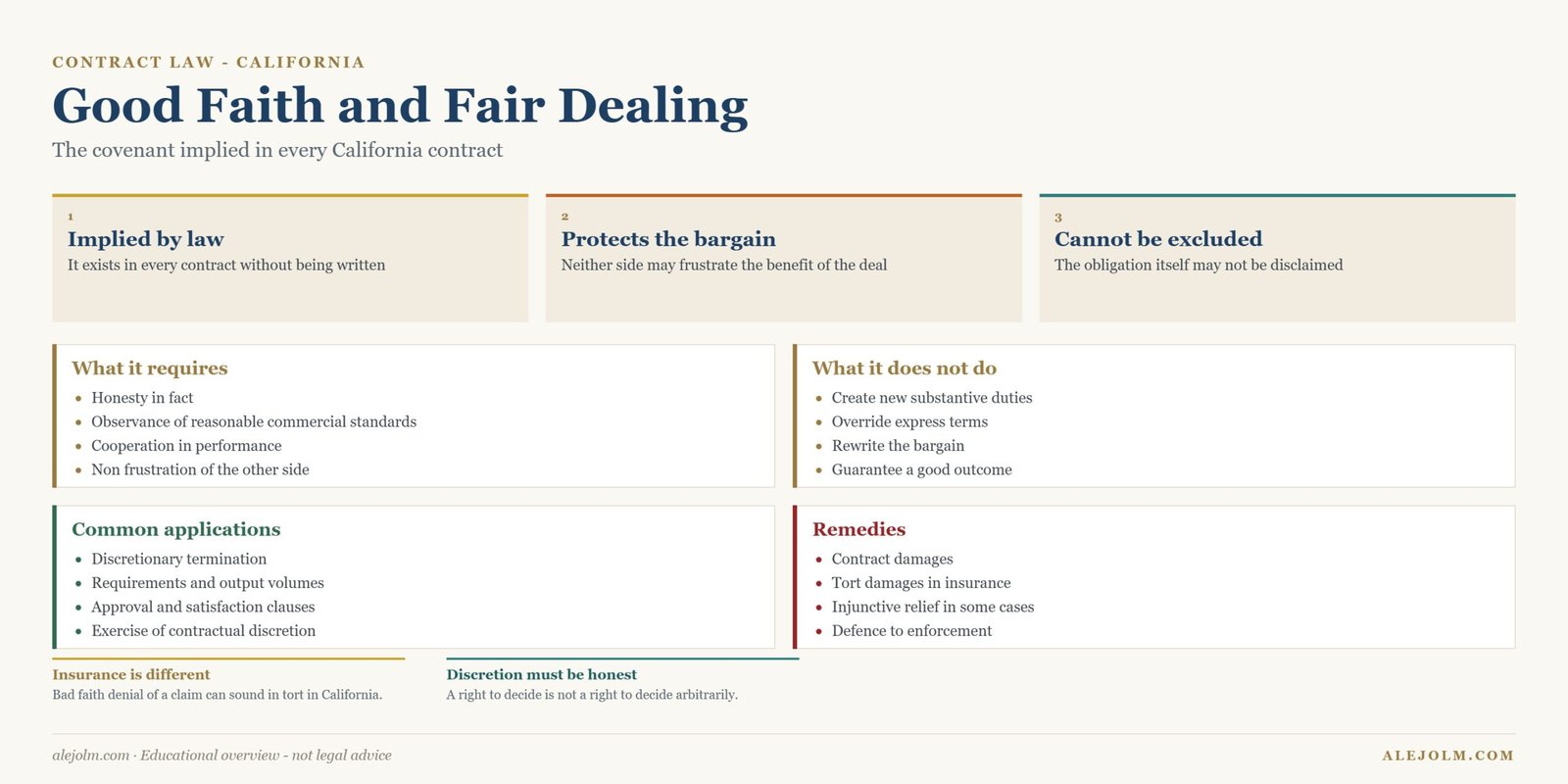
What the covenant requires
The covenant obliges each party to refrain from conduct that would frustrate the other right to receive the fruits of the contract. In practice that means exercising discretion honestly and for its intended purpose, cooperating where cooperation is necessary for performance, and not manufacturing an excuse for non performance.
What the covenant does not do
California courts are clear that the covenant cannot impose substantive duties or limits beyond those to which the parties actually agreed. It cannot be invoked to strike out an express provision that a party now regrets, and it does not entitle anyone to a better bargain than they made. Its role is to protect the agreement, not to improve it.
Where the covenant matters most
- Discretionary termination. A right to end a contract for convenience may not be used arbitrarily or to punish.
- Requirements and output volumes. Demand and supply must reflect genuine good faith needs, not opportunism.
- Approval and satisfaction clauses. Approval must be genuinely withheld, and in commercial contexts reasonably so.
- Consent to assignment. Consent may not be refused arbitrarily where the contract requires it.
- Price and rate adjustments. Discretion over pricing must be exercised within the reasonable expectations of the parties.
- Modification demands. A change extracted by an opportunistic threat is not made in good faith.
| Doctrine | What it addresses | When it applies |
|---|---|---|
| Good faith | Conduct during performance | Every contract |
| Unconscionability | Fairness at formation | At the time of contracting |
| Duress | A specific improper threat | Formation or modification |
| Illusory promise | Absence of any obligation | Formation |
| Material breach | Failure of performance | During performance |
A worked example
A distributor in Los Angeles supplies a retailer under an agreement terminable on notice. After three years the distributor learns that a competitor is undercutting it, demands a substantial price rise and cuts off supply when the retailer refuses. The termination right existed, but it was exercised not for any legitimate business reason connected with the agreement but to extract a better bargain, and that is a breach of the covenant.
Change the reason. Suppose the distributor terminated because the retailer had repeatedly failed to pay on time and had damaged the brand through poor storage. The same clause, exercised for a reason connected with the contract itself, is entirely proper and the covenant is not engaged.
Good faith and fair dealing in California and Los Angeles County in 2026
California is distinctive in allowing a breach of the covenant in the insurance context to sound in tort, which opens the door to consequential and in some cases punitive damages when an insurer denies a claim unreasonably. Outside insurance, the covenant ordinarily gives rise to contract damages only, and attempts to extend tort liability to ordinary commercial relationships have generally failed.
Employment and franchise relationships in Los Angeles County produce a steady flow of covenant claims, usually concerning the exercise of discretion over commissions, territories, renewals and performance targets. The critical drafting response is to tie discretion to identifiable criteria rather than leaving it at large.
- Tie discretion to criteria. A stated standard is far easier to defend than unlimited judgement.
- Record the reason. Contemporaneous documentation of a legitimate business reason is the best evidence.
- Give notice. Terminating without the notice the contract contemplates invites a covenant claim.
- Apply terms consistently. Selective enforcement suggests bad faith.
- Handle claims promptly. In insurance, delay itself can be evidence of bad faith.
- Do not disclaim the covenant. The attempt is ineffective and looks bad.
For 2026, confirm the current California authority on the implied covenant, discretionary termination and insurance bad faith directly with current authority, since these continue to develop.
Common mistakes to avoid
- Using the covenant to rewrite a term. It cannot contradict an express provision.
- Treating discretion as absolute. A contractual power must be exercised honestly and for its purpose.
- Assuming tort damages are available. Outside insurance the claim is generally contractual.
- Disclaiming the obligation. The covenant itself cannot be excluded by agreement.
- Confusing it with unconscionability. One governs performance, the other formation.
- Ignoring consistency. Enforcing a term against one party but not another suggests bad faith.
Frequently asked questions
Is the covenant part of every California contract?
Yes. It is implied by law in every contract, and for transactions governed by the Commercial Code it is stated expressly as an obligation of honesty and reasonable commercial standards.
Can a contract exclude the duty of good faith?
No. The obligation itself cannot be disclaimed, although the parties may set the standards by which performance is measured, provided those standards are not manifestly unreasonable.
Can I sue in tort for breach of the covenant?
Generally not. California confines tort recovery largely to the insurance context, where an unreasonable denial or delay in paying a claim can support tort damages.
Does the covenant stop a party from terminating a contract?
It does not remove a termination right, but it prevents that right being used arbitrarily or for a purpose unconnected with the agreement.
What is the difference between good faith and unconscionability?
Good faith governs how the parties behave while performing. Unconscionability looks at whether the bargain was fair when it was made.
Related guides
- Illusory promises
- Modification of a contract
- Unconscionability
- Material breach
- Conditions precedent
- Employment at will and fixed terms
- Duress and undue influence
- Remedies for breach of contract
Next steps
If your agreement gives one side discretion over price, volume, approval or termination, check whether the criteria for exercising it are written down. Our guides to illusory promises and material breach explain the neighbouring problems.
For primary sources, read California Commercial Code section 1304 and the civil jury instructions published by the Judicial Council of California.