
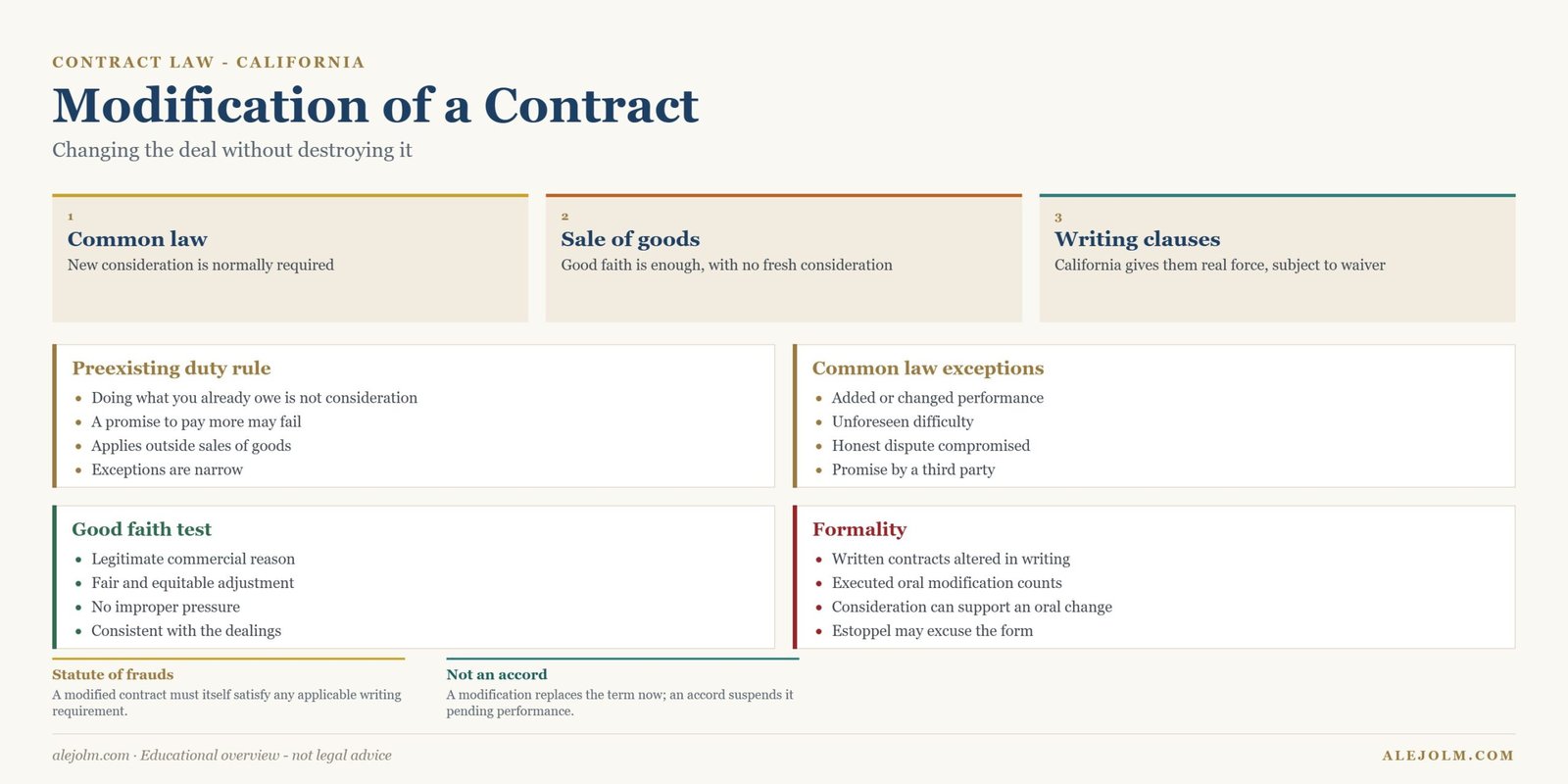
A contract modification is an agreement to change the terms of a deal that already exists. It substitutes the new term immediately, which distinguishes it from an accord that merely suspends the old obligation until the substitute performance is rendered. Most disputes about modification are really disputes about whether anything was given in exchange for the change.
California approaches the question along two tracks. Outside the sale of goods, the preexisting duty rule means that a promise to do what you were already bound to do buys nothing, and the Civil Code adds its own rules about when a written contract can be altered orally. For goods, the Commercial Code abandons the consideration requirement altogether and asks only whether the change was made in good faith.
The preexisting duty rule
If a builder is already contractually bound to complete a house for a fixed sum, a later promise by the owner to pay more, given in exchange for nothing beyond the same work, is unsupported. The builder surrendered nothing, so the owner promise has no consideration behind it and the original price stands.
The four escapes
- Something new is added. Any genuine change in what one side must do supplies fresh consideration.
- Unforeseen difficulty. Where the contract is unperformed and circumstances have changed unexpectedly, a fair adjustment may be enforced.
- An honest dispute is compromised. Each side gives up a genuinely contested claim, and that surrender is consideration.
- A third party promises. Someone not already bound can make an enforceable promise to pay an existing debt.
- Mutual rescission and a fresh agreement. The parties end the old deal and make a new one.
- Reliance on the change. Estoppel may enforce a modification that consideration cannot support.
Modification of contracts for goods
The Commercial Code takes a commercial view. An agreement modifying a contract for the sale of goods needs no consideration to be binding. What it does need is good faith, which in practice means a legitimate commercial reason for the change, a fair adjustment given the circumstances, and the absence of pressure amounting to coercion.
That last requirement matters. A supplier who threatens to stop deliveries unless the price rises, knowing the buyer has no alternative source and no time to sue, may find that the resulting agreement is set aside for economic duress even though it looked consensual.
Form: oral changes to written contracts
California addresses the point directly in the Civil Code. A contract in writing may be altered by a contract in writing, or by an executed oral agreement, and not otherwise. An oral modification that has actually been carried out therefore counts, and California also recognises that an oral change supported by its own consideration can be effective. Clauses requiring modifications to be in writing are given force in sales of goods, though a course of performance may waive them.
| Question | Common law | Sale of goods |
|---|---|---|
| New consideration needed | Usually yes | No |
| Good faith required | Implied | Expressly required |
| No oral modification clause | Limited effect | Enforceable, but waivable |
| Oral change fully performed | Effective | Effective |
| Writing requirement on the new deal | Applies | Applies |
A worked example
A contractor rebuilding a commercial unit in El Segundo discovers unmapped utilities and asks for an increase. The owner agrees to keep the programme moving. Under the common law the promise is vulnerable, because the contractor was already bound to finish, unless the unforeseen difficulty exception applies. The buried services were genuinely unexpected and the adjustment is proportionate, so a court may well enforce it.
Change the subject matter. Suppose the same increase is sought by a supplier of steel sections after a tariff change. Because this is a sale of goods, no fresh consideration is needed and the only question is good faith. A documented cost increase passed through proportionately will usually pass; an opportunistic demand made when the buyer cannot switch suppliers will not.
Contract modification in California and Los Angeles County in 2026
Construction and supply agreements in Los Angeles County are modified constantly, usually through change orders that nobody analyses until a dispute arises. The single most useful discipline is to record why the change was needed and what each side gave for it, because that record answers both the consideration question and the good faith question at once.
Public works and regulated contracts add a further layer, since the authority of the person agreeing to the change may be limited by statute or by the contract itself. A modification agreed by someone without authority is not a modification at all.
- Use written change orders. They satisfy the form rules and evidence the bargain.
- State the reason for the change. A documented cause supports good faith and unforeseen difficulty.
- Give something in return. A small concession removes the consideration problem entirely.
- Check signing authority. Especially on public and institutional projects.
- Avoid pressure tactics. A modification extracted by threat is vulnerable to duress.
- Re-test the writing requirement. A price increase can bring the deal within a statute it previously escaped.
For 2026, confirm the current California authority on modification, executed oral agreements and good faith adjustments directly with current authority, since these continue to develop.
Common mistakes to avoid
- Applying the preexisting duty rule to goods. The Commercial Code abandons it.
- Assuming a no oral modification clause is worthless. In sales of goods it is enforceable.
- Relying on an unexecuted oral change. California requires the oral agreement to have been carried out.
- Ignoring the writing requirement on the new terms. The modified contract must satisfy it independently.
- Confusing modification with accord. One replaces immediately, the other suspends pending performance.
- Overlooking duress. Good faith is not satisfied by an agreement extracted under threat.
Frequently asked questions
Can a written contract be changed orally in California?
Only in limited ways. The Civil Code allows alteration by a written contract or by an oral agreement that has been executed, and an oral change supported by its own consideration may also be effective.
Do I need to pay something extra to modify a contract?
Outside the sale of goods, usually yes unless an exception applies. For goods, no consideration is required provided the change is made in good faith.
Is a change order a modification?
Generally yes. It is an agreement to alter the scope, price or programme, and it is analysed under the same rules as any other modification.
What if the other side threatened to walk away?
A modification extracted by an improper threat, where the victim had no reasonable alternative, may be voidable for economic duress even if it looks agreed.
Does a modification need to be signed by both parties?
Not always, but a signed record is by far the safest course, particularly where the original contract requires changes to be in writing.
Related guides
- Accord and satisfaction
- Novation
- Consideration in contract law
- Good faith and fair dealing
- Duress and undue influence
- The statute of frauds
- Rescission of a contract
- Contract formation in California
Next steps
Before you agree to a change, write down what each side is giving and why the change is needed. Our guides to consideration and accord and satisfaction explain how the same facts can produce very different legal effects.
For primary sources, read California Civil Code section 1698 and the civil jury instructions published by the Judicial Council of California.