
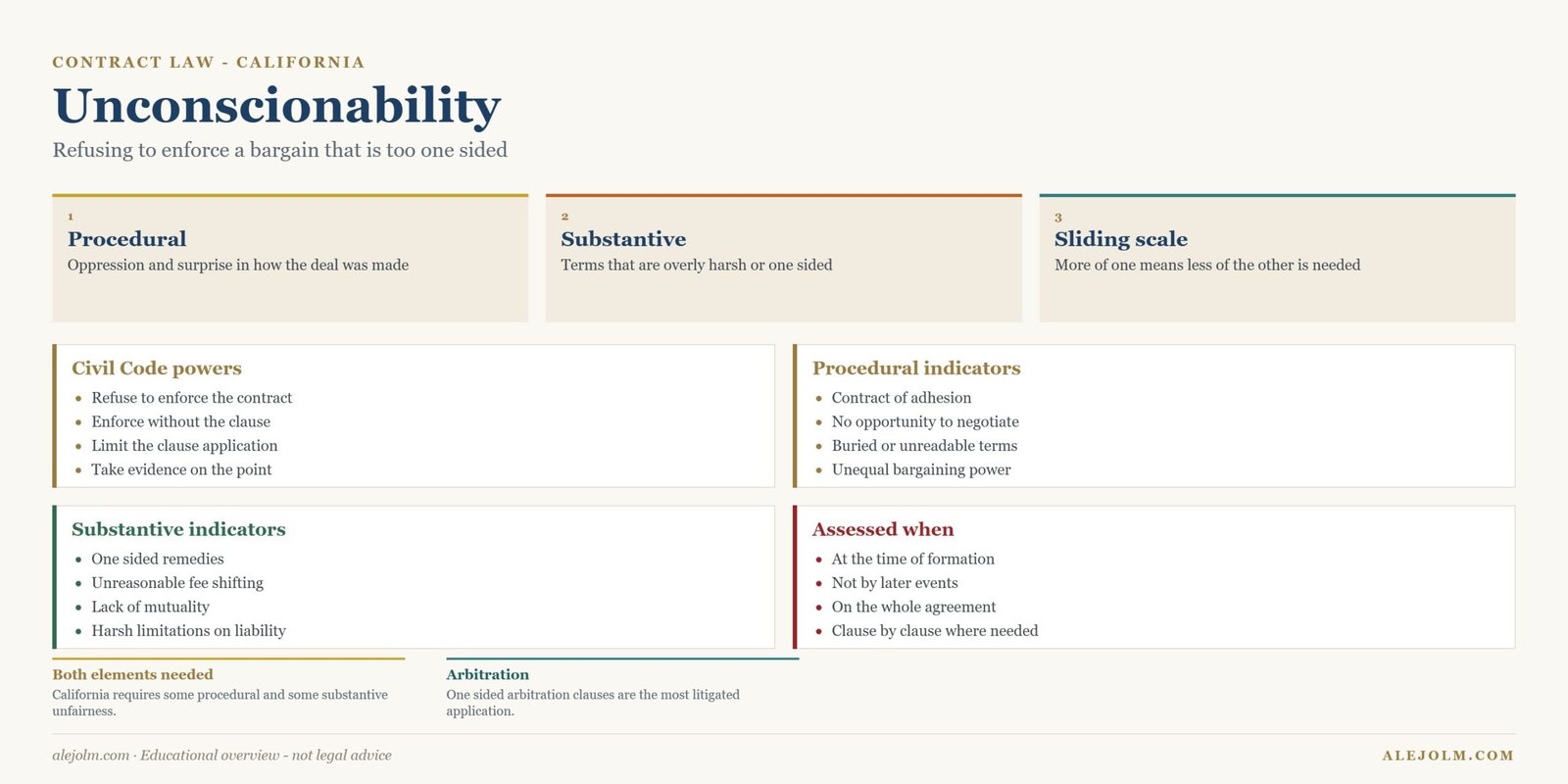
Unconscionability allows a California court to refuse to enforce a contract, or a single clause within it, that was so one sided at the time it was made that enforcement would be unjust. The Civil Code gives the court three options: refuse to enforce the agreement, enforce it without the offending clause, or limit the application of the clause to avoid an unconscionable result.
California requires both procedural and substantive unfairness, but on a sliding scale. The more oppressive or surprising the manner in which the contract was formed, the less harsh the terms need to be, and the reverse is equally true. This guide sets out both elements, the indicators courts look for, the remedies available and the arbitration cases that dominate the modern case law.
The procedural element
Procedural unconscionability concerns the circumstances of formation, and California analyses it under two headings: oppression and surprise. Oppression arises from inequality of bargaining power that leaves no real negotiation and no meaningful choice. Surprise arises where the challenged term is hidden in a prolix printed form drafted by the party seeking to enforce it.
A contract of adhesion, presented on a take it or leave it basis, supplies at least a modest degree of procedural unconscionability by itself. That alone is rarely enough, but it opens the door to the second element.
The substantive element
Substantive unconscionability concerns the terms. California asks whether the provision is overly harsh, unduly oppressive, unreasonably favourable to the stronger party or so one sided as to shock the conscience. The formulations vary but the idea is constant: not merely a bad bargain, but a term that no reasonable person would have accepted with a genuine choice.
The indicators courts look for
- Absence of mutuality. A clause that binds one side only, such as arbitration for the consumer but litigation for the drafter.
- Unreasonable cost allocation. Requiring a consumer or employee to bear forum costs they would not face in court.
- Truncated remedies. Cutting off damages, warranties or statutory rights.
- Shortened deadlines. Limitation periods far shorter than the statutory ones.
- Inaccessible terms. Rules incorporated by reference but never provided.
- Restrictive discovery. Procedures that make it impossible to prove the claim.
| Procedural level | Substantive level | Likely outcome |
|---|---|---|
| High oppression and surprise | Moderate harshness | Unenforceable |
| Moderate adhesion only | Extreme harshness | Unenforceable |
| Moderate adhesion only | Mild imbalance | Enforceable |
| Negotiated at arms length | Harsh but bargained | Usually enforceable |
| None | Any | Enforceable |
A worked example
An employee in Los Angeles is handed a lengthy form on the first day of work and told to sign it to be paid. Buried within it is a clause requiring arbitration of all claims by the employee, while preserving the employer right to go to court for the claims it is most likely to bring, and imposing a six month deadline. The adhesion supplies the procedural element and the lack of mutuality with the truncated deadline supplies the substantive one, so the clause is vulnerable.
Change the balance. Suppose the same agreement required both sides to arbitrate, preserved the statutory limitation period, gave the employee adequate discovery and required the employer to bear the forum costs. The procedural element remains, since the form was still presented on a take it or leave it basis, but the substantive element has largely disappeared and the clause will usually be enforced.
Unconscionability in California and Los Angeles County in 2026
California is one of the most active jurisdictions in the country for unconscionability litigation, and the great majority of it concerns arbitration provisions in consumer and employment agreements. Los Angeles County courts see a continuous flow of motions to compel arbitration in which the response is a challenge to the clause under the Civil Code.
Severance is the other recurring battleground. Where a single provision offends, a court may strike it and enforce the rest. Where the agreement is permeated by unconscionable terms, the court may refuse to enforce it at all rather than rewrite the bargain for the drafter.
- Draft mutual obligations. Lack of mutuality is the most commonly cited substantive defect.
- Do not shorten statutory periods. It rarely survives challenge in consumer or employment contracts.
- Provide the incorporated rules. A reference to unseen procedures invites a surprise finding.
- Allocate forum costs sensibly. Ask whether the claimant could realistically bring the claim.
- Give real time to review. Presenting a form under pressure aggravates the procedural element.
- Include a severance clause. It preserves the rest of the agreement if one term fails.
For 2026, confirm the current California authority on unconscionability, arbitration agreements and severance directly with current authority, since these continue to develop.
Common mistakes to avoid
- Relying on one element alone. California requires some measure of both procedural and substantive unfairness.
- Judging by hindsight. The assessment is made as at the time of formation.
- Assuming a conspicuous clause is safe. Visibility answers surprise but not harshness.
- Confusing it with duress. Unconscionability concerns the bargain, not a specific threat.
- Treating a bad deal as unconscionable. Disparity in value alone is not enough.
- Forgetting severance. A single offending term need not destroy the agreement.
Frequently asked questions
Does an adhesion contract automatically fail?
No. Presenting a form on a take it or leave it basis supplies a low degree of procedural unconscionability, but the terms must also be substantively unfair before a court will refuse enforcement.
Can a court rewrite an unfair clause?
It may refuse to enforce the clause, enforce the rest of the contract without it, or limit its application. Courts are reluctant to redraft terms for the party that wrote them.
Are arbitration agreements unconscionable in California?
Not as a class. They are enforced where they are mutual, preserve statutory rights, allow adequate discovery and do not impose costs that would deter a claim.
When is unconscionability assessed?
At the moment of formation. A contract that later turns out badly for one side does not become unconscionable for that reason.
Who bears the burden?
The party resisting enforcement bears the burden of showing that the contract or the clause was unconscionable when it was made.
Related guides
- Duress and undue influence
- Capacity and legality
- Liquidated damages
- Good faith and fair dealing
- Illusory promises
- Contract formation in California
- Misrepresentation and fraud
- Remedies for breach of contract
Next steps
If you have been asked to sign a standard form containing terms you cannot negotiate, note what you were told and how much time you were given. Our guides to contract formation and good faith and fair dealing explain the related protections.
For primary sources, read California Civil Code section 1670.5 and the civil jury instructions published by the Judicial Council of California.